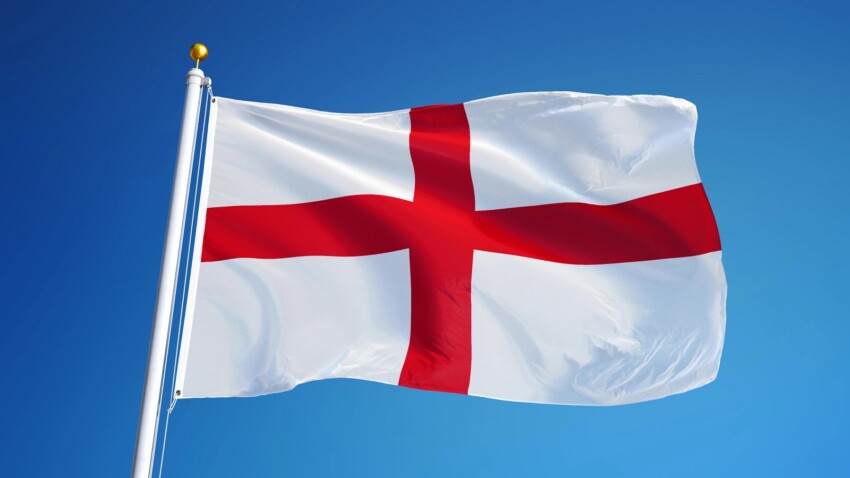
A red cross on a white background: in its geometric simplicity, the flag of England is one of the most recognisable national symbols in the world. Known as the St George’s Cross, it is the official flag of England and one of the fundamental components of the Union Jack, the flag of the United Kingdom. Behind this essential design lies a complex history that spans the Crusades, the Maritime Republic of Genoa, the legend of a knight and a dragon, and centuries of English national identity formation.
The flag is closely linked to the figure of St George, patron saint of England, whose veneration spread throughout Europe through the Crusading expeditions. Yet the origins of the symbol are even more ancient and controversial than commonly thought: the red cross on a white field already appeared on the Bayeux Tapestry around 1070, long before it officially became the symbol of England. Its history weaves together faith, politics, maritime commerce and national identity in a narrative that still fuels passionate historical debates today.
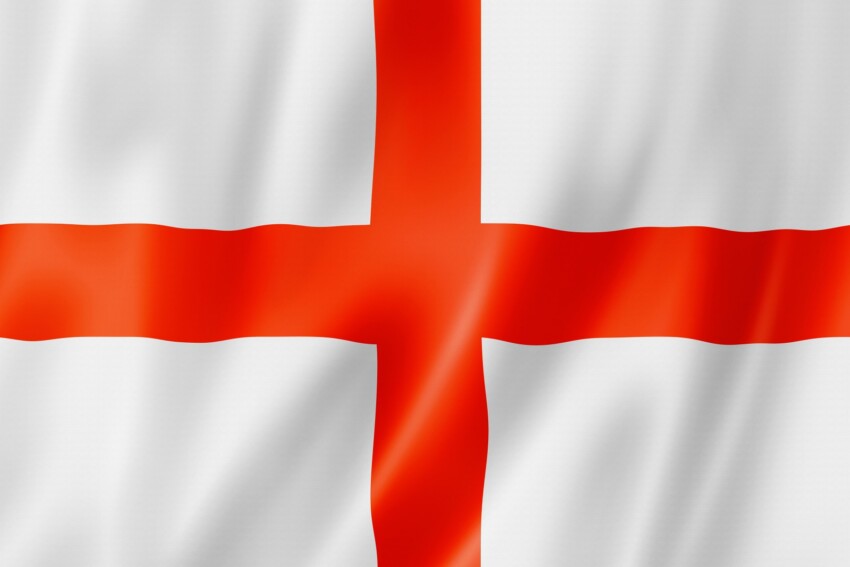
The flag of England is composed of a red cross, both vertical and horizontal, which divides the banner into four equal white quadrants. The cross occupies approximately one-fifth of the flag’s total width and extends from edge to edge both vertically and horizontally, intersecting exactly at the centre.
Unlike the flags of the other constituent nations of the United Kingdom, St George’s Cross has a perfectly symmetrical structure: it can be displayed in any orientation without any noticeable difference. The official red colour corresponds to Pantone 186C, the same red used in the Union Jack. The background is pure white.
The same colour combination is found in the flag of London, where the red cross on a white field is enriched by a vertical sword in the upper left quadrant, a symbol of St Paul the Apostle, patron saint of the city. This is no coincidence: the flag of the capital directly echoes that of the nation, with the addition of the emblem of its patron saint.
The first surprising element of the English flag is that its protagonist, St George, has no direct connection to England. According to tradition, George was a Roman soldier from Cappadocia (in present-day Turkey), who lived in the 3rd century and died a martyr around 303 AD. His tomb is located in Lydda (present-day Lod, in Israel), and his veneration spread throughout the Christian Church from at least the 4th century.
The most famous legend concerning him — that of St George and the Dragon — depicts him as a Christian knight who saves a princess by sacrificing himself to confront a terrible dragon that terrorised the city of Silene. The victory over the monster is traditionally interpreted as the triumph of Christian faith over the forces of evil. It is a powerful narrative archetype, and it is hardly surprising that it has endured through the centuries, becoming one of the most widespread chivalric symbols of Western civilisation.
St George is patron saint not only of England, but also of Portugal, Georgia, Catalonia, numerous Italian cities including Genoa, Ferrara and Venice, and many other regions across the world. His feast day is celebrated on 23 April.
The history of the red cross on a white field as a symbol of England is inextricably linked to the Crusades, and in particular to the role of the Maritime Republic of Genoa. The Ligurian city used the banner of St George well before 1096 as its own official symbol, and its powerful fleet of crossbowmen had acquired such a fearsome reputation that the Genoese flag was an emblem dreaded throughout the Mediterranean: enemy ships, upon seeing the cross of St George, would avoid confrontation.
According to tradition, in 1190 King Richard I of England (Richard the Lionheart), departing for the Third Crusade, adopted the Genoese flag and St George as his own patron in order to enjoy the protection of the Genoese fleet in Mediterranean waters. This version has been taken up over the centuries by various sources, and in 2018 it even inspired the Mayor of Genoa, Marco Bucci, to write to Queen Elizabeth II, gently reminding her that England had not paid the “rental fee” for the flag for approximately 250 years.
However, the historical reality is more nuanced. According to medievalist Antonio Musarra of the University of Genoa, there is no archival evidence demonstrating a formal concession of the flag from Genoa to England, nor any record of a tribute payment. The two flags rather share a common origin in the Crusades: both adopted the symbol of the red cross on a white field as the Christian ensign of the crusaders, probably derived from the ancient vexillum Sancti Petri, the papal standard. Even more significant is the fact that the Cross of St George already appears in the Bayeux Tapestry, created around 1070-1080, where it depicts the banner of William the Conqueror at the Battle of Hastings in 1066 — decades before Richard the Lionheart departed for the Crusades.
The official link between St George and England consolidated progressively during the 14th century. King Edward III, founder of the Order of the Garter in 1348 — the oldest and most prestigious English chivalric order — chose St George as the patron of the order and, consequently, of all England. The choice was consistent with the values of Christian chivalry that the king wished to embody: St George represented the perfect warrior, noble, courageous and devout.
From 1415, following Henry V’s victory at Agincourt, 23 April — St George’s Day — began to be recognised as a national holiday. English soldiers wore the red cross on their chest and back as a sign of identity on the battlefield. The flag began to appear in official documents as early as the Book of All Kingdoms of 1367, whilst its use on English warships is certainly attested from the end of the 14th century.
During the 19th century, with the geopolitical need to define globally a flag for each state, the Cross of St George was officially adopted as the national flag of England, consolidating a process of recognition that had medieval roots.
In 1603 James VI of Scotland inherited the English throne as James I of England, uniting the two crowns under a single sovereign. On 12 April 1606, by royal decree, it was decided that the union of the two kingdoms should also be represented by a new common flag. The first Union Jack was born from the superimposition of the English Cross of St George (red on a white field) with the Scottish Saltire (white diagonal cross on a blue field), creating that symbol which remains one of the most famous flags in the world today.
Initially the use of the new flag was limited to Scottish and English civil and military vessels. In 1801, with the Act of Union between Great Britain and Ireland, the Cross of St Patrick (red diagonal cross on a white field) was added to the design, creating the version of the Union Jack we know today. The Cross of St George is therefore the historical and visual foundation upon which the entire flag of the United Kingdom is built: the red and white it contains derive directly from it.
The expansion of the British Empire brought the Cross of St George — or the Union Jack containing it — to appear on the flags of dozens of countries across the world. The flags of Australia, New Zealand, Fiji, Tuvalu and many other Commonwealth territories still incorporate the Union Jack in their upper left canton, a lasting testament to the influence of British history.
But the Cross of St George has left its mark elsewhere too: the flag of Georgia (the Caucasian country) features a large red cross on a white background with four smaller red crosses in the four quadrants — a variant of the Georgian symbol of St George. The city of London has made it the centrepiece of its coat of arms. Even some English counties and cities incorporate it into their local heraldic insignia.
For much of the 20th century, English fans in stadiums were accustomed to displaying the Union Jack rather than the Cross of St George, which was perceived as a British symbol rather than strictly English. It was particularly from the 1990s onwards, as a sense of specifically English national identity strengthened — accelerated also by the growing nationalist pride of Wales and Scotland — that the Cross of St George returned to being the quintessential symbol of English supporters’ identity.
Today the Cross of St George flies everywhere during England matches at Wembley, at the European Championship and the FIFA World Cup, in the Six Nations rugby championship and the Rugby World Cup. It is the symbol of the England national team in all sports in which England competes independently from the other British nations. By contrast, in Olympic competitions and other sports where British athletes compete together, the Union Jack is used under the “Team GB” banner.
The feast of St George, on 23 April, is England’s national day, celebrated with cultural events, concerts and festivities throughout the country. It is not an official public holiday in the UK calendar — an asymmetry that periodically fuels political discussions about English identity — but it is celebrated with growing participation, in a country that in recent decades has rediscovered and reasserted with pride its own national distinctiveness within the broader British framework.
In London, the Cross of St George is visible in many contexts. As already noted, the flag of the city is a direct derivation of the national flag, with the addition of the sword of St Paul. On the coat of arms of the City of London — the financial and historic heart of the capital — the same red cross on a white field appears, enriched by the sword that recalls London’s patron saint.
On St George’s Day, 23 April, the flag is displayed on public buildings, churches and private homes throughout England. Tower Bridge, the Tower of London and the city’s major monuments are adorned with the colours of St George. The cathedral dedicated to the saint is located in Windsor, where in St George’s Chapel — one of the masterpieces of English Perpendicular Gothic — you will find the funerary monuments of numerous British monarchs and the stalls of the Order of the Garter.
 Hotel
Hotel  Budget accommodations
  Apartments
  Family Hotel
  Luxury Hotel