Oxford: University and City Walking Tour with Alumni Guide
4.461 reviews
Buy now
From 34,42€ per person
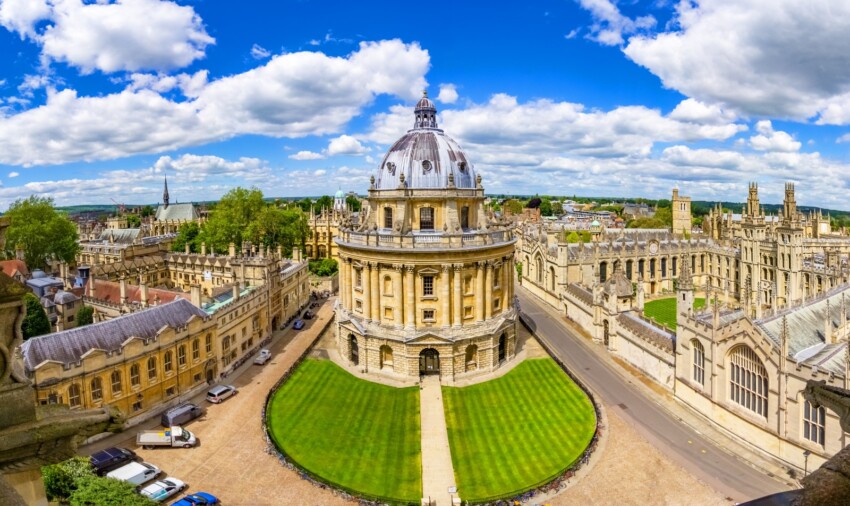
Oxford, the celebrated English university city, captivates visitors with its unmistakable skyline of Gothic spires and its timeless atmosphere. Founded in the twelfth century, Oxford University has shaped not only the city’s appearance but also its soul, creating a unique environment where history and innovation blend harmoniously.
Strolling through the cobbled streets of the historic centre, you’ll sense an air of culture and tradition embodied in 38 historic colleges, each with its own distinctive architectural style and flourishing gardens. The city is far more than an open-air museum: it’s a vibrant place where historic pubs sit alongside modern cafés, and where students on bicycles navigate between buildings that have hosted some of history’s greatest minds.
The blend of academic tradition and lively cultural life makes Oxford the perfect destination for those seeking a travel experience that combines history, art and that distinctly British atmosphere that only an English university city can offer.
Oxford is a city that guards centuries of history and culture within its golden stone walls. Every corner tells a story, every building conceals a secret waiting to be discovered. The city offers a perfect blend of historical, cultural and natural attractions that make it an ideal destination for a stay of several days.
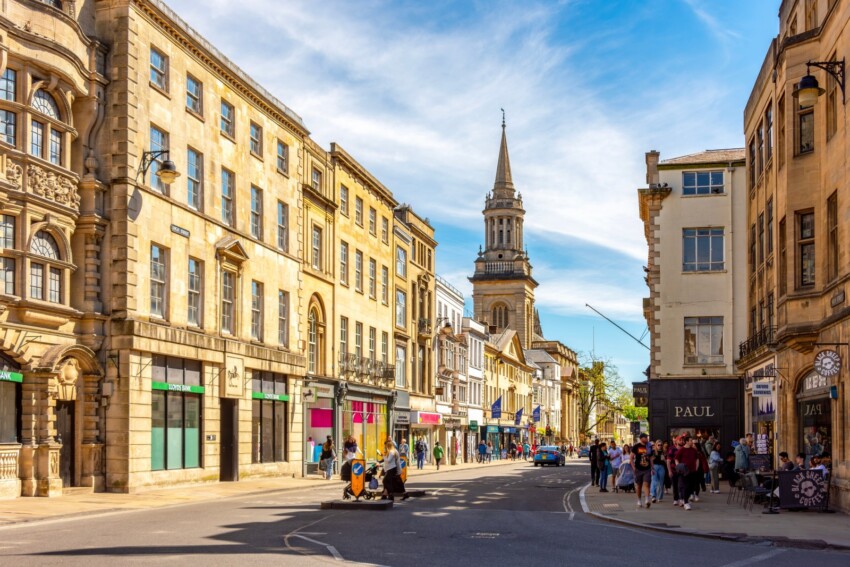
Oxford’s High Street is far more than just a road: it is the main artery of the city and an open-air museum of historic architecture. Along this avenue stands a succession of some of the university’s most iconic buildings, historic shops and traditional pubs. The most picturesque stretch extends for about a kilometre, from Carfax Tower to Magdalen College.
The street is flanked by medieval colleges, ancient churches and golden stone buildings that create a unique setting. Particularly enchanting in the early morning hours or at sunset, when the warm light makes the buildings’ stone glow. It’s the ideal place to begin exploring the city and to experience the authentic university atmosphere.
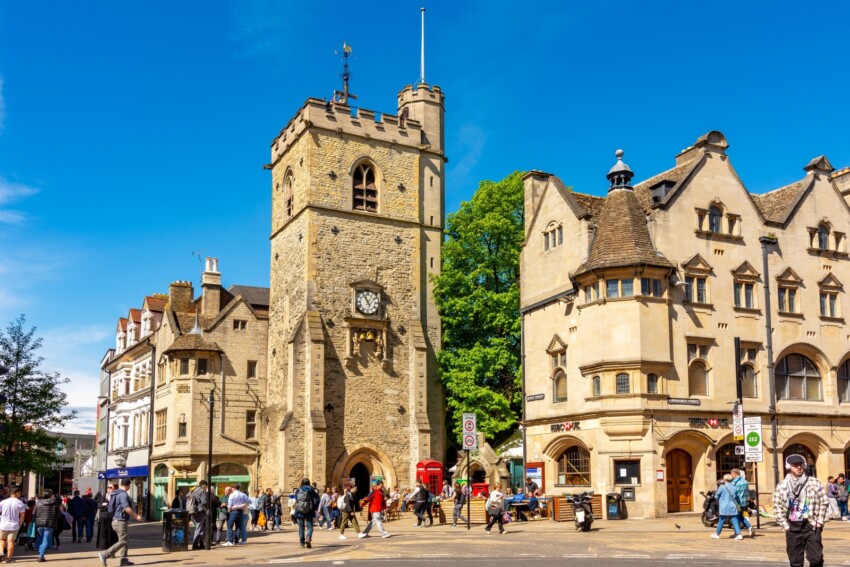
Carfax Tower represents the geographical heart of Oxford and offers one of the best panoramic views over the city. This 13th-century tower, standing 23 metres tall, is all that remains of the ancient Church of St Martin and is considered the central point of the city, from which the four main streets radiate.
The climb of 99 steps to the top is rewarded with spectacular views over Oxford’s rooftops and spires. From here you can admire the city’s main monuments and better understand its medieval urban layout. The tower also houses a set of bells that ring every quarter hour, keeping alive an ancient city tradition.
The Bodleian Library has been the beating heart of Oxford’s academic life for over 400 years. Founded in 1602 by Sir Thomas Bodley, it is one of the oldest libraries in Europe and the second largest in the United Kingdom after the British Library. The complex comprises several historic buildings, including Duke Humfrey’s Library from the 15th century, where scholars still consult precious manuscripts in an atmosphere that seems suspended in time.
Among its most precious treasures are a copy of the Magna Carta, first editions of literary classics and medieval manuscripts of inestimable value. Visitors can take guided tours that allow them to explore the most significant rooms.
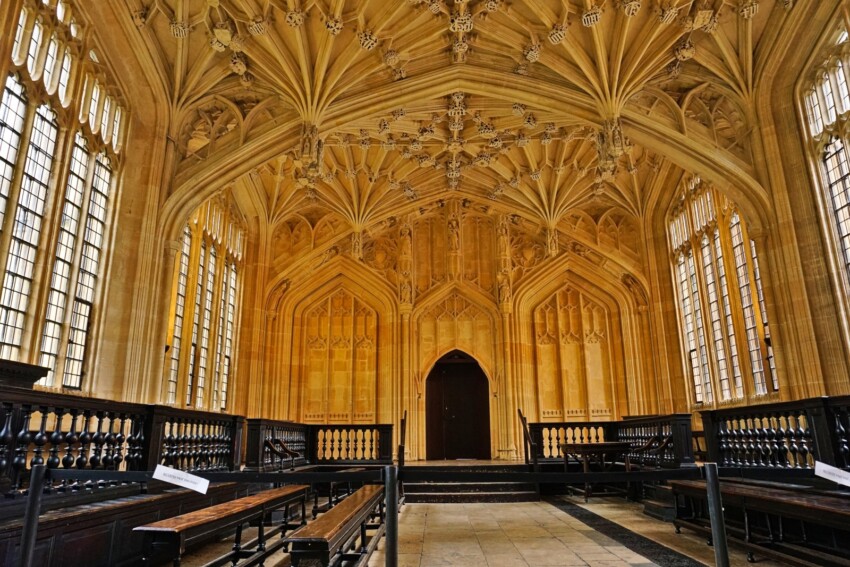
The most beautiful of the rooms is certainly the Divinity School, a jewel of Gothic architecture and the oldest teaching room of Oxford University. Built between 1427 and 1483, this magnificent hall was dedicated to theology lectures and oral examinations. Its vaulted ceiling is a masterpiece of medieval architecture, with elaborate keystones bearing the coats of arms of the benefactors who financed its construction.
The Gothic windows and sculptural details make this room an extraordinary example of medieval craftsmen’s skill. The 455 stone seats along the walls were designed to accommodate students during theological disputes. Like the Bodleian Library, the Divinity School also appeared in various scenes from the Harry Potter films, used as Hogwarts’ infirmary.
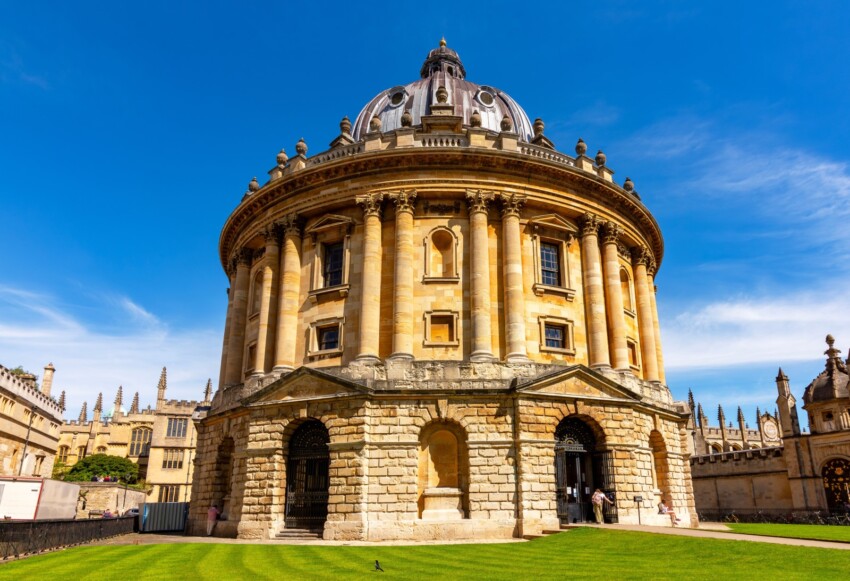
The Radcliffe Camera is probably Oxford’s most photographed building and a masterpiece of 18th-century English architecture. Designed by James Gibbs and completed in 1749, this circular library in the Palladian style takes its name from physician John Radcliffe, who financed its construction. Its imposing dome and finely carved columns make it one of the most refined examples of English neoclassical style.
The interior, accessible only through guided tours of the Bodleian Library, is equally impressive, with original shelving that spans two floors and a richly decorated ceiling. Today the structure serves as a reading room for students of history and English literature. Its central position, between the Bodleian Library and the Church of St Mary the Virgin, creates one of the most picturesque views of Radcliffe Square, especially at sunset when the golden stone gleams in the evening light.
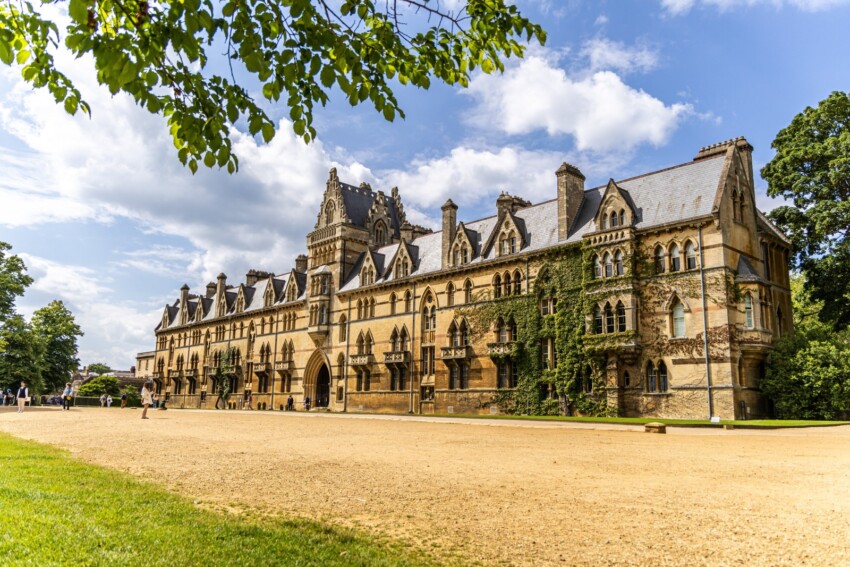
Christ Church College represents the very essence of Oxford, combining history, architecture and culture in one magnificent complex. Founded in 1546 by Henry VIII, it is one of the largest and most prestigious colleges in the university, as well as one of the most visited thanks to its extraordinary architectural beauty and its connections with popular culture.
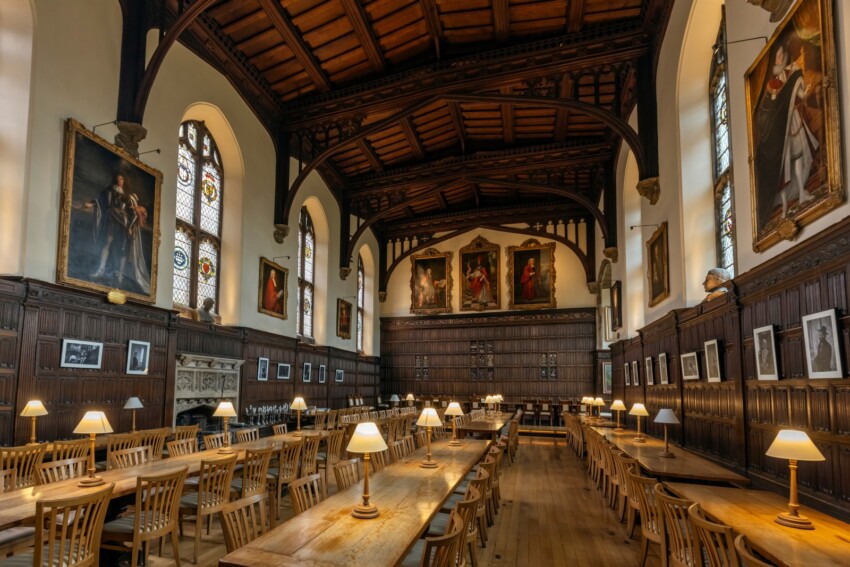
The Great Hall, with its impressive vaulted ceiling and portraits of illustrious alumni, inspired the Great Hall of Hogwarts in the Harry Potter films. This historic hall continues to serve as a dining hall for students, keeping alive ancient academic traditions. Christ Church Cathedral, which serves as both the college chapel and the cathedral of the diocese, is a masterpiece of English Gothic architecture, with its elaborate stained glass windows and fan vaulting.
The Tom Quad, Oxford’s largest quadrangle, offers breathtaking views of Tom Tower, designed by Sir Christopher Wren. The tolling of the Great Tom bell, which rings 101 times every evening at 21:05, is one of the most characteristic rituals of college life.
Magdalen College is considered the architectural jewel of Oxford. Founded in 1458 by Bishop William of Waynflete, it stands out for its magnificent location along the Cherwell river and its extraordinary variety of architectural styles. Its imposing bell tower, 44 metres high and visible from much of the city, is one of Oxford’s most recognisable symbols.
Visitors can admire the medieval cloisters, remarkable for their carved grotesques and perfect architectural symmetry. The Gothic Chapel, dating from the 15th century, is famous for its world-renowned choir and magnificent stained glass windows. The Great Quad, completed in 1480, is one of the finest Renaissance courtyards in England, whilst the New Building, added in the 18th century, offers a superb example of Georgian architecture.
One of the college’s most unique features is the Deer Park, a park where fallow deer and red deer roam freely, a tradition dating back to 1720. Addison’s Walk, a picturesque 1.6 km footpath that winds around an island formed by the Cherwell river, has been a place of rambling for numerous writers and intellectuals, including C.S. Lewis.
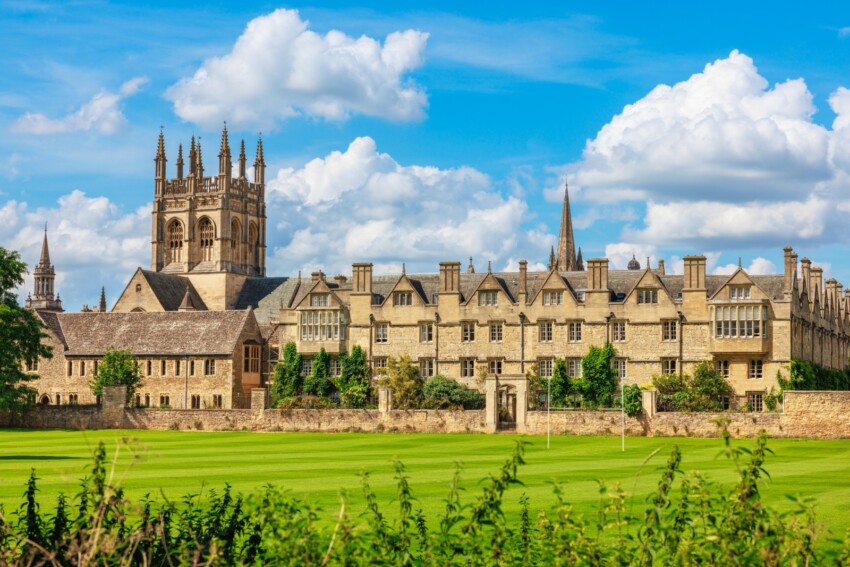
Merton College, founded in 1264, boasts the distinction of being Oxford’s oldest college with a complete set of statutes and a resident academic community. Its Mob Quad, built between 1288 and 1378, is considered the world’s oldest university quadrangle and represents a perfect example of medieval architecture.
The college’s library, housed in the upper wing of the quadrangle, is the world’s oldest academic library still in continuous use, with a collection of manuscripts and rare books of inestimable value.
Merton Chapel, built in the Gothic style between 1288 and 1294, is one of Oxford’s oldest and preserves one of the largest original medieval stained glass windows in England. The Fellows’ Garden offers a spectacular view of the medieval city walls and Christ Church Meadow, as well as hosting an ancient sundial and a romantic pergola.
The college has hosted numerous prominent figures over the centuries, including J.R.R. Tolkien, who was a professor there from 1945 to 1959, and T.S. Eliot, who studied there for a year.
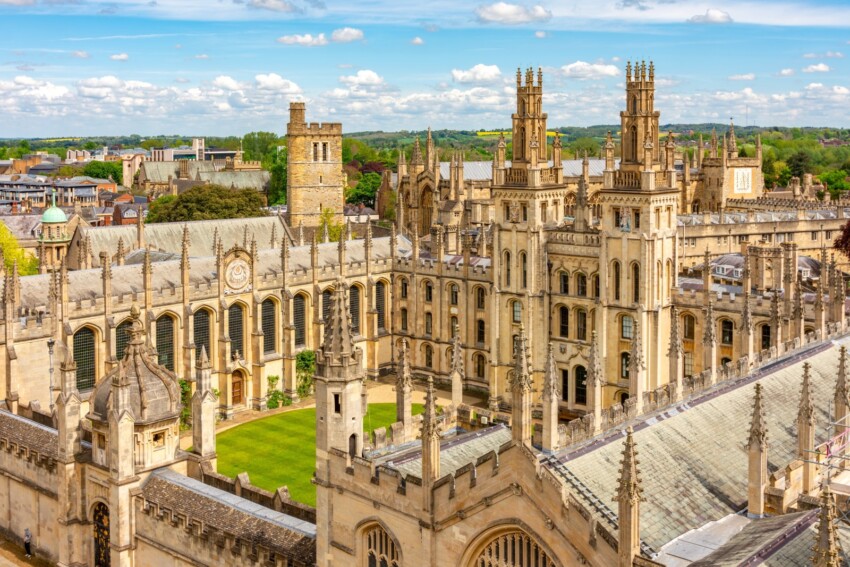
All Souls College, founded in 1438, is one of Oxford’s most mysterious and exclusive colleges. Unlike other colleges, it accepts only students selected through what is considered one of the world’s most difficult examinations. The college’s architecture is a sublime example of the perpendicular Gothic style, with the Great Quad representing one of Oxford’s most harmonious courtyards.
The college chapel is one of the city’s most beautiful, with original medieval stained glass windows and a 15th-century Flemish triptych. The twin towers on the High Street have become an iconic landmark on the city’s skyline. Although public access is limited, visitors can admire the exteriors and occasionally attend guided tours during special events.
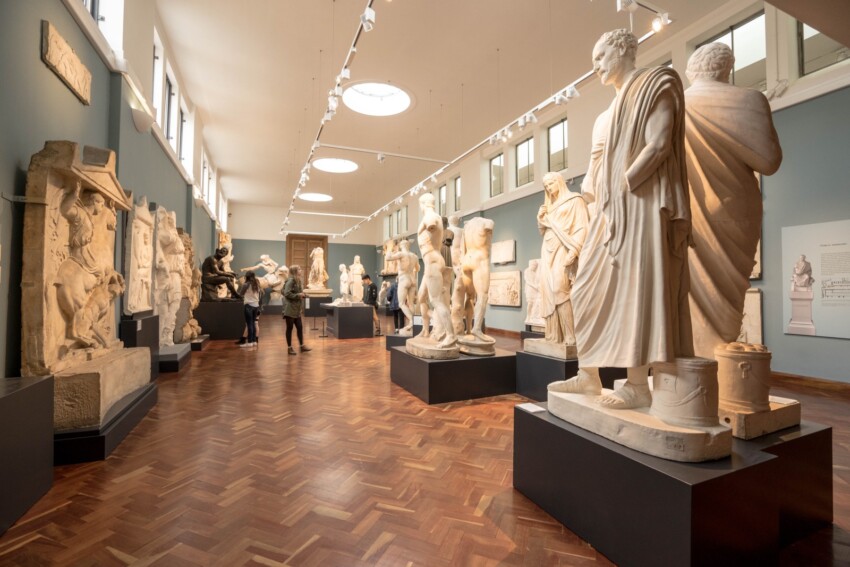
The Ashmolean Museum, founded in 1683, is the world’s oldest university museum and houses an extraordinarily diverse collection of art and archaeology. The neoclassical building, renovated in 2009, offers modern exhibition space that showcases its ancient treasures to best effect.
The collections range from ancient Egypt to classical Greece, from European art to works from the Middle and Far East. Among the most notable pieces are Guy Fawkes’ lantern, a vast collection of ancient coins and works by Raphael, Michelangelo and Leonardo da Vinci.
The museum is organised thematically over five floors, with galleries that tell the story of humanity through art and artefacts. Free admission and frequent temporary exhibitions make it an unmissable stop for any visitor.
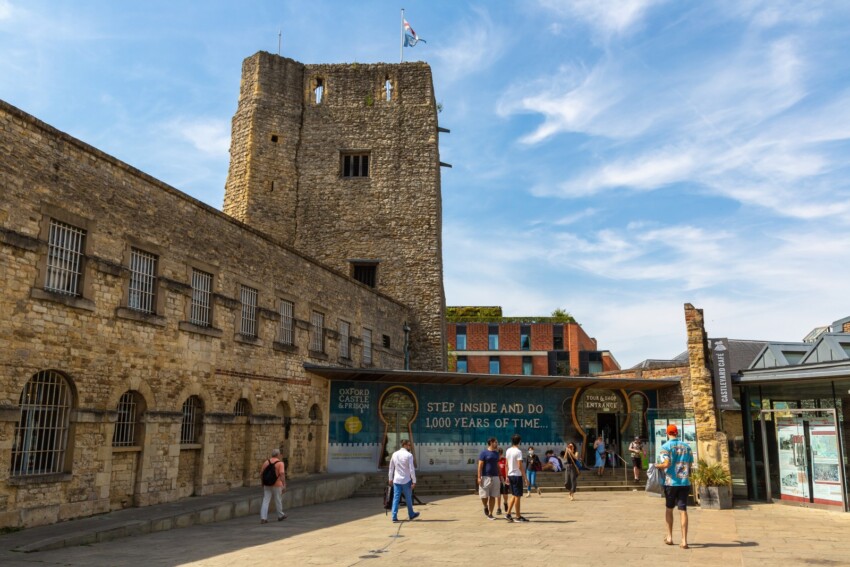
Oxford Castle and Prison offers a fascinating glimpse into the darker side of the city’s history. Built in 1071 by Robert D’Oilly, this Norman castle served as a fortress, prison and place of execution for almost a thousand years.
Visitors can explore the Saxon tower of St George, climb the round tower for a panoramic view of the city, and descend into the medieval crypt. Guided tours, conducted by period costume staff, tell stories of famous prisoners and daring escapes. The old Victorian prison has been converted into a luxury hotel, but retains many original elements that testify to its past.
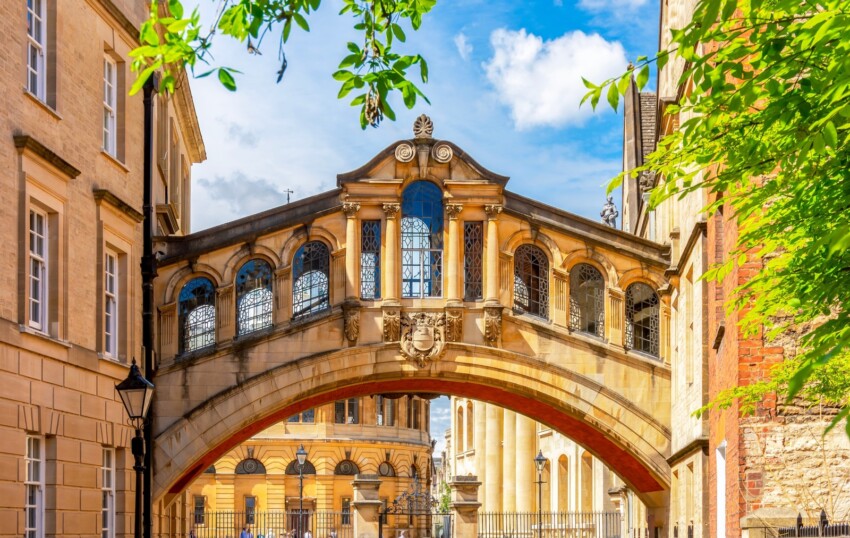
Inspired by the famous Venetian bridge of the same name, Oxford’s Bridge of Sighs connects two buildings of Hertford College across New College Lane. Built in 1914, this covered passage in the neo-Gothic style has become one of the most photographed symbols of the university city. Its arched structure, made of pale stone, is distinguished by elaborate decorations and stained glass windows that make it particularly enchanting, especially at sunset when light filters through its architectural details.
Unlike its Venetian “cousin”, which owes its name to the sighs of prisoners being led to their cells, Oxford’s bridge served a far more prosaic purpose: to allow students to move easily between the college’s dormitories and teaching spaces. Today it has become an unmissable stop for visitors walking through the historic streets of the city centre, offering a perfect glimpse of the essence of Oxonian architecture.
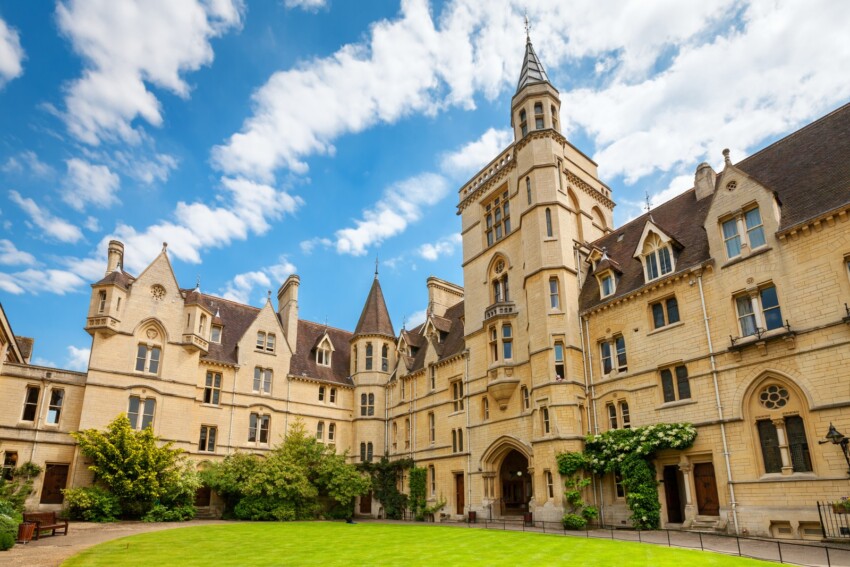
Founded in 1263, Balliol College is one of the oldest colleges of Oxford University and boasts an academic history of absolute prestige. Its golden stone courtyards contain centuries of university tradition and have hosted numerous British Prime Ministers, Nobel Prize winners and illustrious figures from the cultural world. The college’s architecture ranges from Victorian Gothic to neoclassical, creating a fascinating mosaic of styles that reflects the various eras of its expansion.
The Great Hall, with its impressive vaulted ceiling and historic stained glass windows, remains one of the most evocative spaces, where students still dine today following ancient traditions. The college’s gardens, maintained with mathematical precision, offer an oasis of peace in the heart of the university city.
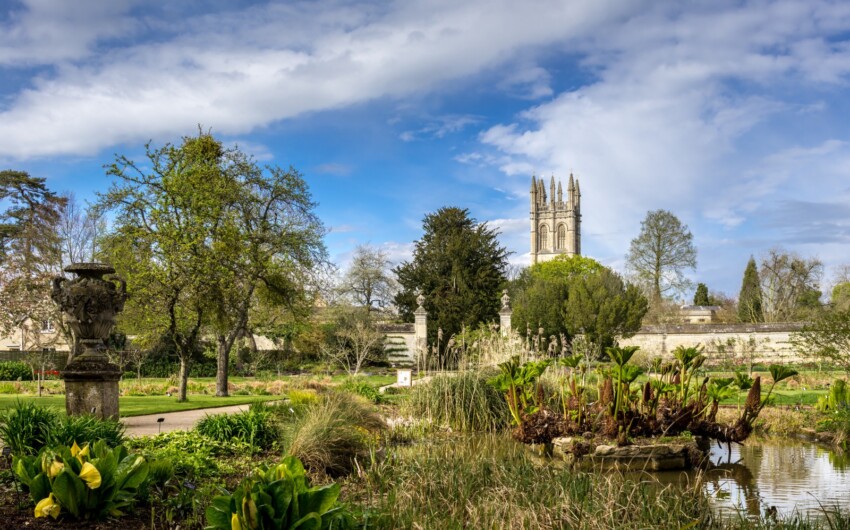
The Oxford Botanic Garden, founded in 1621, is Britain’s oldest botanic garden and one of the world’s oldest scientific gardens. Located in the heart of the city, this green paradise is home to over 5,000 plant species in a relatively compact area.
Themed gardens include the Border Herbaceous, one of the oldest in the world, the Garden of Eden with plants mentioned in the Bible, and Victorian greenhouses that house a rich collection of tropical plants. The garden is also a place of literary inspiration: here Lewis Carroll imagined Alice in Wonderland and Philip Pullman set scenes from the trilogy His Dark Materials.
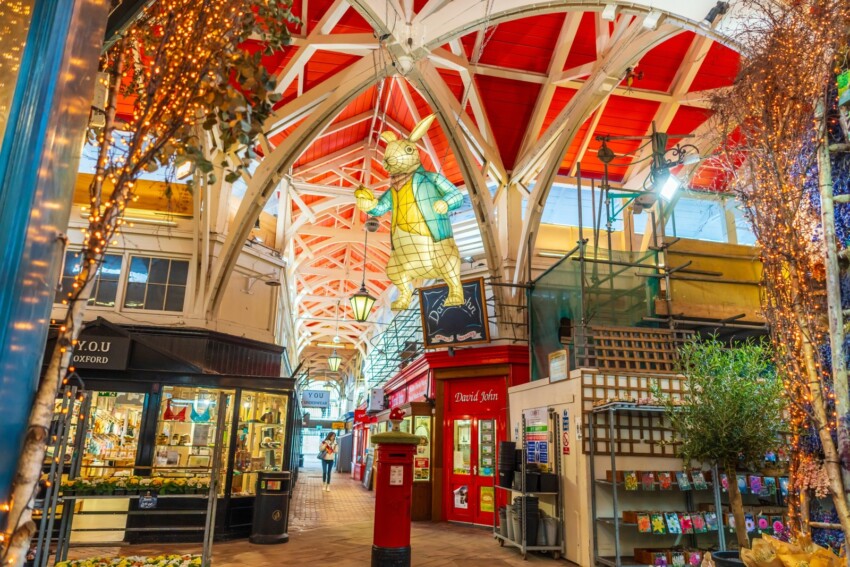
The Covered Market, opened in 1774, is a lively covered market that offers an authentic experience of local shopping and gastronomy. Its cobbled aisles are home to over 40 independent shops, from traditional butchers to artisan boutiques.
This historic market is the ideal place to taste local specialities such as Oxford pasties, buy fresh produce or simply immerse yourself in the vibrant atmosphere of a traditional English market. The cafés and restaurants offer a relaxing break during shopping.
In the following map you can see the location of the main places of interest mentioned in this article.
Taking a guided tour of Oxford is the best way to fully appreciate the city’s distinctly British character and gain access to places normally closed to the public.
Among the most popular tours are those focusing on university history, walking routes exploring Harry Potter filming locations, and literary trails following in the footsteps of Tolkien and Lewis. Some tours include privileged access to selected colleges that are otherwise inaccessible.
Oxford’s historic centre is the best area for those wanting to immerse themselves in university life and have all the main attractions within walking distance. You’ll find charming hotels in historic buildings and welcoming bed and breakfasts, perfect for those seeking an authentic experience. The central location allows you to explore the city on foot and enjoy the vibrant nightlife in historic pubs.
Jericho, north of the centre, is a trendy residential neighbourhood with an excellent selection of restaurants and bars. It’s ideal for those seeking a quieter atmosphere whilst still being just steps from the main attractions. Accommodation here tends to be more affordable than in the historic centre.
Summertown, an elegant residential area in the north of the city, is perfect for families. It offers a good selection of flats and holiday lets, and is well connected to the centre by frequent buses. The area has all the necessary amenities and lovely parks.
Oxford lies in the heart of England, approximately 100 km from London, and is easily accessible by car or public transport. Its strategic location makes it an ideal base for exploring other parts of the United Kingdom.
London Heathrow is the most convenient airport for reaching Oxford, located just 80 km away. Direct coach service is provided by The Airline, which departs every 30 minutes and takes approximately 90 minutes to reach Oxford city centre. Tickets cost around £30 per journey.
London Gatwick, whilst further away (140 km), is well connected to Oxford via the direct The Airline coach service. The journey takes around two and a half hours and tickets cost approximately £35 per journey.
For those arriving at London Luton, National Express provides a service connecting the airport to Oxford in approximately two hours.
Oxford is excellently connected to London by frequent trains departing from London Paddington station. The journey takes around one hour and trains depart every 30 minutes. It’s advisable to book tickets in advance to secure the best fares.
Coach tours from London offer a practical and efficient option for visiting Oxford, particularly for those with limited time. These organised tours allow you to combine a visit to the university city with other popular destinations such as the Cotswolds, Stonehenge, Windsor, or even the Harry Potter studios.
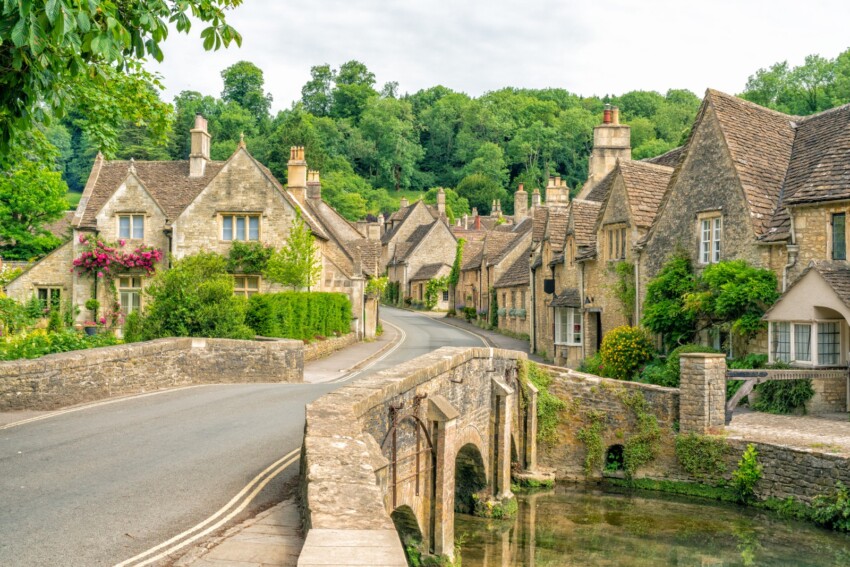
Oxford’s location in the picturesque Cotswolds region makes it an ideal base for exploring some of England’s most beautiful landscapes and historic villages. Hiring a car is highly recommended for greater flexibility and to make the most of your time, although many locations are accessible by public transport.
The Cotswolds are less than an hour’s drive from Oxford and offer some of England’s most picturesque countryside. Villages such as Bourton-on-the-Water, Stow-on-the-Wold and Chipping Campden, with their characteristic honey-coloured stone buildings, look as if they’ve stepped straight out of a postcard. A day trip allows you to visit several villages and experience the English countryside at its finest.
Blenheim Palace, a UNESCO World Heritage Site, is one of the largest and most impressive palaces in the United Kingdom. Located just 15 km from Oxford, this magnificent Baroque residence is the birthplace of Winston Churchill and offers visitors over 300 years of history. The landscaped gardens designed by Capability Brown are a masterpiece of English landscape design.
The birthplace of William Shakespeare, Stratford-upon-Avon, is approximately one and a half hours’ drive from Oxford. Here you can visit the playwright’s birthplace, the Royal Shakespeare Theatre, and numerous beautifully preserved Tudor buildings. It’s an ideal destination for literature and history enthusiasts.
What's the weather at Oxford? Below are the temperatures and the weather forecast at Oxford for the next few days.
Oxford is located in south-east England, approximately 90km from London, 140km from Bristol. It also makes an excellent base for exploring the picturesque Cotswolds region.
 Hotel
Hotel  Budget accommodations
  Apartments
  Family Hotel
  Luxury Hotel