Bestseller
London: London Stadium Tour
From 25,25 €
Buy the ticket
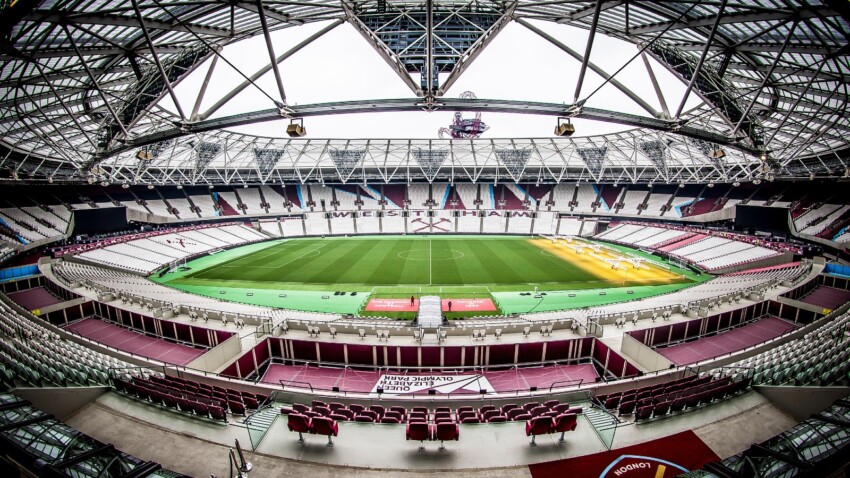
Built in East London as the main Olympic stadium for the London 2012 Games, the London Stadium has undergone a remarkable transformation to become the home of the West Ham United Football Club from 2016 onwards.
Its distinctive architecture, characterised by a rippling white roof and contemporary lines, makes it immediately recognisable on the East London skyline. Unlike traditional football stadiums, the London Stadium is surrounded by extensive green spaces, waterways and new facilities that make up the Olympic Park, creating a unique atmosphere that goes far beyond a simple sporting experience.
With a capacity of 60,000 spectators for football matches, the London Stadium is today one of the UK’s largest and most modern stadiums, an impressive structure that combines Olympic heritage with the passion of English football.
This multifunctional stadium not only hosts West Ham’s home matches but also concerts, world-class athletic events and other sporting fixtures, establishing itself as one of London’s major multifunctional attractions.
The London Stadium offers visitors numerous points of interest that go far beyond the pitch itself. Here are the main attractions you shouldn’t miss during your visit.
The architectural design of the London Stadium represents an excellent example of contemporary sports architecture. Designed by architecture firm Populous, the stadium was conceived with an innovative idea: a partially dismantleable and convertible structure after the Olympic Games. The result is an architectural work combining functionality and design, with the characteristic white roof that appears to float above the stands.
During your visit, pay particular attention to the stadium’s roof, which measures 84 metres from the pitch and is the largest structure of its kind in the world. Its triangular steel supports and PVC covering create a striking visual effect, especially when illuminated during evening events. An excellent vantage point is the exterior area of Queen Elizabeth Olympic Park, where you can admire the entire structure and take panoramic photographs.
One of the most fascinating aspects of the London Stadium is its transformation from Olympic stadium to football venue. During a tour, you can observe the elements that document this momentous change. Particularly interesting is the retractable seating system that allows the stadium configuration to be modified to accommodate different sporting disciplines.
Signs of this transformation are also visible in the internal corridors, where information panels and photographs document the conversion process. Don’t miss the opportunity to see how the pitch was brought closer to the stands to create a more engaging football experience, with the addition of the characteristic claret and blue seats, West Ham United’s official colours.
One of the features that makes the London Stadium unique is its integration within the Queen Elizabeth Olympic Park. During your visit, don’t miss the opportunity to climb to the upper levels of the stadium, from where you can enjoy spectacular views not only of the pitch but also of the surrounding park with its iconic attractions.
From here you can admire the ArcelorMittal Orbit (the UK’s tallest sculpture), the Aquatics Centre designed by Zaha Hadid and the canals running through the park. On clear days, London’s skyline with its iconic buildings is visible in the distance, offering an extraordinary glimpse of the British capital.
Inside the stadium is the West Ham United museum, a space dedicated to the history and legends of this historic London club. The museum houses an extensive collection of memorabilia, trophies, historic shirts and memorabilia that tell the story of the club founded in 1895 as Thames Ironworks FC.
Particularly moving are the spaces dedicated to the Cup Winners’ Cup victory in 1965 and the West Ham players who contributed to England’s 1966 World Cup victory: Bobby Moore, Geoff Hurst and Martin Peters. There are also references to the most significant moments in the club’s recent history and the move from the old Boleyn Ground (Upton Park) to the London Stadium.
The pitch at the London Stadium is considered one of the finest in England, thanks to the cutting-edge technologies used for its maintenance. The pitch dimensions (105 × 68 metres) comply with UEFA and FIFA standards, and the quality of the grass is maintained by an automatic irrigation system and artificial lighting to promote grass growth during the winter months.
During guided tours, you’ll have the opportunity to access the pitch side and observe the perfection of the playing surface up close, an experience that will help you appreciate the meticulous work required to maintain these optimal conditions throughout the season.
A visit to the changing rooms is one of the most anticipated moments of guided tours. West Ham United’s changing room has been designed to the highest modern standards, with individual spaces for each player, marked with name and shirt number. The circular layout encourages team spirit, whilst adjoining facilities include massage areas, whirlpool baths and state-of-the-art medical rooms.
During the tour you can sit in the same seats used by your favourite players and imagine the charged atmosphere of concentration that precedes a Premier League match. Particularly interesting is observing the strategic arrangement of seats, which reflects the team hierarchy and player preferences. Guides often share exclusive anecdotes about players’ pre-match rituals, making the experience even more authentic.
The VIP areas and Royal Box represent the pinnacle of luxury within the London Stadium. These exclusive spaces, accessible during guided tours, offer an interesting perspective on the experience of more privileged supporters and dignitaries who attend events.
The Royal Box, used by the royal family and distinguished guests during the Olympic Games, still retains that air of exclusivity, with premium seating and an unparalleled view of the pitch. The surrounding hospitality suites, elegantly furnished and decorated with sporting memorabilia, complete the luxury experience offered by the stadium.
Tickets for the stadium tour can be purchased on this website.
Guided tours of the London Stadium are generally available every day of the week, with multiple departures throughout the day, usually at 10:00, 12:00, 14:00 and 16:00. However, on match days and during other events (concerts, athletic competitions) tours are not available. During the summer season (June-August), when the team is on break, additional time slots may be offered.
To fully enjoy a guided tour experience of the London Stadium, it’s advisable to allow approximately 90-120 minutes. The tour itself lasts around 75 minutes, but it’s worth allowing extra time to visit the club’s official shop and explore the stadium’s external areas, where commemorative monuments and artistic installations celebrating the 2012 Olympic Games can be found.
Ticket prices for watching West Ham United matches at the London Stadium vary depending on the match category and seat location in the stadium.
It is strongly recommended to purchase tickets in advance through the official West Ham United website as home matches, especially those against top teams, tend to sell out quickly. Casual supporters and tourists can access general sales only after season ticket holders and club members have been given priority.
For international visitors, West Ham also offers an away supporter ticket booking service through official partners, which often include packages with additional experiences.
If tickets are sold out on official channels, you can try secondary marketplaces such as Viagogo. Prices will certainly be higher, but if you really want to attend the event and don’t want to miss it, it can be a good alternative.
The history of the London Stadium is relatively brief compared to many other British stadiums, but it is rich with significant events that have marked the development of East London and English sport.
It all began in 2005, when London won the bid to host the 2012 Olympic Games, beating stiff competition from Paris. The project of a new Olympic stadium in the Stratford area became central to plans for regenerating East London, a historically disadvantaged area of the capital.
Construction began in May 2008 and was completed in record time in March 2011, at a total cost of approximately £486 million. The stadium was designed by Populous with an innovative sustainability philosophy: a partially temporary structure that could be downsized after the Olympic Games. The upper structure, in fact, used recycled steel tubes, whilst the design allowed for reducing capacity from the 80,000 Olympic seats to a configuration better suited to post-Olympic use.
On 27 July 2012 the stadium hosted the opening ceremony of the London Olympic Games, a spectacular event directed by filmmaker Danny Boyle that celebrated British history and culture. During the Games, the stadium was the venue for athletics competitions and witnessed numerous world records, including extraordinary performances by Usain Bolt in the 100 and 200 metres.
After the Games, the stadium began its transformation for future use. Following a lengthy selection process, in 2013 West Ham United was chosen as the stadium’s main tenant, with a 99-year lease agreement. The transformation, completed in 2016 at an additional cost of £272 million, included the installation of a new roof (the world’s largest of its kind), retractable seats to accommodate both football and athletics, and new supporter facilities.
On 7 August 2016, West Ham played its first official match at the London Stadium, a friendly against Juventus. The adaptation of supporters to the new home was not immediate, given the strong emotional attachment to the old Boleyn Ground, home to the club for 112 years. In the early years there were some controversies regarding match-day atmosphere and the distance between stands and pitch, issues the club has sought to address with subsequent improvements.
Beyond football, the London Stadium has continued to host major athletics events, such as the 2017 World Championships, and has established itself as one of London’s premier concert venues, welcoming artists of the calibre of Beyoncé, Jay-Z, the Rolling Stones and the Foo Fighters. The stadium has also hosted rugby matches and Major League Baseball games, demonstrating its versatility as a multi-purpose venue.
In 2019 a new phase of improvements was announced, aimed at further optimising the football experience, including the installation of new giant screens and acoustic improvements. Today, the London Stadium represents not only West Ham United’s home but also a symbol of East London’s urban regeneration and the positive legacy of the 2012 Olympic Games.
The London Stadium is located in the heart of Queen Elizabeth Olympic Park at Stratford, in East London, and is well connected to the capital’s public transport network.
London’s underground railway is the most convenient way to reach the stadium. The nearest stations are:
Numerous bus routes serve the Stratford area and Queen Elizabeth Olympic Park:
The Docklands Light Railway (DLR) offers a scenic alternative for reaching the London Stadium. The nearest stations are:
Yes, it’s highly recommended to book tickets in advance. West Ham’s home matches in the Premier League often sell out completely, especially those against bigger clubs or London derbies. Tickets go on sale first to club members and then to the general public.
It depends on availability. For less popular matches, tickets may be available at the box office on the day itself, but there’s no guarantee. To avoid disappointment, it’s always best to purchase tickets in advance. The stadium box office is located at the Ticket Office on the south side of the stadium (Bobby Moore Stand).
If tickets are sold out on official channels, you can try looking on secondary marketplaces such as Viagogo. The cost will certainly be higher, but if you’re keen on the event and don’t want to miss it, it can be a good option.
Yes, the stadium is fully accessible and offers specific facilities and services for fans with disabilities, including:
Yes, the area around London Stadium offers numerous dining options, mainly concentrated in nearby Westfield Stratford City, one of Europe’s largest shopping centres, just 5–10 minutes’ walk from the stadium. Here you’ll find over 70 restaurants and cafés, ranging from fast food to fine dining.
Within Queen Elizabeth Olympic Park there are also several cafés and restaurants, such as Timber Lodge Café and Canalside. In the Hackney Wick area, on the western side of the park, you’ll find some trendy pubs and restaurants that have become popular with fans before and after matches, including Crate Brewery and Four Quarters.
City Card allow you to save on public transport and / or on the entrances to the main tourist attractions.

 Hotel
Hotel  Budget accommodations
  Apartments
  Family Hotel
  Luxury Hotel