Bestseller
London: Wembley Stadium Guided Tour
From 32,06 €
Buy the ticket
Majestic, iconic and steeped in history, Wembley Stadium is one of the most recognisable sporting temples in the world.
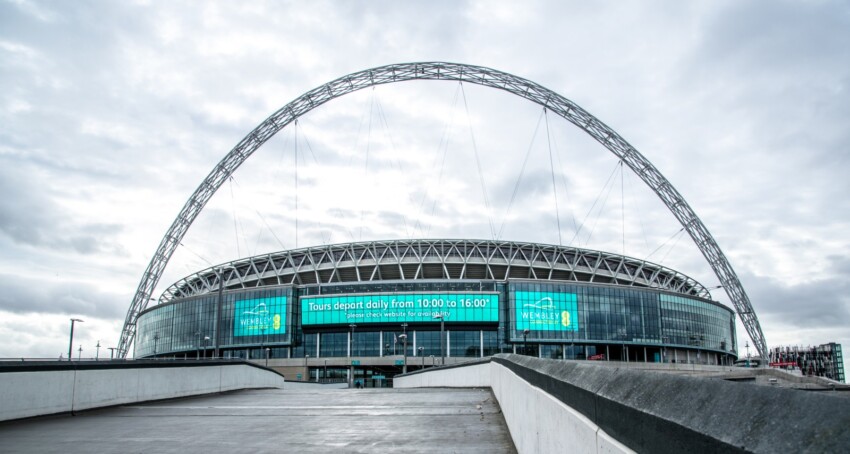
Located in north-west London, in the borough of Brent, this state-of-the-art stadium reopened in 2007, replacing the historic “Old Wembley” with a modern and spectacular structure that keeps the spirit of its predecessor alive. With a capacity of 90,000 spectators, it is the second largest stadium in Europe and the UK’s largest indoor sports arena. Its unmistakable silhouette is dominated by the imposing steel arch, 133 metres high, that towers over the stadium and is visible from much of the British capital, having become a recognisable symbol of London’s skyline.
This national stadium is not only the home of England’s national football team matches, but also hosts the FA Cup finals, the Carabao Cup, Football League playoff matches, and numerous international-level music events. Its importance transcends the purely sporting aspect: Wembley is a cultural monument that has witnessed the history of English and European football taking shape on its pitch, from England’s triumph in the 1966 World Cup to epic Champions League finals.
Each year, millions of fans and visitors pass through its gates to experience the unique atmosphere of one of the world’s most prestigious stadiums.
Wembley Stadium offers visitors numerous points of interest that go far beyond the playing field itself. Here are the main attractions you shouldn’t miss during your visit.
The most distinctive feature of Wembley is undoubtedly its steel arch that dominates London’s skyline. At 133 metres high and 315 metres long, this arch is not merely an aesthetic element but a genuine engineering marvel that supports the entire roof of the stadium, eliminating the need for columns that would obstruct views.
During a stadium tour, you’ll be able to admire the arch from different perspectives and learn fascinating details about its construction. Particularly impressive is the sight of the arch illuminated at night, when it changes colour depending on the events hosted (white and red for England, or the colours of the finalist teams during special events).
The best vantage point is Olympic Way (nicknamed “Wembley Way”), the avenue leading to the stadium’s main entrance, from where you can take iconic photographs of the arch silhouetted against the London sky.
A historic element that connects the new Wembley to its predecessor is the famous Royal Box, the stand from which the royal family and dignitaries watch matches and present trophies. During a tour, you’ll have the opportunity to see this exclusive area up close and understand its significance in English football tradition.
Connected to the Royal Box are the celebrated hallowed steps, the staircase that captains of victorious teams climb to receive trophies. This staircase has been the stage for unforgettable moments in football history, such as when Bobby Moore climbed it to receive the World Cup in 1966. During the tour, you’ll have the chance to walk these historic steps yourself, reliving the emotions of the greatest champions.
A visit to the changing rooms is one of the most anticipated moments of guided tours. Wembley’s changing rooms are designed to the highest world standards and offer a luxury experience to both England national team players and visiting squads.
England’s changing room, larger and more luxurious, features individual seats for each player with their name and number. During the tour, you can sit in the same seats used by English and international football stars, take photographs and imagine the atmosphere in these spaces before an important final.
Particularly interesting is the contrast between the home team’s changing room and the visitors’ room, designed with subtle psychological differences to give the home team a mental advantage.
Walking through the players’ tunnel and emerging at the pitch-side is an emotional experience that allows you to literally follow in the footsteps of your sporting heroes. Wembley’s tunnel is decorated with images of iconic moments in the stadium’s history, creating an evocative passage to the playing field.
When you emerge from the tunnel and see the immense 90,000-capacity stadium in its entirety, the sensation is truly extraordinary. The expanse of the stands, the vertiginous height of the upper tiers and the perfection of the grass pitch offer a completely different perspective from the television view.
From pitch-side, you can admire the state-of-the-art lighting system, the retractable roof that allows natural light to reach the pitch whilst protecting spectators, and the acoustic design that contributes to the famous “Wembley atmosphere” during events.
The Trophy Hall houses an impressive collection of cups, medals and memorabilia that tell the glorious story of English football. Here you can see replicas of the 1966 World Cup, the FA Cup and other significant trophies.
Particularly moving are the commemorative areas dedicated to the most significant moments in the stadium’s history and the great champions who have graced its pitch. Don’t miss the section dedicated to the England team that won the 1966 World Cup, with original memorabilia, period photographs and accounts of that historic moment.
During the tour, the guides share anecdotes and trivia that enrich the experience, allowing you to fully understand the cultural and sporting significance of Wembley.
Wembley is one of the technologically most advanced stadiums in the world, and during your visit you can discover the innovations that make it a unique facility. The LED lighting system, the enormous video screen, the surround sound system and the Wi-Fi network that covers the entire stadium are just some of the technical features you can explore.
Particularly impressive is the microclimate management system that allows the grass pitch to grow in optimal conditions despite the partial roof coverage. This system includes artificial lights, controlled ventilation and humidity sensors that ensure perfect playing conditions year-round.
During the tour, you can also see the stadium’s control room, from where all technological systems are managed during events, including cutting-edge safety measures that protect the tens of thousands of spectators.
Stadium tour tickets can be purchased on this website.
Guided tours of Wembley Stadium are available almost every day of the year, with some exceptions during preparation for major events. Standard hours are:
During peak seasons (school holidays, summer), additional tours may be added to meet higher demand. The last tour departure is usually at 15:00, to allow visitors to complete the experience before the stadium closes.
Ticket prices vary considerably depending on the type of event and seating location:
If tickets are sold out through official channels, you can try looking on secondary marketplaces such as Viagogo. The cost will certainly be higher, but if you’re keen on the event and don’t want to miss it, it can be a good compromise.
The history of Wembley is inextricably linked to the evolution of English and world football, representing a journey from the humble origins of the game to the global stage it is today.
The original Empire Stadium at Wembley was built in just 300 days and opened in 1923 for the British Empire Exhibition. Originally conceived as a temporary structure, its fate changed dramatically when it hosted the 1923 FA Cup final between Bolton Wanderers and West Ham United, remembered in history as the “White Horse Final” because of a mounted police officer who helped control the crowd of over 200,000 people (well beyond the official capacity).
The iconic Twin Towers in white became the distinctive symbol of old Wembley, whilst its capacity was gradually reduced to 82,000 seats for safety reasons in the 1980s.
During its 77-year existence, old Wembley was the stage for historic events:
Over time, however, the structure aged and its limited facilities no longer met modern standards. In 2000, following the FA Cup final between Chelsea and Aston Villa, old Wembley closed to be demolished, with the iconic towers brought down in 2003 amid the emotion of many fans who were attached to it.
Construction of the new Wembley began in 2002 and was completed in 2007, with a total cost of approximately £798 million, making it the most expensive stadium ever built at the time. Designed by the Foster + Partners architecture firm in collaboration with Populous and Sport Concepts, the new stadium was conceived as a state-of-the-art sports arena that would maintain the spirit of its predecessor whilst introducing modern technology and comfort.
The official opening took place on 19 May 2007 with the FA Cup final between Chelsea and Manchester United, won by the Blues with a goal from Didier Drogba in extra time. Since then, the new Wembley has written new chapters in sporting history:
From an architectural perspective, the new Wembley is defined by its distinctive arch, visible from much of London, which supports the entire roof of the stadium. With a capacity of 90,000 seats, it is the second largest stadium in Europe after Barcelona’s Camp Nou and boasts the world’s largest roof-covered span.
Unlike old Wembley, which was primarily a football stadium, the new facility is a multi-purpose structure that can host a wide range of sporting and entertainment events, reinforcing its status as a world-class venue in the global sports and cultural landscape.
Wembley Stadium is well connected to London’s transport network and easily accessible by various means.
The Underground represents the most efficient way to reach the stadium. The nearest station is Wembley Park (Metropolitan and Jubilee Lines, Zone 4), approximately 10-12 minutes’ walk from the stadium. Alternatively, you can alight at Wembley Central (Bakerloo Line, Zone 4), roughly 15-20 minutes’ walk from the stadium. This station is slightly further away but may be less crowded on event days.
On major event days, these stations can become extremely busy, with lengthy queues at the exits. Transport for London often implements crowd management systems, including controlled station access and designated routes. It’s advisable to follow station staff instructions.
If you’re travelling by train, the station serving the Wembley area is Wembley Stadium. This station is just 5 minutes’ walk from the stadium entrance and is an excellent option, although trains run less frequently than the Underground. On event days, additional trains are often laid on to handle the increased passenger numbers.
Several bus routes serve the Wembley area:
Yes, it’s highly recommended to book tickets in advance, especially during weekends, school holidays and peak tourist season (June–August). The most popular tours, particularly half-day tours, tend to sell out quickly. Advance booking not only guarantees availability at your preferred time but often saves time by avoiding ticket office queues.
Yes, both stadium tours and many events are designed with families in mind. During tours, guides are experienced at engaging younger visitors with age-appropriate facts and anecdotes. Children under 5 can participate in tours free of charge, whilst reduced rates are available for those aged 5–16.
If tickets are sold out through official channels, you can try secondary marketplaces such as Viagogo. Prices will certainly be higher, but if you’re keen on the event and don’t want to miss it, it could be a worthwhile compromise.
Absolutely yes, Wembley is designed to be fully accessible to visitors with various needs. The stadium offers:
During tours, alternative routes are available for visitors with reduced mobility. It’s advisable to inform the stadium of any specific requirements when booking your tour or purchasing event tickets, so that appropriate facilities can be arranged.
The area surrounding Wembley Stadium offers several dining and drinking options before or after events:
On major event days, advance booking is highly recommended, as venues in the immediate stadium vicinity fill up rapidly.
City Card allow you to save on public transport and / or on the entrances to the main tourist attractions.
 Hotel
Hotel  Budget accommodations
  Apartments
  Family Hotel
  Luxury Hotel