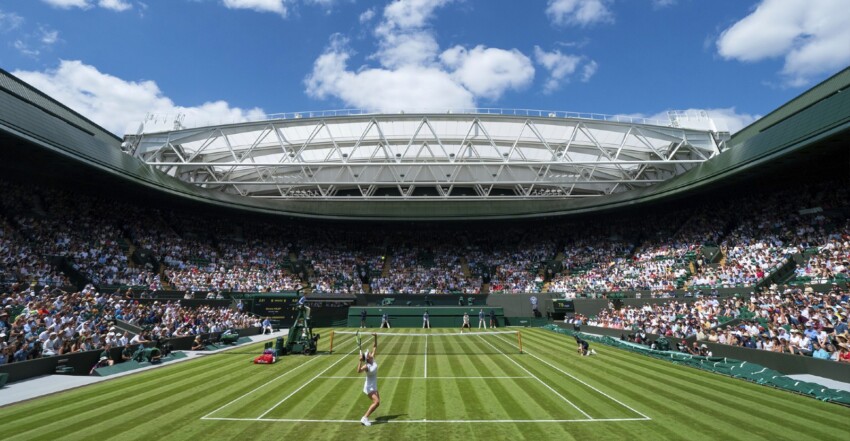
Wimbledon is far more than a stadium or tennis tournament: it is a British cultural institution and a symbol of sporting excellence recognised worldwide.
Located on the exclusive residential Church Road in south-west London, this sporting complex hosts the world’s oldest and most prestigious tennis tournament, the “Championships Wimbledon”, commonly known simply as “Wimbledon“. Founded in 1877, it is one of the four Grand Slam tournaments and the only one still played on grass, the sport’s original surface. The complex features 18 main courts within its main grounds, including two show courts: the iconic Centre Court with a capacity of 14,979 spectators and No.1 Court, which seats 12,345 people.
Wimbledon’s magic derives from its perfect blend of tradition and modernity. Whilst it rigidly maintains customs such as the white dress code for players, strawberries and cream for spectators, and the presence of the British royal family, the venue has undergone continuous modernisation, including the installation of a retractable roof over Centre Court, completed in 2009, and over Court No.1 in 2019.
Every year, for two weeks straddling June and July, this place becomes the centre of the tennis world, welcoming the planet’s top players and over 500,000 spectators, creating an atmosphere that combines the formal elegance of British tradition with the vibrant passion for world-class tennis.
Unlike many modern sporting venues, Wimbledon is not merely a competition facility but a thriving complex year-round that hosts the Wimbledon Museum, training courts for rising stars, and a variety of tennis-related events. Its unique atmosphere, characterised by meticulously maintained gardens, the lush green of the grass courts, and architecture blending historical elements with cutting-edge structures, makes it an unmissable destination for both tennis enthusiasts and visitors keen to immerse themselves in an authentic slice of British tradition.
The Wimbledon complex offers visitors numerous points of interest that extend far beyond the famous tennis courts.
Centre Court is the beating heart of Wimbledon and one of the most sacred places in world tennis. Opened in 1922 when the tournament moved to its current home, this stadium has hosted some of the most memorable moments in the sport’s history. The most distinctive feature is the retractable roof installed in 2009, which revolutionised the tournament by allowing play to continue in the rain, traditionally an unwelcome element for the event.
What truly makes Centre Court special is its unique atmosphere, with its traditional dark green seating, the Royal Box where members of the royal family and other prominent figures sit, and perfect sightlines from every seat. On a tour, you’ll be able to admire the court’s architectural details, including the famous Rudyard Kipling inscription at the players’ entrance: “If you can meet with triumph and disaster and treat those two impostors just the same”.
Particularly evocative is the view from the Royal Box, which lets you imagine how the British and international elite watch the matches, and the chance to see the sophisticated mechanism of the retractable roof, an engineering marvel that can close completely in just 10 minutes.
No.1 Court is Wimbledon’s second most important show court and, following its complete refurbishment completed in 2019, has become a state-of-the-art facility with a capacity of 12,345 spectators and its own retractable roof. Originally built in 1924 as an open-air court, it was completely rebuilt in 1997 and further modernised in recent years.
During your visit, you’ll notice how this court combines modernity and tradition, with a design that maximises spectator visibility whilst maintaining Wimbledon’s classic aesthetic. Particularly interesting is the natural ventilation system which, together with the retractable roof, creates an ideal microclimate for grass growth even when the roof is closed.
No.1 Court hosts some of the tournament’s most important matches, including quarter-final and semi-final fixtures, and offers a slightly less formal atmosphere than Centre Court, whilst maintaining Wimbledon’s characteristic elegance.
Officially known as Aorangi Terrace, this grassy mound within the complex became famous as Henman Hill during the 1990s and 2000s, when British fans would gather here to watch Tim Henman, a local hero, on a giant screen. Subsequently, it was renamed Murray Mound in honour of Andy Murray, the first British man to win the singles title at Wimbledon since Fred Perry in 1936.
This area represents one of the most democratic and lively aspects of the Wimbledon experience. During the tournament, thousands of spectators with general admission tickets (not specific to a court) gather here with picnics, drinks, and great enthusiasm to follow matches on the big screen. The festive atmosphere and collective reactions to crucial match moments create a unique experience that contrasts with the formality of other parts of the complex.
During a tour, don’t miss the chance to climb the mound and enjoy the panoramic view over the Wimbledon complex and the surrounding south-west London landscape.
The Wimbledon Museum is a must-visit for any visitor, whether a tennis enthusiast or a casual tourist. Completely renovated in 2006, it offers a fascinating immersion into the tournament’s history and the evolution of tennis.
Among the museum’s main attractions are:
The museum is open year-round and can be visited independently or as part of a full tour of the complex. An audio guide in several languages enriches the experience with anecdotes and detailed information.
Beyond the two main show courts, Wimbledon comprises 16 other courts used during the tournament, plus numerous practice courts. On a tour, you’ll have the opportunity to see these more intimate courts which, though less well-known, often feature exciting matches during the tournament and allow you to get close to the players.
Particularly interesting are courts No.2 to No.5, which host important tournament matches, and the Aorangi Park practice courts, where players prepare during the Championships. During your visit, you’ll appreciate the incredible care dedicated to every square inch of grass, with groundskeepers maintaining the courts in perfect condition through specialised maintenance techniques.
A fascinating element is the chance to observe up close the distinctive grass surface that makes Wimbledon unique in the modern professional tennis circuit. Tours often include detailed explanations of the process of court preparation and maintenance, a refined art that requires months of meticulous work.
The Orchid Garden is a tranquil and picturesque area within the complex, characterised by splendid floral displays and ornamental plants. During the tournament, this space becomes an elegant meeting point where spectators can relax between matches.
The garden is designed according to English landscape gardening tradition, with particular attention to detail and the creation of an environment that reflects Wimbledon’s characteristic elegance. Benches scattered among the flowerbeds offer a quiet place to rest and absorb the atmosphere of the location.
During a tour, you’ll appreciate how this space perfectly represents Wimbledon’s philosophy: meticulous attention to detail, respect for tradition, and the creation of an experience that goes beyond a simple sporting event.
When the Championships is not in session, Wimbledon offers guided tours of the complex and museum access, allowing visitors to explore this sporting institution in a more relaxed atmosphere.
The Wimbledon Tour Experience is a guided tour of approximately 90 minutes that takes you behind the scenes of the Championships. The tour includes:
It is highly recommended to book in advance on the official Wimbledon website, as the most popular tours tend to sell out quickly, especially during weekends and school holidays.
Tours are generally available Monday to Sunday, from 10:00 to 17:00, with departures every hour or half hour depending on demand. The last tour usually departs at 16:00.
The Wimbledon Museum can be visited independently of the tour or in combination with it. The museum is open year-round, except during the Championships and some periods of closure for maintenance, generally in December and January.
During certain times of the year, such as when the complex is being prepared for the Championships (May–June) or during significant maintenance work, tours may be limited or modified. It is always advisable to check updated opening times on the official Wimbledon website before planning your visit.
In total, a complete visit including tour and museum requires approximately 3–4 hours. If you also wish to dine at one of the restaurants in the area or explore the Wimbledon neighbourhood, you may want to dedicate an entire half day to the area.
The Wimbledon tournament traditionally takes place for two weeks, beginning at the end of June or the start of July. During the tournament, the complex gates generally open at 10:00 in the morning.
Matches begin:
The complex remains open until all scheduled matches conclude, which can extend late into the evening, particularly if there are rain delays or especially long matches. With the introduction of retractable roofs on the main courts, matches can continue until 23:00, a limit set by local regulations.
Attending the Wimbledon tournament is a unique experience, but obtaining tickets requires planning and, often, a bit of luck.
If tickets are sold out on official channels, you can try secondary marketplaces such as Viagogo. The cost will certainly be higher, but if you really don’t want to miss the event, it can be a good compromise.
One of Wimbledon’s most distinctive traditions is The Queue, an orderly ticket-buying system for same-day purchases. Each day during the tournament, approximately 1,500 tickets are made available for the main courts (Centre Court, No.1 Court and No.2 Court) and several thousand Ground Passes giving access to the complex and outer courts.
The queue starts at Wimbledon Park and operates strictly on a first-come, first-served basis. For the most popular days, such as the tournament’s second week, many enthusiasts arrive to camp overnight to secure a spot. Each person in the queue receives a numbered card that determines priority, and the system is managed with typical British efficiency and fairness.
The most traditional system for obtaining tickets in advance is through the Public Ballot, which operates on a purely random basis. To participate in the ballot, you must register on the official Wimbledon website during the opening period (generally September to December of the previous year).
There is also an Overseas Ballot specifically for residents outside the United Kingdom. It’s important to note that ballot participation does not guarantee ticket allocation, and lucky winners cannot choose a specific day or court.
Ticket prices obtained through the ballot are the same as those in The Queue, but with the advantage of being able to purchase them well in advance.
Since 2020, Wimbledon has introduced a limited quota of tickets available for online purchase through the official website and the Wimbledon app. These tickets are generally released in several tranches in the months leading up to the tournament and tend to sell out within minutes.
The history of Wimbledon is as fascinating as the tournament itself, evolving from a modest amateur event to one of the world’s most prestigious sporting occasions.
It all began in 1877, when the All England Croquet Club (founded in 1868) decided to add lawn tennis to its sports, changing its name to the All England Croquet and Lawn Tennis Club. The first amateur tennis tournament was organised to raise funds for the purchase of a roller for maintaining the croquet courts.
This inaugural championship, held on the courts of Worple Road in Wimbledon, saw the participation of 22 players and was won by Spencer Gore. It was exclusively for men, with rules significantly different from today’s: serves had to be made with feet on the ground, sets were played to 9 games, and the court had an hourglass shape, narrower at the net than at the baselines.
The success of this first tournament was such that the following year the club officially added “Lawn Tennis” to its name. In 1884, the women’s tournament, won by Maud Watson, and the men’s doubles were introduced, expanding the scope of the event.
As the tournament grew in popularity, the Worple Road facilities became inadequate. In 1922, the Championships relocated to its current home at Church Road, also in the Wimbledon area, where the new Centre Court was built with a capacity of 14,000 spectators. The move marked the beginning of the tournament’s transformation from a relatively local event into a leading international spectacle.
The 1920s and 1930s witnessed growing international prestige for the tournament, with victories by legends such as Bill Tilden, Fred Perry, Helen Wills Moody and other champions who helped consolidate Wimbledon’s reputation as the world’s most important tennis tournament.
During World War II (1940-1945), the Championships were suspended, and the Wimbledon complex suffered significant damage during an air raid in 1940, which destroyed 1,200 seats in the Centre Court. Despite this, during the conflict, the remaining courts and facilities were used for civil purposes, including growing vegetables as part of the war effort.
1968 marked a turning point with the beginning of the Open Era, when Wimbledon became the first Grand Slam tournament to admit professional players, eliminating the division between amateurs and professionals that had characterised tennis until then. Rod Laver and Billie Jean King claimed the first Open Era titles.
The 1970s and 1980s witnessed some of the greatest rivalries in tennis history, such as that between Björn Borg and John McEnroe, culminating in the legendary 1980 final, considered by many to be the greatest tennis match ever played. In 1985, the tournament set an attendance record with 490,081 spectators, demonstrating the growing popularity of the event.
The end of the 20th century and the beginning of the 21st saw important modernisation work:
Despite these modernisations, Wimbledon has rigorously maintained many of its traditions, such as the all-white dress code for players, the absence of advertising on the courts, and the presence of the Royal Box, continuing to represent a perfect balance between respect for history and innovation.
The history of Wimbledon is inseparable from the great champions who have triumphed on its courts:
These and other champions have helped build the Wimbledon legend, making the tournament not only a sporting event but a true global cultural heritage.
The Wimbledon complex is located in south-west London and is well connected to the capital’s public transport system.
The London Underground represents one of the most convenient ways to reach Wimbledon, especially during the Championships when services are increased. The nearest stations are:
During the Championships, both stations can become very crowded, especially at the end of the day when thousands of spectators leave the complex simultaneously. Transport for London typically implements special crowd management measures during these periods.
Several bus routes also serve the Wimbledon area:
During the Championships, a special shuttle service is set up between Wimbledon Station and the tennis complex, with a separate cost from the normal public transport fare.
The railway stations serving the Wimbledon area are:
During the Championships, rail services are often enhanced with additional trains, especially in the evenings when matches finish.
Yes, it is highly recommended to book tickets in advance, especially during weekends, school holidays and the periods immediately before and after the Championships. The most popular tours, particularly the half-day ones, tend to sell out quickly.
The Public Ballot for Wimbledon tickets is a long-standing tradition and is considered the fairest method for distributing tickets in advance. To participate:
It is important to note that the ballot is completely random and does not operate on a first-come, first-served basis. Participation does not guarantee ticket allocation, and if selected, you cannot choose the specific day or court.
For international visitors, there is a separate Overseas Ballot that follows a similar process but with a number of tickets reserved for non-UK residents.
If tickets are sold out on official channels, you can try looking on secondary marketplaces such as Viagogo. The cost will certainly be higher, but if you’re keen on the event and don’t want to miss it, it can be a good compromise.
Yes, both the museum and the tours are suitable for families with children of all ages. The Wimbledon Museum features several interactive sections specifically designed for younger visitors, including virtual reality games and tactile exhibitions.
During tours, guides are accustomed to adapting their explanations to engage children, and the route is accessible and not excessively long even for the youngest visitors.
As far as the Championships are concerned, the event is generally family-friendly with:
However, bear in mind that tennis matches can last several hours and require silence during play, so they may not be ideal for very young or particularly lively children.
Yes, the Wimbledon complex is designed to be accessible to visitors with various mobility needs and other disabilities.
During the Championships, Wimbledon also offers a specific ballot system for spectators with disabilities, which allows you to request accessible tickets. It is recommended that you contact the Wimbledon Ticket Office well in advance for more information.
For regular tours, it is advisable to inform staff of your specific needs at the time of booking, so they can arrange any necessary facilities.
City Card allow you to save on public transport and / or on the entrances to the main tourist attractions.



 Hotel
Hotel  Budget accommodations
  Apartments
  Family Hotel
  Luxury Hotel