Guide to the British Museum in London, one of the world's largest museums. Which masterpieces to see without fail, how to get there and opening hours.
The British Museum stands as one of the world’s most extraordinary and influential museums, an institution housing over 8 million objects that tell the story of human civilisation through art, culture and science. Founded in 1753 thanks to the private collection of Sir Hans Sloane, it was the world’s first public national museum, opening its doors to visitors in 1759 in the historic Montagu House in Bloomsbury, the same neighbourhood where it remains today.
What makes the British Museum truly unique is its universal mission: to document the history and culture of all humanity, from our origins to the present day. Its galleries house priceless treasures from every continent, allowing visitors to embark on a journey through two million years of human history within a single building.
From the magnificent Great Court with its spectacular glass and steel dome, to the controversial Parthenon Marbles, from the mysterious Rosetta Stone that unlocked Egyptian hieroglyphics, to the captivating mummies that fascinate visitors of all ages, the British Museum offers an unparalleled cultural experience. And the fact that admission to the permanent collections is completely free makes this treasure accessible to everyone.
With its 60 galleries housing thousands of artefacts, the British Museum can feel overwhelming for visitors. Here’s a selection of unmissable treasures you should definitely include in your itinerary.
The Rosetta Stone
The Rosetta Stone is one of the museum’s most celebrated and significant artefacts. Discovered in 1799 by Napoleonic troops in Egypt and acquired by the British Museum in 1802, this slab of black granite dating from 196 BC proved to be the key to deciphering Egyptian hieroglyphics.
The significance of this artefact lies in the fact that it contains the same text written in three different scripts: Egyptian hieroglyphics, Demotic script and ancient Greek. It was thanks to this “code” that French scholar Jean-François Champollion finally succeeded in deciphering Egyptian writing in 1822, opening the door to understanding an entire civilisation.
The Rosetta Stone is located in Gallery 4 (Egyptian Sculpture Gallery) and is always surrounded by visitors eager to admire this authentic treasure of human knowledge. To photograph it best, try visiting this gallery in the early morning or late afternoon, when crowds are thinner. An interesting detail is to observe the marks left by scholars who made plaster casts of it, still visible on the stone’s surface.
The Parthenon Marbles
The Parthenon Marbles, often also called the “Elgin Marbles” after Lord Elgin who removed them from the Acropolis in Athens between 1801 and 1812, constitute the most important collection of ancient Greek sculptures outside Greece itself.
This extraordinary sculptural ensemble comprises approximately half of the sculptures that originally decorated the Parthenon, the temple dedicated to Athena on the Acropolis in Athens, built between 447 and 432 BC under the direction of Phidias, ancient Greece’s greatest sculptor.
The collection includes:
247 feet (75 metres) of the original frieze depicting the Panathenaic procession
15 of the original 92 metopes depicting mythological battles
17 figures from the east and west pediments illustrating stories related to Athena
These sculptures, displayed in Galleries 18-19, allow you to admire up close the technical perfection and idealistic beauty achieved by fifth-century BC Greek art. The gallery’s lighting has been specially designed to highlight marble details and recreate, as far as possible, the effect of natural light on the Acropolis.
It’s worth noting that these marbles are at the centre of one of the most heated controversies in cultural heritage, with Greece requesting their return since 1832. Take time to carefully observe the tense muscles of the horses, the folds of drapery that resemble real fabric, and the serene expressions of the faces—characteristics that have influenced Western art for centuries.
Egyptian mummies
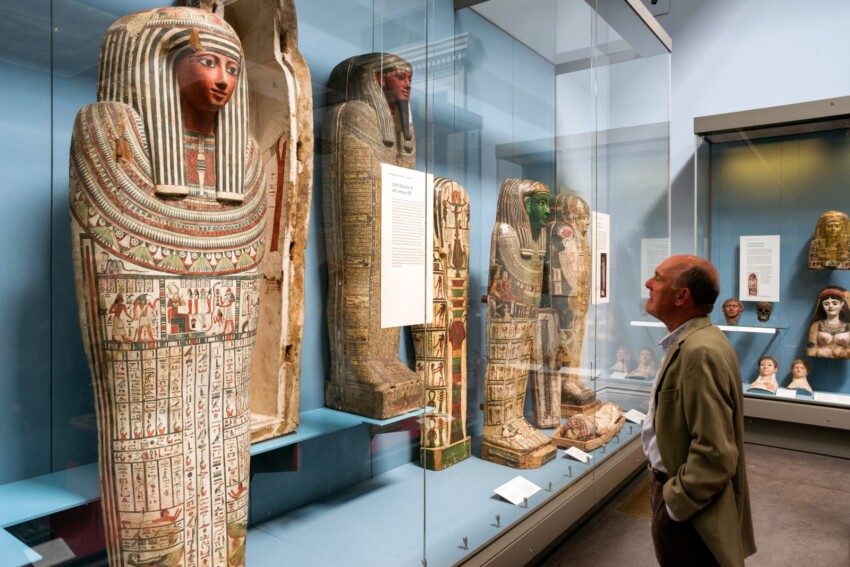
The British Museum’s collection of Egyptian mummies is one of the most comprehensive in the world and certainly one of the most popular attractions, especially among younger visitors. Located in Galleries 62-63, it offers a fascinating glimpse into ancient Egyptian funerary practices and their elaborate rituals for the afterlife.
The galleries display not only the mummies themselves, but also their elaborate sarcophagi, amulets, funerary objects and extensive documentation on the mummification process. Particularly noteworthy is the mummy of Katebet, a priestess of Amun who lived around 1300 BC, whose richly decorated sarcophagus shows scenes of the journey to the afterlife.
Thanks to modern scanning technology, the museum is able to show you the interior of some mummies without disturbing the remains, revealing surprising details such as hidden jewellery, protective amulets and even information about the health and living conditions of ancient Egyptians.
A photography tip: lighting in this section is kept low to preserve the artefacts, so prepare your camera for low-light conditions, and remember that flash photography is not permitted.
A little-known curiosity: some of the mummies on display still retain hair, fingernails and even skin, testament to the incredible effectiveness of Egyptian mummification techniques.
The Great Court
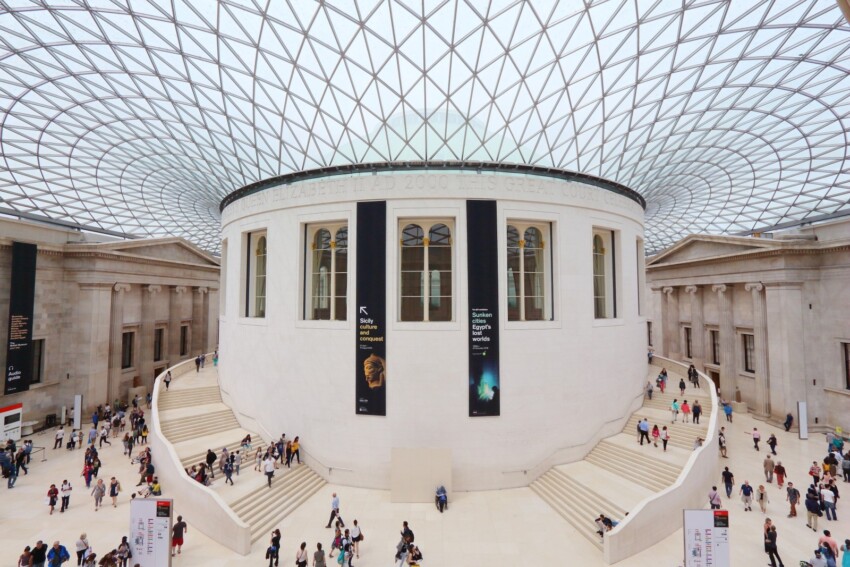
The Great Court is the architectural heart of the British Museum and represents one of Europe’s largest covered public spaces. Completed in 2000 to a design by architect Norman Foster, it is dominated by a spectacular glass and steel roof that spans the entire inner courtyard of the museum, creating a bright and airy space of 6,100 square metres.
At the centre of the court stands the historic Reading Room with its distinctive circular shape, where distinguished figures such as Karl Marx, Virginia Woolf and Mahatma Gandhi studied when it housed the British Museum’s library, before the book collections were transferred to the British Library.
The Great Court is not only an extraordinary example of contemporary architecture in dialogue with a historic building, but also a fundamental orientation point for visitors, a place to rest and reflect between gallery visits, and where you’ll find essential services such as cafés, shops and information desks.
The best time to photograph this space is on sunny days, when natural light creates fascinating shadow play through the geometric roof structure, or at sunset, when it takes on particularly evocative golden tones. Try climbing to the upper levels to capture panoramic views of the court.
Ancient Egypt Gallery
The Egyptian Galleries (Galleries 61-66) house one of the world’s largest collections of Egyptian antiquities, second only to the Egyptian Museum in Cairo. Here you can admire colossal statues, finely decorated sarcophagi, precious jewellery and everyday objects spanning over 3,000 years of Egyptian history, from the predynastic period to the Roman era.
Among the most extraordinary pieces are:
The gigantic head of Amenhotep III in red granite, impressive for its size and sculptural mastery
The famous bust of Ramesses II (the “Young Memnon”)
The refined alabaster statue of Amenhotep III
The Stela of Shabaka, an important religious document from the late period
Particularly fascinating is the collection of everyday objects that offers a snapshot of ancient Egyptian life, from work tools to children’s toys, from cosmetics to musical instruments.
An interesting detail: pay attention to colours still visible on some artefacts, reminding us that Egyptian art was originally vividly coloured, contrary to the monochromatic image we often have of it.
To appreciate this section to the fullest, plan to spend at least an hour here and, if possible, visit the Egyptian sculpture galleries (4-6) first to better understand the chronological development of Egyptian art.
The Assyrian Gallery
The Assyrian Gallery (Galleries 6-10) offers an extraordinary immersion into the art and culture of the ancient Assyrian empire, with particular focus on the sumptuous royal palaces of Nimrud, Khorsabad and Nineveh in present-day Iraq.
The centrepiece of this collection is the magnificent alabaster wall reliefs from the North Palace of Nineveh, commissioned by King Ashurbanipal (668-631 BC). These panels, which originally decorated the walls of royal palaces, depict lion hunts of incredible realism and dynamism, with surprisingly accurate anatomical details of both animals and human figures.
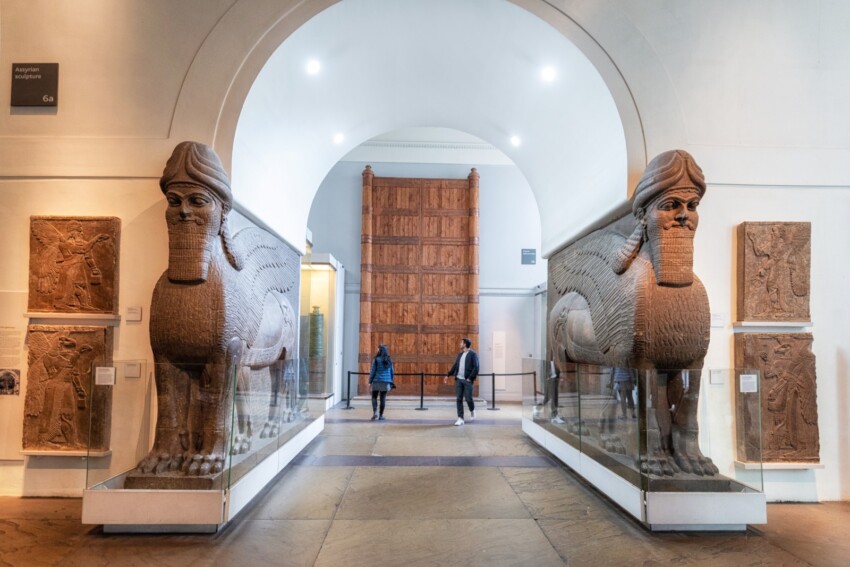
Equally impressive are the Lamassu, imposing statues with the body of a bull or lion, eagle wings and a human head, which served as protective guardians at the entrances to Assyrian palaces. Standing up to 4.5 metres high, these mythological beings combine the strength of the bull, the majesty of the lion, the keen sight of the eagle and the intelligence of man.
A curious detail is that these statues are carved to appear correct from any angle: viewed from the front they show two legs, while from the side they appear to have four, creating the illusion of movement as the viewer moves past.
The British Museum’s Assyrian collection is particularly precious today, as many of the original sites have been damaged or destroyed during recent conflicts in Iraq and Syria, making these artefacts irreplaceable testaments to ancient civilisations.
The Cassiobury Clock
Less well-known than other artefacts but absolutely fascinating, the Cassiobury Clock (Gallery 39) is one of the world’s oldest and most extraordinary mechanical clocks. Built around 1630 by English clockmaker William Clement, this astronomical clock is an exceptional example of Baroque engineering and artistry.
Standing approximately two metres tall and finely decorated with inlays, twisted columns and allegorical figures, the clock does far more than tell the time: it also indicates lunar phases, months of the year, zodiac signs and seasons. Its extraordinarily complex mechanism for the era still functions.
What makes this clock particularly interesting is the combination of scientific precision and decorative richness typical of the Baroque era, when clocks of this type were not merely timekeeping instruments but also symbols of prestige and scientific knowledge.
A tip: if you’re fortunate, you may witness a demonstration of the clock’s operation occasionally performed by museum staff.
The Lewis Collection
The Lewis Chessmen (Gallery 40) represent one of the museum’s most fascinating and mysterious medieval treasures. Discovered in 1831 on the Isle of Lewis in the Outer Hebrides in Scotland, these walrus ivory chess pieces date from the twelfth century and are probably of Norwegian origin.
The collection comprises 93 pieces, of which 82 are chess pieces, whilst the others are pieces for other board games. The chess pieces have extremely expressive character: kings seated majestically on their thrones, queens appearing distressed (with a hand to their cheek in worry), bishops with mitres and crosiers, knights on horseback, rooks shaped like berserkers (Viking warriors) and pawns shaped like stelae.
These pieces are not merely gaming objects but offer a snapshot of Norse medieval society, its values and aesthetics. Their expressiveness has made them so iconic that they have appeared in numerous films and contemporary creative works, including the Harry Potter series.
A curious detail: some of the queens show bite marks, suggesting that perhaps a child hid them on the island, possibly gnawing on them as one would with a toy.
History of the British Museum
The history of the British Museum begins with an eccentric physician, naturalist and collector: Sir Hans Sloane (1660-1753). During his lifetime, Sloane accumulated an extraordinary collection of over 71,000 objects, ranging from natural specimens to books, manuscripts, antiquities and ethnographic curiosities. In his will, he offered this collection to the British nation in exchange for £20,000 to be given to his heirs—a considerable sum but far below the collection’s true value.
On 7 June 1753, the British Parliament approved the Act of Parliament that officially established the British Museum, the world’s first public national museum, funded not by the crown but by the state. To house the collection, Montagu House, a grand aristocratic residence in Bloomsbury, was purchased, and the museum officially opened its doors to the public on 15 January 1759.
From the outset, the museum adopted a revolutionary principle for its time: free admission for “all persons desirous of seeing and observing,” regardless of their social class or background. However, in its early years, visits were limited and required a written application.
During the 19th century, the museum experienced a period of extraordinary expansion, fuelled by British imperialism and major archaeological expeditions. It was during this period that some of the most celebrated artefacts entered the collection, including the Rosetta Stone (1802), the Parthenon Marbles (1816) and the great Assyrian monuments (1840-1860).
As the collections grew, Montagu House soon proved inadequate, and between 1823 and 1857 the current neoclassical building was constructed, designed by architect Sir Robert Smirke. The distinctive façade with its Ionic portico and forty-four columns has become one of London’s most iconic images.
A pivotal moment in the museum’s history was the construction of the circular Reading Room, completed in 1857, which became one of Europe’s most important intellectual centres, frequented by figures such as Karl Marx, Lenin, Virginia Woolf and Arthur Conan Doyle.
In the 20th century, the museum faced new challenges, including damage sustained during Second World War bombing raids. Many collections were temporarily transferred to safe locations, including the Rosetta Stone, which was hidden in Holborn Underground station.
An important chapter opened in 1972, when the British Museum’s library collections were separated to create the British Library, which moved to its own premises in 1997. This allowed for the transformation of the historic Reading Room and its surrounding courtyard into the spectacular Great Court, completed in 2000 to mark the new millennium.
Today, the British Museum continues to evolve, tackling contemporary issues such as the debate over returning contested objects to their countries of origin and adapting to new technologies to make its extraordinary collections accessible to a global audience.
On 7 June 2023, the museum celebrated its 270th anniversary, confirming itself as one of the world’s most longstanding and influential cultural institutions, with a mission that remains true to Sir Hans Sloane’s original vision: making knowledge accessible to all.
Admission
Admission to the permanent collections is completely free for all visitors. This policy, in line with the tradition of British national museums, reflects the museum’s fundamental mission of making human culture and heritage accessible to as many people as possible.
Despite free admission, it is advisable to book a timed ticket online on the British Museum’s official website, particularly during peak tourist season (summer and holiday periods) or at weekends. Whilst not mandatory, booking will allow you to avoid queues and guarantee entry even on days of high footfall, when the museum may reach capacity.
Temporary exhibitions
Special temporary exhibitions, unlike the permanent collection, are generally ticketed. For temporary exhibitions too, advance booking is strongly recommended, as spaces tend to sell out, especially for peak times such as weekends.
Guided tours and special visits
The British Museum offers a variety of paid guided tours that allow you to explore specific collections or themes in depth. These tours are led by museum experts and represent an excellent opportunity to enhance your visit.
Audioguides are also available in 10 different languages. The audioguide offers several thematic routes and can be a good alternative to guided tours for those who prefer to explore the museum at their own pace.
Opening hours and visiting times
The British Museum maintains consistent opening hours throughout the year, with some variations during holiday periods:
The museum is closed on 1 January and 24, 25 and 26 December. Hours may vary for particular holidays or special events, so it’s always advisable to check the official website before your visit.
Friday evening opening offers an excellent opportunity to visit the museum with fewer crowds. During these evenings, special events, musical performances or thematic talks are often organised, enriching your visit experience.
Recommended visiting times
Given the vast scale and richness of the collections, it’s practically impossible to see everything at the British Museum in one visit. For a satisfactory visiting experience, you should allow at least 3-4 hours, which will give you time to admire the main masterpieces and explore the galleries that interest you most.
If you’re passionate about a specific cultural area or wish to explore the collections in depth, consider planning multiple visits, perhaps focusing on different sections each time.
When to visit the British Museum
For a more relaxed experience with fewer crowds, the best times to visit the museum are weekdays (Monday to Thursday), especially early morning or late afternoon, and Friday evenings during extended opening hours (after 18:00).
If you must visit during peak times, concentrate on the upper floor galleries or side wings, which tend to be less crowded than the most popular areas such as the Egyptian section or the Rosetta Stone.
Events and special visits
The British Museum is not merely a place to admire ancient treasures, but a vibrant cultural institution offering a rich programme of events and special visits throughout the year. Participating in these activities can greatly enhance your experience and offer unique perspectives on the collections.
Lectures and talks
The museum regularly organises free lectures delivered by curators and international experts on various aspects of the collections or topics related to temporary exhibitions. These events, generally held in the BP Lecture Theatre, offer extraordinary insights and the opportunity to ask questions directly of scholars.
Particularly popular are lunchtime talks, brief 30-45 minute presentations held at midday focusing on a single object or small collection, allowing even those with limited time to expand their knowledge.
Evening events
Friday Late represents one of the most popular formats: during extended Friday opening, the museum organises themed events combining gallery visits, artistic performances, live music, creative workshops and tastings. These events, often tied to international holidays or cultural commemorations, transform the museum into a space for socialising and discovery with a particularly vibrant atmosphere.
Special evenings such as Museum Lates or Silent Discos in the Great Court are periodically organised, allowing you to experience the museum’s spaces in an unusual and festive way.
Family and children’s activities
At weekends and during school holidays, the museum organises numerous family activities, including:
Creative workshops inspired by the collections
Themed treasure hunts through the galleries
Storytelling sessions bringing to life myths and legends from different cultures
Practical workshops where children can experiment with ancient artistic or archaeological techniques
Most of these activities are free, though some require advance booking due to limited spaces. Recommended ages vary depending on the activity, but programmes are generally available for children aged 3 to 15.
Temporary exhibitions
In addition to the permanent collection, the British Museum hosts several temporary exhibitions each year, exploring specific cultures, historical periods or cross-cutting themes in depth. These exhibitions, unlike the permanent collection, are generally ticketed and require advance booking.
Temporary exhibitions often feature exceptional loans from other international museums, creating unique opportunities to view together objects that are normally dispersed across different collections worldwide. The exhibition calendar is published well in advance on the museum’s website, allowing you to plan your visit based on your specific interests.
How to get to the British Museum
The British Museum enjoys a central location in London, in the Bloomsbury area, making it easy to reach by any mode of transport.
The Underground is the most efficient way to reach the museum. The nearest stations are:
Tottenham Court Road (Central and Northern lines): 5 minutes’ walk, exiting on Oxford Street and heading north via New Oxford Street, then Great Russell Street
Holborn (Central and Piccadilly lines): 7 minutes’ walk, following Great Russell Street westbound
Russell Square (Piccadilly line): 7 minutes’ walk, following Montague Street southbound
Goodge Street (Northern line): 8 minutes’ walk, heading south down Tottenham Court Road and then turning onto Great Russell Street
Numerous bus routes serve the area around the British Museum:
Routes 1, 8, 19, 25, 38, 55, 98, 242: stop on New Oxford Street/High Holborn
Routes 7, 10, 14, 24, 29, 73, 134, 390: stop on Tottenham Court Road/Oxford Street
No, it’s not compulsory, but it is highly recommended to book a free timed ticket online on the official website, especially during peak season or at weekends, to avoid potential queues and guarantee entry even on the busiest days.
For special temporary exhibitions, however, booking is almost always necessary, as tickets tend to sell out quickly, particularly for the most popular periods.
Can I take photographs inside the British Museum?
Yes, photography is permitted in most galleries of the British Museum, provided images are for personal, non-commercial use. Flash photography is allowed, except in certain galleries where particularly light-sensitive materials are on display (this will be clearly marked).
Some objects on loan from other institutions may have specific photography restrictions, in which case there will be appropriate signs nearby. You’re welcome to use compact tripods that don’t obstruct the passage, though selfie sticks are generally discouraged in the busier galleries.
Is the British Museum suitable for children?
Absolutely. Despite its vastness and the academic nature of many collections, the British Museum offers numerous opportunities to engage younger visitors. Attractions particularly popular with children include Egyptian mummies, ceremonial artefacts from indigenous cultures, and ancient coins.
The museum regularly organises family-friendly activities, including themed treasure hunts, creative workshops and storytelling sessions. There’s also a dedicated children’s audio guide, designed to make the visit more interactive and engaging.
For families, changing facilities are available in all toilets, and there’s a picnic area in the basement where you can enjoy snacks brought from outside. Children’s menus are also available at the museum’s cafés.
Are there restaurants or cafés inside the British Museum?
The museum offers several dining options to cater for different needs:
Great Court Restaurant: located on the upper level of the Great Court, it offers refined cuisine with dishes inspired by the diverse cultures represented in the museum. Ideal for a relaxed lunch or afternoon tea.
Court Café: on the ground floor of the Great Court, serving quick snacks, sandwiches, cakes and beverages – perfect for a brief break during your visit.
Kitchen: in the basement, offering hot dishes, salads and children’s options in an informal setting.
Gallery Café: near the south entrance, specialising in quality coffee and pastries.
It’s advisable to book the Great Court Restaurant, especially at weekends or during peak season. The other refreshment points operate on a counter service basis without reservation.
In the vicinity of the museum, you’ll also find numerous restaurants and cafés in the Bloomsbury area, which offer good alternatives often at lower prices.
Is the British Museum accessible for people with disabilities?
Yes, the museum is committed to ensuring accessibility for all visitors. The building is fully wheelchair accessible, with ramps, lifts and appropriate facilities. The main entrance on Great Russell Street has a ramp, whilst a level-access entrance without steps is available on Montague Place.
Wheelchairs are available free of charge upon request (advance booking is advisable), as are portable stools for resting during your visit. For visitors with visual impairments, tactile maps and Braille descriptions of selected objects are available.
Visitors with hearing impairments can access guides in British Sign Language (BSL) via tablet and induction loops in all information areas. Guide dogs and assistance dogs are welcome throughout the museum.
Are the British Museum and the British Library the same thing?
No, they are two separate institutions. Until 1973, the British Library was part of the British Museum, and the famous circular Reading Room at the centre of the current Great Court was the library’s main hall. In 1973, the British Library was established as a separate entity, and in 1997 it relocated to its current home at St. Pancras.
Today, the British Library is housed in a modern building near King’s Cross St. Pancras station and holds one of the world’s largest library collections, including historical manuscripts such as the Magna Carta and Leonardo da Vinci’s notebooks. It’s absolutely worth a separate visit, particularly for literature and history enthusiasts.
How can I find out what temporary exhibitions are scheduled?
The easiest way to stay updated on temporary exhibitions is to check the “What’s on” section of the British Museum’s official website, where you’ll find detailed information on all current and forthcoming exhibitions, including dates, prices and the option to book tickets.
You can also subscribe to the museum’s newsletter to receive regular email updates, or follow the official social media accounts (Facebook, Twitter, Instagram), where exhibition and event information is regularly posted.
Major exhibitions are typically announced 6–12 months in advance, allowing you to plan your visit well ahead.
Can I leave my luggage at the British Museum?
The museum has a paid cloakroom located near the main entrance, where you can deposit coats, umbrellas and small to medium-sized bags.
For security reasons, large luggage is not permitted inside the galleries. If you’re travelling with large suitcases, it’s advisable to use the luggage storage facilities at the main railway stations (Euston, King’s Cross, St. Pancras) or one of the numerous private services available in central London.
Please note that all bags, including hand luggage, are subject to security checks at the museum’s entrance.
 Hotel
Hotel  Budget accommodations
  Apartments
  Family Hotel
 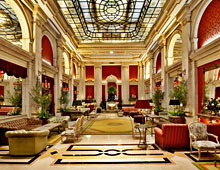 Luxury Hotel