Bestseller
London: Kew Gardens Admission Ticket
From 19,47 €
Buy the ticket
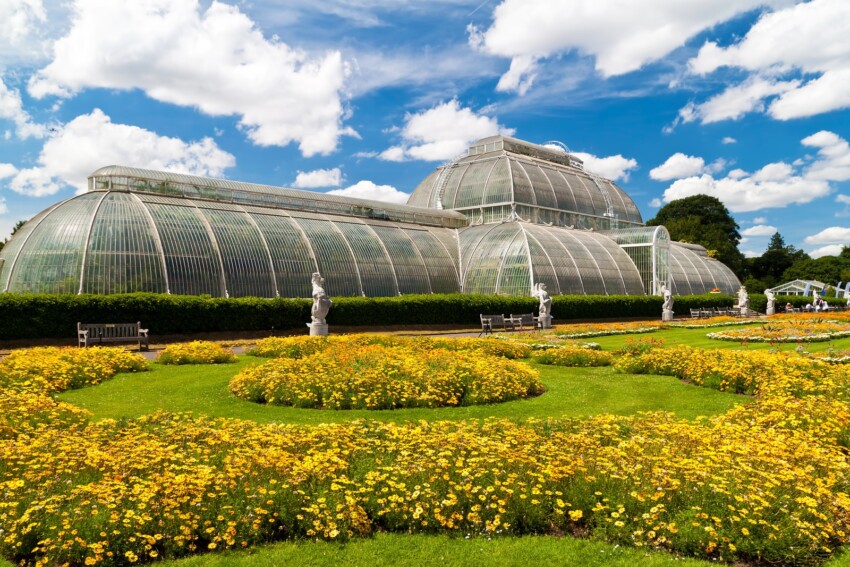
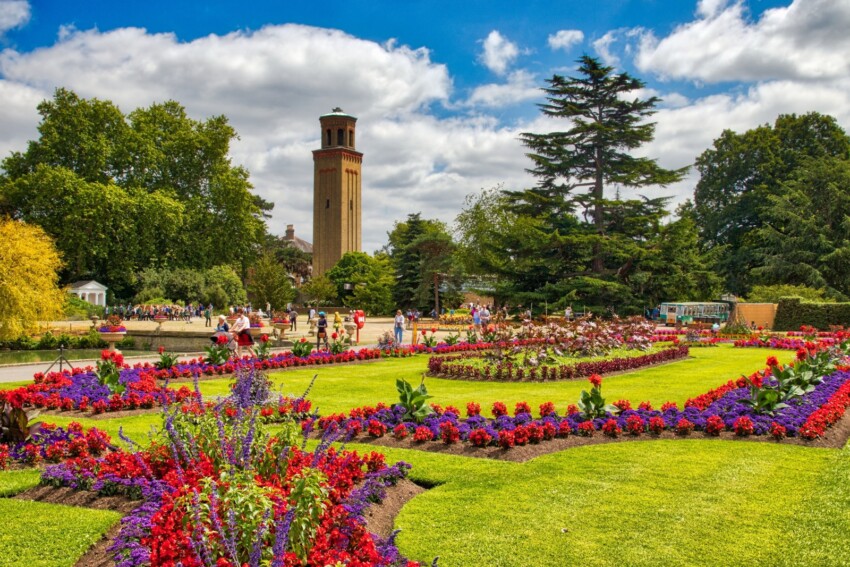
Located in Richmond, in the south-western part of London, Kew Gardens represents one of the world’s most important botanical gardens. Spanning 132 hectares, it houses the planet’s most extensive collection of living plants, with over 50,000 botanical species, many of which are rare or extinct in nature.
Recognised as a UNESCO World Heritage Site since 2003, the Royal Botanic Gardens are far more than an oasis of extraordinary beauty – they are also an internationally renowned scientific research centre, dedicated to conserving global biodiversity.
Accessible in around 30 minutes from central London, Kew Gardens offers an experience that extends well beyond a simple botanical visit. Amongst magnificent Victorian glasshouses, meticulously landscaped grounds, historic architecture and contemporary installations, the complex presents itself as a living museum where science, art and nature blend harmoniously. A complete visit requires at least half a day.
The Palm House is undoubtedly the iconic centrepiece of Kew Gardens. This magnificent Victorian glasshouse, completed in 1848, represents a milestone in iron and glass architecture. Designed by Decimus Burton and constructed by Richard Turner, it was the first large-scale structure to employ wrought iron as the main supporting element – an innovative technique inspired by naval construction of the era. Its curved form actually recalls an inverted ship’s keel.
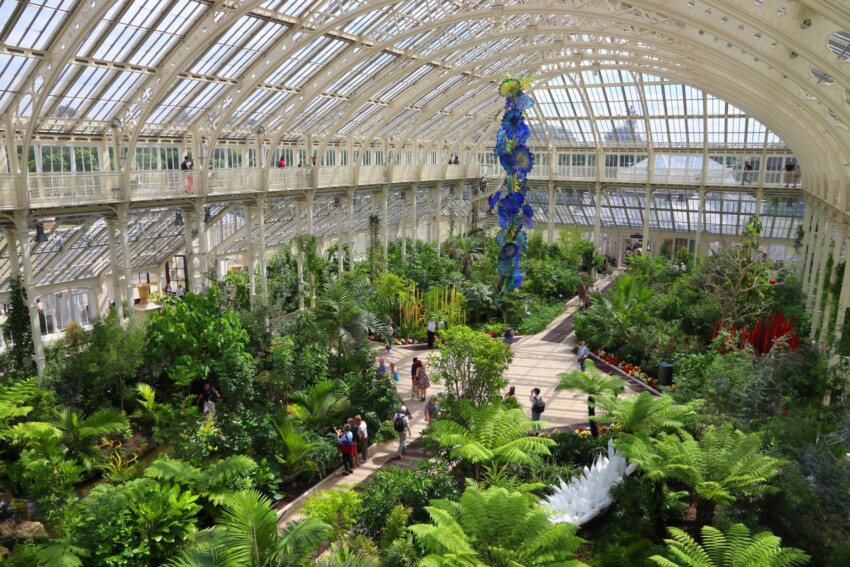
Within the Palm House unfolds an authentic tropical rainforest, where exotic palms, giant ferns and rare plants create a humid, lush environment. The temperature is maintained at a consistently high level to ensure the survival of species from Africa, Asia, America and the Pacific. An elevated walkway allows visitors to walk amongst the fronds of the tallest trees, offering a unique perspective on the vegetation below. Among the treasures housed here is the Encephalartos altensteinii, considered the world’s oldest potted plant, brought from South Africa in 1775 and still flourishing after nearly 250 years.
The Temperate House holds the distinction of being the world’s largest surviving Victorian glasshouse. Originally opened in 1863 and reopened in 2018 after five years of meticulous restoration, this cathedral of glass and iron extends across 628 square metres, housing over 10,000 plants belonging to 1,500 different species from the temperate zones of all continents.
During restoration work, 15,000 individual glass panes were replaced and tonnes of rust-affected iron structures were refurbished. The interior is arranged across two levels: the ground floor features winding pathways through the collections, whilst a perimeter balcony offers aerial views of the vegetation below. Here you’ll find some of the planet’s rarest and most threatened plants, including the Encephalartos woodii, a South African cycad of which only a handful of specimens exist worldwide, along with economically important plants such as tea, quinine and an extensive citrus collection.
Opened in 1987 by Princess Diana in memory of her ancestor Augusta, founder of the gardens, the Princess of Wales Conservatory represents a masterpiece of modern botanical technology. At 4,500 square metres, this high-tech glasshouse recreates ten different climatic zones controlled by sophisticated computerised systems that regulate temperature, humidity and ventilation.
The journey through the conservatory is an extraordinary voyage through completely different ecosystems. In the section dedicated to carnivorous plants, visitors can admire Venus flytraps, capable of capturing an insect in less than half a second, and pitcher plants with their jug-shaped traps. The desert section houses cacti and succulents, whilst in the humid tropical zones thrives the Victoria amazonica, the giant water lily whose leaves can reach 3 metres in diameter. A curious fact: the leaves are so robust they can support the weight of a child, as demonstrated by historical photographs preserved in Kew’s archives.
Among the most spectacular plants is the Amorphophallus titanum, nicknamed the “corpse flower” for its putrid flesh-like odour emitted during blooming to attract pollinating insects. Another interesting detail: in 1985 Sir David Attenborough buried a time capsule in the conservatory’s foundations, containing seeds of fundamental plants and endangered species, to be opened in 2085.
Built in 1852 specifically to house the Victoria amazonica, the Waterlily House is a small Victorian gem of modest dimensions yet suggestive atmosphere. The square structure centres on a circular pool over 10 metres in diameter, where the giant water lilies float in water tinted black with a harmless food dye to prevent algae growth and create crisper reflections.
In addition to the Victoria amazonica, the Victoria boliviana also grows here, recognised as a new species only in 2022 by Kew’s scientific team, its leaves reaching up to 3 metres in width. The flowers of these water lilies are ephemeral and spectacular: they open at dusk in white, close in the morning and reopen the following evening, transforming to pink before withering. The structure of these plant leaves inspired architect Joseph Paxton in his design of the Crystal Palace for the Great Exhibition of 1851.
Standing 18 metres above ground, the Treetop Walkway is a suspended walkway among the tree canopies offering a completely different perspective on the gardens. Designed by architects Marks Barfield, the same team responsible for the London Eye, this 200-metre structure enables visitors to observe the forest canopy ecosystem up close and enjoy panoramic views across the entire complex.
Access to the walkway is via a staircase of 188 steps, divided into several flights with intermediate landing platforms for pausing to admire the landscape. The walkway itself features chest-height railings and includes some circular viewpoints projecting from the main structure. A lift is also available, though it may occasionally be out of service. Before the elevated walkway, the route includes the Rhizotron, offering the opposite perspective and showcasing the underground world of the trees’ root systems.
The Great Pagoda, completed in 1762, is one of Kew Gardens’ oldest and most iconic structures. Designed by Sir William Chambers, court architect who had travelled in China studying Oriental architecture, this ten-storey tower rises nearly 50 metres and offered one of the earliest panoramic views of London in the Georgian era.
The pagoda presents an interesting architectural anomaly: contrary to Chinese tradition, which always favours an odd number of storeys, this structure has ten. Originally the roofs of each level were decorated with 80 gilded wooden carved dragons, removed in 1784 and restored only in 2018 during a major conservation project. During the Second World War, the pagoda had a surprising use: it was employed by the Ministry of Defence to test bomb trajectories, with holes deliberately drilled through each storey.
Climbing to the top requires conquering 253 steps, but the effort is rewarded by spectacular views across the city. On the ground floor, accessible free of charge, a small exhibition space features mechanical automata recounting the pagoda’s history and Chambers’ travels in China.
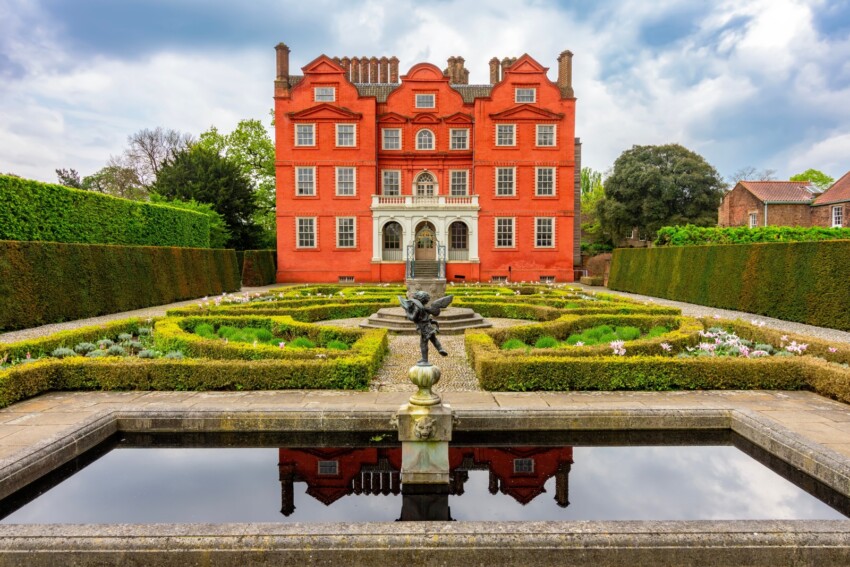
The Kew Palace, also known as the Dutch House for its characteristic Dutch architectural style, is Britain’s smallest royal palace and the oldest structure within the gardens. Built in 1631 by Samuel Fortrey, a wealthy merchant of Flemish origin in the textile trade, the red-brick building with stepped gables became royal property in the 18th century.
King George III used the palace as a summer residence and spent periods here during episodes of mental illness. Queen Charlotte, his wife, died here in 1818. The palace is open to visitors from April to September and offers an intimate glimpse into Georgian royal family life, with the princesses’ bedrooms, dining room and recently restored royal kitchens. To the rear extends the Queen’s Garden, a formal 17th-century garden featuring exclusively plants cultivated in Britain before or during the 1600s, creating an authentic journey through British horticultural history.
The Great Broad Walk Borders is a spectacular 320-metre avenue, considered the longest double herbaceous border in the United Kingdom. Situated between the Palm House and Temperate House, this garden explodes with colour and fragrance during the summer season, when over 30,000 specimens and 13,000 bulbs are planted.
The project, completed in 2010, represents a tribute to Britain’s great herbaceous gardens, with a careful selection of perennials, annuals and bulbs ensuring continuous flowering from spring through autumn. Among the most appreciated species are echinacea, achillea, ornamental salvias and euphorbias, arranged according to colour schemes designed to create striking visual effects.
The Japanese landscape at Kew Gardens comprises three distinct areas following the principles of traditional Japanese design. The Garden of Peace recreates the atmosphere of a tea garden, with stone lanterns and a dripping water basin. The Garden of Activity uses raked gravel and large rocks to represent flowing water movement, whilst the Garden of Harmony combines both preceding elements.
At the centre of the landscape stands the Chokushi-Mon, the imperial messenger’s gate, a replica of an authentic Japanese structure. Nearby is the Minka House, a traditional Japanese farmhouse from 1900 from Okazaki, donated to Kew in 2001 and reassembled through collaboration between Japanese craftspeople and British workers. A special white cherry tree, Prunus ‘Taihaku’, has a particular story: this variety was believed extinct in Japan in the 1920s until an English collector found a specimen, enabling its rediscovery and reintroduction to its homeland.
One of Kew Gardens’ most contemporary and captivating installations is The Hive, a structure rising 17 metres high and constructed with 170,000 aluminium pieces and illuminated by 1,000 LED lights. The artwork, designed by artist Wolfgang Buttress, recreates the visual and audio effects of a real beehive.
The structure is connected to an actual beehive within the gardens, with the intensity of lights and sounds varying according to bee activity, creating an immersive experience that raises visitor awareness of the importance of these pollinating insects to the global ecosystem. The installation also represents a call to conservation, as bee populations are experiencing a worrying decline worldwide.
The Arboretum occupies approximately two-thirds of the entire Kew Gardens surface and houses over 14,000 trees representing thousands of species from all continents. The trees are often grouped by genus, creating specialised collections that allow comparisons between related species.
Among the most notable specimens are “heritage” trees planted during the earliest botanical explorations of the 18th century, including chestnuts, ginkgo biloba, black locusts and Oriental plane trees. Particularly striking is the Sophora japonica specimen, known as the Pagoda Tree, planted in 1760, whose trunk is dramatically twisted and contorted, creating a natural sculptural form. The different seasons offer ever-changing visual spectacles, with spring blooms, summer shade and the fiery autumn colours that tint the canopies in red, gold and orange.
Tickets are available for online purchase, a solution strongly recommended as it guarantees entry without queues and often offers slightly discounted rates compared to on-site purchases.
Kew Gardens is also included in the London Pass, a tourist card providing access to over 80 attractions across the British capital, representing an excellent option for those planning to visit multiple attractions during their London stay.
The ticket grants access to all glasshouses, gardens, art galleries (Shirley Sherwood Gallery of Botanical Art and Marianne North Gallery), Kew Palace (open April to September), the Treetop Walkway and most attractions.
Access to the Great Pagoda requires a supplementary ticket, purchasable online, at ticket offices or directly at the pagoda’s base. Children under 5 are not permitted to climb the pagoda for safety reasons.
Tickets for special events, such as Christmas at Kew, can be purchased only on the official website.
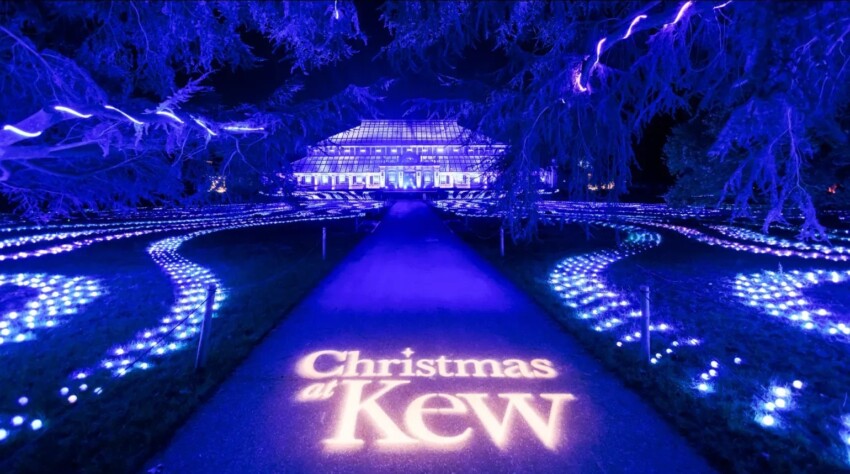
Throughout the year, Kew Gardens hosts a rich calendar of special events that enhance your visit.
The most famous is undoubtedly Christmas at Kew, an evening event that transforms the gardens into an enchanted realm of lights, illuminated installations and festive decorations. Typically running from mid-November to early January, this event requires a separate ticket from standard admission and places are limited, so advance booking is essential.
In spring, the Orchid Festival turns the Princess of Wales Conservatory into a spectacular display of orchids from around the world, with thousands of blooming specimens creating stunning themed arrangements. Usually held from February to March, this event is included with standard admission but requires booking a specific time slot.
During the warmer months, musical events such as “Sounds of Blossom” take place – an immersive experience created in collaboration with the Royal College of Music, where original compositions inspired by spring blossom resonate through the garden’s most beautiful spots. Summer also brings outdoor concerts and theatrical performances staged in the park’s natural settings.
Kew Gardens is easily accessible from central London by various public transport options.
The nearest Underground station is Kew Gardens, served by the District Line (green line) and London Overground. The station is just 500 metres from Victoria Gate, the gardens’ main entrance, a short 5-minute walk away. Kew Gardens falls within Zone 3 of London’s Underground fare system.
An alternative is Kew Bridge railway station, served by South Western Railway trains, approximately 800 metres from Elizabeth Gate. This option is particularly convenient if you’re travelling from other parts of London connected to the national rail network.
Several bus routes connect the gardens to various parts of the city: lines 65, 391, 237 and 267 stop at Victoria Gate and Lion Gate. During the summer months, you can also arrive by river using the Thames riverboat service from Westminster Pier, a scenic option that adds something special to your day.
The four entrances to the gardens are: Victoria Gate (main entrance near the Underground station), Elizabeth Gate (near Richmond station, convenient for Kew Palace and the Orangery Restaurant), Brentford Gate (near the car park, ideal for the Children’s Garden) and Lion Gate (on Kew Road, the quietest entrance with access to the Japanese Garden).
Do I need to book in advance?
Online booking is strongly recommended for several reasons: it guarantees queue-free entry, often offers slightly discounted rates, and during peak times may be the only way to secure admission. For special events such as Christmas at Kew and the Orchid Festival, booking is mandatory.
How long does it take to visit Kew Gardens?
A complete visit requires at least 5-6 hours. To see the main highlights, allow 3-4 hours. Many visitors choose to spend the entire day enjoying the gardens at a leisurely pace, taking breaks in the cafés and joining guided tours.
Can I bring food and have a picnic?
Yes, you’re welcome to bring food and picnic on the grassed areas of the gardens. Several quiet spots are ideal for outdoor eating. Barbecues and garden furniture are not permitted. Various refreshment facilities are available throughout the gardens: Victoria Terrace Café, Orangery Restaurant, Bianco Peaks Café and Pavilion Bar & Grill.
Are Kew Gardens accessible for disabled visitors?
Yes, most of the site is wheelchair accessible with level paths and lifts in some facilities such as the Treetop Walkway (when operational). Free Blue Badge parking is available at Ferry Lane car park. Some areas, such as the Temperate House balcony or the steps of the Great Pagoda, are not wheelchair accessible.
What is the climate like inside the glasshouses?
The tropical glasshouses such as the Palm House and certain areas of the Princess of Wales Conservatory maintain high temperatures (25-30°C) and high humidity. It’s advisable to dress in layers so you can adjust as you move between the glasshouses and outdoor spaces, especially in winter. Bring a water bottle with you.
Is Kew Gardens included in the London Pass?
Yes, admission to Kew Gardens is included in the London Pass, which gives access to over 80 London attractions. The pass is an excellent option if you plan to visit multiple attractions during your London stay. You still need to book a specific time slot for entry.
Are there special activities for children?
Yes, in addition to the Children’s Garden with trampolines, climbing structures and interactive activities, Kew Gardens offers educational trails, botanical treasure hunts and seasonal family workshops.
Can I visit Kew Gardens in bad weather?
Yes, the gardens are open in all weather conditions. Numerous glasshouses and covered structures allow you to enjoy the experience even in rain. However, some outdoor attractions such as the Treetop Walkway may be temporarily closed for safety reasons in high winds or extreme weather.
City Card allow you to save on public transport and / or on the entrances to the main tourist attractions.


 Hotel
Hotel  Budget accommodations
  Apartments
  Family Hotel
  Luxury Hotel