Bestseller
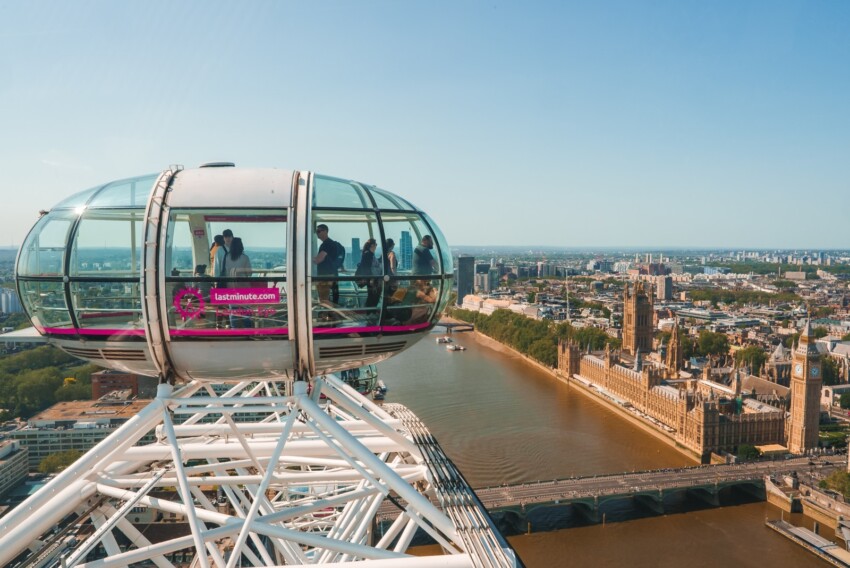
London: The London Eye Entry Ticket
From 33,21 €
Buy the ticket
Since its completion in 1999, the London Eye has become one of the most iconic symbols of the British capital. Situated on the south bank of the Thames, this impressive observation wheel offers a 360-degree view that stretches up to 40 km away on the clearest days. Standing at 135 metres tall, the London Eye has revolutionised London’s skyline, quickly becoming a landmark for both tourists and locals.
Originally conceived as a temporary structure to celebrate the millennium transition, the wheel became so popular that it was made permanent. Every year, more than 3.5 million visitors board its glass capsules to admire London from above. It’s worth noting that the London Eye is Europe’s most visited observation wheel and one of the most popular paid attractions in the United Kingdom.
Before boarding the London Eye, don’t miss the London Eye 4D Experience, which is included in your ticket price. It’s a short 4D film that offers a preview of your panoramic journey, enriched with special effects such as wind, mist and soap bubbles.
This experience lasts approximately 4 minutes and adds an interactive dimension to your visit. It’s particularly popular with children, but fascinates visitors of all ages thanks to its well-executed special effects and stunning aerial shots of London.
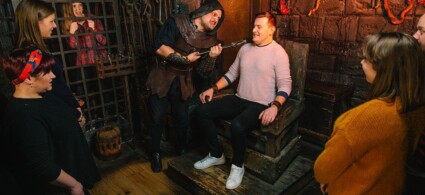
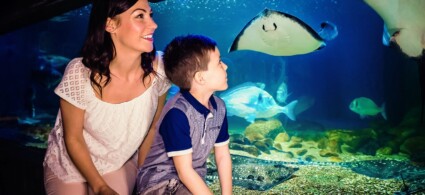
The 4D Experience is located within County Hall, the historic building adjacent to the London Eye, where you’ll also find other attractions such as the Sea Life London Aquarium and the London Dungeon, which could be combined into a single itinerary.
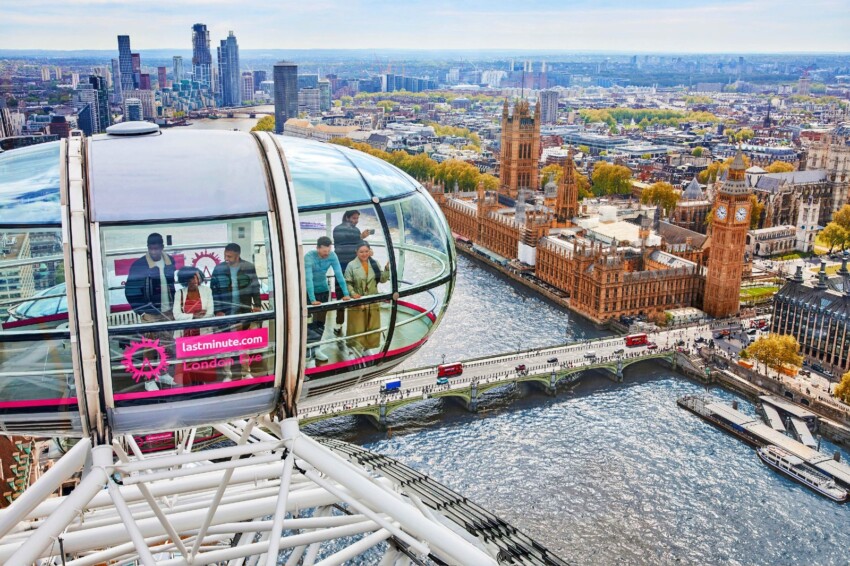
The London Eye’s 32 air-conditioned capsules are essentially rooms with a view. Made of glass, they offer an unobstructed view of the city. Each capsule can hold up to 25 people and completes a rotation in approximately 30 minutes. The capsules are numbered 1 to 33, but number 13 is missing out of respect for British superstition.
The interior is simple but functional, with a central bench that allows you to rest during the experience. Don’t worry about space: the capsules are spacious enough to allow you to move freely and admire the panorama from different angles.
The highlight is naturally the ever-changing view as the wheel rotates slowly. The experience is particularly spectacular when the capsule reaches its highest point, at 135 metres above sea level.
One of the most spectacular views the London Eye offers is that of the River Thames winding through the city. From this privileged vantage point, you can observe the vessels navigating the river’s waters, from traditional tourist boats to modern catamarans that serve as public transport.
The contrast between the dark waters of the Thames and the surrounding buildings creates a beautiful visual effect, especially at sunset when the sun reflects on the water’s surface. If you visit the London Eye on a clear day, you can follow the river’s course for kilometres, appreciating how it has shaped London’s urban development over the centuries.
The best moment to observe the Thames is when the capsule is at approximately mid-height, when you’ll have a perfect view both east and west, allowing you to appreciate the river’s natural curve as it winds through the city.
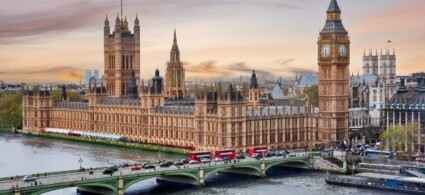
One of the most iconic views the London Eye offers is that of the Palace of Westminster and Big Ben. This perspective allows you to admire the palace’s neo-Gothic architecture in all its splendour, with its intricately carved towers and spires.
The parliamentary complex, designated a UNESCO World Heritage Site, appears particularly striking at sunset, when lights begin to illuminate and the building glows against the darkening sky.
It’s advisable to position yourself on the western side of the capsule as you ascend to capture the best possible view of these historic monuments.
From the London Eye, you can admire London’s ever-evolving skyline. The metropolis offers a fascinating contrast between historic buildings and contemporary architecture.
To the east, you can see the distinctive silhouette of The Shard, the EU’s tallest skyscraper (310 metres), designed by architect Renzo Piano. Nearby, you can spot the curved form of the Walkie-Talkie (20 Fenchurch Street) and the cucumber-shaped structure of 30 St Mary Axe, known as “The Gherkin”.
Looking north-west, you can admire the monumental buildings of Canary Wharf, the financial district that has become a city within a city. On particularly clear days, you can even spot Wembley Stadium on the horizon, recognisable by its distinctive arch.
London’s skyline is particularly striking at dusk, when buildings light up and the city transforms into a sea of lights.
From above, you can appreciate the numerous parks that dot the British capital, providing green spaces within the urban fabric. Just opposite the London Eye, on the opposite bank of the Thames, is Victoria Tower Gardens.
Looking north-west, you can see the vast St. James’s Park, with its distinctive lake, and beyond that, the imposing Hyde Park, one of the world’s largest city parks. These green spaces create a fascinating contrast with the concrete and glass of the surrounding buildings.
During spring and summer, these parks transform into patches of vivid colours, while autumn offers splendid shades of red, orange and gold. Even in winter, when the trees are bare, the sight of snow-covered parks can be particularly picturesque.
The London Eye, originally called the Millennium Wheel, was conceived by architect David Marks and his partner Julia Barfield as part of the celebrations for the millennium transition. The couple entered a competition launched by the Sunday Times in 1993 to create a new symbol for London, and although the competition had no winner, they decided to pursue their project nonetheless.
The construction of this impressive structure was not without challenges. The wheel’s components were manufactured in the Netherlands and transported on the Thames by barges. The final assembly, which took place horizontally on the river’s banks, was a remarkable engineering feat. The lifting of the structure from the horizontal to the vertical position, which occurred in September 1999, took days of work and represented one of the most complex engineering interventions ever undertaken in London.
The London Eye was originally intended to remain in operation for just five years, but its incredible popularity convinced authorities to keep it as a permanent attraction. Over the years, it has had several sponsors: originally called “British Airways London Eye”, it later became “Merlin Entertainments London Eye”, subsequently “EDF Energy London Eye” and from January 2015 to 2020 was known as “Coca-Cola London Eye”, following a sponsorship agreement.
In 2006, the structure underwent major maintenance, during which the original capsules were replaced with more modern and comfortable ones. Since then, the London Eye has been continuously improved with the addition of cutting-edge technologies that have made the experience increasingly engaging for visitors.
In 2020, on the occasion of its twentieth anniversary, the London Eye was illuminated with spectacular light displays that celebrated its lasting impact on London’s skyline and its importance as a world-class tourist attraction. From 2020 onwards, the London Eye’s sponsor has been Lastminute.com.
To visit the London Eye, various ticket types are available to suit the needs of every visitor. In any case, we recommend that you book online in advance both to select your preferred visiting time, avoiding potential disappointment in case of sold-out, and because prices at the ticket office are generally around 10-15% higher.
Family packages are also available, offering significant savings for groups of 2 adults and 2 children.
Please also note that the London Eye is included in the London Pass, the tourist card that allows entry to numerous attractions in the city with a single purchase.
In addition to the standard visit, the London Eye offers several premium experiences for those seeking a more exclusive outing. The Champagne Experience allows you to enjoy a glass of Laurent-Perrier champagne during your panoramic ride, adding a touch of elegance to your visit.
For special occasions, you can book a Private Pod, having the entire capsule at your disposal for up to 25 people. This option is particularly popular for marriage proposals, anniversary celebrations or corporate events.
The VIP Experience includes priority access, a champagne tasting and the assistance of a personal guide who will provide detailed information about the points of interest visible during your rotation.
For a truly special experience, consider the London Eye River Cruise, which combines a spin on the observation wheel with a Thames river cruise, offering different perspectives of the city.
The London Eye is open every day of the year, with the exception of Christmas Day (25 December) and some days in January, when annual maintenance is carried out. Opening hours vary depending on the season:
During holiday periods such as Easter, Christmas (pre- and post-Christmas period) and school holidays, hours are extended. It’s always advisable to check the updated opening times on the official website before your visit, as they may vary based on special events or weather conditions.
In case of extreme weather conditions, such as high winds or storms, the London Eye may be temporarily closed for safety reasons.
A complete rotation of the London Eye takes approximately 30 minutes. However, you should also factor in the time needed for access, especially during peak periods. During peak tourist season (summer, school holidays and festive periods), you may have to queue for up to an hour with a standard ticket.
To make the most of your visit:
As for visibility, clear days naturally offer the best views, but evenings are also particularly striking, when you can admire the city lights. Sunsets create a magical atmosphere, making this time ideal for memorable photographs.
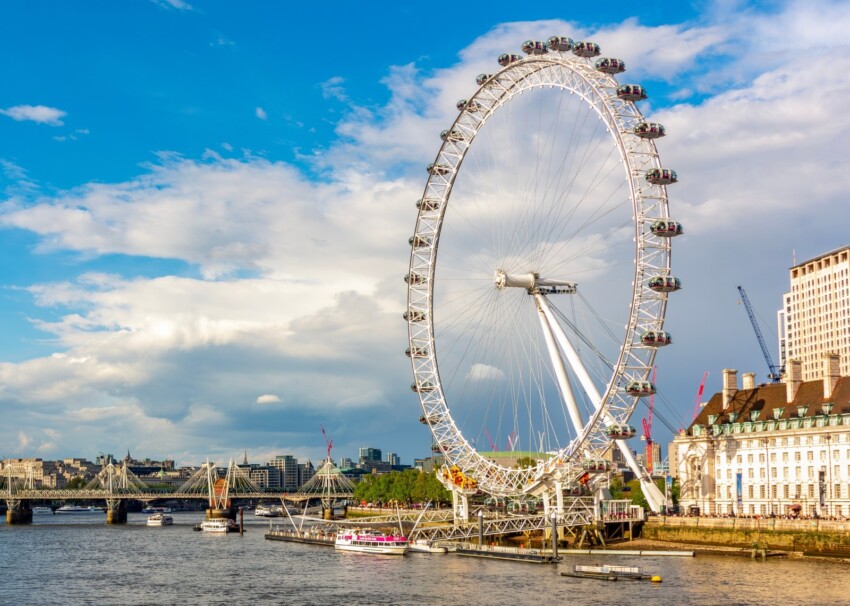
The London Eye is located on the south bank of the Thames, in the heart of London, and is easily accessible by various modes of transport.
The nearest London Underground station is Waterloo. From here, the London Eye is accessible with a walk of approximately 5 minutes following the signs. An alternative is Westminster station, situated on the opposite bank of the Thames. From here, cross Westminster Bridge and within approximately 10 minutes’ walk you will reach the attraction.
Numerous bus routes stop near the London Eye. Routes 77, 211 and 381 stop directly on Westminster Bridge Road. Routes 12, 53, 148 and 159 stop on Waterloo Road, a short distance from the attraction.
Yes, it’s highly recommended. During peak season and weekends, the London Eye can reach full capacity. Booking online not only saves you money (around 10-15% compared to ticket office prices) but also valuable time by avoiding long queues. Plus, you can select a specific time slot for your visit and won’t risk sold-out tickets.
The London Eye operates even in light rain, still offering a spectacular panoramic experience. However, in cases of extreme weather conditions such as strong winds, storms or thick fog, the attraction may be temporarily closed for safety reasons. If your visit is cancelled due to bad weather, you can generally reschedule for another day or request a refund.
Yes, the London Eye is fully accessible to visitors with disabilities. The capsules can accommodate wheelchairs and the entire structure is designed to be accessible. Visitors with disabilities and a companion can benefit from reduced rates, and in some cases the companion can enter free of charge. It’s advisable to contact customer service in advance to arrange your visit accordingly.
Yes, you’re allowed to bring food and non-alcoholic beverages inside the capsules. However, alcoholic drinks are not permitted unless they’re part of a premium experience such as the Champagne Experience. Various refreshment facilities are available within the London Eye complex where you can purchase snacks and beverages before or after your visit.
A full rotation of the London Eye takes approximately 30 minutes. However, you should allow at least 1-2 hours for the entire experience, taking into account queuing time, the London Eye 4D Experience (included with your ticket) and time to explore the surrounding area after your visit.
For safety reasons, large luggage cannot be brought on board the capsules. All baggage is subject to security checks before entry. Left luggage facilities are not available at the London Eye, but you’ll find baggage storage services at nearby Waterloo and Charing Cross stations.
Children under 3 years old enter free of charge but still require a ticket. Children aged 3 to 15 benefit from reduced rates. All minors must be accompanied by an adult (minimum age 18 years). Special family rates are available, offering significant savings compared to purchasing individual tickets.
Absolutely yes! Photography is not only permitted but encouraged during your visit. There are no restrictions on using cameras or smartphones for personal use. Professional photographers wishing to use specialist equipment (such as tripods) may need prior authorisation.
Yes, the London Eye is included in the London Pass, one of the main city cards offering access to numerous London attractions. However, please note that with the London Pass you may need to book a specific time slot, especially during peak season periods.
City Card allow you to save on public transport and / or on the entrances to the main tourist attractions.
 Hotel
Hotel  Budget accommodations
  Apartments
  Family Hotel
  Luxury Hotel