Bestseller
London Transport Museum Entrance Ticket
From 30,96 €
Buy the ticket
The London Transport Museum is an essential stop for understanding the profound relationship between London’s development and its celebrated public transport system.
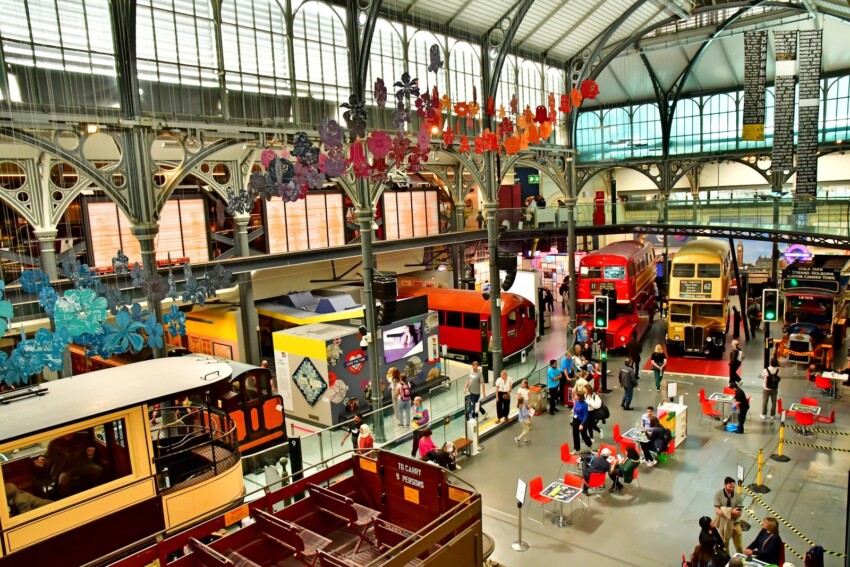
Located in the heart of Covent Garden, housed within the historic Victorian building that once accommodated the flower market, this museum holds over 450,000 objects that tell more than 200 years of London transport history. The collection spans from the earliest horse-drawn omnibuses to the iconic red double-decker buses, from the steam locomotives of the world’s first underground railway to modern electric trains.
The exhibition route allows you to board authentic historic vehicles, experience driving simulators for the Northern Line, and admire the extraordinary collection of advertising posters that made London transport aesthetics famous. Since 2015, the museum has expanded its offerings with the award-winning Hidden London tours, which take visitors to disused stations, abandoned platforms, and Second World War air-raid shelters, normally closed to the public.
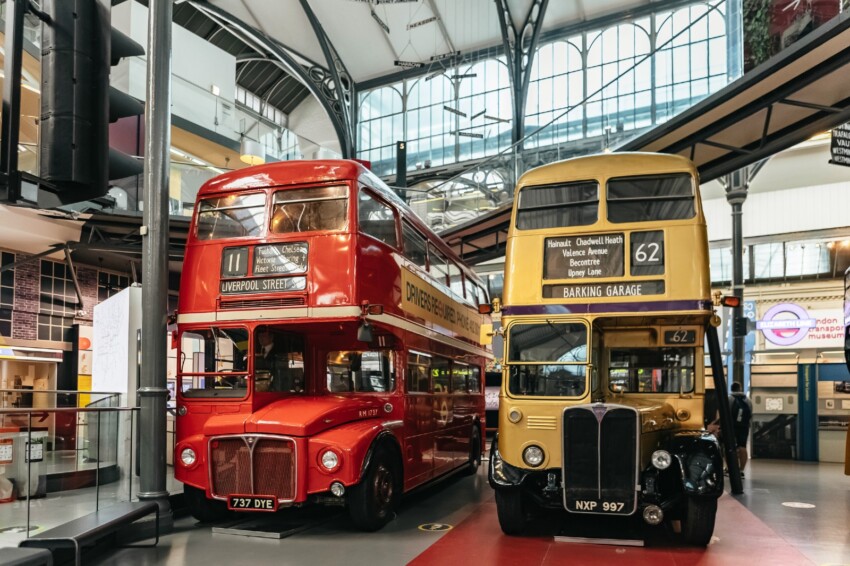
The museum’s route opens with an extraordinary display of beautifully preserved period vehicles. Among the most significant pieces is the only surviving steam locomotive from the 1860s, used on the Metropolitan Railway, the world’s first underground railway line. This giant engine bears witness to the extreme conditions in which the first underground trains operated, with exceptionally high temperatures and air saturated with smoke in the tunnels.
The collection continues with a complete series of London buses, from the first motorised models of 1910 to the contemporary Routemaster. Particularly significant is the Type B bus, extensively used during the First World War not only as a civilian transport vehicle but also as a military vehicle on the Western Front. Visitors can board many of the vehicles, sit in the original seats, and directly experience how Londoners travelled in different historical periods.
The London Transport Museum stands out for its strongly interactive exhibition approach. The All Aboard Playzone, designed for children up to 7 years old, features mini-vehicles, costumes, and play activities that allow young children to familiarise themselves with London transport through play. The Future Engineers Gallery, meanwhile, invites visitors of all ages to test themselves on an Elizabeth line driving simulator, experiencing the responsibilities and skills needed to operate a modern train.
Particularly popular is the Northern Line simulator, where you can virtually drive a train through tunnels and stations, following timetables and safety procedures. These hands-on experiences make the visit engaging even for those without a particular interest in transport history, transforming the museum into an educational and entertaining experience for the whole family.
One of the most fascinating sections of the museum is the Global Poster Gallery, which opened in 2024, and houses one of the world’s most important collections of twentieth-century graphic art, with approximately 1,000 original works and over 30,000 posters. The collection has been recognised as Designated Outstanding by Arts Council England, certifying its exceptional artistic and historical value.
Among the museum’s treasures is the original drawing by Harry Beck for the London Underground map, created in 1931. This extraordinary document represents a revolution in information design: Beck abandoned geographically accurate representation in favour of a simplified topological scheme, inspired by electrical diagrams, which immediately clarified the connections between lines.
Beck’s brilliant insight of representing lines as straight segments angled only at 45° or 90°, and spacing stations uniformly regardless of their actual distance, created a model followed by underground systems worldwide. Seeing the original drawing allows you to appreciate the minimalist elegance of this design that continues, with minor modifications, to guide millions of travellers every day.
A particularly moving section of the museum is dedicated to the contribution of the Caribbean workforce to London’s transport system. After the Second World War, thousands of citizens from the Caribbean, particularly from Jamaica, Trinidad, and Barbados, arrived in the United Kingdom to address a severe labour shortage.
The “Legacies” exhibition tells their stories through photographs, interviews, and personal objects, illustrating not only their professional roles as drivers, train operators, and conductors, but also the cultural impact they had on London society. The exhibition also addresses the difficulties they encountered, from discrimination to precarious living conditions, offering an honest and necessary perspective on a crucial chapter of post-war British history.
The museum devotes considerable space to the evolution of station design, with particular attention to the work of architect Charles Holden. In the 1920s and 1930s, Holden designed over 50 stations for the Underground, introducing a clean, functional modernist style that still characterises many stations on the network today. His art deco architectures, with innovative use of brick, glass, and concrete, transformed stations into architectural landmarks.
The exhibition includes period photographs, design drawings, and reconstructed sections illustrating how elements such as the famous roundel (the red and blue circular logo) and Johnston typeface became integral to London’s visual identity. Particular attention is given to 55 Broadway, London’s first skyscraper and the Underground’s headquarters, designed by Holden in 1929.
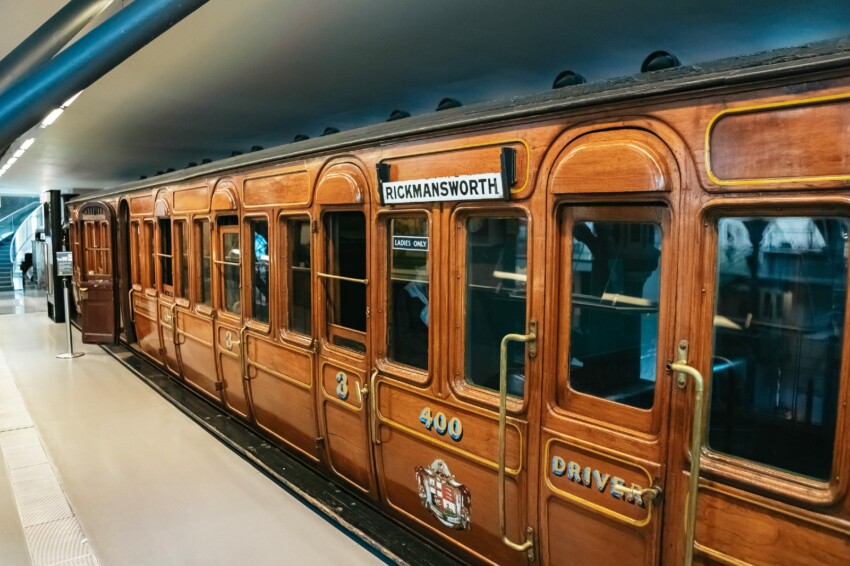
Among the museum’s most curious artefacts is a railway carriage from the 1890s nicknamed the “Padded Cell”. This vehicle, used on the early lines of the Metropolitan Railway, was characterised by seats upholstered in quilted fabric that resembled the cells of Victorian asylums, hence the unofficial name.
The carriage bears witness to the travel conditions of the late nineteenth century, when steam-powered underground trains made the air in tunnels unbreathable. The padded seats and heavy upholstery also served to dampen the noise and vibrations of the journey, which were extremely violent by modern standards. You can enter the carriage and directly experience the cramped spaces and suffocating atmosphere that passengers had to endure daily.
Online booking is strongly recommended: in addition to guaranteeing entry at your preferred time slot, it saves £1.50 compared to on-site purchase. The ticket includes access to all permanent galleries and temporary exhibitions, plus a 15% discount in the museum shop.
The celebrated Hidden London tours offer a unique experience that goes far beyond the standard museum visit. These guided tours, lasting 90-120 minutes, take visitors to disused stations, abandoned platforms, and air-raid shelters normally inaccessible to the public.
Among the available tours, particularly evocative is Aldwych: The End of the Line, which explores the station closed in 1994 and used as a shelter during Second World War bombing. The Charing Cross: Behind the Silver Screen tour allows you to visit the disused Jubilee line platforms, used as a film set for productions such as Skyfall, Sherlock, and Paddington.
Hidden London tours are open to children from age 10 upwards (previously the minimum age was 14 years), significantly broadening access to the experience. Young people between 10 and 16 must be accompanied by an adult. The tour ticket includes 50% discounted entry to the main museum within one month of the tour date and a 10% discount in the shop.
The Museum Depot in Acton, situated west of London and accessible via the Piccadilly Line, houses most of the 320,000 objects from the collection that don’t fit in the Covent Garden exhibition. This vast 6,000 square-metre warehouse holds large vehicles, historic signage, scale models, uniforms, and lost property accumulated over the decades.
The Depot is accessible through guided visits by reservation and during three open-weekend weekends per year.
Throughout the year, the London Transport Museum hosts free classical and jazz music concerts performed by young London talent. These events, held among the historic vehicles and creating a unique atmosphere, are included with your admission ticket and offer an original way to experience the museum space. Concerts typically take place at weekends and last approximately 45-60 minutes.
The museum is located in the heart of Covent Garden.
By Underground, the nearest station is Covent Garden on the Piccadilly Line, just 2 minutes’ walk from the museum entrance. Alternatively, Leicester Square (Piccadilly and Northern Lines) is 4 minutes away, Holborn (Central and Piccadilly Lines) 5 minutes away, Charing Cross (Bakerloo and Northern Lines) 7 minutes away, and Embankment (Circle, District, Bakerloo, and Northern Lines) 8 minutes away. Covent Garden station is particularly busy and has stairs only (no lifts or escalators to the exit), so visitors with mobility issues should use one of the alternative stations.
Numerous bus lines serve the Covent Garden area, with stops at Strand or Aldwych. The most useful routes are RV1, 9, 11, 13, 15, 23, and 139.
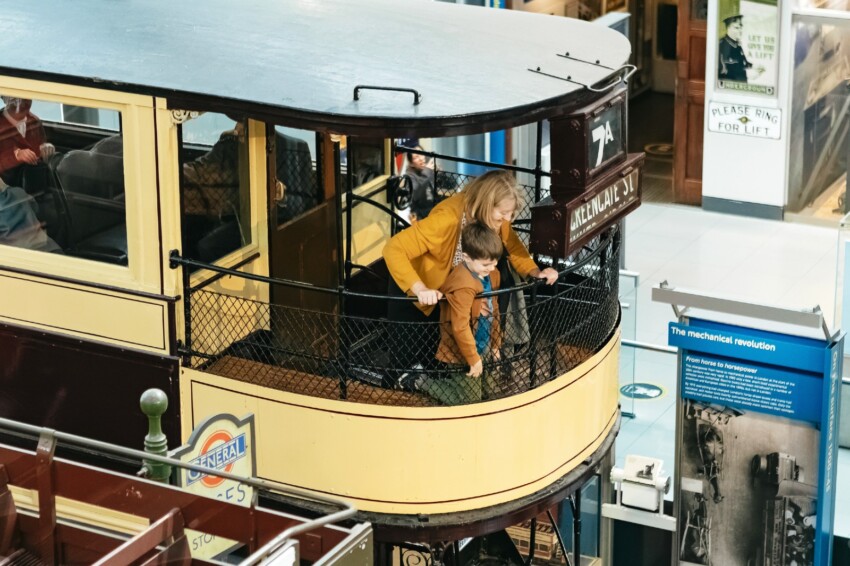
Absolutely. The London Transport Museum is particularly family-friendly, featuring the All Aboard Playzone dedicated to children aged 0-7, interactive simulators for all ages, and the opportunity to board real vehicles. Children under 17 enter free. The museum has changing facilities, nursing areas, and offers pram storage (personal pushchairs are not permitted in the exhibition galleries, but free storage is available).
A full visit requires between 2 and 4 hours. Those visiting with young children who want to experience all the interactive areas should allow at least 3 hours. Transport history enthusiasts might spend considerably more time, especially if participating in one of the free guided tours or attending a concert. The museum has two cafés where you can take a break.
Personal photography is generally permitted throughout the museum. However, tripods and selfie sticks are prohibited for safety reasons and to avoid obstructing other visitors. Some temporary exhibitions may have specific restrictions, which are signposted at the entrance to the area. Professional video recording requires prior authorisation.
The museum is fully wheelchair accessible, with lifts connecting all floors. Free wheelchairs are available on request, and personal assistants of disabled visitors enter free. However, some historic vehicles are not wheelchair accessible due to their historical nature (narrow steps, cramped corridors).
City Card allow you to save on public transport and / or on the entrances to the main tourist attractions.

 Hotel
Hotel  Budget accommodations
  Apartments
  Family Hotel
  Luxury Hotel