Bestseller
Royal Observatory Greenwich & Prime Meridian Entrance Ticket
From 27,54 €
Buy the ticket
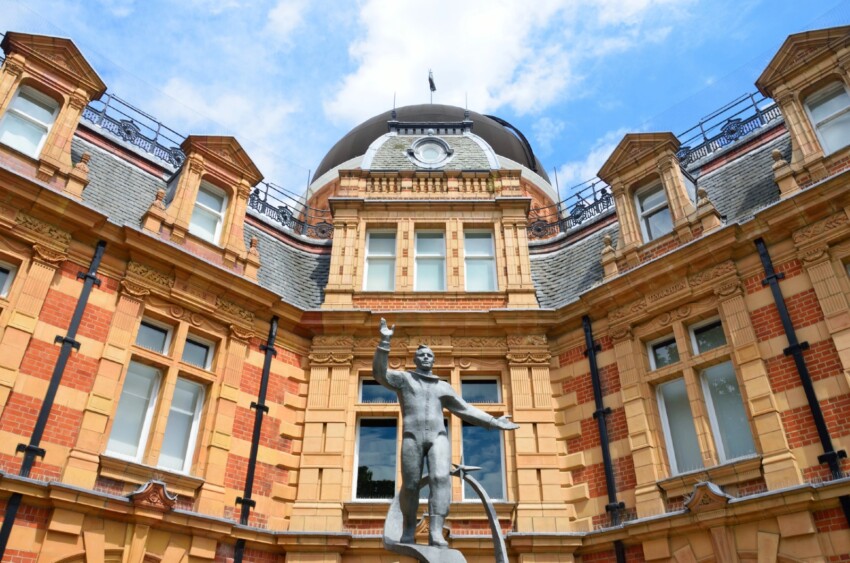
Crossing the Prime Meridian with one foot in the Eastern Hemisphere and the other in the Western Hemisphere is not an experience that happens often in a lifetime. The Royal Observatory at Greenwich offers precisely this unique opportunity, along with a fascinating journey through the history of astronomy and maritime navigation. Perched on the hill of Greenwich Park, the observatory is not merely a museum, but the place where time itself finds its universal definition.
Founded in 1675 by King Charles II with the practical aim of solving the longitude problem at sea, the Royal Observatory was Britain’s first state-funded scientific institution. It houses the marine chronometers of John Harrison, instruments that revolutionised ocean navigation, and from here passes the meridian that in 1884 was recognised as the Prime Meridian of the world by the International Meridian Conference.
A visit to the observatory allows you to witness centuries of scientific discovery firsthand: from the elegant Octagon Room designed by Christopher Wren, to the ancient telescopes that scanned the starlit skies, and the famous red Time Ball that has marked one o’clock in the afternoon with its daily drop since 1833. From the observatory’s terrace, moreover, you enjoy one of London’s most spectacular views, with the City silhouetted on the horizon beyond the bends of the Thames.

The architectural heart of the observatory is the magnificent Octagon Room, the eight-sided chamber located on the upper floor of Flamsteed House. This room represents a masterpiece of Wren’s design: its eight walls and tall windows were conceived specifically to provide astronomers with an uninterrupted view of the sky, whilst the high ceilings allowed for the installation of some of the most advanced timepieces of the era.
Two special clocks, made by Thomas Tompion at the commission of Jonas Moore, were installed in the room in 1676. These extraordinary instruments had pendulums 13 feet long (approximately 4 metres) mounted above the dial, with an oscillation period of 4 seconds that guaranteed unprecedented precision of 7 seconds per day. The driving weights were so heavy that the clocks could function for an entire year without needing to be rewound, minimising interruptions for maintenance.
Today the Octagon Room retains its original charm thanks to intricate wooden panelling and period decorations. From its windows one admires a spectacular view over Greenwich Park and the bends of the Thames, the same view that Flamsteed observed whilst conducting his pioneering research. The room also displays reproductions of the astronomical instruments used in the observatory’s early years, enabling visitors to understand the conditions in which the first Astronomers Royal worked.
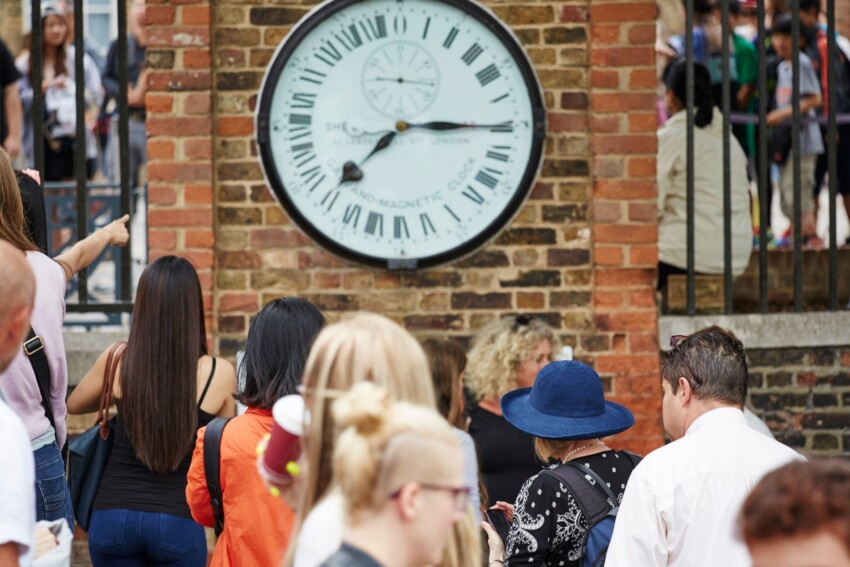
The celebrated Prime Meridian line – marked by a stripe of polished steel that crosses the observatory courtyard – represents the starting point for measuring global longitude: 0° longitude. Standing astride this line means finding yourself literally with one foot in the Eastern Hemisphere and the other in the Western, an irresistible photographic experience for millions of visitors each year.
But how did Greenwich come to be the centre of world time? The story begins in 1767, when the fifth Astronomer Royal Nevil Maskelyne began publishing the Nautical Almanac, based on observations conducted at the observatory. This almanac, updated annually, became an essential tool for navigators around the world. By the 1880s, nearly two-thirds of the world’s ships used nautical charts based on the Greenwich meridian.
When the International Meridian Conference was held in Washington in 1884 to establish a prime meridian for the world, the choice naturally fell on Greenwich. On 13 October 1884, 41 delegates from 25 countries determined that the meridian passing through the Royal Observatory at Greenwich would become the fundamental meridian, thereby also defining Greenwich Mean Time (GMT) as the global time standard. This decision placed Greenwich literally at the centre of the world’s time measurement system, giving rise to the time zones we still use today.
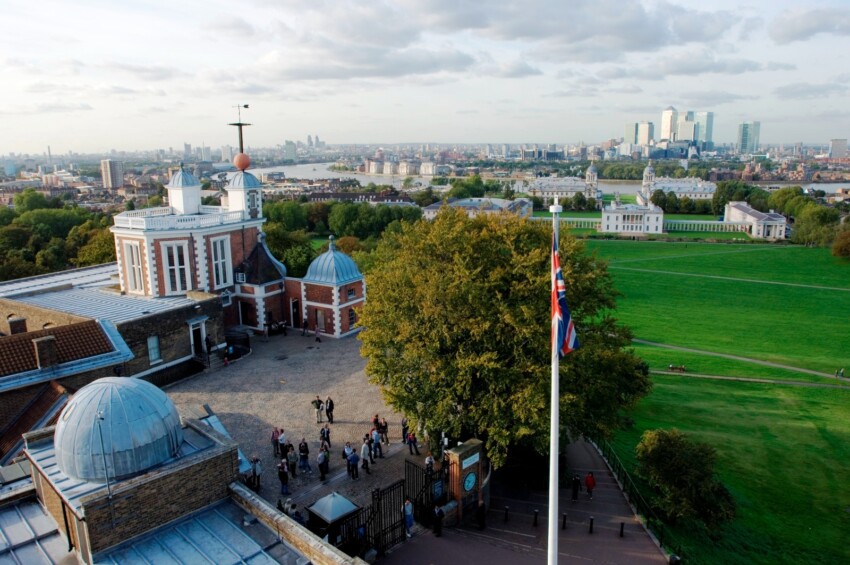
One of the most fascinating features of the Royal Observatory is the large red Time Ball mounted on the roof of Flamsteed House. Installed in 1833 by Astronomer Royal John Pond, this sphere represents one of the world’s first public time signals, and continues to function to this day after nearly two centuries.
The mechanism is simple but ingenious: every day at 12:55, the red ball rises halfway up its mast. At 12:58, it reaches the top. Exactly at 13:00 (one o’clock in the afternoon), the sphere drops suddenly, providing a precise visual signal to anyone watching. The original purpose was to allow the captains of ships moored on the Thames to synchronise their chronometers – instruments vital for navigation – before setting sail on long ocean voyages.
The choice of one o’clock in the afternoon rather than noon was not by chance: at midday the observatory’s astronomers were occupied recording the exact moment when the Sun crossed the meridian. The Time Ball was built by Maudslay, Son & Field and quickly became so popular that petitions arose to install others in port cities such as Southampton. From 1852, the Time Ball signal was also distributed via telegraph to railway stations and buildings across London.
Witnessing the drop of the Time Ball today is an experience that connects visitors to centuries of maritime history. The mechanism, although updated with modern electronics, maintains its historic function intact. It is worth noting that on particularly windy days or in icy conditions, the ball is not dropped for safety reasons – a problem that afflicted Victorian sailors as well.
One of the Royal Observatory‘s most precious collections is that of John Harrison‘s four marine chronometers – H1, H2, H3 and H4 – all displayed together in a dedicated room to his work. These instruments collectively represent one of the greatest triumphs in the history of British science and engineering, as they finally solved the “longitude problem” that had caused countless shipwrecks and loss of life.
In 1714, following the disastrous wreck of a Royal Navy fleet off the Isles of Scilly in 1707 (which caused over 1,000 deaths), the British Parliament passed the Longitude Act, offering a prize of £20,000 (equivalent to over £3 million today) to anyone who found a reliable method for determining longitude at sea. John Harrison, a self-taught joiner and watchmaker from Yorkshire, devoted over thirty years of his life to this challenge.
The first chronometer, H1, was built between 1728 and 1735. Standing 63 centimetres tall and weighing 34 kilograms, it was spring-driven and fitted with an ingenious system of springs and shock absorbers that made it immune to ship’s motion. H2 and H3 followed, each with progressive technical improvements. But it was the H4, completed in 1759, that proved revolutionary. With a diameter of just 13 centimetres and weighing 1.45 kilograms, it resembled an oversized pocket watch more than its bulky predecessors.
In 1761, the H4 was subjected to the decisive test during a voyage to Jamaica aboard HMS Deptford. During 81 days at sea, it lost only 5 seconds compared to Greenwich time – extraordinary precision that ensured longitude determination with an error of less than half a degree. Despite this success, Harrison had to struggle with the Board of Longitude for years before receiving the recognition and prize he deserved. Only the personal intervention of King George III in 1772 finally allowed Harrison to receive justice, albeit technically in the form of a “generous gift” from Parliament rather than as an official award.
Remarkably, three of Harrison’s chronometers (H1, H2 and H3) still function to this day, thanks to the restoration work of Commander Rupert Gould in the early twentieth century. To observe these magnificent instruments in working order is an experience no horology or history of science enthusiast should miss.
Another iconic symbol of the Royal Observatory is the Great Equatorial Telescope, recognisable by its distinctive “onion” dome that bulges beyond the diameter of the turret beneath it. This refractor telescope, installed in the 1890s, has an aperture of 28 inches (71 centimetres) and was built by Howard Grubb. At the time of its installation, it was one of the most powerful astronomical instruments in the world.
The telescope’s dome can rotate 360 degrees to follow celestial objects in their apparent motion across the sky, whilst the telescope itself is mounted on an equatorial support that allows it to compensate for the Earth’s rotation with a simple movement around a single axis. This ingenious mechanical configuration, devoid of electronics yet incredibly precise, bears witness to the skill of Victorian craftsmen.
To visit the Royal Observatory at Greenwich you will need a ticket which we recommend you purchase online in advance, not only to save time by avoiding queues at the ticket office, but also to guarantee access during peak periods.
For those wishing to visit other attractions in the Greenwich complex, the Royal Museums Greenwich Day Pass represents an excellent option. This combined ticket includes entry to the observatory, the celebrated sailing ship Cutty Sark, the Queen’s House and the National Maritime Museum (which is free of charge anyway). The pass allows you to explore Greenwich’s entire maritime and astronomical heritage in a single day.
The London Pass includes entry to the Royal Observatory, making it a convenient option for those visiting London and intending to see numerous attractions.
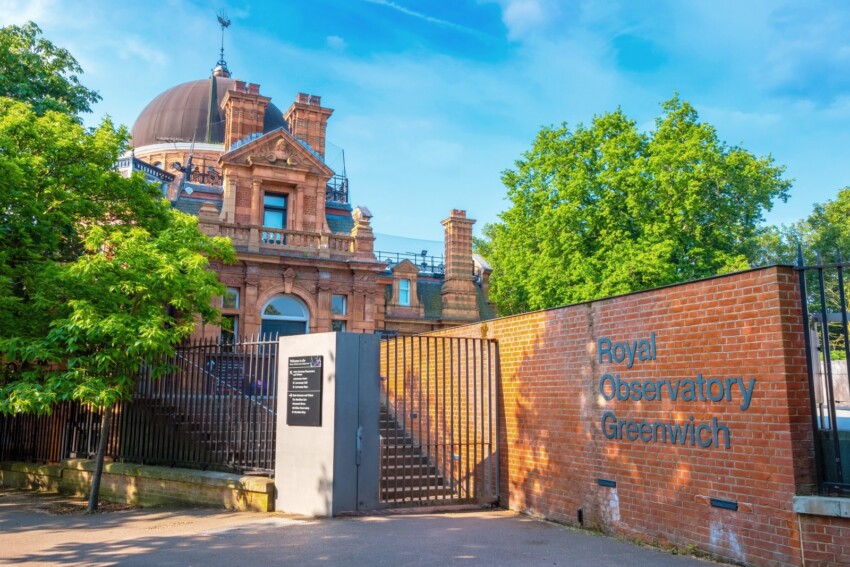
The Royal Observatory is located within Greenwich Park, on the hill that overlooks the Greenwich neighbourhood in south-east London. The elevated position offers spectacular views but means you must tackle a fairly steep climb to reach the main entrance.
The nearest station is Greenwich, served by the DLR (Docklands Light Railway) and Southeastern and Thameslink trains. From the station, the observatory is approximately 15–20 minutes’ walk through the park. The main route, known as Castle Hill, is very steep and includes steps, so it is not suitable for everyone. For easier access, you can enter the park via Blackheath Gate, which offers a level route, or take Blackheath Avenue, a longer but far gentler climb.
Various bus lines serve Greenwich: lines 129, 177, 180, 188, 199 and 386 stop near the park. The DLR station at Cutty Sark is also within easy walking distance.
A particularly scenic way to reach Greenwich is by river: numerous ferry companies offer regular services along the Thames from piers such as Westminster, Tower and Greenwich Pier. A Thames river cruise allows you to admire London’s principal landmarks from a unique perspective before arriving at your destination.
Whilst not compulsory, purchasing tickets online in advance is strongly recommended for several reasons. During peak season and weekends, queues at the ticket office can be lengthy, and if capacity is reached, there may be delays to entry. Online tickets guarantee access during your chosen time slot and often offer a small discount compared to on-the-gate prices.
The Prime Meridian line continues beyond the observatory grounds, along the public pathways through Greenwich Park, so you can photograph yourself on the line without purchasing a ticket. However, this is merely a continuation of the main line. The complete experience – which includes standing on the original line in the observatory courtyard, viewing Harrison’s chronometers, exploring the historic galleries and enjoying the vista from the terrace – requires paid admission and is well worth the cost.
A thorough visit to the Royal Observatory takes approximately 2–3 hours. If you’d like to combine your visit with nearby attractions such as the National Maritime Museum and the Cutty Sark, plan to spend at least half a day in Greenwich, or ideally a full day.
Absolutely. The Royal Observatory offers numerous interactive activities designed specifically for young visitors. Standing astride the Prime Meridian is always a magical moment for children, as is touching an ancient asteroid fragment billions of years old. Audio guides are available in a simplified English version, ideal for children and those learning the language.
The Royal Observatory remains open in all weather conditions. Most of the exhibitions are indoors, so rain or cold won’t spoil your visit. However, some outdoor exhibits and the panoramic views are naturally more enjoyable in fine weather. The Time Ball may not operate in very strong winds or icy conditions for safety reasons. If visibility is poor, the famous views across London will be limited, so if possible, choose a clear day.
City Card allow you to save on public transport and / or on the entrances to the main tourist attractions.



 Hotel
Hotel  Budget accommodations
  Apartments
  Family Hotel
  Luxury Hotel