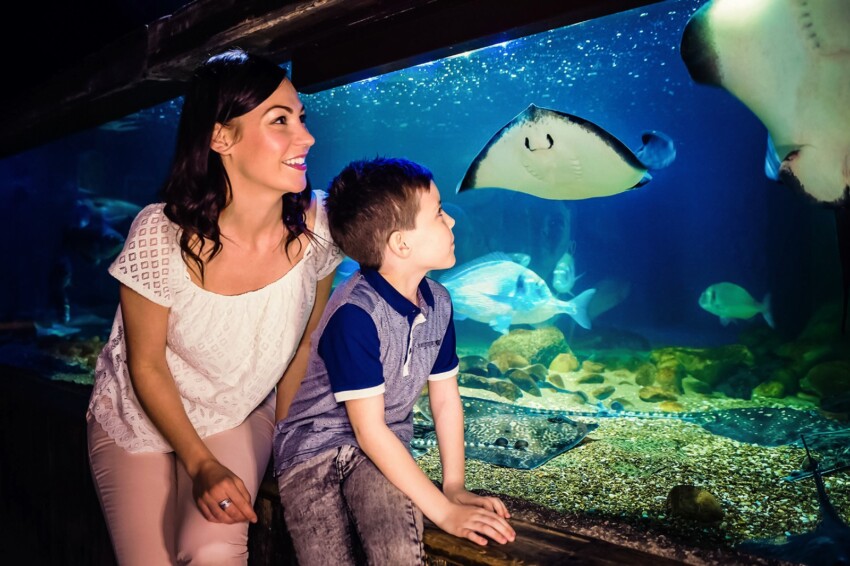
Bestseller
London: SEA LIFE Entry Ticket
From 32,13 €
Buy the ticket
In the heart of London, just a short walk from the London Eye and the iconic Big Ben, lies one of Europe’s most extraordinary aquariums. The SEA LIFE London Aquarium is far more than a collection of tanks: it’s a journey through the world’s oceans, from tropical coral reefs to the frigid waters of Antarctica, from the depths of the Pacific to the Amazon rainforest.
Opened in March 1997 within the historic County Hall, the aquarium welcomes over one million visitors annually. With more than 500 marine species distributed across 14 themed zones spanning three floors, this attraction represents one of the UK’s leading centres for marine wildlife conservation and management. Since 2009 it has been part of the SEA LIFE chain, operated by Merlin Entertainments.
What sets SEA LIFE London apart from most aquariums is its immersive approach: here you don’t simply observe through glass, but literally walk beneath the ocean through underwater tunnels, watch sharks swim in tanks with transparent floors beneath your feet, and touch starfish and sea anemones in interactive rockpools.
A typical visit lasts around two hours, though time flies between feeding sessions, marine biologist talks and discovering creatures many see alive for the first time.
Your experience at SEA LIFE London Aquarium begins with a lift taking you to the lower level, where the Shark Walk awaits—one of the most thrilling attractions in the entire route. This glass-floored walkway lets you literally walk above the Pacific tank whilst zebra sharks, blacktip reef sharks and other predatory species swim beneath your feet. The tank spans three floors and holds approximately one million litres of water.
The Coral Kingdom is home to the UK’s largest living coral reef, a 40-foot installation that faithfully recreates a tropical reef ecosystem. Passing through the shallow mangrove waters, you’ll observe the transition from day to night—a scenic effect that highlights how different species behave depending on light levels.
Swimming among the hard and soft corals are clownfish (the iconic Nemo), royal tangs displaying electric blue colours, cardinalfish and dozens of other tropical species. The zone is designed not just to amaze visually, but to educate: information panels explain the importance of coral reefs to marine ecosystems and the threats they face from climate change and pollution. For younger children there’s the Clownfish Challenge, an interactive trail inviting them to move like clownfish between the corals.
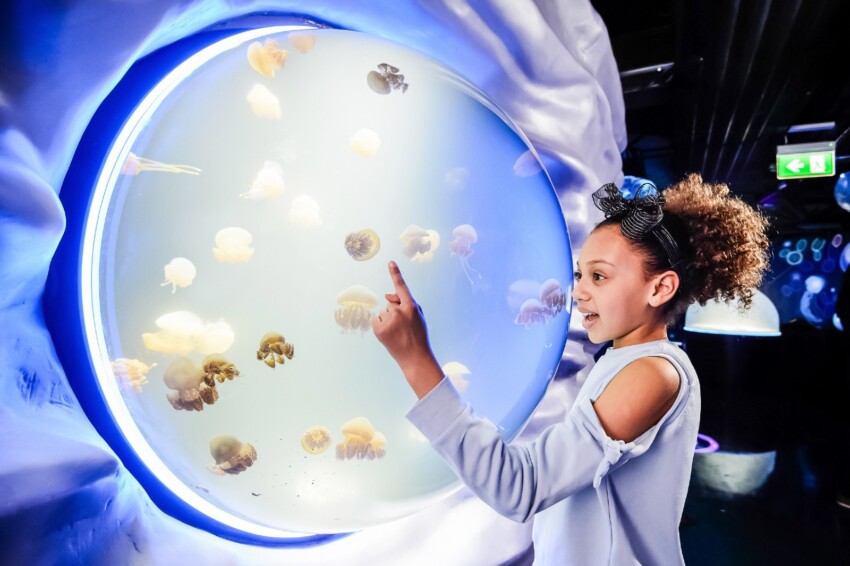
Ocean Invaders features the UK’s largest jellyfish exhibition, divided into three interactive zones exploring the evolution, biology and behaviour of these ancient organisms. Back-lit tanks create an almost hypnotic atmosphere, whilst flame jellyfish, Japanese sea nettles and moon jellyfish dance through the water with elegant, flowing movements.
This section tackles complex scientific topics in an accessible way: why are jellyfish proliferating in today’s oceans? How have they adapted to survive for over 500 million years? What roles do they play in marine ecosystems? Jellyfish life cycles are made visible through tanks dedicated to different developmental stages, offering a thorough understanding of these fascinating invertebrates.
The Rainforest Adventure transports visitors to the Amazon rainforest, a humid, lush habitat where aquatic and terrestrial species coexist. The experience is presented by explorer Ben Fogle, who guides visitors virtually through this complex ecosystem struck by a tropical storm.
Here you’ll encounter red-bellied piranhas, the largest collection of these predatory fish in the UK, and observe the African dwarf crocodile up close—the world’s smallest crocodile species, reaching a maximum of just 1.5 metres in length. There are also tarantulas, snakes and other reptiles contributing to the Amazon jungle atmosphere. The section also features Bowsa, an impressive snapping turtle remarkable for its size and longevity.
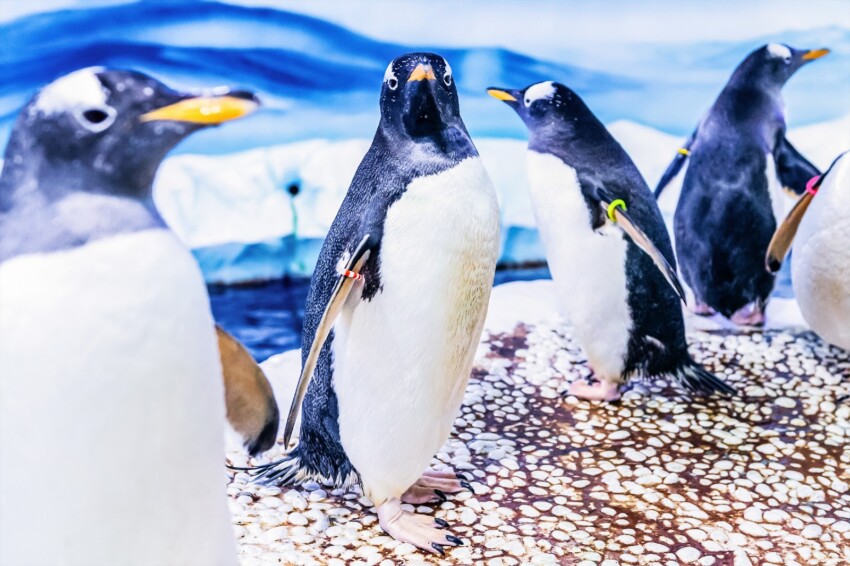
The Polar Adventure recreates the Antarctic environment and is home to a vibrant colony of Gentoo penguins, which arrived in 2011 from Edinburgh Zoo. These penguins, known for being the fastest swimmers among all species (reaching 36 km/h underwater), put on an irresistible spectacle as they dive, swim and interact with one another.
The habitat was designed with specialist veterinary consultation to ensure the animals’ welfare, balancing aquatic and terrestrial areas that allow penguins to express their natural behaviours. In 2014 the aquarium’s first Gentoo penguin chick was born, named Elsa, weighing just 90 grammes at hatching. The birth represented an important success for SEA LIFE’s conservation programme.
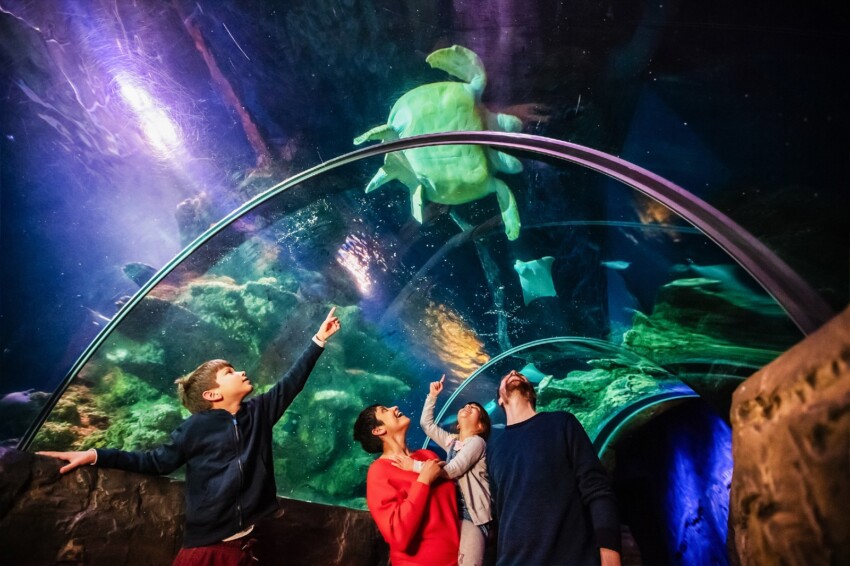
The Open Ocean is perhaps the most spectacular zone in the entire aquarium: a glass tunnel letting you literally walk along the ocean floor whilst marine life flows above and around you. Southern rays patrol the sandy seabed, eagle rays dance overhead, and hundreds of colourful tropical fish swim in coordinated schools.
Centrepiece is a reconstructed skeleton of a grey whale, through whose ribcage swim purple tangs, triggerfish and snappers. The effect is extraordinarily immersive: for a few moments you forget you’re in central London and genuinely feel you’re walking on the seabed. It’s not uncommon to spot the majestic green sea turtles as well, gliding slowly above visitors with elegant, seemingly effortless movements.
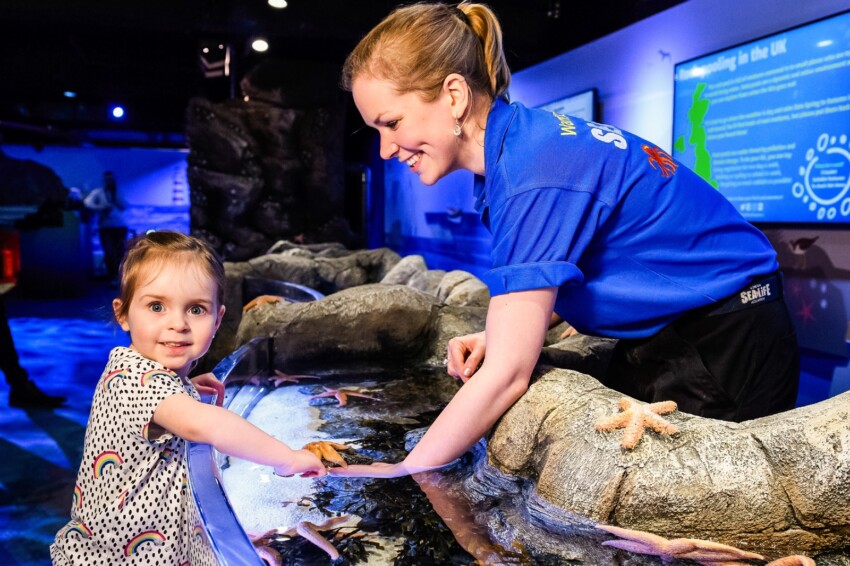
The Rockpool Explorer is designed specifically for younger children and offers interactive rockpools where you can touch starfish, sea anemones and even feel a crab’s shell, always under aquarium staff supervision.
This zone faithfully recreates the environment of British rockpools—those small natural pools forming along rocky coasts when the tide recedes. It’s an opportunity to discover what lies hidden in local waters and understand that you needn’t fly to the tropics to find fascinating creatures: simply look carefully closer to home.
The Ray Lagoon offers a tactile experience that delights especially younger visitors: here you can stroke the rays swimming in open tanks. Aquarium biologists are always on hand to guide visitors, explain how to interact correctly with the animals and provide information about the different species present.
Rays, contrary to what you might expect, have rough skin like sandpaper—a detail that always surprises first-time touchers. The Ray Lagoon is home to several species, including spotted rays and blue rays, and represents a moment of direct connection with marine life that few forget.
The Atlantic Coasts zone recreates European Atlantic coast ecosystems—often visually less spectacular than tropical reefs but equally rich in biodiversity. Here you can observe octopuses, masters of camouflage capable of changing colour and texture in seconds, eels hiding among rocks, and various temperate-water fish species.
This section is particularly important educationally because it brings visitors closer to local marine fauna, often overlooked in favour of more eye-catching tropical species. Biologist talks held in this area (typically at 11:00) provide insights into octopus biology and their extraordinary intelligent behaviours.
SEA LIFE London Aquarium’s ticketing system is structured and offers various options depending on visitor needs. Purchasing tickets online in advance always guarantees significant savings compared to buying on-site, with prices varying by as much as 30-40%.
SEA LIFE London Aquarium also offers several combination tickets including other Merlin attractions, such as the London Eye, Madame Tussauds, London Dungeon and Shrek’s Adventure.
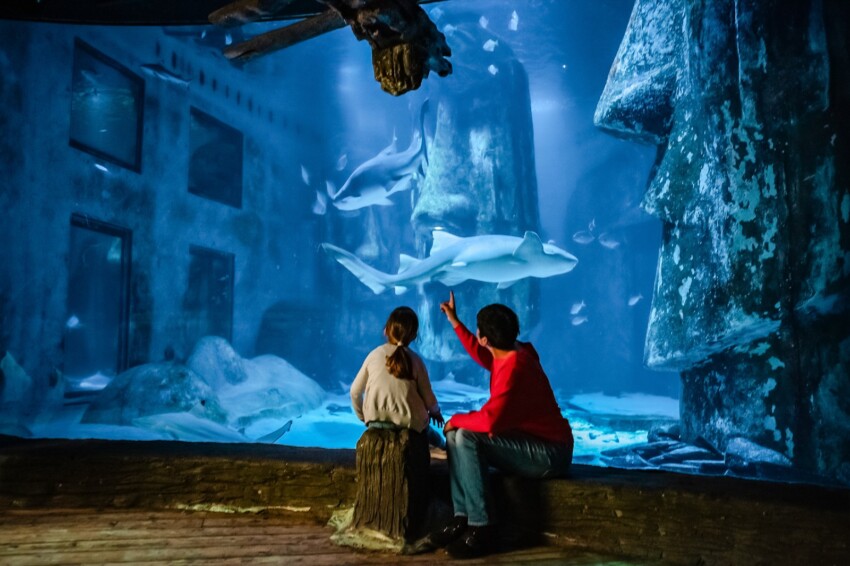
SEA LIFE London Aquarium regularly organises feeding sessions offering privileged moments to observe animals’ natural behaviour and listen to marine biologists’ explanations. Times are fixed and posted at the entrance:
At 11:00 daily, octopuses are fed in the Atlantic Coasts zone—a fascinating moment watching these molluscs’ intelligence and dexterity as they open containers and solve small puzzles to reach food. At 11:30 and 15:00 it’s the rays’ turn in the Ray Lagoon, where keepers explain differences between species and answer public questions. Gentoo penguin feeding at Polar Adventure generally happens at 12:00, whilst sharks are fed at 14:00 in the Shark Walk zone (not daily—check the schedule).
The Behind the Scenes tour is an exclusive 30-40 minute experience allowing access to normally closed areas, discovering how an aquarium of this scale operates daily, learning about water filtration and purification systems, and speaking directly with the biologists and veterinarians caring for the animals. This tour is only available some weekends and during school holidays, with very limited spaces, so advance booking is essential.
For children, SEA LIFE offers free activity sheets at the entrance transforming your visit into an educational treasure hunt, with challenges and quizzes guiding them through different themed zones. During school holidays, educational workshops are also organised on topics such as climate change, plastic pollution and coral reef conservation.
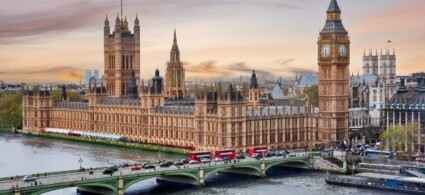
SEA LIFE London Aquarium is located in County Hall, on the South Bank of the Thames, literally just metres from the London Eye and opposite Palace of Westminster and Big Ben.
By Underground, the nearest stations are Westminster and Waterloo, both about 6 minutes’ walk from the aquarium. From Westminster, cross Westminster Bridge heading south and you’ll find the aquarium on your right. From Waterloo, follow signs for South Bank and head towards the London Eye.
Numerous bus lines stop nearby: lines 12, 53, 59, 76, 148, 159, 211 and 341 have stops on Westminster Bridge Road, whilst lines 77 and RV1 stop on Belvedere Road. If arriving from north of the Thames, you can also use lines 211, 77 and 381 stopping on York Road.
If you prefer to arrive on foot, SEA LIFE London Aquarium is easily reached from many central attractions: from Buckingham Palace it’s about 15 minutes’ walk through St. James’s Park, whilst from the British Museum it takes approximately 20 minutes.
Advanced booking is highly recommended for several reasons: it guarantees entry during your preferred time slot (the aquarium operates capacity limits for safety and comfort), allows you to save up to 30-40% compared to purchasing at the ticket office, and helps you avoid long queues at the entrance. During peak seasons, weekends and school holidays, tickets can sell out several days in advance.
The average visit lasts 1.5 to 2 hours, though it can extend to 3 hours if you want to attend biologist talks, watch feeding sessions and explore all the themed zones at leisure. Families with small children who linger in the interactive areas may spend even longer. There’s no limit on how long you can stay: once inside, you can remain until closing time. Bear in mind that re-entry is not permitted with the same ticket: if you leave, you’ll need to purchase a new ticket to return.
Yes, pushchairs and wheelchairs are welcome throughout the aquarium and must stay with you at all times. Please note that certain areas, particularly the underwater tunnels, can get crowded during peak times, making it less convenient to navigate with large pushchairs.
SEA LIFE London Aquarium doesn’t have full-service restaurants or cafés, but offers vending machines and Polar Point Refreshments, a small kiosk where you can buy drinks, snacks and ice cream. For a proper meal, it’s worth stepping outside to enjoy the numerous restaurants and pubs on the South Bank, just a few minutes’ walk away.
Yes, photography and personal videos are permitted throughout the aquarium. However, flash photography is not allowed to avoid disturbing the animals. For better photos in dimly lit areas like Ocean Invaders, use a smartphone or camera with strong low-light performance. Professional tripods and bulky camera equipment may be restricted during busy periods.
Yes, SEA LIFE London Aquarium is included in the London Pass, which offers free entry. It’s also part of the London Explorer Pass (which includes 3 to 7 attractions of your choice) and the Merlin’s Magical London Pass (which includes 5 Merlin attractions: London Eye, Madame Tussauds, SEA LIFE, London Dungeon and Shrek’s Adventure).
City Card allow you to save on public transport and / or on the entrances to the main tourist attractions.


 Hotel
Hotel  Budget accommodations
  Apartments
  Family Hotel
  Luxury Hotel