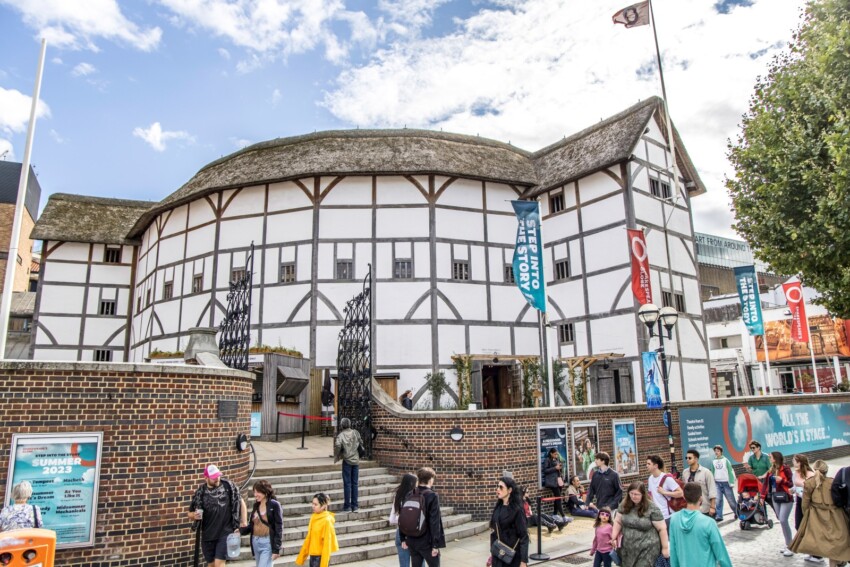
Imagine yourself on the banks of the Thames in the 16th century, amidst the bustle of street vendors, the aroma of meat pies and the palpable excitement of a crowd awaiting the latest work by the greatest playwright of all time. Shakespeare’s Globe Theatre allows you to do exactly that: step back in time to experience theatre as Londoners did during the Elizabethan era.
This meticulous reconstruction of the iconic circular theatre with its characteristic thatched roof is not merely a monument to William Shakespeare, but a living theatre where his works continue to come alive just as they did 400 years ago.
Opened in 1997 after 27 years of determined effort by American actor Sam Wanamaker, the Globe is located just 230 metres from the original 1599 site and represents an essential cultural landmark for London today.
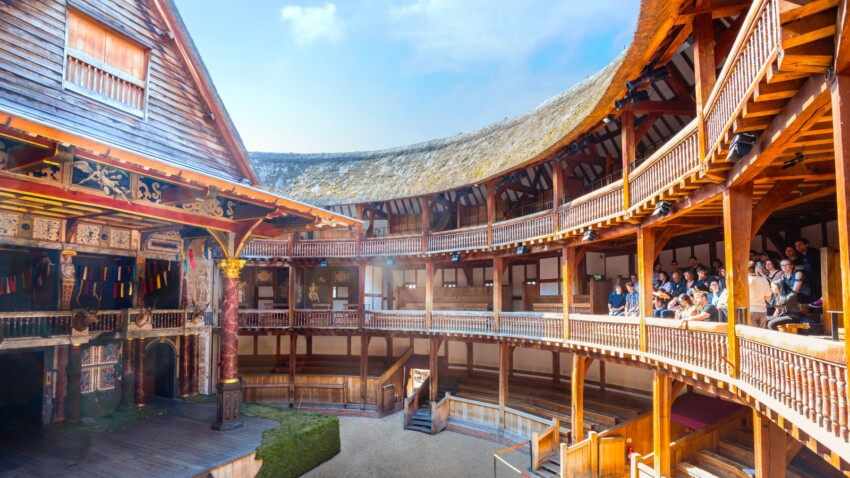
The beating heart of the Globe is undoubtedly the open-air theatre, a circular wooden structure built from oak with the distinctive thatched roof that makes it unique in London’s modern architectural landscape – it is in fact the only building in London authorised to have a thatched roof since the Great Fire of 1666.
Its architecture faithfully reproduces that of Elizabethan theatres, with a space organised across three levels of galleries surrounding an open-air central courtyard called the “yard”. Here, in Shakespeare’s time, less wealthy spectators (the so-called “groundlings”) stood to watch the performances, paying just a penny, whilst the more affluent occupied the seated galleries.
The stage projects towards the audience, creating that intimate relationship between actors and spectators characteristic of Elizabethan theatre. The architectural details are extraordinary: columns painted to imitate marble, the ceiling decorated with astronomical symbols (the “Heavens”) and floors in clay tile that recreate the atmosphere of the original 1599 building.
The best vantage point to fully appreciate the structure is from the upper galleries, from where you can admire the perfect symmetry of the building and enjoy an excellent view not only of the stage but also of the Thames flowing nearby.
Next to the open-air theatre stands the Sam Wanamaker Playhouse, an architectural jewel opened in 2014 that faithfully replicates the covered theatres of the Jacobean period. This intimate space, illuminated exclusively by candlelight as in the 17th century, offers a completely different yet equally authentic theatrical experience.
The dark wooden structure, ceiling paintings and gilded details create an environment of extraordinary beauty that evokes the private theatres frequented by the aristocracy of the era. The candlelit illumination is not merely a decorative element, but recreates the exact lighting conditions that influenced original dramaturgy and staging.
The acoustics have been studied in meticulous detail to allow even whispers to reach every corner of the hall, just as in theatres of the period. During your visit, pay particular attention to the plays of light and shadow created by the candles, which offer unique and evocative photographic perspectives.
The Globe Exhibition offers a fascinating journey into the world of Elizabethan theatre and the life of Shakespeare. The exhibition presents a rich collection of historical costumes, stage properties, period musical instruments and reproductions of original documents that illustrate the cultural and social context in which Shakespeare lived and worked.
Particularly interesting are the demonstrations of 16th-century theatrical techniques, such as sound effects produced with wooden machinery to simulate thunder and storms, or pulley systems used to make actors “fly” during supernatural scenes. Don’t miss the section dedicated to Elizabethan clothing, where you can observe the complex layering of period costumes and even try on some faithfully reproduced garments.
The exhibition also documents the fascinating history of the Globe’s modern reconstruction, with architectural models, historical photographs and testimonies of the long process that led to the realisation of Sam Wanamaker’s dream. Guided tours are conducted by experts who share fascinating anecdotes and little-known details about 16th-century London theatrical life.
For scholars and the more curious enthusiasts, the John Wolfson Library represents a genuine treasure. This specialised library houses a precious collection of first editions of theatrical works from the 1500-1700 period, including some rare Shakespeare quartos.
The archives hold documents relating to the theatre’s reconstruction, audio and video recordings of past productions, and an extensive photographic collection documenting the history of the modern Globe. Whilst full access to the library is generally reserved for researchers, during certain special visits it is possible to view some of the most precious volumes on display in display cases.
The library testifies to the institution’s commitment not only to staging Shakespeare’s works, but also to academic study and the preservation of the Bard’s cultural heritage and Elizabethan theatre.
A fascinating and often overlooked feature is the small Elizabethan herb garden located near the main entrance. This green space has been designed according to 16th-century horticultural principles and hosts plants that were common in Shakespeare’s England and are frequently mentioned in his works.
You will find medicinal herbs such as rue (cited in Hamlet), plants used for dyeing textiles, and flowers that appear in the poetic descriptions of the Bard’s works. Each plant is accompanied by a plaque explaining its use in the Elizabethan era and its reference in Shakespeare’s works.
The garden offers an interesting perspective on daily life of the period and Shakespeare’s deep connection with the natural world. It is a tranquil spot that provides a pleasant contrast to the theatre’s energy and is an excellent place for taking special photographs, especially during late spring and summer when many plants are in bloom.
The history of the Globe Theatre is as dramatic as the works performed there. The original theatre was built in 1599 by Shakespeare’s theatrical company, the Lord Chamberlain’s Men (later the King’s Men), using materials salvaged from their previous theatre called “The Theatre”.
Located in the Southwark area on the south bank of the Thames, the Globe quickly became one of the centres of London’s cultural life. Numerous Shakespearean masterpieces premiered on this stage, including probably Hamlet, Othello, King Lear and Macbeth. The theatre could accommodate up to 3,000 spectators, an impressive number for the time.
In 1613, during a performance of Henry VIII, a theatrical cannon shot caused a fire that completely destroyed the building in less than two hours. Fortunately there were no fatalities. The theatre was rebuilt the following year, this time with a tiled roof instead of thatch, but its second life was short-lived: in 1642, the Puritans who had seized power in England closed all theatres, regarding them as places of immorality. The second Globe was demolished in 1644 to make way for social housing.
The modern rebirth of the Globe is due to the vision and determination of American actor and director Sam Wanamaker. In 1949, during a visit to London, Wanamaker was surprised and disappointed to find only a small commemorative plaque where the celebrated theatre once stood. He then decided to dedicate his life to the reconstruction project, founding the Shakespeare Globe Trust in 1970.
The path to realisation was long and complex: extensive historical research, archaeological excavations (remains of the original building were partially discovered in 1989), bureaucratic and financial difficulties. The project was opposed by many sceptics, but Wanamaker persevered to the end, although he did not live long enough to see his dream realised: he died in 1993, four years before the opening.
Construction of the new Globe began in 1987 and was completed ten years later. The theatre officially opened to the public in 1997, located approximately 230 metres from the original site. To ensure maximum historical authenticity, period materials and construction techniques were used: seasoned oak wood, joints fastened without nails, plaster made with a traditional mixture of lime, sand and horsehair, and a thatched roof created using 16th-century methods.
The architects based their work on period drawings, written descriptions and archaeological studies of other Elizabethan theatres to recreate a building as faithful as possible to the original, whilst respecting modern safety regulations. The result is a theatre that is not merely a monument to the past, but a living organism that continues to explore and celebrate Shakespeare’s heritage through both innovative and traditional productions.
Shakespeare’s Globe Theatre can only be visited by guided tour. Standard guided tours last approximately 40 minutes and are available in several languages, including Italian, French, German and Spanish, as well as English. They are led by expert guides who provide insights not only into the theatre’s architecture, but also into Shakespeare’s life, Elizabethan theatrical practices and the historical and social context in which the Bard operated.
Admission tickets for guided tours at Shakespeare’s Globe Theatre are available in various price bands based on visitor type. Discounted rates are available for students and those over 60 and for children aged 5 to 15, whilst children under 5 enter free of charge.
We strongly recommend purchasing tickets online in advance through the official website, especially during the high tourist season (June-September), to avoid lengthy queues and ensure availability on your desired date and time.
The Globe Theatre is included in several London tourist passes, such as the London Pass, which could be a convenient option if you plan to visit numerous attractions during your stay.
As for theatre performances, prices vary considerably depending on the type of seat and production. One of the most fascinating features of the Globe is the possibility of watching performances standing in the yard (as the “groundlings” did in the past) from just a few pounds, making Shakespeare’s theatre accessible to all budgets. The most popular productions tend to sell out weeks or even months in advance, so it is advisable to book as soon as possible.
Shakespeare’s Globe Theatre is open for guided tours daily from 9:30 am to 5:00 pm, with the last tour generally departing at 4:30 pm. However, hours can vary significantly during the theatre season (April to October), when tours end earlier to allow preparation for afternoon and evening performances.
During this period, the last tour might depart as early as 12:00 pm, especially on days when matinées are scheduled. We strongly recommend checking the hours on the official website before your visit.
On Christmas and New Year’s Day the theatre is closed to the public, whilst on other public holidays reduced hours may be in effect. In the event of rehearsals or special events, tour times may also be subject to change.
As for visiting times, you should plan for approximately 1 hour and 30 minutes to fully enjoy the experience, accounting for 40 minutes for the guided tour and at least 30-45 minutes to freely explore the museum and exhibitions. If you also wish to take advantage of the café or souvenir shop, we recommend adding at least another 30 minutes.
The best time to visit the Globe is on a weekday morning, when the theatre is generally less crowded. At weekends and during school holidays, we recommend arriving at opening time or in the late afternoon to avoid the larger crowds.
If you wish to attend a performance as well, the summer theatre season (May to September) offers the most authentic experience, with performances taking place in the open-air theatre just as in Shakespeare’s time. However, bear in mind that in summer tickets tend to sell out quickly, so it is essential to book well in advance.
Beyond regular guided tours and theatrical productions, Shakespeare’s Globe offers a range of special events and unique opportunities that further enrich the visitor experience.
During the summer season, the theatre presents “midnight matinees”—special performances beginning at midnight and staged under the stars, creating a particularly atmospheric setting. These nocturnal performances are hugely popular and offer a distinctive way to experience Elizabethan theatre, with the magic of natural light fading into darkness as actors perform by torchlight.
In the winter months, the Sam Wanamaker Playhouse hosts concerts of Renaissance and Baroque music illuminated solely by candlelight, recreating the acoustic and visual conditions that would have characterised musical performances in the 17th century. These events deliver an extraordinary sensory experience, with the intimacy of the space and the warmth of natural light enhancing the qualities of period music.
The Globe also organises theatre workshops for adults and children, where you can learn Elizabethan acting techniques, diction and stage movement under the guidance of professional actors. These workshops are particularly popular with drama students and enthusiasts keen to deepen their understanding of Shakespeare’s texts through practical performance.
For history buffs, themed tours such as “Women and Shakespeare” or “The Dark Side of Shakespeare” offer alternative perspectives on the Bard’s life and work, exploring specific aspects of Elizabethan society or themes within the texts. These specialist tours are generally available on specific dates and require advance booking.
A truly unique experience is the behind-the-scenes tour, available at selected times, which grants access to areas normally closed to the public, such as the actors’ dressing rooms and the costume workshops where historical garments are created using traditional techniques. During this tour, you’ll discover the secrets of theatrical production and understand the meticulous research that underpins every aspect of the performances.
During the Christmas period, the Globe transforms with period decorations and hosts special events including readings of traditional tales and concerts of Elizabethan Christmas carols, offering visitors a fascinating immersion in 16th-century festive celebrations.
By Underground, the nearest station is London Bridge (Northern and Jubilee lines), about 10 minutes’ walk away. Alternatively, you can use Blackfriars station (Circle and District lines), situated on the north bank of the river but directly connected to the south bank by a pedestrian bridge that will bring you within just 5 minutes’ walk of the theatre.
For those preferring buses, several iconic London red bus routes stop nearby. Routes 45, 63, 100 and RV1 all stop within a few paces of the theatre. The most convenient stop is generally Southwark Street for routes 45 and 63, or Blackfriars Bridge for route 100.
A particularly scenic way to reach the Globe is via the Thames, using Uber Boat. The nearest pier is Bankside Pier, situated right next to the theatre.
Whilst not always compulsory, advance booking is strongly recommended, especially during peak tourist season (June–September) and at weekends. For theatrical performances, advance booking is virtually essential, as the most desirable or affordable seats tend to sell out quickly, particularly for popular productions.
Photography is allowed during guided tours, both in the theatre and the museum, provided you do not use flash. During performances, however, photography and recording are strictly prohibited. We recommend bringing a camera with good low-light performance, particularly for capturing the interiors of the candlelit Sam Wanamaker Playhouse.
Performances at the Globe take place in all weather conditions, faithful to Elizabethan tradition. In the event of rain, the performance continues, with both actors and spectators in the yard braving the elements (just as happened in Shakespeare’s time). If you have tickets for the yard, we recommend bringing waterproofs or a poncho (umbrellas are not permitted as they obstruct the view). Seats in the galleries are covered, but may still be reached by lateral rain in cases of strong wind.
The theatre has implemented various measures to ensure accessibility, despite constraints imposed by the historical authenticity of the building. Dedicated wheelchair spaces are available in the galleries, lift access to the museum and accessible facilities are provided. For visitors with hearing impairments, some performances offer subtitles or sign language interpretation. It is advisable to contact the theatre in advance to discuss specific needs and ensure the best possible experience.
Rehearsals are generally closed to the public. The best way to see the theatre when there are no performances is to take part in one of the regular guided tours. During the theatre season, guided tours finish earlier to allow preparation for afternoon and evening performances.
The Globe Theatre can be an educational and stimulating experience for children, particularly those interested in history, theatre or Shakespeare. Guided tours are generally suitable for children from 7 years upwards, and the museum offers interactive elements that can engage younger visitors too. As for performances, some productions are specifically designed for a younger audience, whilst others may contain themes and language more suited to adults. The theatre’s website always indicates age recommendations for each performance.
For security reasons, the Globe does not offer a left-luggage service. Visitors are asked to bring only what is necessary. Suitcases and large bags are not permitted inside the theatre. If you have bulky luggage, we recommend using the left-luggage services available at London’s major railway stations, such as London Bridge or Blackfriars.
The Globe Theatre is included in several London tourist cards, including the London Pass. However, these cards generally cover only admission to guided tours and do not include theatre performance tickets.
City Card allow you to save on public transport and / or on the entrances to the main tourist attractions.
 Hotel
Hotel  Budget accommodations
  Apartments
  Family Hotel
  Luxury Hotel