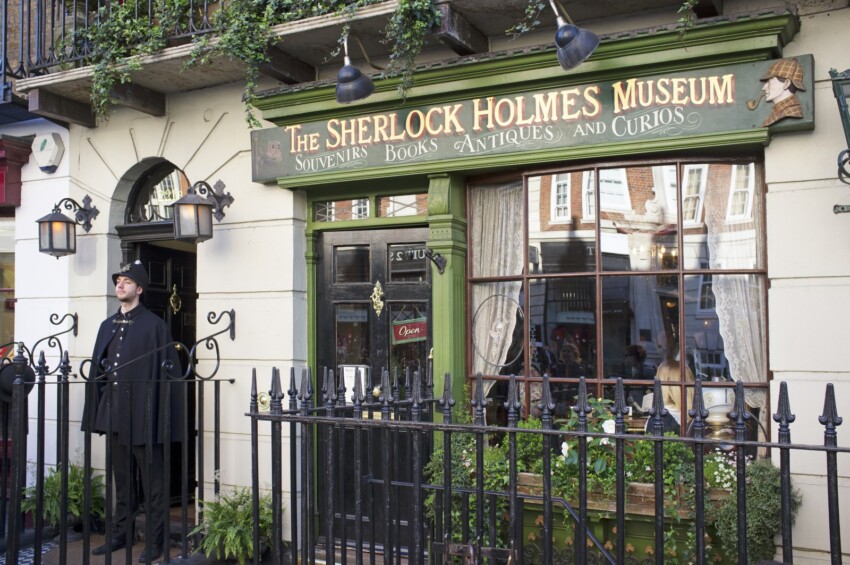
At 221B Baker Street, one of the world’s most famous literary addresses, stands the Sherlock Holmes Museum, a unique attraction dedicated to the legendary detective created by Sir Arthur Conan Doyle. Located precisely where the tales place Holmes’s residence and that of his loyal friend, Doctor John Watson, this captivating museum offers visitors the opportunity to immerse themselves in the atmosphere of Victorian London and explore the settings described in the celebrated stories.
Open to the public since 1990, the museum is a must-visit pilgrimage for crime fiction enthusiasts, Sherlock Holmes fans, and anyone fascinated by the Victorian era. Each year, thousands of visitors from around the world cross the threshold of this Georgian-style building from 1815, eager to see the faithful recreation of Holmes and Watson’s flat as described in the original stories.
Although Sherlock Holmes is a fictional character, the museum brilliantly brings him to life, creating the illusion that the great detective actually lived and worked in these spaces. The meticulously reconstructed interiors, evocative props, and perfectly recreated Victorian atmosphere transport visitors on a journey through time, to 1881–1904, the period in which Holmes’s adventures are set.
Your visit to the Sherlock Holmes Museum begins as you enter 221B Baker Street, where you’ll be greeted by a custodian dressed as a Victorian police officer, which immediately adds an air of authenticity to the experience. The address itself is special: although in Conan Doyle’s time Baker Street didn’t extend to number 221, today the museum has officially obtained this address, despite being physically located between 237 and 241 Baker Street.
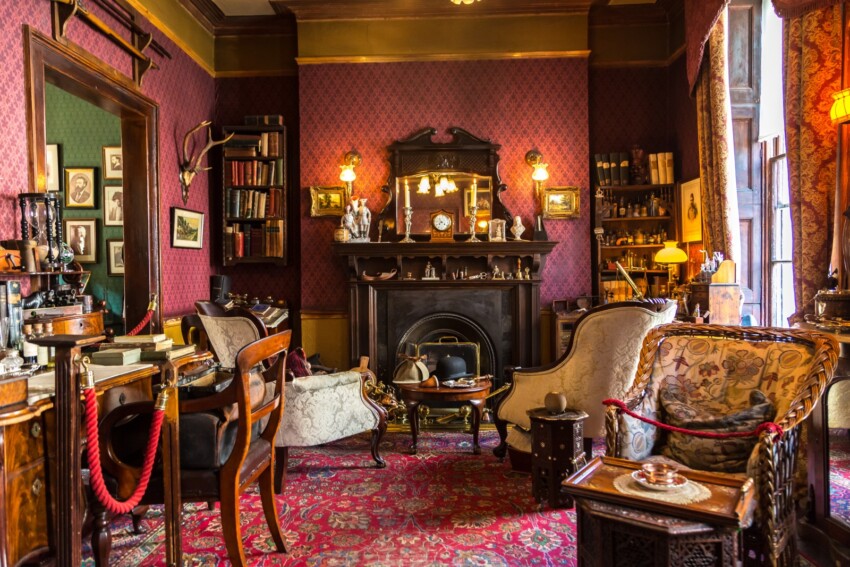
Climbing the narrow Victorian stairs to the first floor, you enter the heart of the museum: the famous sitting room shared by Holmes and Watson. This room, probably the most photographed space in the museum, has been meticulously furnished according to the descriptions in the original stories, faithfully recreating the setting where the detective would receive his clients and solve his most complex cases.
The sitting room is a triumph of authentic Victorian details: the worn leather armchairs by the fireplace (where you can imagine Holmes seated whilst playing the violin or lost in thought), the desk cluttered with papers and scientific instruments, the walls adorned with Victorian portraits and vintage decorations. Particularly evocative are the numerous objects linked to cases described in the stories, such as the morocco leather box containing Holmes’s personal syringe (a reference to his cocaine addiction), the long-stemmed pipe, and the deerstalker cap that has become emblematic of the character.
Another distinctive element of the sitting room is the V formed by bullet holes in the wall, which Holmes allegedly fired during moments of boredom. These details, mentioned in the original stories, have all been faithfully reproduced, creating an immersive atmosphere that makes visitors feel as though the detective has just stepped out on an urgent case and could return at any moment.
Adjacent to the sitting room lies Sherlock Holmes’s bedroom, a more intimate space that offers a glimpse into the detective’s private life. The room is dominated by a large Victorian four-poster bed, carefully dressed with period sheets and a quilted bedspread.
In this room, the curators have positioned various personal items attributed to Holmes, including period clothing hung on a coat stand, a washbasin with ceramic bowl and pitcher (typical of the era before running water was common in homes), and some scientific instruments that reflect the detective’s interest in chemistry and other scientific fields.
Particularly interesting is the collection of disguises displayed in the room, representing Holmes’s legendary ability to change his identity for his investigations. These include various wigs, false moustaches, spectacles, and hats which, according to the stories, allowed the detective to pass unnoticed or infiltrate various environments.
Ascending to the second floor, visitors can explore Doctor John Watson’s bedroom, furnished to reflect both his medical profession and his military past. The room contains a desk with period medical instruments, a bookcase with medical texts, and naturally, manuscripts representing his accounts of the adventures experienced with Holmes.
A touching detail is the photograph of Watson’s wife, Mary Morstan (a character from the novel “The Sign of the Four”), placed on the bedside table next to the bed. The room also includes a military trunk that recalls Watson’s service in the British Army in Afghanistan, an experience that profoundly marked him before meeting Holmes.
This room offers an interesting perspective on Watson, often overshadowed by the dominant figure of Holmes, but actually a complex and fundamental character in the stories—not merely as a narrator but as a compassionate human counterpoint to the detective’s cold and analytical intellect.
The third floor of the museum houses a gallery dedicated to the numerous characters who populate Sherlock Holmes’s stories. Here you’ll find costumed mannequins representing key figures such as:
In this section are also displayed numerous objects linked to famous cases described in the stories. You’ll see the preserved paw of a mastiff (from “The Hound of the Baskervilles”), the swamp-marked snake from “The Speckled Band”, and various other items related to celebrated cases such as “A Scandal in Bohemia” or “The Adventure of the Five Orange Pips”.
The display cases also contain reproductions of evidence and clues that Holmes would have collected during his investigations: plaster casts of footprints, samples of tobacco ash (Holmes could distinguish 140 different types), and threatening letters. These objects are accompanied by explanatory panels linking them to specific stories, making the visit particularly interesting for those familiar with Conan Doyle’s works.
The museum’s top floor, created within the building’s attic, contains further exhibitions that explore both the historical context of Holmes’s adventures and the character’s cultural impact in subsequent decades.
In this section you’ll find Victorian-era newspapers that help contextualise the stories in their historical period, showing us the London that Holmes and Watson would have known. Also on display are reproductions of early editions of the Strand Magazine, the publication in which many of Holmes’s stories first appeared.
Particularly interesting is the collection of film and television adaptations that show how the Holmes character has been portrayed over the years, from Basil Rathbone and Jeremy Brett to more modern versions such as Benedict Cumberbatch’s. Vintage posters, stills from films, and cinema memorabilia tell the story of the evolution of Holmesian imagery.
The attic also houses a small section dedicated to Sir Arthur Conan Doyle himself, with information about his life, his complicated relationship with the character that made him famous, and his other interests and literary works that are often overshadowed by Holmes’s success.
On the ground floor of the building is the souvenir shop, where you can purchase a wide range of Holmes-themed items. From reproductions of the famous pipe and deerstalker cap, to editions of Conan Doyle’s works, postcards, mugs, magnets, and even complete detective costumes, the shop offers souvenirs for all budgets and preferences. It’s worth exploring both at the beginning and end of your visit, if only to admire the many items evoking the world of Sherlock Holmes.
An interesting detail to note is the letterbox at the entrance, which still receives correspondence addressed to Sherlock Holmes from around the world today. This small detail testifies to how alive the character created by Conan Doyle remains in the collective imagination.
The adventures of Sherlock Holmes were written between 1887 and 1927 and comprise 60 cases (divided into 4 novels and 56 short stories) in which the investigator manages to solve all the mysteries, thanks to his great powers of observation and his acute deductive abilities.
The 60 tales of detective Sherlock Holmes achieved such high levels of success and popularity that they completely overshadowed the English writer’s other works, particularly the novellas he had written previously. For this reason, Conan Doyle “killed off” Sherlock Holmes near the end of episode number 26, only to backtrack 8 years later, succumbing to pressure from his family and publisher. Following the detective’s resurrection, Sir Arthur Conan Doyle wrote another 34 stories centred on his character between 1901 and 1927.
The history of the Sherlock Holmes Museum is almost as fascinating as the stories it celebrates. Although the adventures of Sherlock Holmes were published between 1887 and 1927, the museum is relatively recent, having opened in 1990 after years of preparation and overcoming bureaucratic hurdles.
The idea of creating a museum dedicated to the celebrated detective originated in the mind of John Aidiniantz, a British entrepreneur and passionate admirer of Conan Doyle’s stories. Aidiniantz purchased the Georgian building at 239 Baker Street in the late 1980s, choosing this location for its proximity to the fictional address of 221B. At that time, the actual address 221B on Baker Street didn’t physically exist because, when Conan Doyle wrote his stories in the late nineteenth century, Baker Street was shorter and the street numbers didn’t reach that high.
An interesting curiosity concerns the address question itself: for decades, the London headquarters of the Abbey National Building Society occupied a building covering numbers 219 to 229 on Baker Street, and employed a full-time secretary to answer the numerous letters addressed to Sherlock Holmes that arrived daily! There was even a legal dispute between Abbey National and the new museum over the right to receive correspondence addressed to the fictional detective.
Finally, in 1994, after Abbey National relocated, the museum officially obtained permission to use the address 221B Baker Street, despite being physically located at 239. The famous black door with the brass number 221B was installed, making the museum immediately recognisable.
Creating the museum required enormous attention to historical detail. Victorian furnishings were carefully selected to match descriptions in the stories, and many authentic period items from 1881–1904 (when Holmes’s stories are set) were acquired to create an atmosphere as faithful to the era as possible. The rooms were designed based not only on Conan Doyle’s descriptions but also on the original illustrations by Sidney Paget that accompanied the stories in the Strand Magazine.
Over the years, the museum has become a cultural landmark, hosting special events such as reconstructions of famous cases, lectures on Sherlock Holmes, and celebrations marking anniversaries related to the detective. It has also become a place of pilgrimage for “Sherlockians” (as the most devoted fans call themselves) from all over the world.
Today, the Sherlock Holmes Museum is managed by the Sherlock Holmes International Society and is recognised as an important element of London’s cultural heritage, celebrating not only a literary character but also the Victorian era that forms the backdrop to his adventures.
A visit to the Sherlock Holmes Museum requires the purchase of a ticket, with various options available depending on age and the type of experience desired.
Children under 6 years of age enter free when accompanied by a paying adult. Discounted rates are also available for students and seniors upon presentation of valid identification.
Due to the museum’s small size and popularity, it is not possible to book tickets in advance online. Tickets are sold exclusively at the ticket office located at the museum entrance, on a first-come, first-served basis. This may result in significant waiting times during peak season or at weekends.
The museum also offers a family ticket that includes admission for two adults and two children, representing savings for family groups.
The Sherlock Holmes Museum is open every day of the year, including weekends and most public holidays (with the exception of Christmas Day), with the following hours: Monday to Sunday: 9:30 AM to 6:00 PM (last entry at 5:30 PM).
During peak seasons (summer and holiday periods) or for special events, opening hours may be extended. It is always advisable to check updated opening times on the museum’s official website before your visit.
Given the museum’s relatively compact size, a complete visit typically takes around 60 minutes. This allows you to explore all the rooms at a leisurely pace, read the information panels and examine the numerous fascinating details and artefacts on display without rushing.
Devoted fans of Conan Doyle’s works may wish to spend up to 2 hours, fully immersing themselves in the atmosphere and identifying all the references to the original stories woven throughout the displays.
It is worth noting that, as the building is a Georgian townhouse with narrow and steep staircases, visitor flow can be slow, especially during busy periods when queues form to access the various rooms. The compact size of each room also limits the number of people who can enter at any given time.
The best time to visit the museum is on weekdays, preferably early morning (9:30 AM–11:00 AM) or late afternoon (after 4:00 PM). During these time slots, visitor numbers are generally lower, allowing for a more relaxed experience.
The museum is particularly popular, and given its limited capacity, during peak season it is not uncommon to wait in a queue outside for 30–45 minutes. In such cases, staff manage admissions carefully to maintain a comfortable visiting experience, allowing small groups in at regular intervals.
The Sherlock Holmes Museum regularly organises special events and temporary exhibitions that enrich the visiting experience and offer fresh perspectives on the world of the famous detective.
On significant anniversaries related to Sherlock Holmes or Sir Arthur Conan Doyle, the museum hosts special commemorative events. For instance, for the 125th anniversary of the publication of Holmes’s first story (“A Study in Scarlet”) in 2012, the museum mounted a temporary exhibition featuring rare first editions and original manuscripts.
Similarly, on the anniversary of Holmes’s fictional “death” at Reichenbach Falls (as narrated in “The Final Problem”), the museum organises dramatic readings and costume recreations of the event with professional actors.
Several times a year, typically around Halloween or during the Christmas period, the museum hosts Murder Mystery Evenings, interactive events where visitors can participate in solving a fictional case inspired by Holmes’s adventures. These events, held after normal closing time, offer an engaging experience with professional actors playing suspects and witnesses, whilst participants take on the role of the great detective’s assistants.
Tickets for these special events typically cost between £30 and £45 and often include a refreshment or Victorian-style afternoon tea. Given their popularity and limited capacity, advance booking via the museum’s website is essential.
The museum occasionally hosts talks and lectures by contemporary Holmes novelists or scholars of the Holmesian canon. These events offer insights into Holmes’s deductive methods, the historical and social context of Victorian London, or the character’s influence on subsequent detective fiction.
At certain times of the year, particularly during the Christmas holidays, the museum offers theatrical guided tours in which costumed actors portray key characters from Holmes’s stories, such as Doctor Watson, Mrs. Hudson or Inspector Lestrade. These special guides lead visitors through the rooms, recounting anecdotes “in character” and recreating the atmosphere of the original stories with a touch of theatrical flair.
Occasionally, the Sherlock Holmes Museum collaborates with the London Film Museum on temporary exhibitions dedicated to the detective’s cinematic and television portrayals. These exhibitions may feature original costumes, props and storyboards from famous adaptations, ranging from early silent films to modern reinterpretations such as the BBC’s “Sherlock” series or the Robert Downey Jr. films.
For up-to-date information on special events and temporary exhibitions, we recommend consulting the museum’s official website or subscribing to their newsletter.
The Sherlock Holmes Museum is located at 221B Baker Street, in the heart of London, and is easily accessible by various forms of transport.
The most convenient way to reach the museum is by using London Underground. The nearest station is Baker Street, served by five Underground lines. The exit for Baker Street from the station is clearly signposted. Once at street level, the museum is just a 2-minute walk heading north.
Baker Street station is one of the oldest on the London Underground network and features an interesting interior decoration with silhouettes of Sherlock Holmes’s profile on the tiled walls, making your arrival part of the themed experience.
Many London bus routes stop near Baker Street:
No, advance booking is not available for standard museum visits. Tickets are sold exclusively at the entrance on a first-come, first-served basis. This may result in waiting times, particularly at weekends and during peak season. Only private group guided tours can be booked in advance by contacting the museum directly.
Yes, photography for personal use is permitted inside the museum, but without flash to protect the historical artefacts on display. Particularly popular are photos taken sitting in Holmes’s chair in the sitting room or wearing the famous deerstalker hat. Commercial or professional photography requires prior authorisation from the museum’s administration.
The museum can be interesting for older children (8 years and up) who are familiar with Sherlock Holmes, perhaps through modern adaptations or children’s versions. Younger children may find the environment less engaging given its historical and literary focus.
There are no activities specifically designed for children, though the souvenir shop does offer some items aimed at younger visitors. Pushchairs may be difficult to manoeuvre due to the narrow staircases and limited spaces.
Unfortunately, due to the historic nature of the Georgian building, the Sherlock Holmes Museum has significant accessibility limitations for visitors with reduced mobility. The building spans four floors connected by narrow and steep staircases, and has no lift or stair lift. This makes access impossible for wheelchair users and difficult for those with mobility issues.
Museum staff do their best to assist visitors with special needs, but the structural constraints of a protected historic building limit the modifications that can be made. The ground floor (souvenir shop) is the only level accessible without stairs.
This is an interesting question that touches the boundary between reality and fiction. Technically, the Sherlock Holmes Museum is a tourist attraction created to celebrate a literary character who never actually existed. The building itself at 221B Baker Street is not the “true” home of Holmes (which could not exist, given that Holmes is a fictional character), but a meticulous reconstruction based on the descriptions provided in Conan Doyle’s stories.
However, the museum is “authentic” in that:
The museum succeeds in creating an immersive experience that makes visitors feel as though they are truly stepping into the apartment of a detective who has become so iconic that he has transcended his fictional status to become part of British cultural heritage.
City Card allow you to save on public transport and / or on the entrances to the main tourist attractions.




 Hotel
Hotel  Budget accommodations
  Apartments
  Family Hotel
  Luxury Hotel