Bestseller
London: St Paul's Cathedral Entry Ticket
From 30,98 €
Buy the ticket
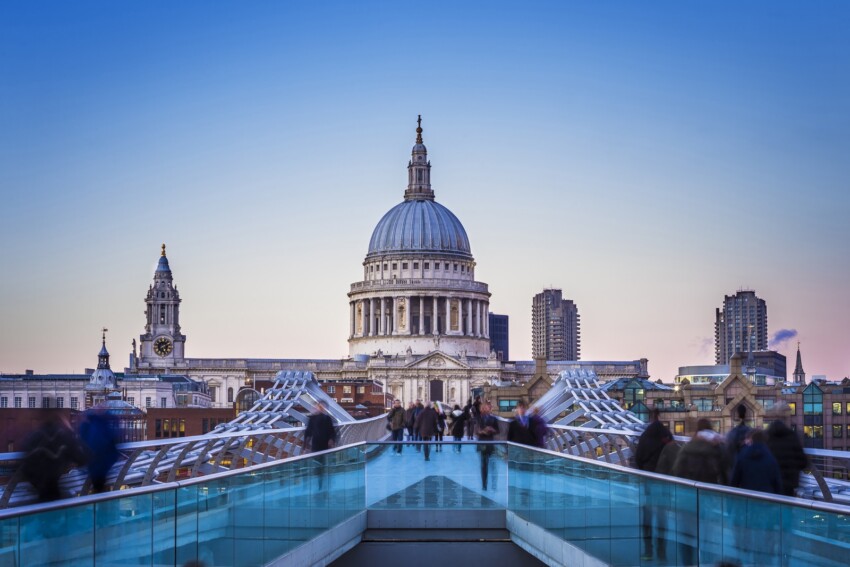
At the heart of London’s City, atop Ludgate Hill, stands one of the most recognisable symbols of the British capital. St Paul’s Cathedral dominates the London skyline with its majestic Baroque dome, a witness to over three centuries of British history and an architectural landmark that has endured wars, fires and urban transformation.
Designed by the genius of Sir Christopher Wren following the devastating Great Fire of London in 1666, the cathedral represents a masterpiece of English Baroque architecture. At 111 metres tall, the dome is second in size only to that of St Peter’s Basilica in Vatican City and remained the city’s tallest building until 1962.
Yet St Paul’s is far more than an architectural monument: it is the stage for events that have shaped British history. It witnessed the wedding of Prince Charles and Lady Diana Spencer in 1981, the state funerals of Winston Churchill, Admiral Nelson and the Duke of Wellington, and celebrations for royal jubilees. During the Second World War, the image of the cathedral emerging unscathed amid the flames of the Blitz became a symbol of British resilience.
A visit to the cathedral will allow you to explore its monumental spaces, climb the 528 steps to the Golden Gallery for breathtaking panoramic views across London, discover the famous Whispering Gallery with its extraordinary acoustic properties, and descend into the crypt where some of Britain’s greatest national heroes rest.
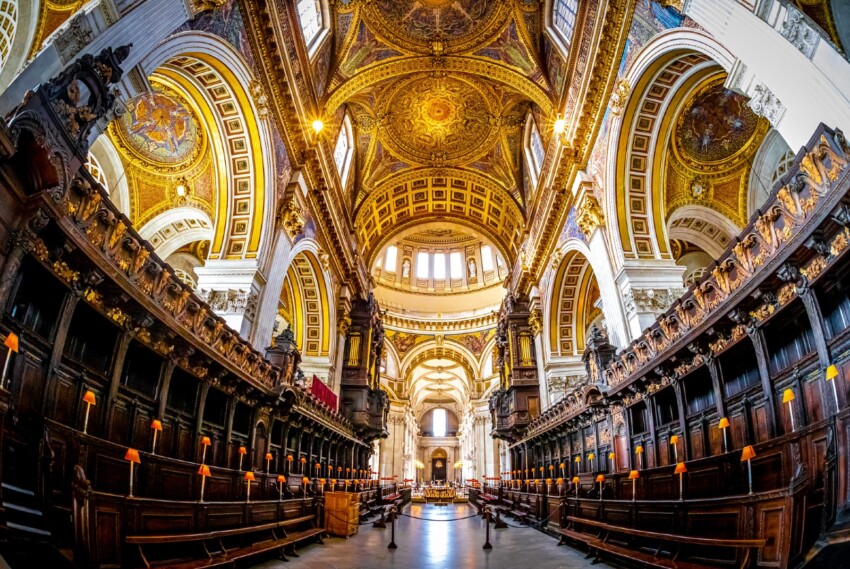
The dome of St Paul’s is the architectural heart of the cathedral and one of the most impressive achievements of 18th-century engineering. Wren faced enormous technical challenges in erecting this monumental structure on London’s clay soil. His solution was ingenious: he created a three-tier structure, with a decorated inner dome, an intermediate brick cone that bears the weight, and the outer dome visible from outside, faced in lead.
The frescoes inside the dome, executed by Sir James Thornhill between 1716 and 1719, depict eight scenes from the life of St Paul. These monochromatic paintings, created using the grisaille technique, produce an effect of extraordinary depth. In the pendentives beneath the dome are Victorian mosaics representing the four evangelists and the four greater prophets, added in the late 19th century.
The structure culminates with the gilded lantern and cross, soaring 111 metres above ground. The golden ball beneath the cross is 7 metres tall and weighs 7 tonnes. Originally installed in 1708, it was replaced in 1821 with the current design by C.R. Cockerell.
Positioned 30 metres above the cathedral floor, the Whispering Gallery is one of the world’s most celebrated acoustic phenomena. This circular passageway running at the base of the dome takes its name from an unintended architectural feature: a whisper spoken against the wall can be clearly heard on the opposite side of the gallery, over 33 metres away.
The phenomenon is caused by whispering-gallery wave modes, discovered here by physicist Lord Rayleigh in the late 19th century. Low-intensity sound waves travel along the curved surface of the wall, following the gallery’s perimeter without dispersing towards the centre. The slight inward inclination of the walls and the perfectly circular shape work to contain and amplify the sound.
To reach the Whispering Gallery you must climb 257 steps via a narrow spiral staircase. Once there, beyond experiencing the acoustic effect, you can admire the details of Thornhill’s frescoes up close and enjoy a dizzying view down to the cathedral floor below, decorated with a compass rose.
Continuing up another 119 steps (376 in total from the cathedral floor) brings you to the Stone Gallery, the first of the dome’s two external galleries. This balcony, protected by stone balustrades and decorated with alternating pilasters and rectangular windows, already offers spectacular views across London. From here you can appreciate the dome’s architectural details and begin to comprehend the vastness of the city stretching all around.
For the more adventurous and fit, another 152 steps lead to the Golden Gallery, the smallest gallery encircling the highest point of the outer dome, 85 metres above the floor. The views from here are among London’s most spectacular: on clear days you can see for miles in all directions, identifying The Shard, Tower Bridge, the London Eye, the Barbican, the Gherkin and many other capital landmarks.
The total climb of 528 steps should not be underestimated: the stairs are narrow, steep in places, and the route demands a good level of fitness. The cathedral advises against attempting the climb for those with mobility issues, pre-existing medical conditions, fear of heights or confined spaces.
Entering through the Great West Door, you’ll find yourself facing the majestic nave stretching over 150 metres. The perspective is designed to draw the eye towards the dome and high altar, creating a sense of upward movement towards the heavens. The barrel vaults of the nave, inspired by classical architecture, are decorated with simple geometric ornaments that do not distract from the overall architectural harmony.
The current high altar, made of marble with oak carvings and gilding, replaced the original Victorian altar, damaged during a Second World War bombing that destroyed much of the cathedral’s eastern end. The baldachin above the altar, designed by Wren, is decorated with intricate woodwork and creates a focal point for liturgical celebrations.
Beneath the dome lies the altar of the dome, used for daily celebration of the Eucharist. This area is the building’s natural heart and demonstrates how the cathedral continues to evolve as a living place of worship, not merely a historic monument.
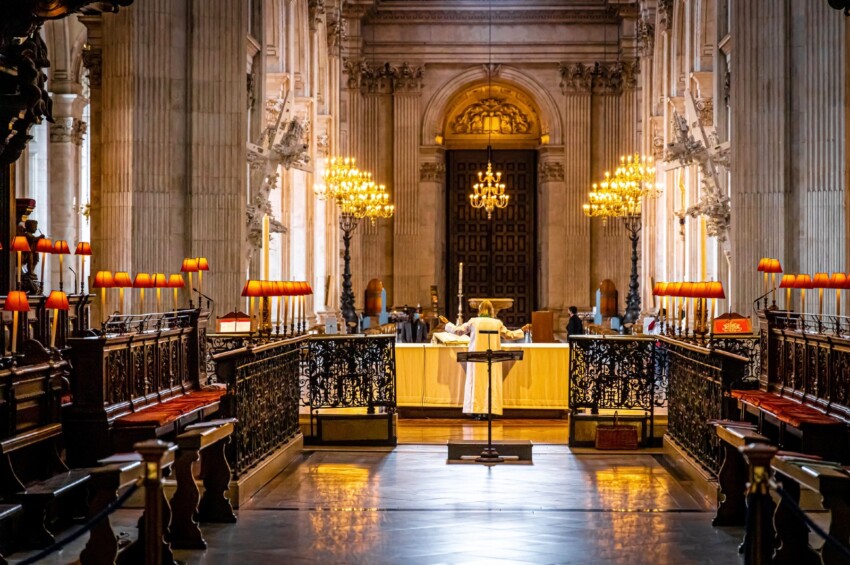
The quire of St Paul’s is a richly decorated space housing the carved wooden stalls where the bishop, clergy and the cathedral’s celebrated choir sit. The wooden decorations are the work of Grinling Gibbons, the period’s greatest woodcarving master, whose virtuosic lime wood sculptures depict festoons of fruit, flowers, angels and Christian symbols with stunning naturalism.
Above the stalls, divided between the two sides of the choir, stands the Great Organ, originally built in 1695. With its 7,189 pipes, 5 keyboards and 138 stops, it is the third-largest organ in the United Kingdom. The organ has been rebuilt and enlarged several times over the centuries, with the most significant restoration completed in 2008. The organ case, also by Grinling Gibbons, originally formed a screen separating the nave from the quire.
The cathedral choir, founded in 604, is one of England’s oldest and most prestigious. The choristers sing regularly during liturgical services, and hearing them during choral Evensong is an unforgettable experience.
The most imposing monument in St Paul’s is dedicated to the Duke of Wellington and stands beneath one of the arches between the nave and north aisle. Designed by Alfred Stevens and completed only in 1912, sixty years after the duke’s death, it depicts Wellington on horseback on an enormous decorated base. The monument was originally placed in what is now the Chapel of St Michael and St George, but was relocated to its current position in 1906 due to its imposing size.
In the south transept are monuments dedicated to Admiral Horatio Nelson, who died at the Battle of Trafalgar in 1805, Vice Admiral Cuthbert Collingwood, Captain Robert Scott, the Antarctic explorer, and Admiral Richard Howe. The Nelson monument is particularly elaborate, with reliefs depicting his naval victories.
In the north transept you’ll find memorials to Major General Thomas Dundas and Major General Andrew Hay. A curious detail: the soldier’s head on Hay’s monument is a noticeably lighter colour than the rest of the sculpture, as it was damaged during a Second World War bombing and subsequently replaced.
Among modern artworks, the sculpture by Henry Moore “Mother and Child: Hood”, a memorial to modern martyrs, stands out, as does the celebrated painting “The Light of the World” by William Holman Hunt (currently not on display), representing Christ knocking at the door with a lantern.
Entry to St Paul’s Cathedral for tourist visits is charged, whilst attendance at religious services is free.
The admission ticket includes access to the cathedral floor, crypt and dome galleries, plus a free multimedia guide available in 12 languages. It is strongly recommended to purchase tickets online in advance to avoid queues and guarantee entry at your preferred time. Online booking also allows you to select a specific entry time slot.
Disabled visitors are entitled to free admission and may also bring a companion or carer free of charge. These tickets can be booked online or requested upon arrival. Holders of Universal Credit, Pension Credit or Employment Support Allowance can purchase special tickets for £1 by presenting appropriate documentation.
St Paul’s is included in several London tourist passes. The London Pass offers free entry along with over 90 other attractions, whilst the Go City London Explorer Pass allows visits to a selection of attractions. Both passes also offer 10% discount in the cathedral shop.
There is also a 2 for 1 offer with rail tickets: travellers arriving in London by train can obtain two admission tickets for the price of one, booking online and presenting valid rail tickets at entry.
The cathedral is open for tourist visits Monday to Saturday. Opening hours are 8:30am to 4:30pm, with last admission at 4:00pm, whilst on Wednesday opening is delayed to 10:00am. The dome galleries open at 9:30am (10:00am on Wednesday) with last admission at 4:15pm.
On Sunday the cathedral is open only for worship and not for tourist visits. The shop remains open on Sundays, however. Hours may vary during special services or events, so it is always advisable to check the official calendar before your visit.
For a complete visit to the cathedral, including the main floor, crypt and all three dome galleries, allow approximately 2–3 hours. If you decide not to climb the dome, an hour and a half may suffice to explore the main spaces. The climb to the galleries alone takes about 45 minutes to 1 hour, accounting for pauses to catch your breath and admire the views.
The best times to visit are early morning, shortly after opening, when the cathedral is less crowded. Avoid Friday and Saturday if possible, as these are the busiest days. The summer season (mid-July to early September) is particularly busy due to British and European school holidays.
St Paul’s regularly offers free guided tours led by expert guides. These 90-minute tours include areas normally closed to the public, such as the Geometric Staircase, the Chapel of St Michael and St George, and the quire. Tours typically depart hourly, 4–5 times daily, but cannot be booked in advance: simply turn up at the stated time. Information on tours for the day is available at the information desk near the entrance.
For those who love sacred music, choral Evensong is an unmissable experience. This evening service, accompanied by the cathedral’s celebrated choir, is held regularly and is free of charge. During Evensong you can listen to sacred music by composers such as Purcell, Handel and contemporaries, in an authentic liturgical setting. Check times on the official website, as they may vary.
The cathedral regularly hosts classical music concerts, from organ performances to orchestral and choral concerts. Special events include Christmas concerts and the traditional Messiah by Handel during Advent. Some events require separate tickets and can be booked on the official website.
A permanent exhibition, “Christopher Wren: The Quest for Knowledge”, is displayed inside, exploring the life and career of the great architect, scientist and mathematician. The exhibition highlights his achievements in mathematics, astronomy and physiology, as well as his work designing the cathedral.
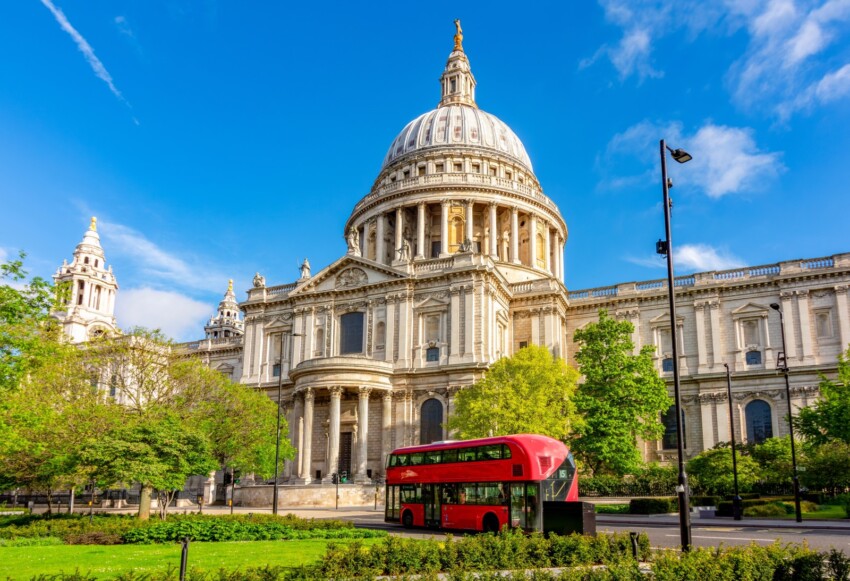
St Paul’s Cathedral sits at the heart of London’s City, atop Ludgate Hill, and is easily accessible by public transport.
By Underground: The nearest station is St Paul’s (Central Line), just a 2-minute walk from the cathedral. Other nearby stations include Mansion House and Blackfriars (both served by the Circle and District Lines), about 6–8 minutes’ walk away, and Bank (Central, Northern, Waterloo & City Lines and DLR), an 8-minute walk.
By train: City Thameslink station is the closest, just a 3-minute walk. Blackfriars (5 minutes) and Cannon Street (6–8 minutes) are also convenient options.
By bus: Numerous routes serve the area, including 4, 8, 11, 15, 17, 23, 25, 26, 56, 76, 100, 172 and 242. Stops are located on Ludgate Hill or in the immediate vicinity.
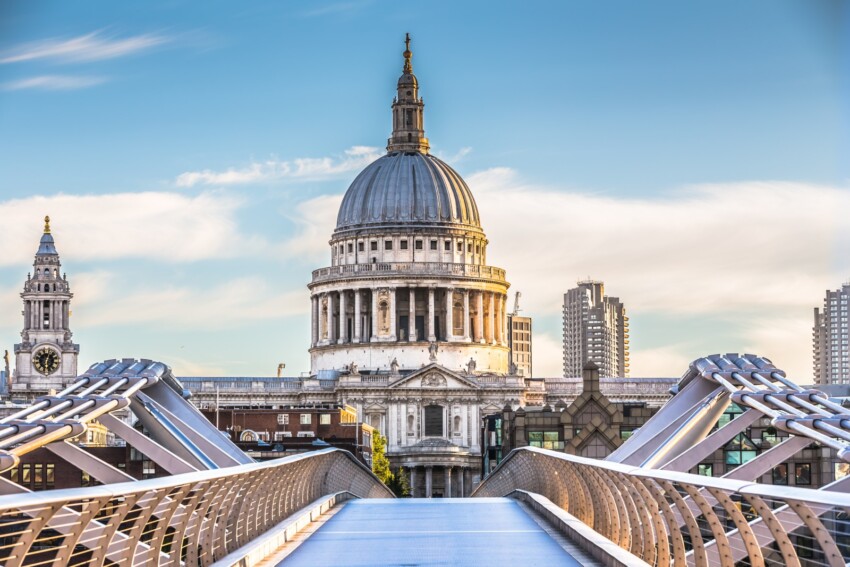
On foot: If you’re coming from the South Bank or the Tower Bridge area, consider crossing the Millennium Bridge, the pedestrian bridge that connects Tate Modern directly to St Paul’s. The view of the cathedral as you approach whilst crossing the Thames is one of London’s most spectacular photo opportunities.
By car: Not recommended due to traffic congestion and restrictions within the Congestion Charge zone. Should you need to drive, paid car parks are available nearby, but rates are steep.
Descending beneath the cathedral floor, you’ll find Europe’s largest crypt, extending the full length of the building and covering approximately 2,800 square metres. This underground space houses over 200 monuments and tombs of some of Britain’s most celebrated historical figures.
The crypt’s focal point is the tomb of Admiral Lord Nelson, positioned directly beneath the dome’s centre. Nelson, killed at the Battle of Trafalgar on 21 October 1805, famously declared “Westminster Abbey or glorious victory!” during the Battle of Cape St Vincent in 1797, but when he died, the Abbey was full. His body, preserved in a barrel of naval brandy during the journey home from Spain, rests in a wooden coffin crafted from the mainmast of a French ship captured at the Battle of the Nile, encased in a black marble sarcophagus.
This sarcophagus has a remarkable history: it was originally commissioned in the 1520s for Cardinal Wolsey but was never used when the cardinal fell from favour. It then lay unused for nearly three centuries until King George III donated it to house Nelson’s remains. On top, instead of the cardinal’s hat originally intended, Nelson’s viscountcy coronet was placed.
Nearby stands the imposing tomb of the Duke of Wellington, fashioned from Cornish porphyry granite on a Peterhead granite base, decorated at its four corners with carved sleeping lions. Arthur Wellesley, 1st Duke of Wellington, defeated Napoleon at Waterloo in 1815, and his state funeral on 18 November 1852 was every bit as grand as Nelson’s. Approximately half a million people filed past his coffin during five days of lying-in-state. A curious detail: Wellington’s coffin was initially lowered through a specially created opening in the cathedral floor and remained above Nelson’s tomb for a year before being moved to its current sarcophagus. Five original flags carried during the funeral procession hang above the tomb.
In 1965, the state funeral of Sir Winston Churchill took place here, the first state funeral for a non-member of the royal family since the Duke of Wellington’s. Though Churchill is not buried at St Paul’s, the ornate gates at the western end of Nelson’s chamber were installed to commemorate the event and place Churchill among Britain’s great historical figures.
The crypt also contains the resting place of Sir Christopher Wren, the cathedral’s architect, in a relatively modest tomb on the east wall. The inscription reads “Si monumentum requiris, circumspice” (If you seek his monument, look around you)—a perfect epitaph for the man who designed the entire cathedral surrounding it.
Other notable figures buried or commemorated in the crypt include painter J.M.W. Turner, sculptors Henry Moore and Edwin Landseer (famous for the Trafalgar Square lions), scientist Sir Alexander Fleming (discoverer of penicillin), whose ashes are preserved beneath a tablet near Wren’s tomb, and Florence Nightingale, who, though not buried here, has an elaborate marble memorial featuring an alabaster relief depicting her tending a wounded soldier.
The crypt also houses the Chapel of the Order of the British Empire (OBE Chapel), a space dedicated to quiet reflection, often used for private ceremonies, with a beautiful altar and stained-glass windows. Another chapel, St Dunstan’s, is open to the public for prayer during opening hours.
The mosaic floors of Nelson’s chamber were created by women imprisoned at Woking Prison in the late 19th century, a detail that adds another layer of social history to this already profoundly significant space.
Whilst not mandatory, it’s highly recommended to purchase tickets online beforehand. This allows you to avoid queues at the ticket desk, guarantees entry during your preferred time slot (especially during peak season) and often saves precious time. Those with tourist passes such as the London Pass need not book but should verify opening hours before your visit.
A comprehensive visit to the cathedral, including the main floor, crypt and all three dome galleries, takes approximately 2–3 hours. If you choose not to climb the dome, 1–1.5 hours should suffice to explore the cathedral floor and crypt. The dome galleries alone, with stops to admire the views, require about 45 minutes to 1 hour.
The climb involves 528 steps in total and can be demanding. The staircases are narrow, steep in places, and there’s no lift. The ascent route is separate from the descent, so once you begin, turning back isn’t easily done. The cathedral recommends that those with mobility issues, heart or breathing conditions, vertigo, claustrophobia, or who are pregnant refrain from attempting the climb. There are, however, three natural stopping points: the Whispering Gallery (257 steps), the Stone Gallery (376 steps) and the Golden Gallery (528 steps), where you can rest before deciding whether to continue.
Yes, flash-free photography for personal use is welcome inside the cathedral outside service times. Video, tripods, monopods and selfie sticks are not permitted. During religious services, photography is not allowed out of respect for the liturgy.
St Paul’s is committed to providing access for all visitors. The main floor and crypt are wheelchair accessible, with lifts available. The dome galleries, however, are accessible only via stairs. Free wheelchairs are available by prior booking. Visitors with disabilities receive free admission and may bring a companion free of charge. Guided tours in British Sign Language (BSL) are available, and multimedia guides include a BSL version.
Absolutely, and admission to services is free. St Paul’s is first and foremost a working cathedral, with prayers every hour and daily services. Choral Evensong is held regularly and is a particularly atmospheric experience, with the cathedral choir singing ancient and contemporary sacred music. Service times are available on the official website. Arrive 15 minutes early as you won’t be admitted once the service has begun.
Yes, St Paul’s is included in both the London Pass and the Go City London Explorer Pass. With these passes you gain free admission without needing to book (though always check opening hours beforehand) and a 10% discount in the cathedral shop. A 2 for 1 offer is also available with valid National Rail train tickets for London.
The cathedral is ideally positioned for exploring London’s City. Within short walking distance you’ll find the Millennium Bridge and Tate Modern on the south bank of the Thames, Tower Bridge and the Tower of London to the east, the British Museum to the north, and South Bank with the London Eye to the west along the river.
There’s no formal dress code for tourist visits, but respectful attire is required given that this is an active place of worship. For religious services, avoid very short shorts, vests and excessively casual clothing. Even in summer heat, remember you’re visiting a cathedral.
The best time is early morning on weekdays, Monday to Thursday, when the cathedral is least crowded. Avoid Fridays and Saturdays if possible. The summer season (July–September) is particularly busy. If you wish to photograph the exterior in good light, late afternoon offers spectacular golden light, especially from the south bank of the Thames or the Millennium Bridge.
The history of St Paul’s Cathedral reaches back to 604 AD, when the Saxon king Sæberht, at the urging of his uncle Æthelberht, King of Kent, commissioned the construction of a church dedicated to St Paul. Bishop Mellitus, consecrated by St Augustine of Canterbury, became London’s first bishop. This original wooden church was destroyed by fire in 675.
A second cathedral was erected but fell victim to Viking raids in 962. The third structure burned down in 1087 during a devastating fire that destroyed much of Norman London. What we know today as Old St Paul’s was probably the fourth cathedral on the site, begun under the Normans in 1087 and consecrated in 1240, then enlarged between 1256 and 1314.
Old St Paul’s was an impressive Gothic cathedral, 179 metres long and 88 metres wide across the transepts. Its spire was amongst the tallest in Europe, second only to Lincoln Cathedral, traditionally reaching 149 metres (though Wren later estimated 140 metres). This spire was destroyed by lightning in 1561, along with the bells and lead roof melted by the heat. The medieval cathedral became a vital hub of London life, hosting not only religious services but also markets in its churchyard and serving as a social meeting place.
By the early 1600s, the cathedral was in grave disrepair. Restoration work begun in the 1630s was interrupted by the English Civil War (1642–1651). In 1666, Christopher Wren had already proposed a radical renovation scheme featuring an impressive dome in place of the tower, a plan approved in late August that year.
But only days later, in the early hours of Sunday, 2 September 1666, a fire broke out at Thomas Farriner’s bakery on Pudding Lane. The Great Fire of London raged for four days, destroying over 13,200 houses and 87 parish churches, including Old St Paul’s. The fire reached the cathedral on the evening of 4 September, spreading rapidly through the wooden scaffolding erected for restoration work. The flames were fed by books and documents that printers and booksellers from nearby St Paul’s Churchyard had stashed in the crypt, believing it to be a safe place.
Eyewitness John Evelyn wrote that “the stones of St Paul’s flew like grenades”, that the melted lead roof poured down Ludgate Hill like a torrent, and that the pavings glowed red from the heat of the inferno. When the wind died down and the fire was extinguished on 6 September, only blackened ruins remained of the medieval cathedral.
Christopher Wren (1632–1723) was not originally an architect, but a renowned scientist, mathematician and astronomer. Only in his early thirties did he turn to architecture, receiving his first two commissions at Oxford in 1663. He could never have anticipated the extraordinary opportunities that would come his way: to become the architect of monarchs and design a new cathedral for London.
Following the Great Fire, Wren was appointed Surveyor of St Paul’s Cathedral in 1669 and spent nine years developing the final design. He had to submit five different versions before gaining approval. In 1672 he obtained Charles II’s approval for what is known as the “Great Model”, but the ecclesiastical commission rejected it. The final approved design, known as the “Warrant Design”, included a spire that Wren subsequently replaced with the dome we see today.
The foundation stone was laid on 21 June 1675, though actual construction work began months later, as Wren continued to radically alter almost every element of the design (the king had secretly granted him this freedom). As a result, the final building is quite different from the original Warrant Design.
During construction, Wren had to solve complex engineering problems. London’s clayey soil was not ideal for supporting such a massive structure. With the help of Nicholas Hawksmoor, Wren used a combination of enormous blocks of Portland stone (a high-quality limestone from Dorset), brick, iron and timber to distribute the weight. Portland stone, with its characteristic pale grey colour, gives the cathedral its distinctive and elegant appearance.
The consecration took place on 2 December 1697, when the western end and dome were still under construction. The first regular service was held the following Sunday. The Bishop of London, Henry Compton, preached the sermon based on Psalm 122: “I was glad when they said unto me, We will go into the house of the Lord”.
The final stone of the structure, the lantern crowning the dome, was set in place on 26 October 1708 by Christopher Wren Jr., the architect’s son, along with the son of one of the master masons. Parliament officially declared the cathedral complete on 25 December 1711 (Christmas Day), though work continued for years. The interior dome decorations by Thornhill were completed in 1721, and the west front statues by Francis Bird in 1722. The total cost came to 1,095,556 pounds (roughly 207 million pounds in today’s value), funded partly by donations and partly through a special tax on coal.
One of the most fascinating stories connected with the construction concerns the phoenix, symbol of rebirth from the ashes. According to legend, as Wren was marking out the centre of the dome on the cleared ground, he called over a workman to bring him a stone from the debris scattered across the site to use as a marker. The man brought him the nearest piece of masonry. When Wren turned the stone over, he discovered it was a tombstone with a single word carved upon it: “RESURGAM” (Latin for “I shall rise again”).
Today, on the south pediment of the cathedral, you can see a stone relief depicting a phoenix with wings spread, rising from flames, beneath which is carved that very word: RESURGAM. This image perfectly encapsulates both Christian resurrection and London’s own rising from the ashes of the Great Fire.
City Card allow you to save on public transport and / or on the entrances to the main tourist attractions.


 Hotel
Hotel  Budget accommodations
  Apartments
  Family Hotel
  Luxury Hotel