Bestseller
London: Tower of London and Crown Jewels Exhibition Ticket
From 42,37 €
Buy the ticket
Imposing and austere, the Tower of London has risen on the banks of the River Thames for nearly a thousand years, a silent witness to some of the most dramatic events in British history. This medieval fortress, officially called Her Majesty’s Royal Palace and Fortress of the Tower of London, is far more than an ancient castle—it is a complex of buildings that encapsulates the very essence of English history.
With its mighty walls of white stone that contrast sharply with the modern landscape of the City of London, the Tower has served over the centuries as a royal fortress, state prison, mint, arsenal, treasury and even a royal zoo. Today it stands as one of the most visited monuments in the United Kingdom, attracting over 3 million visitors annually, all captivated by its tales of royal intrigue, betrayal, executions and the mysterious ravens that guard its walls.
In this guide, we will take you through the tumultuous centuries of the Tower of London’s history, reveal its most precious treasures—including the legendary Crown Jewels—and provide you with all the practical information you need to plan your visit to this extraordinary monument, recognised by UNESCO as a World Heritage Site since 1988.
At the heart of the complex stands the White Tower, the square tower of white stone that gives the entire castle its name and represents one of the finest examples of Norman architecture in England. Built on the orders of William the Conqueror around 1078, this imposing structure, standing 27 metres tall, was designed to inspire fear in Londoners and symbolise the power of the new Norman regime.
Today the White Tower houses the Royal Armouries Collection, an extraordinary display of royal armour and weapons spanning more than 500 years of British military history. Don’t miss the Line of Kings, the world’s oldest museum exhibition, showcasing the armour of various English monarchs, including that of Henry VIII, specially designed to accommodate his imposing physique. Each floor of the building features fascinating exhibits, from sophisticated medieval torture instruments to elegant royal apartments.
The most picturesque vantage point for photographing the White Tower is from the western entrance, where you can capture the entire façade with its distinctive corner turrets. To fully appreciate the Norman architecture, pay attention to the massive columns and arches of the Chapel of St John the Evangelist on the first floor, one of the finest preserved sacred spaces of the period.
One of the Tower’s most spectacular attractions is undoubtedly the Jewel House, which safeguards the British Crown Jewels, the world’s largest collection of royal regalia still in active use. This priceless assemblage comprises crowns, sceptres, ceremonial swords and other symbols of monarchical power used during coronations and state ceremonies.
The most celebrated piece is the Imperial State Crown, worn by Queen Elizabeth II during the State Opening of Parliament and adorned with over 2,800 diamonds, 273 pearls, 17 sapphires, 11 emeralds and 5 rubies. Equally impressive is the St Edward’s Crown, used solely during the moment of coronation, and the Cullinan I (or “Great Star of Africa”), the largest cut diamond in the world, set into the Sceptre with Cross.
To avoid long queues, visit the Jewel House in early morning or late afternoon. The jewels are displayed behind reinforced glass, with a conveyor system that regulates visitor flow, ensuring everyone gets a chance to admire them. Photography is not permitted inside the Jewel House, so take the time to savour these extraordinary treasures.
The Bloody Tower owes its macabre name to the belief that the two young Princes in the Tower, Edward V and his younger brother Richard, Duke of York, were murdered here in 1483 on the orders of their uncle, Richard III. Although this has never been definitively proven, the tower was indeed the scene of other tragic royal events.
It was here that Anne Boleyn, Henry VIII’s second wife, spent her final days before her execution in 1536, along with other fallen queens such as Catherine Howard and Lady Jane Grey. The tower now houses an exhibition telling the stories of these and other illustrious prisoners, featuring reconstructions of their cells and personal artifacts.
Particularly moving is the small chapel of St. Peter ad Vincula adjacent to the tower, where the decapitated bodies of Anne Boleyn and Catherine Howard were buried. This royal chapel, usually included in guided tours by the Yeoman Warders, offers a moment of reflection on the tragic human stories that unfolded within these walls.
The Tower Green is a small grassed area within the fortress where private executions took place, reserved for prisoners of noble blood or particular political importance. Unlike public executions that occurred on nearby Tower Hill, these offered a kind of “privilege,” away from the gaze of the crowd.
Today, a poignant glass memorial marks the site of the scaffold. Designed by artist Brian Catling and installed in 2006, the commemorative monument bears an inscription remembering those who lost their lives here, including three Queens of England: Anne Boleyn (1536), Catherine Howard (1542) and Lady Jane Grey (1554).
The place has a particularly evocative atmosphere, especially in the early morning hours or at sunset, when tourist groups are fewer. Spend a moment in this history-laden space and reflect on the human dramas that unfolded in this small corner of London.
According to an ancient legend, should the ravens ever abandon the Tower of London, the kingdom would fall and the nation with it. For this reason, at least six ravens are always kept within the Tower complex, with a “reserve” of trained ravens standing ready to replace any bird that might escape or die.
These majestic black birds, considered the official guardians of the Tower, are cared for by the Ravenmaster, a Yeoman Warder specifically charged with their welfare. Each raven has a name and distinct personality, easily recognised by a coloured ring on its leg. Currently, the Tower is home to seven ravens: Jubilee, Harris, Gripp, Rocky, Erin, Poppy and Merlina.
The ravens are highly intelligent and often interact with visitors, though it’s advisable to maintain a safe distance and not attempt to feed or touch them. Their night quarters are located near the Wakefield Tower, but during the day you may encounter them freely throughout the fortress grounds.
The Medieval Palace offers a fascinating glimpse into court life during the medieval period. Located within the towers of St. Thomas and Wakefield, the palace has been meticulously reconstructed to show how the royal apartments would have appeared during the reign of Edward I (1272-1307).
The rooms are furnished with accurate replicas of period furniture, fabrics and objects, creating an immersive atmosphere that transports you back in time. You can admire the king’s colourful wardrobe, the bedroom with its sumptuous four-poster bed, and the council chamber where the monarch met with his advisors.
Particularly striking is the original 13th-century fireplace in the Wakefield Tower, decorated with murals depicting zodiac signs. Don’t miss the reconstruction of Edward I’s original crown either, created using ancient designs and historical records.
The Yeoman Warders, commonly known as Beefeaters, are the ceremonial guardians of the Tower of London and one of its most iconic attractions. In their distinctive blue and red uniforms, these guards are far more than tourist attractions—they are serving members of the British armed forces with at least 22 years of military service behind them.
In addition to protecting the fortress, the Yeoman Warders conduct exceptionally popular guided tours departing every 30 minutes from the main entrance. These tours, included in your admission fee, offer the perfect blend of historical facts, fascinating anecdotes and British humour, making your visit all the more memorable.
Don’t miss the Ceremony of the Keys, an evening closing ritual that has been performed without interruption for over 700 years. This brief ceremony, which begins precisely at 21:53 every evening, sees the Yeoman Warders formally secure the fortress gates for the night. The event is free but requires booking several months in advance due to its popularity.
The Traitors’ Gate is one of the Tower’s most notorious entrances, an arched portal that opens directly onto the River Thames. In an era when London’s streets were often controlled by hostile crowds, many state prisoners were transported to the Tower by river, entering through this sinister water gate.
Among the most famous “traitors” said to have passed through this gateway were Anne Boleyn, Sir Thomas More and the future Queen Elizabeth I, when she was still a princess during the reign of her sister Mary I. Today you can see the Traitors’ Gate during your visit via Water Lane, the passageway that runs along the south side of the fortress.
The best time to photograph this historic structure is during low tide, when the water recedes and reveals more of the 13th-century architecture. The view of the gate with Tower Bridge in the background offers an intriguing juxtaposition of medieval and Victorian London.
The Wall Walk offers the opportunity to traverse the mighty defensive walls surrounding the Tower complex, connecting the various perimeter towers. This elevated walkway not only rewards you with spectacular views over London and the River Thames, but also allows you to explore several historic towers, each with its own function and stories to tell.
The route provides access to various towers, including the Martin Tower, where the Crown Jewels were kept until a daring theft attempt in 1671; the Constable Tower, the traditional residence of the Constable of the Tower; and the Salt Tower, where graffiti carved by 16th-century prisoners remains visible.
Along the Wall Walk you’ll also find interactive displays recounting the fortress’s military history, with explanations of medieval defence techniques and the various threats faced by the Tower over the centuries. To make the most of this experience, allow at least 30-40 minutes for the walk and wear comfortable shoes.
The Royal Mint Exhibition tells the story of coin production in England, an activity that took place within the Tower for over 500 years, from 1279 until 1812. This interactive exhibition allows you to discover how coins were minted in medieval times and how this craft evolved throughout the centuries.
You can see original tools used by master minters, rare coins spanning different historical periods, and even try lifting a gold ingot (a replica, of course!) to feel its weight. Particularly fascinating are the stories of the risks posed by “clipping” (the illegal practice of scraping precious metal from coin edges) and the severe punishments meted out to counterfeiters.
The exhibition also includes sections dedicated to Isaac Newton, who served as Master of the Royal Mint from 1699 to 1727, and his relentless pursuit of counterfeiters, revealing a little-known side of the famous scientist.
The history of the Tower of London begins in 1066, when William the Conqueror, after defeating Anglo-Saxon King Harold at the Battle of Hastings, decided to build a fortress to consolidate his power over the newly conquered city. Construction began in 1078 with the building of the White Tower, the original nucleus of the complex.
Over the following centuries, various monarchs expanded the fortress, adding outer defensive walls, additional towers and royal apartments. Henry III (1216-1272) and his son Edward I (1272-1307) were responsible for much of the medieval expansion, transforming the Tower into one of Europe’s most imposing fortresses and a comfortable royal residence.
The Tower reached the height of its use as a royal palace during the medieval period, but with the advent of the Tudor dynasty in the fifteenth century, it increasingly took on the role of state prison for enemies of the crown. During the reign of Henry VIII, the fortress became notoriously known as a place of imprisonment and execution for high-profile figures, including two of his wives.
Throughout its long history, the Tower has served multiple functions: in addition to being a fortress and prison, it has also been a royal arsenal, a mint, a public record office and even a zoo. From the thirteenth to the nineteenth century, it housed a collection of exotic animals gifted to English monarchs, including lions, elephants and even a polar bear that fished in the Thames.
Significant alterations to the structure ceased after the Tudor period, and during the Victorian era the Tower underwent extensive restoration under the direction of architect Anthony Salvin, who sought to restore its medieval appearance, sometimes with results that are historically questionable by modern standards.
A particularly dark chapter in the Tower’s recent history was written during World War II, when the fortress was damaged by German air bombardment. The last major prisoner held in the Tower was Rudolf Hess, Hitler’s deputy, who was briefly imprisoned here in 1941.
Today, the Tower of London is one of the United Kingdom’s most visited tourist attractions and since 1988 has been recognised by UNESCO as a World Heritage Site, celebrated as an exceptional example of Norman military architecture and a testament to the enduring influence of the European monarchical state in the medieval and modern age.
Visiting the Tower of London requires the purchase of an admission ticket. Prices vary depending on age and the type of ticket chosen.
We strongly recommend purchasing tickets online in advance not only to avoid queues at the ticket office, but also because online booking discounts of around 15% compared to gate prices are often available.
For those planning to visit multiple royal historic attractions in London, a Royal Pass is available offering access to multiple sites with significant savings. The Tower of London is also included in numerous city cards such as the London Pass, which can be worthwhile if you plan to visit many attractions during your stay.
The ticket price includes access to a guided tour conducted by the iconic Yeoman Warders (Beefeaters). These free tours last approximately 60 minutes and depart every 30 minutes from the main area near the entrance. They are extremely popular thanks to the mix of historical information, fascinating anecdotes and British humour that characterises them.
For a more exclusive experience, private tours are available before or after public opening hours. These tours allow you to see some areas normally inaccessible to the public and to enjoy the Crown Jewels without the crowds.
Audioguides are also available in several languages offering detailed information on over 45 points of interest within the fortress and can be an excellent alternative if you prefer to explore at your own pace or if for any reason you cannot participate in the Beefeaters tour.
The Tower of London is open to visitors every day of the week, with hours varying slightly depending on the season:
The fortress is closed on 25 and 26 December (Christmas and Boxing Day) and from 1 to 3 January. Additionally, exceptional closures may occur during royal ceremonies or special events.
For a complete visit to the Tower of London, you should plan to spend at least 2-3 hours within the complex. This will allow you to see the main attractions, including the Crown Jewels, the White Tower and participate in a tour with the Yeoman Warders.
If you wish to explore every corner of the fortress, read all the exhibitions and fully enjoy the experience without rushing, you could easily spend 4-5 hours inside. Many visitors choose to bring a packed lunch to consume in designated areas to maximise available time.
The best time to visit the Tower is on weekdays outside school holidays, when there are fewer visitors. If you must visit during peak seasons (summer, Easter or Christmas holidays), we recommend arriving at opening time or in the last two hours before closing to avoid the largest crowds.
Regarding the time of day, the Crown Jewels tend to be particularly crowded between 11:30am and 3:30pm. If possible, visit this section at opening time or in the late afternoon to reduce waiting times.
The Tower of London hosts numerous special events throughout the year, offering unique experiences that go beyond the standard visit.
The Ceremony of the Keys is one of the world’s oldest military rituals, performed continuously for over 700 years. Every evening at precisely 9:53pm, the Chief Yeoman Warder, accompanied by an escort of guards, proceeds to formally close the Tower’s gates for the night. The ceremony lasts approximately 35 minutes and concludes at 10:05pm with the traditional sound of a trumpet.
This fascinating event is free, but requires advance booking which must be made at least 6-12 months in advance due to its enormous popularity. Bookings are made on the Historic Royal Palaces official website, and we recommend checking regularly for availability as additional places are occasionally released.
During the winter months (November-April), the Tower offers Tower Twilight Tours, guided tours at dusk that allow you to explore the fortress after closing time, when shadows lengthen and the atmosphere becomes particularly evocative. These tours, conducted by costumed Yeoman Warders, focus on the Tower’s darker stories and ghost tales.
The tours begin at 7:00pm and last approximately 90 minutes. The experience is recommended for visitors aged 12 and over due to the unsettling nature of some stories. Bookings are made online and spaces are limited, so it is advisable to book several weeks in advance.
On special occasions such as royal birthdays, the monarch’s accession to the throne and state visits, the Tower of London hosts Royal Gun Salutes, ceremonial cannon fire from the Tower’s artillery battery. These spectacular events involve the firing of 62 cannon shots (the standard 21-gun royal salute, plus 20 for being at a royal residence, plus an additional 21 for being in the City of London).
Gun Salutes usually take place at noon and are visible from Tower Wharf, the area along the Thames. Admission to attend this event is free, but a standard ticket is required to enter the Tower complex if you also wish to visit the other attractions.
On significant historical anniversaries, the Tower hosts commemorative art installations. The most famous example was the “Blood Swept Lands and Seas of Red” installation in 2014, in which 888,246 ceramic poppies – one for each British or colonial soldier killed during World War I – were planted in the Tower’s moat, creating a powerful and moving image that attracted millions of visitors.
Similar special events are organised periodically, so check the Tower’s official website for any installations during your visit.
During the summer months and some holiday periods, costumed actors perform historical recreations within the fortress, recreating key moments in the Tower’s history or illustrating aspects of daily life in different historical periods. These interactive performances are included in the standard ticket price and offer an engaging way to immerse yourself in history, particularly appreciated by younger visitors.
Performances take place regularly throughout the day at various points within the fortress, and a detailed schedule is usually available at the entrance or at information points inside.
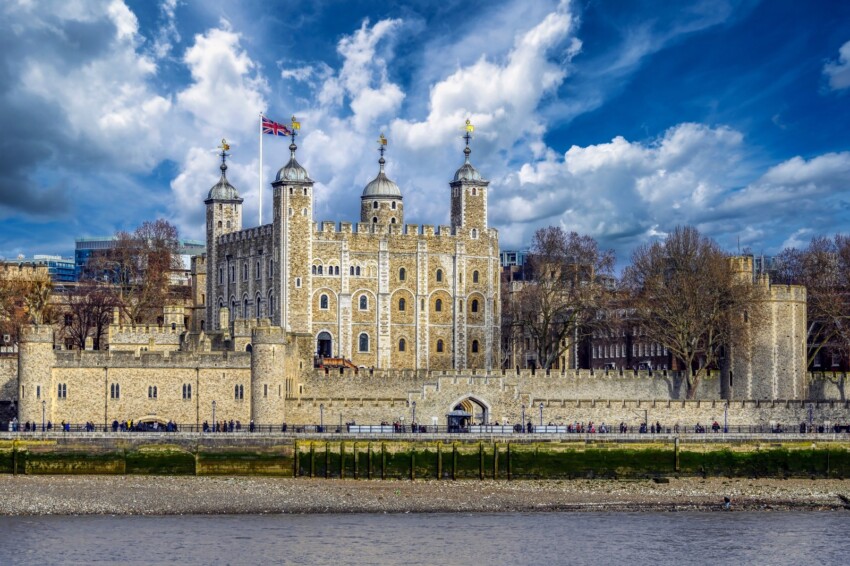
The Tower of London is located in the heart of the city, on the banks of the Thames, and is easily accessible by several means of transport.
The most convenient way to reach the Tower is by using the Underground. The nearest stations are:
Numerous bus routes also serve the Tower of London area:
A particularly scenic way to reach the Tower is to use the River Thames transport service. Thames Clippers boats stop at Tower Pier, right opposite the Tower. This service connects various attractions along the river, including the London Eye, Tate Modern and Greenwich, offering splendid views of the city from the water.
Yes, it’s highly recommended to book tickets online in advance, especially during peak season (summer and holiday periods). Advance booking not only guarantees your entry on your chosen day, but also offers a discount compared to the gate price and helps you avoid queues at the ticket office.
For security reasons, large luggage, suitcases and potentially dangerous items are not permitted inside the Tower. Security checks similar to those at airports are in place at the entrance. You’re welcome to bring small rucksacks, bags, cameras and water bottles. Food is permitted but can only be consumed in designated areas.
No, the Tower of London doesn’t offer a luggage storage service for security reasons. If you have large bags, we recommend using the left luggage services available at major railway stations such as King’s Cross, Victoria or London Bridge, or services like Luggage Hero or Stasher which offer drop-off points throughout the city.
Rigorous security checks, including metal detectors and bag scanning, are in operation at the Tower’s entrance. Security staff are present throughout the fortress, and CCTV cameras are installed. Depending on the national threat level, additional security measures may be implemented, which could result in longer entry times.
Photography is generally permitted throughout the Tower of London for personal use, with some exceptions. Photography is not allowed inside the Jewel House where the Crown Jewels are kept. Tripods are also prohibited, as is flash photography in certain sensitive areas, and professional video recording without authorisation. Commercial photography requires special permission, which must be requested in advance.
Absolutely! The Tower offers numerous activities designed specifically for children. The Family Trails is a free interactive route designed to engage youngsters with the fortress’s history. Many exhibits include interactive elements, and the Yeoman Warders are skilled at telling stories that capture children’s imagination. During school holidays, workshops and special family activities are often organised. Pushchair access is possible in most of the site, although some historic towers have steep stairs and cramped spaces.
The Tower has significantly improved accessibility in recent years, but as a historic building, it still has some limitations. The Tower Fortress route offers an accessible itinerary covering approximately 65% of the site. Ramps and lifts are available to access the White Tower and the Jewel House. Visitors with reduced mobility can request a manual wheelchair for free (it’s advisable to book this in advance). Carers of visitors with disabilities receive free admission. Audio guides with subtitles are available for visitors with hearing difficulties, and tactile maps for the blind.
The Tower has several dining options:
During peak season, additional temporary catering points are available within the complex. You’re also welcome to bring your own food and have a picnic in designated areas, such as the North Moat.
Yes, the Tower is included in the London Pass, which offers entry to over 80 London attractions. The London Explorer Pass and London City Pass also include Tower entry. These cards can be a good investment if you’re planning to visit several attractions during your stay in London.
A visit to the Jewel House alone, where the Crown Jewels are kept, typically takes 30-45 minutes. However, during peak season, queuing time can add a further 30-60 minutes. The Jewels are displayed on slowly moving conveyor belts in front of display cases, ensuring all visitors get a chance to view them, but limiting viewing time. You’re welcome to rejoin the queue to see them a second time if you wish.
Unlike the more famous Changing of the Guard at Buckingham Palace, the Ceremony of the Word at the Tower of London is a smaller and less publicised event. It generally takes place at 11:00 on weekdays and 10:00 on Sundays, when soldiers of the regiment stationed at the Tower (usually the Royal Guard or Royal Fusiliers) formally change the guard. The ceremony lasts approximately 10-15 minutes and takes place in the Tower Green area.
City Card allow you to save on public transport and / or on the entrances to the main tourist attractions.

 Hotel
Hotel  Budget accommodations
  Apartments
  Family Hotel
  Luxury Hotel