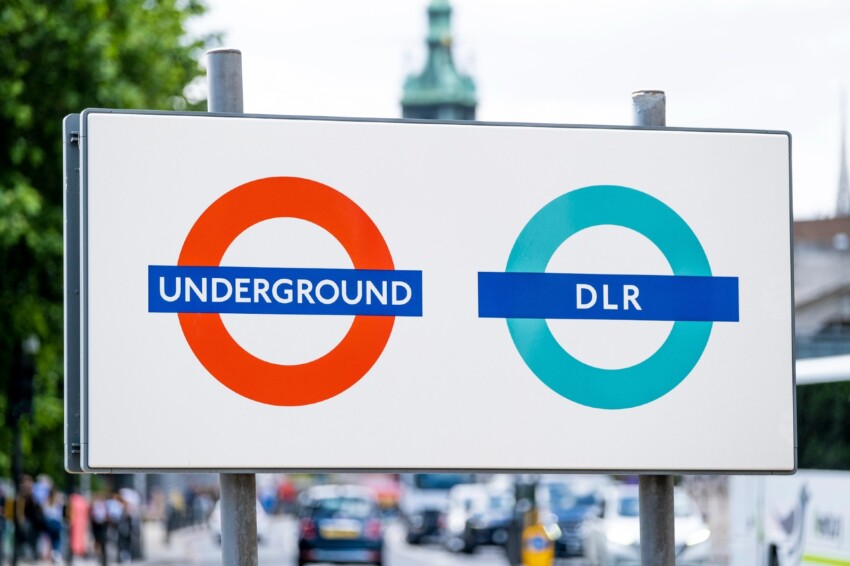
When thinking about London’s public transport, your mind immediately turns to the famous Underground with its iconic coloured lines. However, there exists an equally fascinating and incredibly useful transport system for tourists: the DLR, short for Docklands Light Railway.
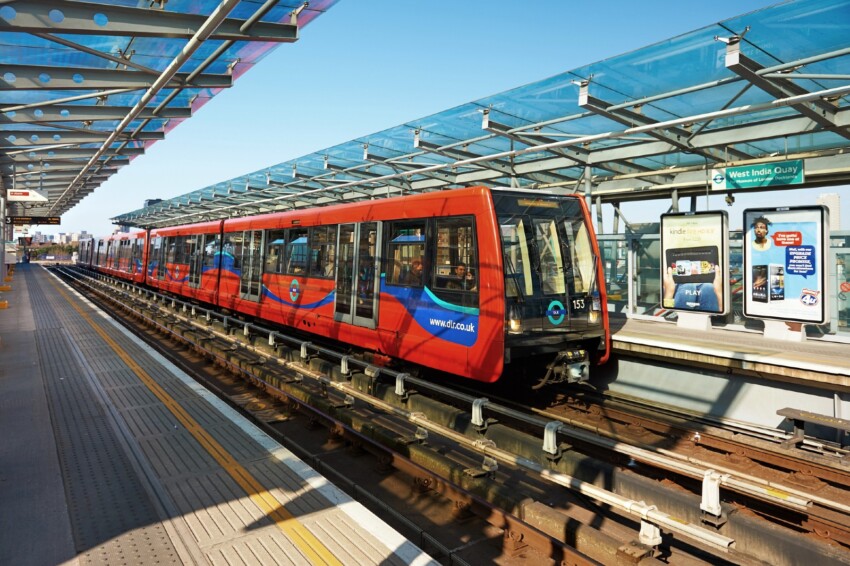
The DLR is a light railway, completely automated and driver-free, that connects central London with the eastern zones.
Its tracks and trains are not compatible with the rest of London’s Underground network, but the two systems are perfectly integrated: train frequencies are synchronised with Underground timetables and you use the same tickets and passes for both services.
The DLR light railway also connects with the IFS Cloud Royal Docks, London’s cable car that crosses the Thames, at Royal Victoria station.
Those who manage to board the front carriage of DLR trains and sit in the front – much sought-after – seats can enjoy a wonderful panorama and, if you fancy it, even imagine yourself in the driver’s role!
The Docklands Light Railway (DLR) is an automated light railway system serving east London, opened in 1987 to regenerate the former dock areas of the Docklands, which had fallen into decline following the closure of commercial ports.
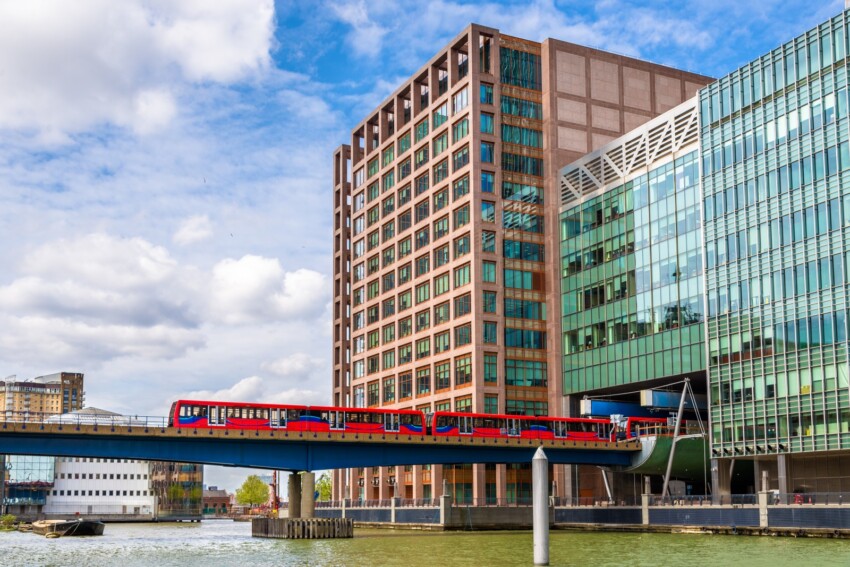
Unlike the traditional Underground, which runs mostly underground, the DLR is an elevated system: most of the route runs on elevated viaducts or at ground level, offering spectacular views of the London skyline, the Thames and the areas it passes through. Only some sections run in underground tunnels, mainly beneath the river and in more densely populated central areas.
The network extends for approximately 38 kilometres and has 45 stations distributed across 6 main lines, all identified by the distinctive aquamarine colour on London’s transport map. It carries approximately 350,000 passengers daily, predominantly commuters working in the financial districts of Canary Wharf and the City, but increasingly tourists drawn to the destinations it serves.
The most distinctive and fascinating characteristic of the DLR is that the trains are completely automated, with no driver on board. The trains are controlled by an advanced computer system that manages speed, stops, door opening and safety.
A staff member called a Passenger Service Agent (PSA) travels on the train and is responsible for assisting passengers, providing information, checking tickets and intervening in emergencies, but does not drive the train. They generally position themselves in the last carriage and monitor the situation through internal cameras.
This characteristic offers a unique opportunity to passengers: you can sit at the front of the train, where the driver’s cabin would normally be, and enjoy a panoramic view of the entire route. It’s like being at the controls of a real train, watching the tracks stretching ahead of you, the signals changing colour, and the bends revealing new glimpses of the city.
For children it’s an exciting experience and for adults a completely different way to experience public transport. Many tourists board the DLR specifically for this experience, even when they don’t have a specific destination in mind.
Main destinations served by the DLR
The Docklands Light Railway is used to reach various areas efficiently that are not served by the Underground.
The DLR connects the city centre with the Docklands area and East London, passing through Canary Wharf, Greenwich, London City Airport, Stratford and extending to outlying areas of the city.
In particular, the connection to London City Airport is extremely convenient, which is located in zone 3, to the east of central London, approximately 10 kilometres away.
DLR Map
Below you can download the DLR map in PDF to have it with you during your London trip.
Canary Wharf is London’s second financial district after the City, characterised by imposing ultra-modern skyscrapers, underground shopping centres and contemporary public spaces. The DLR has three stations in the area: Canary Wharf (the main one), Heron Quays and West India Quay.
The area offers a fascinating contrast with historic London: here everything is modern, vertical and futuristic. You can visit public spaces free of charge, admire contemporary architecture, shop in the underground shopping centres, and enjoy views from river level along the renovated docks.
The Museum of London Docklands (West India Quay stop) tells the story of the Docklands and London’s maritime commerce in a fascinating restored Georgian warehouse. Admission is free and it’s a very interesting visit to understand how this area has transformed.
Greenwich
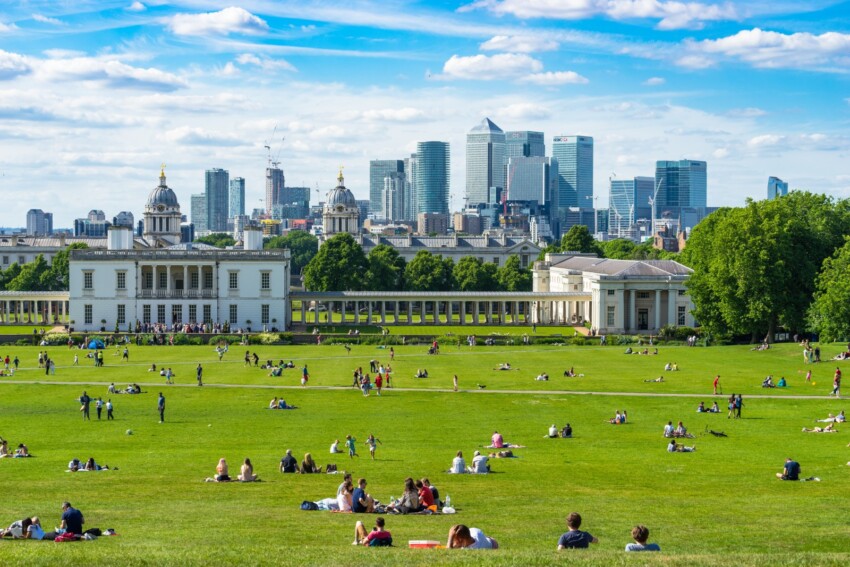
The DLR is the most scenic way to reach Greenwich, the famous UNESCO World Heritage district renowned for the Prime Meridian, the Royal Observatory and the Cutty Sark. The relevant stations are Cutty Sark for Maritime Greenwich and Greenwich.
The journey itself is spectacular: the DLR crosses the Thames in an underground tunnel and then emerges offering magnificent views of the river, the Docklands and the Canary Wharf skyline. Once in Greenwich, you can visit the National Maritime Museum, the Royal Observatory, stroll through the beautiful Greenwich Park and have your photo taken straddling the Prime Meridian.
The entire area is rich in maritime history, characterful markets, historic pubs and excellent restaurants. Greenwich easily deserves half a day of your London itinerary.
ExCeL London and Royal Victoria Dock
Custom House or Prince Regent stops take you to ExCeL London, one of Europe’s largest convention and exhibition centres. Even if you don’t have a specific event to attend, the Royal Victoria Dock area is fascinating to explore.
This Victorian dock, once a busy commercial port, is now a peaceful body of water surrounded by pedestrian and cycle paths. From here departs the IFS Cloud Cable Car, London’s cable car that crosses the Thames connecting Greenwich Peninsula to Royal Docks, offering spectacular aerial views of the city.
Stratford and the Olympic Park
Although Stratford is better served by the Underground and Overground, the DLR offers direct connections from other east London areas. Stratford station is the gateway to the Queen Elizabeth Olympic Park, built for the 2012 Olympics and now transformed into a huge public park with sporting, cultural and recreational attractions.
You can visit the London Stadium (now home to West Ham United), the Aquatics Centre by Zaha Hadid, the ArcelorMittal Orbit (a panoramic tower with an integrated slide), and the shopping centre Westfield Stratford City, one of Europe’s largest.
London City Airport
One of the most useful DLR functions for tourists is the direct connection to London City Airport (London City Airport stop). If your flight arrives or departs from this airport, the DLR is the most convenient and economical way to reach central London.
The journey from Bank to London City Airport takes approximately 22 minutes and costs £3.70 with an Oyster Card during peak hours. Much cheaper and often faster than a taxi, with the added benefit of avoiding London’s traffic.
Fares and payment methods
The DLR is fully integrated into London’s public transport system managed by Transport for London (TfL), which means it works exactly like the Underground in terms of tickets, fares and payment methods.
Accepted payment methods
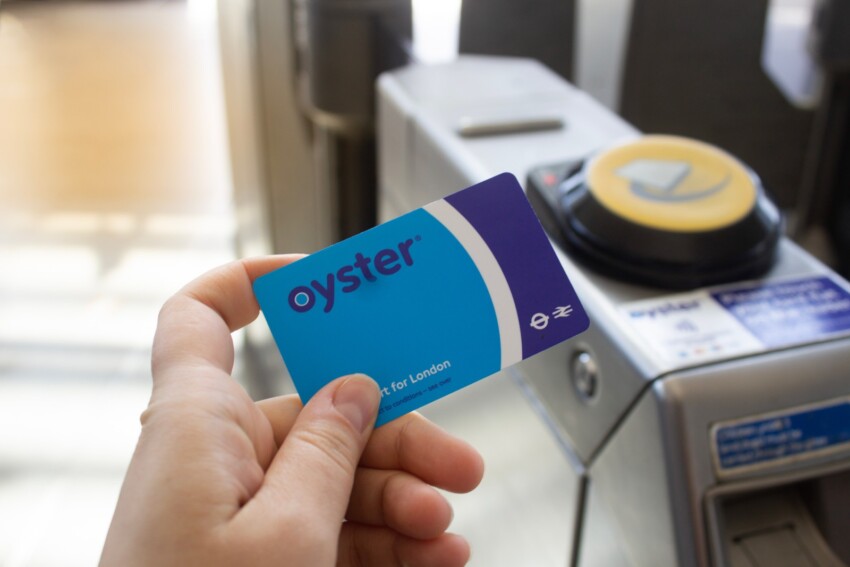
You can use the same payment methods on the DLR that are valid for the entire TfL network. The Oyster Card is the most popular method: this reloadable electronic card works perfectly on all DLR trains and offers the most competitive fares compared to single paper tickets.
Alternatively, you can use a contactless credit or debit card, simply by touching it to the yellow readers at the entry and exit barriers. Fares are identical to those of the Oyster Card and the system automatically calculates the correct cost of your journey and applies daily spending limits.
The Travelcard, the daily or weekly pass for unlimited travel, is also valid on the DLR. If you’ve already purchased a Travelcard to get around London, you can use it freely on all DLR trains at no extra cost, provided the zones you travel through are covered by your card.
Fares and zones
As with the Underground, DLR fares are calculated based on the zones travelled through and the time of travel. Most DLR stations are located in zones 2, 3 and 4, with some extensions to zone 6 for London City Airport.
A typical journey from Bank (zone 1) to Canary Wharf (zone 2) costs £2.80 during peak hours and £2.70 outside peak hours with an Oyster Card or contactless card. Peak hours are Monday to Friday 6:30 to 9:30 and 16:00 to 19:00.
It’s important to remember that, as with the Underground, a daily spending cap applies: once you’ve reached a certain amount in a day, all subsequent journeys are free. For zones 1-2, the cap is £8.50.
How to validate your ticket
All DLR stations are equipped with automatic barriers at entry and exit. You must always validate your Oyster Card or contactless card both when entering and exiting the station, exactly as on the Underground.
Touch your card to the circular yellow reader: you’ll hear a “beep” and see a green light confirming the transaction. The barriers will open automatically. If you forget to touch out on exit, you’ll be automatically charged the maximum fare, which can be significantly higher than the actual cost of your journey.
The reader display shows your remaining credit after each validation, allowing you to monitor your spending and know when you need to top up your card.
Operating hours
The DLR operates with timetables similar to London’s Underground, but with some specificities depending on the different lines and day of the week.
During weekdays, the service generally starts around 5:30 in the morning and ends around midnight, with variations depending on the specific line and station. Lines serving financial districts like Canary Wharf have very high frequencies during peak hours, with trains every 2-3 minutes.
At weekends, the service starts slightly later (around 7:00 in the morning on Sundays) and train frequency is reduced, generally with trains every 8-10 minutes. The DLR closes around midnight at weekends too.
It’s important to note that the DLR does not offer a night-time service like some Underground lines (Night Tube). If you need to travel at night in areas served by the DLR, you’ll need to use night buses or other transport options.
Connections with other transport
The DLR is perfectly integrated into London’s public transport system, with numerous strategic interchange points with the Underground, trains and buses.
Interchanges with the Underground
The main interchange points with the Underground are:
Bank/Monument: here the DLR connects with as many as 5 Underground lines (Central, Northern, Waterloo & City, District and Circle), making it one of the most important hubs in all of London. From here you can reach virtually any part of the city.
Tower Gateway: adjacent to Tower Hill station on the Circle and District Lines, very close to the Tower of London. It’s the ideal starting point if you want to explore the Docklands after visiting the historic attractions of the centre.
Stratford: mega-hub connecting DLR, Central Line, Jubilee Line, London Overground and national trains. From here you can reach any direction.
Canary Wharf: important interchange with the Jubilee Line, which offers quick connections to Westminster, London Bridge and the West End.
Canning Town: here the DLR meets the Jubilee Line and offers connections to various directions of the DLR network itself.
Overground connections
At Shadwell you can change to the London Overground (orange line on the map), useful for reaching areas such as Shoreditch, Dalston and north-east London.
Train connections
At Stratford and Woolwich Arsenal the DLR connects with national trains, allowing you to continue to destinations outside London or arrive directly from other British cities.
Tips for the best experience
Sit at the front for the best views
This is the most important tip: arrive at the platform a few minutes early and position yourself at the front of the train. The front seats are the most coveted, especially at weekends when there are more tourists and families about. From here you’ll enjoy panoramic views of the entire route, turning your journey into an attraction in itself.
If the front seats are taken, the rear carriages offer similar views too, looking back along the route you’ve just travelled.
Take a scenic loop
If you have time, consider taking a complete scenic loop on the DLR without a specific destination in mind. A suggested route is from Tower Gateway to Bank, then to Canary Wharf, continuing to Greenwich and back. In about an hour you’ll have seen some of London’s most spectacular aerial views.
With an Oyster Card or contactless payment card, remember that if you complete the loop in under an hour and return to your starting station without exiting, you may be eligible for a reduced fare, though this isn’t guaranteed.
Combine the DLR with the London Cable Car
For a truly unique experience, combine a DLR journey with a ride on the IFS Cloud Cable Car, the cable car that crosses the Thames. You can take the DLR to Royal Victoria or to North Greenwich (via the Jubilee Line), and from there board the cable car.
The aerial views over the city, the Docklands and the river are spectacular. The cable car is integrated into the TfL payment system and you can use your Oyster Card, though fares are slightly higher than standard transport (£4.50 with Oyster).
How to save on transport and entrance fees
City Card allow you to save on public transport and / or on the entrances to the main tourist attractions.
 Hotel
Hotel  Budget accommodations
  Apartments
  Family Hotel
  Luxury Hotel