London’s iconic red double-decker buses form one of the most extensive public transport systems on the planet.
Travelling by bus represents a cost-effective alternative to the underground whilst also offering the opportunity to admire the city along the way.
Central London benefits from impressive frequency, with buses arriving every 5-10 minutes on main routes. However, you should be aware that traffic can significantly slow journeys in certain areas and at peak times, and buses are often very crowded during rush hours. In outer areas, particularly at night or on public holidays, frequency reduces considerably.
A crucial point to know is that for several years it has no longer been possible to purchase tickets onboard London buses, nor are there paper tickets for single journeys. The payment system is entirely digital and requires one of the methods outlined below.
Pay as you go options
The pay as you go system allows you to pay for each individual journey as you use it, with automatic daily and weekly spending caps that ensure you never spend more than necessary.
Contactless cards (Visa, Mastercard, American Express) often represent the most convenient and practical option for visitors. You can use any contactless credit or debit card by holding it to the reader, with no need for deposits or activation fees. The fares applied are identical to those for the Oyster Card.
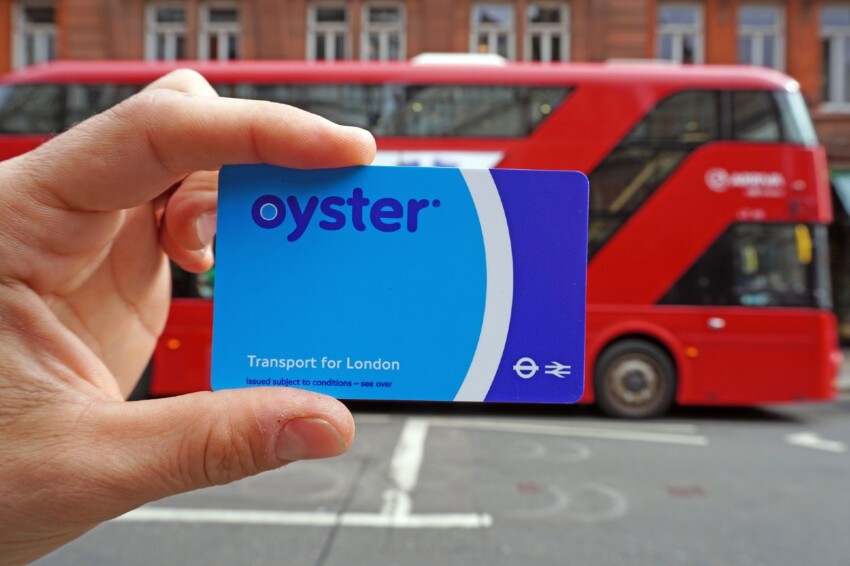
The Oyster Card is London transport’s official rechargeable card. Simply hold it to the yellow reader when boarding the bus. To obtain one, you need to pay a refundable deposit plus credit of your choice. You can purchase it at underground stations, authorised retailers and online.
The Visitor Oyster Card is the tourist version of the standard Oyster Card, which you can conveniently order before travelling to London and have delivered directly to your home. This card requires a non-refundable deposit plus your chosen credit amount.
Smartphones and smartwatches with digital payment technology (Apple Pay, Google Pay or Samsung Pay) also work perfectly on London bus readers, with no additional cost compared to using a physical card. Simply hold the device to the yellow reader as you would for any contactless payment.
Fixed-rate passes
The Travelcard is a pass that includes buses, the underground and other London public transport. You can purchase it as a daily, weekly or monthly option depending on how long you’re staying. This solution can be cost-effective if you’re spending more than 5 days in London and plan to use both buses and the underground intensively.
The Bus & Tram Pass is a specific pass for buses and trams only, cheaper than the general Travelcard. It’s available as a daily, weekly, monthly or annual option, and is ideal if you’re planning to travel mainly above ground and avoid the underground.
If you’re planning a London holiday, we recommend carefully considering whether to purchase a Visitor Oyster Card before departure or simply use your contactless card, which is often the most cost-effective option, avoiding the deposit cost and potential queues at counters on arrival.
How to use the card on buses
The payment system on London buses is straightforward but has one key difference from the underground: you must hold your card to the yellow reader only when boarding, whereas you don’t need to validate again when exiting.
Yellow readers are positioned near all doors where boarding is permitted. When you hold your card or device to the reader, you’ll hear a beep and see a green light confirming successful validation. If the light is red or you hear a different signal, there’s a problem with your card or available credit.
Make sure you have your Oyster Card or contactless card ready before boarding, so as not to hold up the queue of passengers boarding after you. During peak hours when buses are very crowded, quick validation helps keep the service running smoothly.
If you use multiple different contactless cards on the same day, Transport for London won’t be able to calculate your daily cap correctly, and you’ll pay for each journey without the maximum limit being applied. For this reason, it’s essential to use the same card for all your daily travel.
Hopper Fare: multiple journeys at a single price
One of the most significant advantages of London’s transport system is the Hopper Fare, which allows you to make unlimited transfers between buses and trams while paying for just one journey. This system makes multiple journeys extremely affordable, especially when reaching destinations that require several connections.
How the Hopper Fare works
When travelling with an Oyster Card or contactless card in pay as you go mode, you can make unlimited free transfers between buses or trams of your choice within an hour of your first touch in (validating your card on the yellow reader of your first bus).
Each time you change vehicles, you still need to hold your Oyster Card or contactless card to the yellow reader: the amount won’t be deducted from your available credit as long as you stay within the 60-minute window. The system automatically recognises that you’re using the Hopper Fare and doesn’t charge you any additional costs.
This fare is particularly advantageous for exploring different areas of London in a single travel session, allowing you to get off, visit an attraction quickly, and then catch another bus to your next destination without worrying about additional costs.
When the Hopper Fare doesn’t apply
The Hopper Fare is not valid if between one bus or tram and another you use other forms of transport such as the underground, DLR (Docklands Light Railway), London Overground, national rail services, Emirates Air Line (the cable car) or River Bus (boats on the Thames). In these cases, each vehicle is charged separately.
Additionally, if your Oyster Card has completely run out of credit, you’ll lose your entitlement to the Hopper Fare even if you’re still within the hour of your first journey. You can, however, top up your card within the hour to keep the benefit active and continue travelling free on subsequent buses.
London night buses
When the underground and trains stop service, generally from midnight to 4:30 in the morning, buses become the only public transport option available in London, aside from taxis. The night bus system nonetheless guarantees comprehensive coverage of the city throughout the night.
Night buses are easily recognisable because their route number is preceded by the letter N (for example, while the 45 operates only during the day, the N45 provides the night service). Some particularly important routes, however, offer a continuous 24-hour service, keeping the same number both day and night.
Night-time fares remain the same as daytime rates with the same daily caps and Hopper Fare valid during night hours too. This means you can change night buses unlimited times within an hour whilst only paying for one journey.
Night bus frequency is generally lower than daytime service, ranging from 15 to 30 minutes depending on the route and time. Many night routes converge at Trafalgar Square, which serves as the central hub for the night network, allowing transfers between different directions.
Some underground lines also operate at night during weekends with the Night Tube service, but night buses remain essential for reaching the many areas not covered by the night underground and often represent the only option for getting home after an evening in nightlife areas such as Soho or Shoreditch.
London bus maps
The official Transport for London website provides practical and intuitive tools to find any bus route and generate maps specific to your area, all freely downloadable as PDFs from the spider maps dedicated page.
Particularly valuable for tourists is the map of major bus routes in central London, which highlights routes through tourist areas and connecting main attractions. We recommend downloading it before you travel and keeping it on your smartphone for quick reference during your visits.
You can also use the interactive online maps on the TfL website, which allow you to click on a specific stop to see all the routes serving it and view complete routes. This tool is particularly useful when planning complex journeys requiring multiple changes.
Whilst numerous dedicated apps for London public transport exist, including official ones from Transport for London (TfL), the most practical and intuitive solutions for planning a bus journey, possibly combined with the underground or train, are Google Maps and Citymapper.
Both of these apps offer real-time journey information, automatically calculate travel times considering current traffic and suggest the best travel options. The interface is simple to use even for first-time London visitors, clearly showing which bus to take and where to get off.
For even more detailed information on real-time service status, the official TfL Go app provides constant updates on traffic conditions, any delays and possible route changes. This app is particularly useful when service disruptions occur or special events temporarily alter standard routes.
You can download all these apps for free on both iOS and Android devices, and use them offline after downloading the necessary maps.
Practical tips for travelling on buses
Choose the upper deck when possible to benefit from exceptional panoramic views of the city and take memorable photographs. The best seats are in the front rows, which offer a 360-degree perspective of the road ahead and the sides. However, bear in mind that at particularly busy times it might be more practical to stay on the lower deck near the exits.
If you have flexibility with your times, avoid peak hours (7:30-9:30 and 17:00-19:00) when buses are extremely crowded and journey times are significantly extended due to heavy traffic. The best times to travel are late morning, early afternoon and evening after 19:00.
Always have your Oyster Card or contactless card ready before boarding the bus, preferably already in hand whilst waiting at the stop. This will avoid holding up the queue of passengers boarding after you and helps keep the service on schedule. During peak hours, boarding speed is particularly important.
Useful bus routes for visitors
London’s buses are far more than just a practical and economical way to get around—they offer the remarkable opportunity to admire the city from their distinctive open-top decks. Certain routes pass through areas of particular tourist interest and can transform into genuine free sightseeing tours.
Route 11
The number 11 travels an itinerary through Westminster, Trafalgar Square and the City, making it ideal for a panoramic tour of London’s principal attractions in the centre. This route allows you to admire government architecture, historical monuments and the modern skyscrapers of the financial district.
The route also connects Chelsea with the City, passing through some of the capital’s most elegant and historic areas. From the upper deck you’ll be able to photograph iconic buildings, monuments and picturesque views that characterise the heart of London.
Route 15
Perfect for visiting the Tower of London, St Paul’s Cathedral and Tower Bridge, route 15 is one of the city’s most panoramic journeys. On this line, during certain times and mainly at weekends, the historic Routemaster Heritage buses with open rear platforms still operate.
Travelling on these vintage buses is a unique experience that takes you back in time, allowing you to experience the authentic way Londoners travelled in the 1960s. The 15H (Heritage) route operates specifically with these restored vehicles between Trafalgar Square and Tower Hill.
Route 24
The number 24 connects Camden with Soho and Trafalgar Square, offering a fascinating glimpse into London’s diverse cultural and commercial areas. This route passes through neighbourhoods with very distinct personalities, from Camden’s vibrant alternative market to Soho’s theatres and entertainment venues.
The route continues southwards through central tourist zones, allowing you to understand the architectural and cultural variety that characterises the British capital. It’s particularly interesting for those wishing to explore both tourist areas and the more authentic neighbourhoods frequented by Londoners.
Route 139
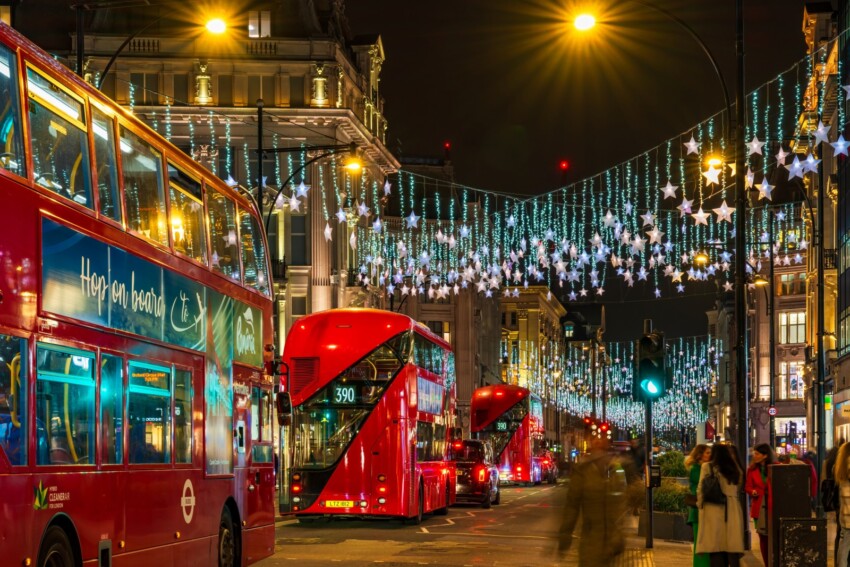
This route runs along Oxford Street and Regent Street, London’s two most famous shopping streets, making it perfect for admiring the window displays of major department stores and the spectacular decorations during the festive season. Throughout December, the journey becomes particularly enchanting thanks to elaborate festive illuminations.
Route 139 allows you to comfortably explore the city’s main shopping district, with the option to hop off at your leisure to visit specific shops and then catch the same bus or the next one using the Hopper fare.
Route 453
The number 453 passes through the main shopping streets and theatres of the West End, offering spectacular views of London’s most vibrant and touristy neighbourhoods. This route passes through areas characterised by intense nightlife, numerous restaurants, historic theatres and cultural attractions.
From the upper deck you’ll admire the elaborate facades of Victorian theatres, the illuminated signs that characterise the West End and the vibrant atmosphere that makes this area one of the capital’s most visited.
Night buses
Night buses, such as routes N9 and N15, traverse iconic areas of the city, offering evocative and fascinating views of illuminated London. Travelling at night from the upper deck allows you to see the capital from a completely different perspective, with monuments lit up and streets far less congested than during the day.
Christmas period
During the festive season, routes that run along Oxford Street and Regent Street offer an unforgettable spectacle of lights and holiday decorations. The elaborate light installations, which are typically switched on in mid-November, transform these streets into a veritable open-air museum of Christmas illumination artistry.
Historic buses
The Routemaster Heritage buses on route 15H represent a special experience in themselves, allowing you to travel on authentic, fully restored 1960s buses. These vehicles retain their original characteristics, including the open rear platform, and are accompanied by a traditional conductor who collects fares (special fare of £2 which also includes unlimited travel on standard buses for an hour).
Hop-on hop-off tourist buses
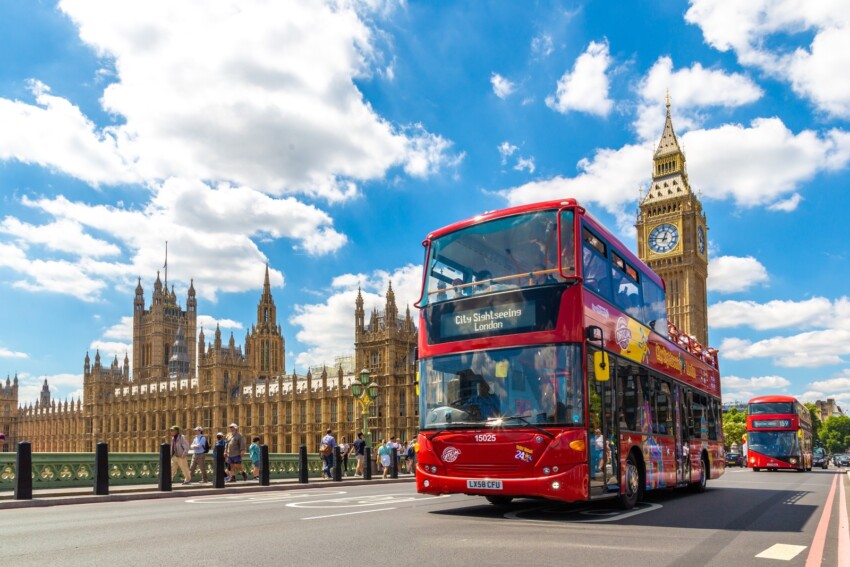
In addition to public buses, London also offers hop-on hop-off tourist bus services run by private companies, which represent a specific alternative for visitors seeking a guided sightseeing experience of the main tourist attractions.
These open-top buses operate on circular routes that touch all the city’s most famous monuments and points of interest, allowing you to hop on and off as many times as you like during your ticket’s validity (generally 24, 48 or 72 hours). Onboard you’ll find audio guides in multiple languages that provide detailed explanations of every attraction along the route.
The main difference compared to public buses is the lower frequency (every 10-20 minutes) and higher cost, but in return you get the advantage of informative audio guides, routes optimised for tourism and the convenience of not having to plan connections. For those with limited time or who prefer a more comfortable experience, these services can be a worthwhile option.
No, cash payment is not accepted on London buses. This payment method was completely phased out in 2014 to speed up boarding times and reduce delays. You must use an Oyster Card, a contactless card (credit or debit), a smartphone with NFC technology (Apple Pay, Google Pay, Samsung Pay) or a valid pre-purchased ticket.
How do I know when to get off the bus?
Modern London buses announce stops automatically through an electronic voice system and display the name of the next stop on digital screens positioned inside the vehicle. To request a stop, press one of the red buttons marked “STOP” located on the handrails throughout the bus, ideally a little before your destination.
Can I bring large luggage or pushchairs on the bus?
Yes, pushchairs are permitted and there is dedicated space on the lower deck. During rush hours, when buses are very crowded, consider folding the pushchair if possible to leave space for other passengers, especially wheelchair users who have priority over designated spaces.
Large luggage is permitted but must not obstruct the passageway, block doors or occupy seats. If you’re travelling with large suitcases, it’s preferable to remain on the lower deck near the central door where there’s more space. The upper deck has no dedicated luggage areas.
Do buses run on public holidays?
Yes, buses operate on public holidays (Bank Holidays), but generally with reduced hours similar to Sundays and lower frequencies than on weekdays. Some peripheral routes might not operate at all during holidays.
Service during the Christmas period (25-26 December) is particularly limited, with many routes suspended or drastically reduced frequencies. We recommend always checking the TfL Go app or the official website to verify specific times during holidays before planning your journeys.
How to save on transport and entrance fees
City Card allow you to save on public transport and / or on the entrances to the main tourist attractions.

 Hotel
Hotel  Budget accommodations
  Apartments
  Family Hotel
  Luxury Hotel