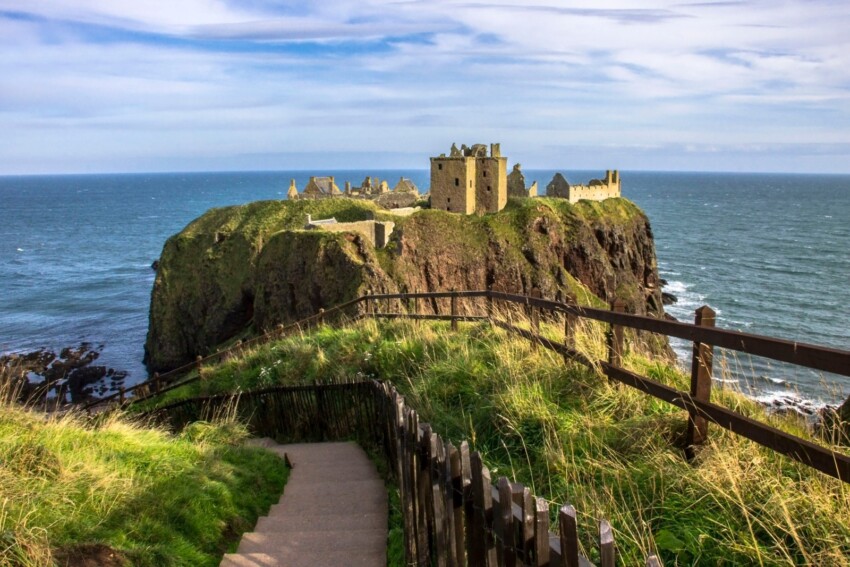
Dunnottar Castle stands on a dramatic rocky promontory overlooking the North Sea in Aberdeenshire, in north-east Scotland. Its spectacular position, almost entirely surrounded by sea and connected to the mainland only by a narrow isthmus, is one of the elements that makes this fortress so celebrated and photographed – an essential stop during any visit to Scotland.
The majestic ruins of this fortress tell centuries of Scottish history, from Viking invasions to the wars of independence and the turbulent Jacobite uprisings. Its naturally defensive position, perched on a rocky promontory almost completely surrounded by the sea, made Dunnottar a secure refuge during Scotland’s most difficult periods.
The mystical atmosphere that pervades these ancient ruins, combined with the breathtaking surrounding landscape, offers visitors an unforgettable experience. With waves crashing against the cliffs below and wind whistling through the remains of ancient walls, you can feel the breath of history and legend that permeates every stone of this extraordinary place.
Dunnottar Castle’s location makes it easy to incorporate into an itinerary along Scotland’s east coast, perhaps combining your visit with other Aberdeenshire attractions such as Balmoral Castle or as part of a wider tour heading towards the Highlands.
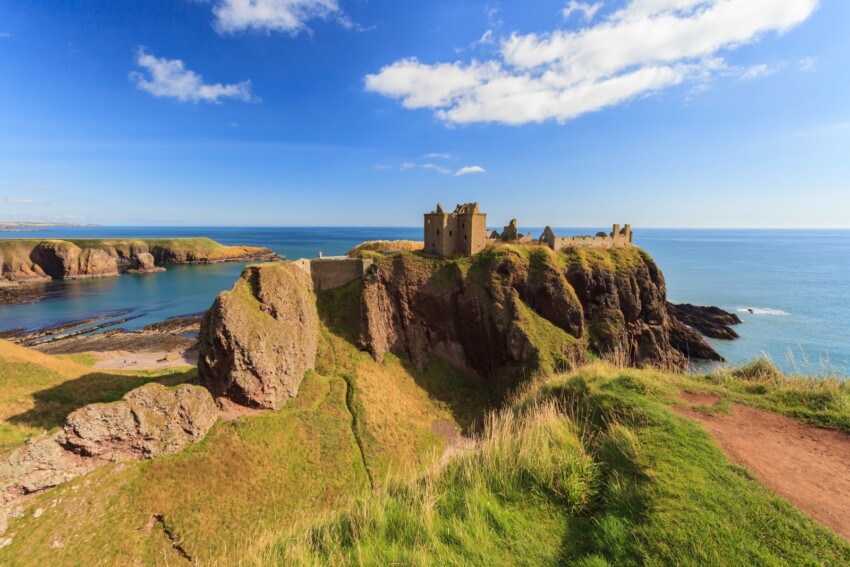
The main entrance to the castle is through the Gatehouse, a structure dating back to the 15th century. This imposing fortified gateway represented the castle’s first line of defence and controlled access to the entire fortress. Today, as you pass through this entrance, you can imagine the guards on duty and high-ranking visitors who have crossed this threshold throughout the centuries.
The strategic position of the Gatehouse provided complete views of the approach path, allowing defenders in the past to spot approaching enemies well in advance. The thick walls and arrow slits bear witness to its primary defensive function, designed to withstand sieges and protect the castle’s inhabitants.
Architectural details still visible, such as the remains of the original gate hinges and traces of the drawbridge, offer a fascinating glimpse into medieval building techniques and the security systems of the era.
The magnificent palace represents the residential heart of Dunnottar Castle and was built in the 16th century by the Earls Marischal, one of Scotland’s most powerful families at the time. This imposing building was designed to display wealth and prestige, rather than serving purely defensive purposes.
The palace’s interior, though now in ruins, still allows you to imagine its former splendour. You can observe the remains of the great hall, where important banquets and receptions were held, and the private chambers used by the noble family. The large windows, unusual for a castle of that era, testify to a shift in architectural priorities: light and comfort began to take precedence over purely defensive considerations.
Decorative elements still visible, such as fragments of carved cornices and the remains of an ornate fireplace, indicate the luxury that once characterised these rooms. This palace represents an important example of the transition between the fortified medieval castle and the Renaissance aristocratic residence.
Although today mainly the foundations and some perimeter walls remain, it is possible to understand the spiritual importance this space held in the daily life of the castle’s inhabitants. Traces of frescoes still visible on the interior walls offer a rare glimpse into Scottish medieval religious decoration. These fragments of sacred art, though deteriorated by time and the elements, represent precious testimony to the artistic and spiritual traditions of the era.
The chapel’s location within the fortified complex, in a relatively quiet and secluded area, underlines the importance of spiritual contemplation even within a military context. Here the castle’s lords and their court could withdraw in prayer away from the bustle of the fortress’s daily activities.
The storeroom area, also known as the Quadrangle, was the vital logistical centre for the castle community’s survival. These buildings, constructed around a central courtyard, housed the essential supplies needed to sustain the castle during long sieges.
The vast underground spaces where food, water and other essential resources were stored are today accessible and offer a fascinating insight into the daily management of a medieval fortress. The large cisterns for collecting rainwater, in particular, represent a remarkable example of the ingenuity of the era’s architects in ensuring the castle’s self-sufficiency.
The storage system enabled Dunnottar’s inhabitants to endure months of siege, a crucial factor that contributed to the fortress’s reputation as a safe refuge.
Service buildings such as the smithy and stables offer insight into the daily life and practical organisation of the fortress. The smithy, where the castle blacksmith worked, was essential for the production and repair of weapons, tools and metal parts necessary for maintaining the complex.
The spacious stables could accommodate numerous horses, indispensable for both warfare and transport. These spaces reveal the importance these animals held in medieval and Renaissance life, representing not only means of transport but also symbols of status and military power.
The organisation of these spaces demonstrates the logistical complexity required for the operation of a large fortress, which was in effect a small self-sufficient town with all the functions and trades necessary for its survival.
The notorious Whigs Vault is perhaps the most emotionally moving structure at Dunnottar Castle. This underground prison acquired grim notoriety in 1685, when it was used to imprison 167 Covenanters (Scottish Protestants who opposed the imposition of Anglicanism) during the religious persecutions known as “The Killing Time”.
The inhumane conditions under which prisoners were held in this cramped and dark space represent one of the darkest chapters in the castle’s history. During your visit, you can enter this oppressive space and imagine the suffering of the prisoners, many of whom died from starvation or disease contracted during their imprisonment.
Admission tickets to Dunnottar Castle are available at various prices depending on age:
You can buy tickets directly at the ticket office at the castle entrance. It is advisable to carry cash, although major credit cards are generally accepted. During peak season (June–August), queues at the entrance may form.
It is possible to book tickets online via the castle’s official website, which is particularly recommended during peak season or holidays to avoid long waiting times.
If you plan to visit several attractions across Scotland, it may be worthwhile to purchase Historic Environment Scotland’s Explorer Pass, which includes entry to Dunnottar Castle along with many other Scottish heritage sites.
Opening hours at Dunnottar Castle vary by season:
The castle is closed on 25 and 26 December and 1 and 2 January.
During adverse weather conditions, the castle may close without notice for safety reasons, as the access path can become slippery and dangerous. It is advisable to check the official website or call ahead if weather conditions are uncertain.
On bank holidays and during special events, opening hours may vary.
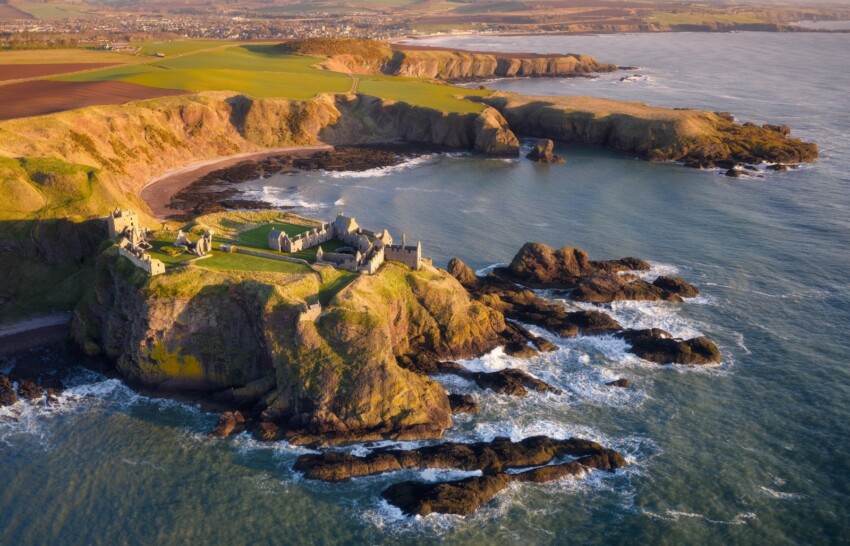
The fortress is located approximately 3km south of the town of Stonehaven, in Aberdeenshire, north-east Scotland. If you are in Aberdeen, the castle is easily accessible with a journey of approximately 25km (around 30 minutes by car) south along the A90, then following signs for Stonehaven and subsequently for Dunnottar Castle.
From Edinburgh, Scotland’s capital, the journey is longer, approximately 180km (2 hours 30 minutes by car), heading north along the A90. For those coming from Glasgow, the route is approximately 215km (2 hours 45 minutes), first heading towards Perth and then following the A90 northwards.
A car hire is certainly the most convenient way to reach the castle. Once you arrive at the dedicated car park, you will need to walk approximately 15–20 minutes along a picturesque but steep path leading to the castle entrance. This route includes steps and unpaved sections, so comfortable footwear is recommended and you should be prepared for a short hike.
By public transport, you can take a train to Stonehaven from Aberdeen station (approximately 15–20 minutes’ travel) or from Edinburgh (approximately 2 hours 30 minutes). From Stonehaven station, you can take a taxi (approximately 10 minutes) or walk to the castle (approximately 45–60 minutes of scenic coastal walking).
During the summer months, a tourist bus service is available connecting Stonehaven to Dunnottar Castle, offering a convenient alternative for those travelling without a car.
It is important to note that access to the castle requires a steep descent followed by an equally steep ascent of over 200 steps. This route may be challenging for people with reduced mobility or heart conditions.
Dunnottar Castle sits approximately 3 km south of the coastal town of Stonehaven and around 25 km south of Aberdeen, roughly 180 km north-east of Edinburgh and 215 km from Glasgow.

 Hotel
Hotel  Budget accommodations
  Apartments
  Family Hotel
  Luxury Hotel