Columba Hotel
Oban - The Esplanade
Book now
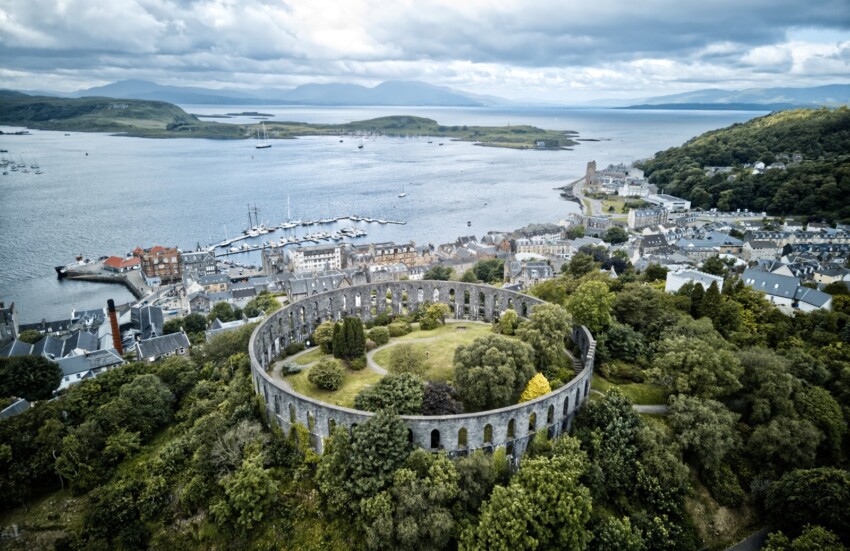
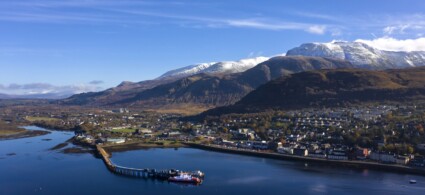
Oban is a picturesque harbour town situated on the west coast of Scotland, in the region of Argyll. Its privileged position, nestled within a horseshoe-shaped bay, has made it an important centre for maritime connections with the Hebrides and a thriving fishing port throughout the centuries.
With a population of over 8,000 inhabitants, Oban is certainly not comparable in size to major cities such as Edinburgh or Glasgow, but it is nonetheless a town of considerable merit, with numerous attractions. The curve of the bay is dotted with Victorian buildings with slate roofs overlooking the harbour, where ferries to the islands alternate with fishing boats in the daily bustle.
The town is dominated by the imposing McCaig’s Tower (also known as McCaig’s Folly), a circular structure somewhat reminiscent of the Colosseum in Rome, which rises on the hill above the town, offering panoramic views of the harbour and the islands on the horizon. This unfinished monument, constructed in the late nineteenth century, has become Oban’s distinctive symbol.
Beyond its natural and architectural beauty, Oban is renowned for two things: seafood and its prized whisky. It is no coincidence that the town is often called the “seafood capital of Scotland” and is home to one of the country’s oldest distilleries, the Oban Distillery, founded in 1794, even before the town itself existed in its present form.
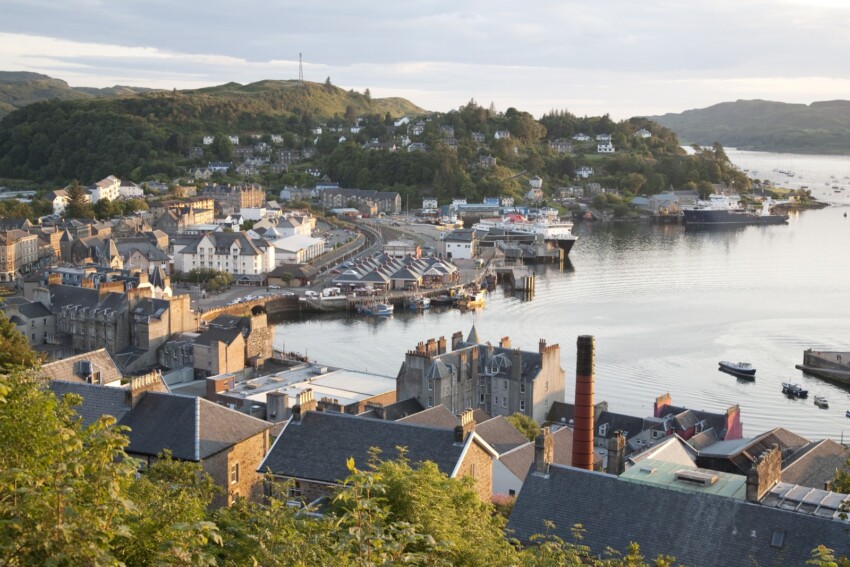
Thanks to the constant flow of ferries, fishing boats and hungry seagulls (watch out when eating fish and chips outdoors!), the harbour is the beating heart of Oban.
Passing in front of the Columbia Hotel, the Oban Promenade runs along Oban Bay and the Oban Esplanade. On one side you will have the sea, and on the other, numerous historic hotels and beautiful colourful buildings.
Walking along the harbour is one of the best things you can do in Oban, whether during the day or at night under the watchful gaze of the illuminated McCaig’s Tower. During the day, let yourself be guided by the hustle and bustle and the aroma of fish and chips that will lead you directly to one of the most famous fish and seafood stalls in all of Scotland: the Oban Seafood Hut.
The highlights of this route also include the Oban Peace & War Museum, the Oban Chocolate Company shop, St Columba’s Cathedral and the Oban War Memorial. There are also other noteworthy points of interest: the Oban Lighthouse (a tiny, charming lighthouse on the waterfront) and the Dog Stone (a unique and distinctive rock formation).
At the end of the promenade you will have practically reached Dunollie Castle and park.
McCaig’s Tower is undoubtedly Oban’s most iconic tourist attraction. This imposing circular stone structure sits atop Battery Hill and was commissioned by philanthropist John Stuart McCaig, after whom it is named. Built with granite quarried from Loch Etive, construction took five years, from 1897 to 1902, the year of McCaig’s death.
The original project envisaged an elaborate monument in honour of his family, and as a great enthusiast of classical culture and civilisation, McCaig had decided to take the Colosseum in Rome as his reference. At the time, this work, which nonetheless provided employment for Oban’s masons and craftsmen, cost no less than £5,000, an enormous sum for the era!
Today, the tower is a peaceful public garden with spectacular views over Oban, its harbour and the islands of Kerrera, Lismore and Mull on the horizon. Our advice is to visit in the evening at sunset, sitting on one of the benches and enjoying the spectacle. Before you, boats and ferries coming and going from the harbour, and in the distance, the islands.
Access is always free and the walk from the town, although steep, takes only about 15-20 minutes. It is also possible to arrive by car, as there is convenient parking opposite.
Another viewpoint, perhaps less well-known, for admiring Oban from above is Pulpit Hill. From this perspective, you will be able to see not only the harbour but also McCaig’s Tower itself.
There are also benches and car parking here. It is easily reached by following the footpath. Using the Calmac ferry terminal as a reference point, it takes only about a 15-minute walk to reach the top of the hill.
Founded in 1794 by brothers Hugh and John Stevenson, the Oban Distillery is one of Scotland’s oldest and smallest whisky distilleries and is notable for its position in the heart of the town.
In fact, it is quite likely that Oban would not have existed at all had it not been for the distillery and the traffic from the harbour and commercial activity that, in the late eighteenth century, the distillery promoted. The business remained in the ownership of the Stevenson family for three generations, until local merchant Peter Cumpstie purchased it in 1830. In 1880, the railway arrived in Oban, ushering in a new era of communications and improving transport.
Today Oban continues to be one of Scotland’s smallest whisky producers, with just seven people producing the whisky, maintaining the character of tradition unchanged. In 1989, Oban 14 Year Old was named one of six Classic Malts representing the Western Highlands region.
Production focuses on the use of local ingredients: water comes from a loch three miles from the distillery and barley comes from nearby Speyside. The tour offers a fascinating introduction to the process of producing Oban Single Malt, a whisky with characteristic notes of malt and sea, reflecting the distillery’s coastal location, and includes a tasting.
If you walk along the entire waterfront north of Oban, you will arrive directly at Dunollie Castle, the former seat of Clan MacDougall. Situated on a rocky outcrop overlooking the sea, the castle offers spectacular views across the bay and to the islands beyond.
It was the home of the MacDougalls, sworn enemies of Robert the Bruce. A MacDougall force defeated Bruce at Dalry in 1306, nearly killing him and tearing a brooch from his cloak. This brooch became known as the Brooch of Lorn and was first kept in the castle, then later at Gylen Castle on Kerrera. Bruce returned and devastated the MacDougall lands in 1309 after defeating them at the Pass of Brander, seizing their stronghold at Dunstaffnage.
Although the castle itself is now largely in ruins, the site is home to the Dunollie Museum, which tells the story of the clan and the region through a collection of artefacts and interactive exhibits. The surrounding grounds offer pleasant walks through ancient oak woodland, with breathtaking views over Oban Bay and the island of Kerrera. Particularly interesting is the Dunollie Weaving House, where visitors can watch demonstrations of traditional weaving techniques and learn about the importance of tartan in Scottish culture.
St John’s Cathedral is a beautiful example of Victorian Neo-Gothic architecture. Built between 1863 and 1909, this Episcopal church impresses with its intimate atmosphere and the beauty of its stained-glass windows.
Particularly noteworthy is the War Memorial Window, a commemorative stained-glass window dedicated to those who lost their lives during the First World War. The interior of the cathedral is enriched with detailed mosaics and excellent acoustics, making it a perfect venue for the concerts regularly held during the summer season.
The cathedral is open to visitors every day and entry is free, although donations towards the upkeep of the building are appreciated.
Located on the waterfront, the Oban War & Peace Museum offers an interesting overview of the town’s history, with particular focus on its role during the two world wars. The museum, run by volunteers, houses an extensive collection of photographs, artefacts and documents that tell the story of Oban’s development from a small fishing village to an important port and tourist centre.
Particularly interesting are the exhibits dedicated to Oban’s function as a flying boat base during the First World War and its role in the Atlantic convoys during the Second World War.
Admission to the museum is free, but donations are much appreciated in support of this valuable community resource.
It is from Oban’s harbour that most of the ferries operated by Caledonian MacBrayne, Scotland’s ferry company that connects many of the Atlantic-facing islands to the mainland, depart. The most accessible islands are Mull and the small Iona, but also Kerrera and Lismore, which can be easily reached on a day trip. The islands of Tiree, Coll and Barra require a longer ferry journey.
For those with limited time, fast day-boat or speedboat excursions are available that allow you to get a taste of several islands. Staffa Tours, for example, sails to Mull, Iona and Staffa. Just these three islands, which all belong to the Inner Hebrides, give you the opportunity to visit the colourful village harbour of Tobermory, the picturesque Abbey of Iona and the incredible basalt columns of Staffa.
Another boat company operating from Oban is Argyll Sea Tours, which allows you to see wildlife and the seal colony in the surrounding area.
Kerrera is the island that forms the natural protective barrier of Oban’s harbour. It is a small island just off Oban, inhabited by fewer than 50 people. It is reached by a brief 5-minute crossing that departs from Gallanach, 3 km from Oban.
The island is free of motor vehicles (except for a few used by residents), making it a paradise for hikers. The circular route of about 10 km allows you to explore the entire island, passing the ruins of Gylen Castle, a sixteenth-century castle belonging to Clan MacDougall with spectacular position on a cliff overlooking the sea.
Once there, do not miss the charming Tea-room, a welcoming café that serves tea, coffee and homemade cakes, ideal for refreshment during your excursion.
The ferry to Kerrera operates only during daytime hours and with limited schedules, so it is advisable to plan your visit carefully and check times before departing.
A few kilometres outside Oban you will find another historic castle: Dunstaffnage Castle. It is one of Scotland’s oldest stone castles. Do not miss the castle chapel, whose ruins are hidden in the woodland between the trees, by following the path on the left side of Dunstaffnage Castle.
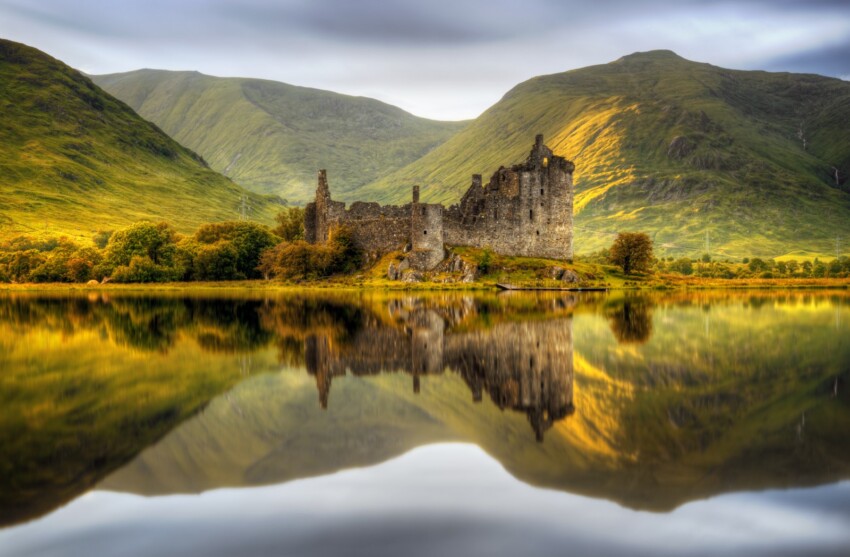
A visit not to be missed is Kilchurn Castle, considered one of Scotland’s most romantic and photogenic castles, much appreciated by photographers. Situated on the tranquil waters of Loch Awe, in the heart of the Scottish Highlands, its ruins are evocative in every season of the year.
Near Kilchurn Castle you will find St Conan’s Kirk, one of Scotland’s most beautiful churches. This small Presbyterian church, built by Walter Douglas Campbell in the late nineteenth century, stands out for its attention to detail and is set in a fascinating location. Particularly noteworthy are the cloister, the entrance door, the apse choir and the chapel dedicated to Robert the Bruce, where you can admire a splendid statue of the famous Scottish king. A visit is highly recommended.
Following the A828 towards Port Appin, you will come across Castle Stalker, a four-storey tower situated on an islet in the middle of the sea, with breathtaking scenery. The castle is privately owned, but can be visited on specific dates throughout the year. Alternatively, the viewpoint near the eponymous café offers an exceptional view, ideal for postcard-perfect photographs, especially at sunset.
In the following map you can see the location of the main places of interest mentioned in this article.
Oban town centre is the ideal location if you want everything within easy reach. Here you’ll find numerous historic hotels such as the elegant Perle Oban Hotel and the Columba Hotel, both boasting spectacular views over the harbour.
For a more personal experience, Oban’s many bed & breakfasts and guesthouses are an excellent choice. These establishments, often housed in charming restored Victorian properties, offer warm hospitality and generous breakfasts prepared with local produce. Many are located along Corran Esplanade or on the hillside streets behind the town centre, offering beautiful views over the bay.
Those travelling on a tighter budget might consider the Oban Youth Hostel, run by Hostelling Scotland, which offers clean and functional accommodation in a central location with harbour views, or Backpackers Plus Hostel, a smaller and more intimate establishment.
During peak season (June–August), Oban becomes extremely popular and accommodation can fill up quickly. We strongly recommend booking well in advance, especially if you wish to stay in the town centre or if you’re visiting during one of its festivals or events.
As we always say, the best way to explore Scotland at your own pace and visit all the attractions is by road, hiring a car. And Oban is no exception. From Edinburgh it takes roughly 3 hours; from Glasgow, only a couple of hours.
If you prefer public transport, it’s perfectly possible to reach Oban, particularly by train. Oban railway station is conveniently located right in the town centre. The journey from Glasgow takes approximately 3 hours.
For those preferring the bus, ScotRail and Scottish Citylink offer regular services from Glasgow to Oban with a journey time of around 3 hours. There are also connections to Fort William, Inverness and other Highlands destinations.
If you’re travelling to Oban from Edinburgh by public transport, bear in mind that you’ll need to get to Glasgow first and then change to a train or bus from there.
What's the weather at Oban? Below are the temperatures and the weather forecast at Oban for the next few days.
Oban is situated on the west coast of Scotland, in the Argyll region, approximately 150 km (93 miles) north-west of Glasgow and 205 km (127 miles) west of Edinburgh. It lies around 70 km (43 miles) south of Fort William and 155 km (96 miles) south-west of Inverness.
 Hotel
Hotel  Budget accommodations
  Apartments
  Family Hotel
  Luxury Hotel