Royal Edinburgh Ticket
Book this Royal Edinburgh Ticket and enjoy the best of the Scottish capital city for 48 hours. Visit the Castle, the Royal Yacht and the Palace.
From 92,80 €
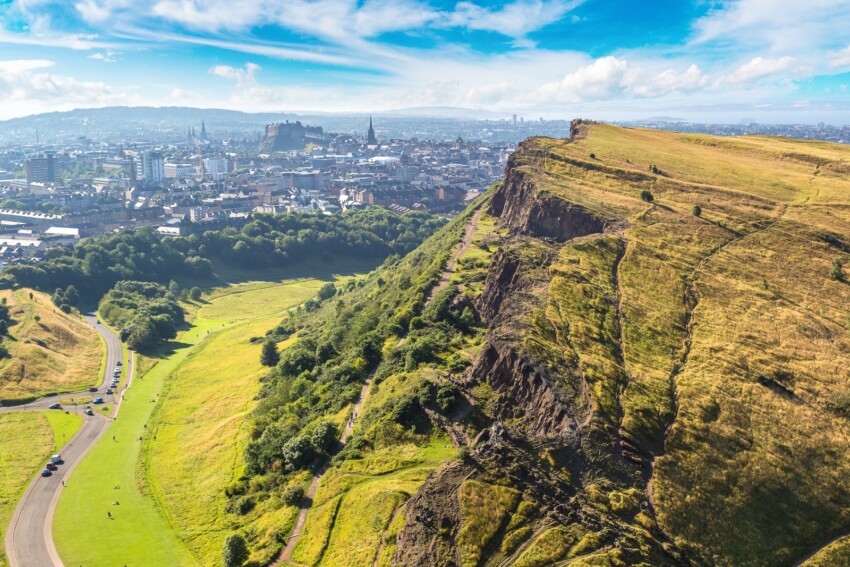
Arthur’s Seat stands as one of Edinburgh’s most iconic symbols. Located at the heart of the city, this volcanic hill rises to 251 metres above sea level, dominating the urban landscape with its distinctive silhouette.
What strikes you most about Arthur’s Seat is the contrast between wild nature and urban setting. Walking the trails of this hill, you can forget for a moment that you’re in the centre of a vibrant European capital, despite being only minutes on foot away. The 360-degree panoramic view from the summit is breathtaking: from the elegant architecture of the New Town to the medieval streets of the Old Town, from the Salisbury Crags to the Firth of Forth, the estuary opening onto the North Sea.
Arthur’s Seat hasn’t always been the tranquil hill we see today. Its story began around 350 million years ago, when the area where Edinburgh now stands was characterised by intense volcanic activity. What we see today is actually what remains of an extinct volcano, which over millennia has been shaped by glacial erosion.
Curiously, when this volcano was active, Scotland was positioned much further south than its current location, probably near the Equator, in a climate and environment completely different from today’s.
Like many places in Edinburgh, Arthur’s Seat is shrouded in fascinating legends. One of the most evocative has Celtic origins and tells of the hill being actually an enormous sleeping dragon.
According to this tale, a terrible dragon once terrorised Edinburgh’s inhabitants, devouring livestock and destroying crops. The creature, ever more voracious, ate ceaselessly until, having become too heavy and lazy to fly, it settled on a high place near the city to rest. Its sleep was so deep that the dragon never awoke, transforming into the hill we now know as Arthur’s Seat.
The origin of the name “Arthur’s Seat” remains subject to debate. A popular theory links it to King Arthur and Arthurian legends, suggesting that the hill was the location of ancient Camelot or an important site for the exploits of the Knights of the Round Table.
A more pragmatic interpretation, supported by historian William Maitland, suggests instead that the name is a corruption of Scots Gaelic “Àrd-na-Said“, which would mean “archer’s height” – a reference to the hill’s strategic position as a lookout and defensive point.
In 1836, a group of boys exploring the slopes of Arthur’s Seat made a disturbing discovery: seventeen tiny wooden coffins containing miniature figurines dressed in carefully crafted miniature clothes. The coffins were arranged in neat rows: two rows of eight, topped with a solitary coffin.
This discovery remains one of Edinburgh’s unsolved mysteries. Of the seventeen original coffins, eight are preserved at the National Museum of Scotland, where they continue to spark curiosity and speculation about their meaning and origins.
Arthur’s Seat is situated in the heart of Edinburgh, within the vast Holyrood Park. This public park extends over several hundred hectares and offers a natural oasis in the city centre, with lochs, trails and spectacular views.
The hill is positioned at the eastern end of the Royal Mile, the main street running through Edinburgh’s Old Town, a short distance from major attractions such as Holyrood Palace (the official residence of the British monarchy in Scotland) and the modern Scottish Parliament building.
Reaching the starting point for the ascent to Arthur’s Seat is very straightforward. Its central location within the city makes this attraction easily accessible on foot from the historic centre. You can simply walk down the Royal Mile until you reach Holyrood Park. The main park entrance is located just behind Holyrood Palace.
There are several trails to reach the summit of Arthur’s Seat, each with different characteristics in terms of length, difficulty and views. Here are the main routes you can choose from:
The Red Route is considered the most scenic and comprehensive route. At around 5 km in length, it follows the ancient lava flow of the volcano, offering spectacular views throughout the ascent. The starting point is the car park behind Holyrood Palace. This route takes about an hour to climb, plus time to enjoy the views and take photographs.
The Blue Route is ideal for those seeking a scenic walk without the need to reach the summit. It starts at the same point as the red route and follows a looped path leading to the Salisbury Crags, from where you still enjoy an excellent view of the city.
Also known as “The Lazy Man’s Route”, the Green Route is the shortest way to reach the summit. It requires only about 30 minutes of walking, but offers fewer views than the red route. The starting point is Dunsapie Loch, a small artificial loch created in 1844 on the initiative of Prince Albert, consort to Queen Victoria.
The Purple Route is the steepest and most adventurous route. Recommended for those seeking a more challenging experience, this trail combines dirt sections and stone steps. It’s not suitable for those with vertigo but offers spectacular views. The starting point is the entrance to Holyrood Park Road, near the Commonwealth Pool.
The Queen’s Drive is a circular route circling the base of the hill and can also be driven (with some Sunday restrictions). This scenic road was constructed during Queen Victoria’s reign, under the supervision of Prince Albert, as part of a project to regenerate the area that also included the creation of the artificial lochs St Margaret’s Loch and Dunsapie Loch.
The climb up Arthur’s Seat is generally considered accessible to everyone, with an easy to moderate difficulty level. However, some sections can be steep and the terrain may be uneven or slippery, particularly after rain.
The walk is suitable for children too, preferably aged 5 and above. Younger children may find it difficult due to the wind and low temperatures that often characterise the summit.
The time needed to reach the summit varies from 30 minutes to an hour, depending on the route chosen and your pace. For the entire experience, including time for photographs and the return journey, plan for 2 to 3 hours.
Arthur’s Seat can be visited at any time of year. Each season offers a different perspective on the city and surrounding landscape. It’s strongly advisable against attempting the climb in rainy conditions, when trails become slippery and hazardous even with proper footwear.
It’s recommended to wear trainers with good grip or hiking boots. Clothing should be appropriate to the season and weather conditions, bearing in mind that the wind is always stronger at the summit than at ground level.
Regardless of the season, it’s advisable to bring a lightweight waterproof jacket, given the unpredictability of Scottish weather. During winter months, gloves and a beanie are essential for protection against the cold.
City Card allow you to save on public transport and / or on the entrances to the main tourist attractions.
 Hotel
Hotel  Budget accommodations
  Apartments
  Family Hotel
  Luxury Hotel