Things to do at Edinburgh Castle
Edinburgh Castle is far more than a single fortress; it comprises a complex of buildings spanning centuries of Scottish history. Passing through the ancient Portcullis Gate, you’ll embark on a journey that will lead you to discover this extraordinary monument’s most significant locations.
Argyle Battery, Cartshed and the One O’Clock Gun
Beyond the main entrance, you can either tackle the steep Hundred Steps that served as the medieval main entrance, or take the more leisurely cobbled pathway. As you progress, you’ll encounter the Argyle Battery, where six imposing cannons—replicas of 19th-century originals loaned from the Royal Armouries—aim towards the city.
From this vantage point, you’ll enjoy a spectacular view of Edinburgh’s New Town with its distinctive Georgian architecture, and the Firth of Forth with its islands visible in the distance. Adjacent to the battery stands the Cartshed, a building that once served as a cart store and now houses a pleasant café.
Don’t miss the famous One O’Clock Gun, a more modern cannon that fires daily at one o’clock precisely—a tradition Edinburgh residents still use to set their watches.
The National War Museum
Continuing along the path and leaving the Argyle Battery behind, you’ll reach a small courtyard where buildings that once served as powder magazines and artillery stores now house the National War Museum. This extraordinary collection illustrates Scottish military history from the creation of the first standing army to the present day.
The carefully curated and engaging display features uniforms, weapons, documents and memorabilia that testify to Scotland’s significant role in worldwide conflicts and military campaigns throughout the centuries. Even for those not typically drawn to museums, this collection represents an essential stop for understanding the strategic and military importance the castle has held in Scottish history.
As you continue uphill towards Foog’s Gate, you’ll encounter the Governor’s House, an elegant Georgian residence closed to the public, and the New Barracks, built during the Napoleonic Wars to house soldiers. Within this latter building, the only accessible wing houses the Royal Scots Dragoon Guards Museum, which recounts this prestigious military unit’s history from 17th and 19th-century European wars through contemporary conflicts.
St Margaret’s Chapel
Beyond Foog’s Gate lies the castle’s heart, where you’ll find its most important buildings. Prominent amongst these stands St Margaret’s Chapel, the oldest structure not only within the castle but in all of Edinburgh. Built around 1130 by David I in memory of his mother Margaret, who died of grief after her husband fell in an ambush, this modest-looking chapel conceals an intimate and delightful interior, characterised by essential and atmospheric Romanesque styling.
Nearby stands Mons Meg, an impressive 15th-century siege cannon weighing six tonnes, capable of firing 150 kg cannonballs over three kilometres—a genuine masterpiece of medieval military engineering.
From the ramparts, you’ll notice the curious Dogs Cemetery, a small burial ground where since 1840 the dogs of officers and regimental mascots have been interred, testament to the affection British people hold for their four-legged companions.
Crown Square
The Crown Square represents the castle’s beating heart. Created in the late 15th century as the principal courtyard, it’s surrounded by four of the complex’s most important buildings: the Royal Palace, residence of the sovereigns; the Great Hall, intended for ceremonies; the former location of the royal arsenal (now replaced by the Queen Anne Building); and the space once occupied by St Mary’s Church, now home to the Scottish National War Memorial.
It’s advisable to visit this area early in the morning or late afternoon to avoid the crowds of tourists that otherwise make it difficult to fully appreciate the majesty of this historic space.
The Royal Palace
The Royal Palace served as the official residence of Scotland’s sovereigns when at the castle. Although most of the original furnishings have been lost, the elegant fireplaces and architectural structure still testify to its former magnificence.
One of the most significant rooms is the small chamber where James VI of Scotland was born (who later became James I of England), son of Mary, Queen of Scots. A macabre legend surrounds this birth: small bones were allegedly discovered hidden in a wall, fuelling the theory that the true heir died in infancy and was replaced by an imposter who was crowned as James VI.
On the first floor of the Clock Tower rests one of Scotland’s most precious treasures: the Honours of Scotland, including the crown, sceptre and Ceremonial Sword. These are the oldest royal regalia in the entire United Kingdom.
The Great Hall
The Great Hall ranks amongst the castle’s most spectacular spaces. Built in 1511 as a venue for ceremonies and receptions, it was subsequently used as barracks for Cromwell’s soldiers for 230 years.
What makes this space particularly impressive is the magnificent medieval ceiling with corbelled wooden beams, considered one of Britain’s finest examples of this architectural type. Today the Hall houses an extensive collection of weapons and armour charting the evolution of military equipment through the ages.
The Scottish National War Memorial
Located where St Mary’s Church once stood (later converted to an ammunition store and finally demolished in 1757), the Scottish National War Memorial is a moving tribute to Scottish soldiers who lost their lives during the First World War.
The interior comprises the Hall of Regiments, dedicated to various Scottish military units, and the Shrine, a sanctuary that houses a chest containing the complete roll of the fallen. Within this place of reflection and remembrance, photography is not permitted, but visitors may browse through the lists of names, paying respects to those who sacrificed their lives for their nation.
The War Prisons
Beneath the Great Hall and Queen Anne Building lie the prisons, stone-built dungeons arranged on two levels that previously served various purposes—from stores to soldier quarters—before being converted to holding cells.
Today these spaces have been reconstructed to show how prisoners lived during the 18th century, including the hammocks used as beds—a detail that surprises many visitors. The prisons also held 21 pirates captured off the coast of Argyll in 1720, who remained here briefly before execution.
The Military Prison
Opposite the entrance to the war prisons stands the military prison, built in 1842. Unlike other castle locations, it’s not associated with particularly heroic or dramatic tales: it simply held garrison soldiers discovered drunk while on guard duty.
Tickets and guided tours
To save time and avoid box office queues, you can purchase tickets online with a “skip the line” option, allowing direct access through dedicated gates.
Admission to Edinburgh Castle is also included in the Royal Edinburgh Ticket package.
As an alternative to visiting independently, multilingual guided tours are available that offer not only admission but also insights into the castle’s history and legends.
Opening hours
To make the most of your Edinburgh Castle visit, plan ahead, bearing in mind it’s Scotland’s most visited attraction and can become very crowded, particularly during summer months.
The average visit lasts at least two hours, though this can vary depending on personal interests and time spent at each attraction.
Edinburgh Castle observes the following opening hours:
- Summer (1 April to 30 September): 9:30 am to 6:00 pm, last admission at 5:00 pm
- Winter (1 October to 31 March): 9:30 am to 5:00 pm, last admission at 4:00 pm
The castle is closed on 25 and 26 December. On 1 January it opens at 11:00 am and closes at 5:00 pm.
To avoid lengthy queues and crowds, arrive shortly before opening, around 9:20 am, or in the late afternoon. The middle hours of the day, particularly around lunchtime, tend to be the busiest.
Useful tips for your visit
- Purchase tickets in advance
Edinburgh Castle tickets can be bought online ahead of time. This lets you skip the long queues forming at the ticket office, especially during summer season, and save precious time using dedicated gates for pre-purchased tickets. - Arrive before 9:30 am
The castle opens at 9:30 am. We recommend arriving around ten minutes earlier to position yourself near the front of the queue, which can become very long within minutes.
If you can’t arrive early, try visiting the castle in the late evening, before closing, rather than around lunchtime when tourist numbers typically peak. - Head straight for the crown jewels
Here’s a golden tip: don’t follow the suggested route order. Just beyond the entrance gates, on the left you’ll find the Hundred Steps leading most directly to Crown Square, the Royal Palace and the Honours of Scotland. Head here first, as arriving later could mean facing a never-ending queue.
Once you’ve viewed the crown jewels and Royal Palace, the castle will probably already be crowded. At this point you can comfortably join the throngs to explore the remaining buildings, having already seen the main attractions.
Castle Legends
Ancient and captivating, with an undeniably spectral atmosphere, Edinburgh Castle sits at the heart of numerous legends. Many ghosts have been spotted within its historic walls, including a headless drummer (first sighted in 1960), a ghostly piper and even a phantom hound.
The bagpiper
One of the most famous ghost stories associated with the castle concerns the solitary bagpiper.
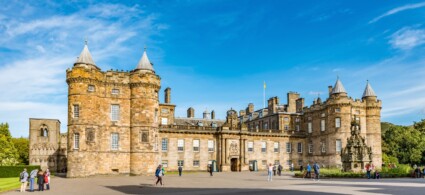
The legend tells of how, when the tunnels beneath the Royal Mile (the street connecting Edinburgh Castle and Holyrood Palace) were discovered centuries ago, a young bagpiper was sent to explore them. As he made his way through the underground passages, he played his instrument so that people above ground could track his progress by sound.
Suddenly, halfway along the Royal Mile, the music stopped. A search party was dispatched to find the boy, but he was never found and his body was never recovered. It is said that to this day, the haunting sound of the young man’s bagpipes can still be heard as he wanders eternally through the castle’s underground tunnels.
The headless drummer
The castle is said to be protected by the spirit of a headless drummer, who appears only as a harbinger of events that might threaten the fortress. The spirit was first sighted in 1650, shortly before Cromwell’s attack.
No one knows the story of this boy or understands why he protects the castle, but some visitors and staff members claim to occasionally hear his drumming echoing through the castle’s corridors.
The prison ghosts
Like most castles of its era, Edinburgh Castle had its dungeons, where over 1,000 prisoners (including captured “Caribbean Pirates” in 1720) were imprisoned, starved, tortured and executed. Today the dungeons are considered one of the most haunted locations in all of Scotland and a hotspot for paranormal activity.
Objects moving of their own accord, eerie sounds and spectral shadows have been reported on countless occasions. Among the ghosts said to haunt these cells is that of Mary, Queen of Scots.
Bobby, the phantom hound of Greyfriars Kirkyard
Over 160 years ago, a sweet Skye Terrier named Bobby was about to become, unknowingly, one of the most famous dogs in history.
The story goes that when his owner, who worked at the castle, died of tuberculosis, the small terrier continued to keep vigil at his grave in Greyfriars Kirkyard for an incredible 14 years. Despite harsh weather and attempts to chase him away, Bobby would always return to his beloved master’s tomb. Upon his death, the townspeople, deeply moved by his loyalty, buried him beside his owner in the same kirkyard.
Today, on the streets of Edinburgh, you can admire a statue dedicated to Bobby and, according to tradition, rubbing his nose brings good luck. Some people even claim to hear, from time to time, the bark of this legendary dog.

 Hotel
Hotel  Budget accommodations
  Apartments
  Family Hotel
  Luxury Hotel