Motel One Edinburgh-Royal
Edinburgh - 18-21 Market Street
Book now
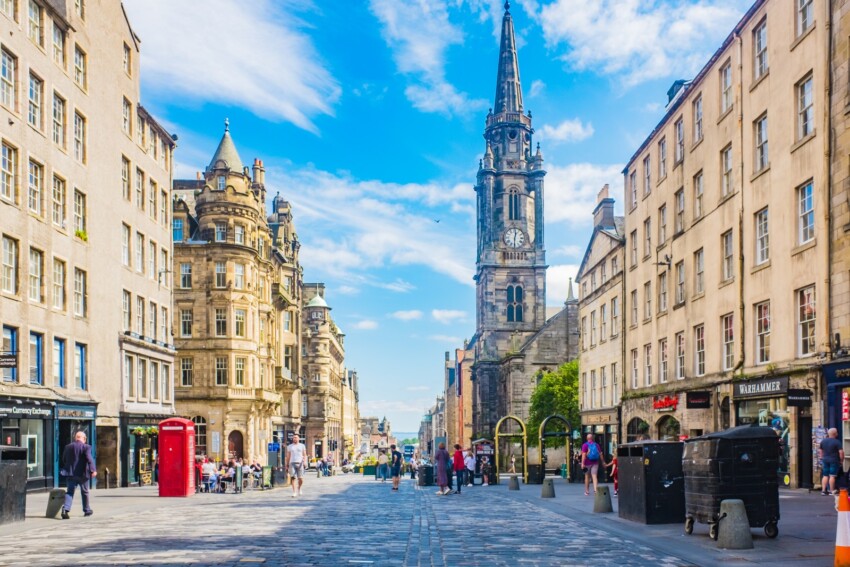
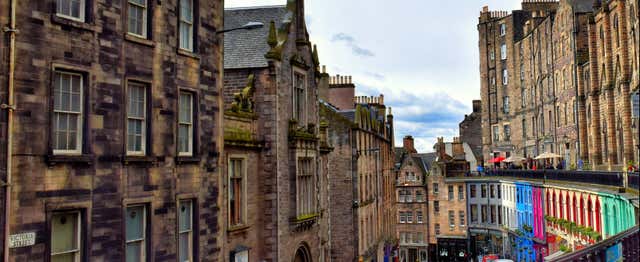
The Royal Mile is the main street of the Old Town, running downhill from the castle at the summit to Holyroodhouse Palace. Stretching roughly 1.8km, this magnificent sloping thoroughfare is lined with all the principal attractions of the historic centre, splendid period buildings, shops selling traditional goods and charming historic pubs, warm and welcoming.
Writer Daniel Defoe, visiting Edinburgh in 1724, was so impressed by this street that he declared it “superior to any other street in the world for breadth, length and architectural beauty”. The name “Royal Mile” derives from its length, which corresponds to a Scots mile (approximately 1,814 metres), a traditional unit of measurement now known only to locals.
The creation of this thoroughfare is inextricably linked to the geological origins of the city. Edinburgh (whose name comes from the Gaelic term “Dun Eidyn”, meaning “fortress on the hill”) grew up around Castle Rock, a volcanic formation shaped by glaciers over 325 million years ago. The Royal Mile naturally developed along the slope formed by volcanic sediments that extended from the hilltop.
During the medieval period, this area became incredibly densely populated: by the 17th century, some 70,000 people were crammed into buildings that could reach fourteen storeys high, with large families sharing extremely confined spaces.
Today, the Royal Mile represents the tourist heart of Scotland’s capital, thronged with visitors from every corner of the globe. While it hosts numerous commercial establishments, restaurants and souvenir boutiques, the real treasure of this street lies in its historic architecture, which has preserved its medieval character intact through the centuries.
Traditionally, the Royal Mile is divided into six distinct sections:
We’ll follow this historic route to guide you through the principal attractions that adorn this street.
Throughout the length of the street, you’ll find an intricate network of closes – narrow covered passageways leading to internal courtyards – and pends – steep, almost vertical alleyways descending from the hill – which we recommend exploring occasionally to discover hidden corners.
Whilst the full route can be covered at a brisk pace in around half an hour, to properly appreciate the numerous wonders you’ll encounter, we recommend allowing a full day, including stops to visit attractions, shop and spend time in the pubs to eat and drink.
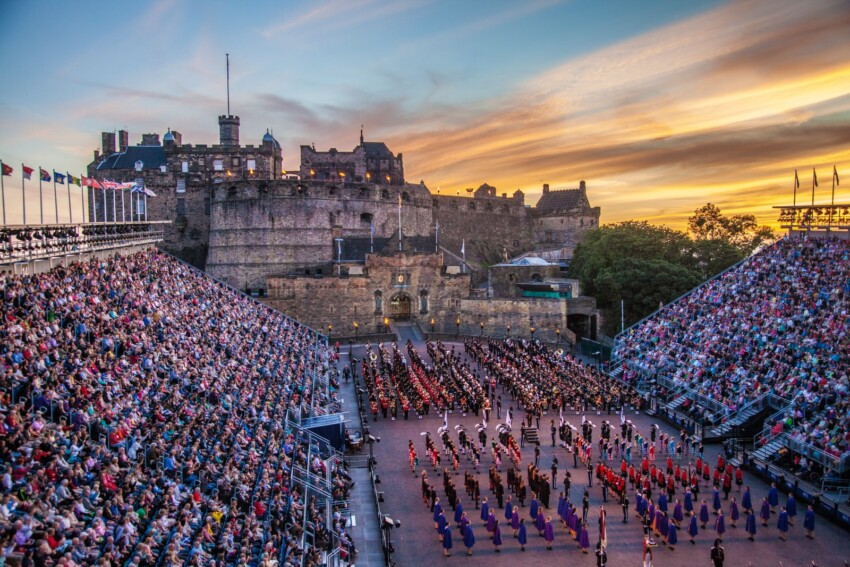
Our journey begins at the area surrounding the castle, the original nucleus of the city settlement.
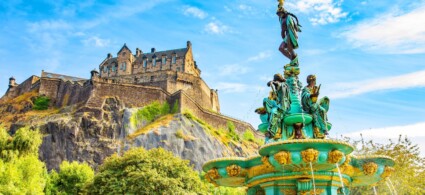
Dominating the skyline from atop the volcanic hill, Edinburgh Castle represents the principal attraction of Scotland’s capital. This impressive fortress, considered the most heavily fortified in Europe, offers breathtaking panoramic views across the city and tells the thousand-year story of Scotland.
Points of interest within the complex include: the famous One O’Clock Gun (the cannon fired daily at one o’clock in the afternoon), the magnificent Great Hall, the ancient St Margaret’s Chapel (the oldest surviving building in the city), the precious Honours of Scotland (Scotland’s crown jewels), the moving National War Memorial, the formidable Mons Meg cannon dating from the 15th century, and the austere military prisons.
A thorough visit requires at least two hours. We recommend purchasing tickets in advance to avoid long queues, particularly during peak tourist season.
To reach the castle, you’ll cross the Esplanade, a spacious plaza dating from the 18th century that links the fortress to the Royal Mile. At the western entrance you’ll find the magnificent main gateway, flanked by statues of legendary Scottish heroes Robert the Bruce and William Wallace. Above the arch stands the royal emblem of Scotland, depicting a red rampant lion on a gold field, accompanied by the Latin motto “Nemo me impune lacessit” (“No one provokes me with impunity”).
This vast esplanade hosts the stands every August for the famous Royal Edinburgh Military Tattoo, a spectacular military band display held in conjunction with the Edinburgh Festival.
At the eastern end of the Esplanade, on the facade of the Tartan Weaving Centre, you’ll notice a distinctive decorative fountain. This Art Nouveau monument, commissioned by urban planner Patrick Geddes, commemorates the site where between the 15th and 18th centuries, roughly 300 women accused of witchcraft were condemned to the stake. The bronze decoration incorporates symbolic elements including a foxglove plant and the effigy of a serpent entwined around the heads of Asclepius and his daughter Hygieia, deities associated with medicine.
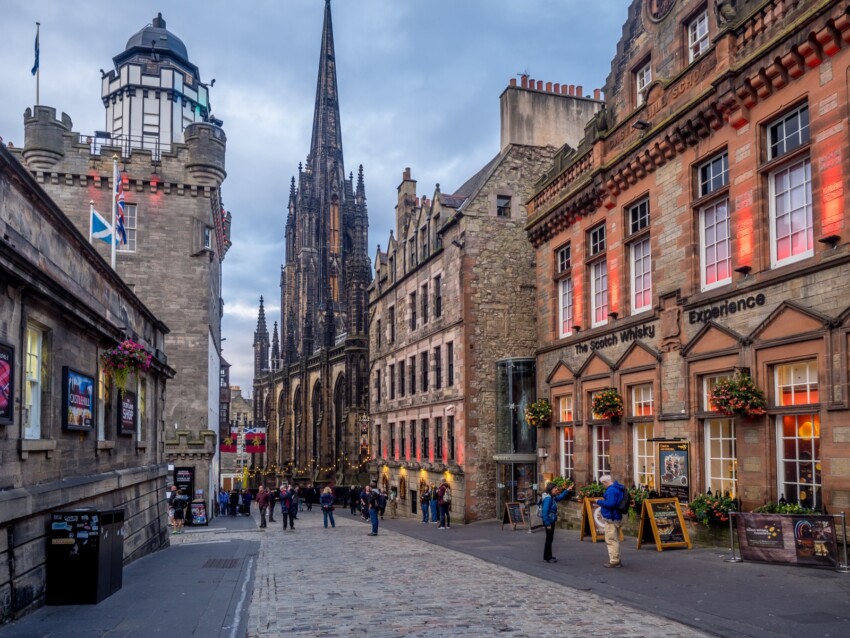
Continuing on, you’ll encounter Castlehill, the narrowest section of the Royal Mile descending from the fortress to the small square where The Hub stands – an imposing black stone church transformed into an exhibition space and information centre, whose tall Gothic tower is Edinburgh’s highest.
If you’re approaching from the Grassmarket area, you can also reach the castle via this steep staircase comprising 187 steps – a panoramic but demanding alternative for accessing the Esplanade.
This commercial complex is far more than a simple souvenir shop. Located in a building that once housed the Castle Hill water reservoir (the main water source for the Royal Mile), it now features a multi-level exhibition dedicated to the traditional Scottish weaving art.
Across its five floors you can observe the entire production cycle of tartan, from sheep shearing to the creation of characteristic kilts. For the comprehensiveness of the display, many consider this attraction a proper textile ethnographic museum.
Descending from Castlehill, on the right you’ll notice a building distinguished by a curious architectural feature: a cannonball embedded in the masonry above a window. According to local legend, this projectile was fired from the castle towards Holyrood Palace during the Jacobite Rising of 1745, when Bonnie Prince Charlie occupied the royal residence.
The historic building now hosts a quality restaurant accessed via Cannonball Close.
Whisky enthusiasts shouldn’t miss this centre dedicated to Scotland’s national drink. Housed in what was originally a school building (Castlehill Primary School), since 1988 it has offered an interactive journey through whisky production processes and tastings.
The centre also holds a world record: it houses the world’s largest collection of whisky, comprising 3,384 bottles gathered over 35 years by Brazilian collector Claive Vidiz and transferred here in 2008.
Adjacent to the Whisky Heritage Centre stands this refined hotel-restaurant, considered one of Edinburgh’s most prestigious establishments. With its finely decorated Gothic interiors and evocative atmosphere, it represents the ideal location for celebrating special occasions with candlelit dining in sumptuous, historically rich surroundings.
This popular attraction, operating since 1853, is an unmissable stop particularly for families with children. Spread across six levels within a characterful tower structure, it offers a series of interactive exhibitions including mirror mazes, light vortices, optical illusions and light games.
The actual camera obscura, located on the top floor, employs an ingenious system of mirrors and lenses dating from the 19th century to project a “virtual” panorama of the surrounding city. A panoramic terrace completes the experience, offering splendid views across Edinburgh.
At the intersection of Castlehill, Johnstone Terrace and Lawnmarket stands the distinctive silhouette of The Hub, a building characterised by Edinburgh’s highest spire. This neo-Gothic construction, originally consecrated as a church (Tolbooth Kirk), has served since 1999 as headquarters of the Edinburgh Festival, housing the ticket office, information centre and cultural event spaces.
Our walk continues along Lawnmarket, a section extending some 100 metres from The Hub to Bank Street. Originally known as “Land Market”, this segment was the principal commercial centre of the 15th century for the sale of yarn, textiles and linen. Once a residential area for city aristocracy, it’s now characterised mainly by souvenir boutiques and gift shops.
The pub nearest the castle takes its name from Charles Ewart, ensign of the Royal Scots Greys regiment who distinguished himself at the Battle of Waterloo (1815) by capturing the standard of the 4th French regiment. This characterful pub, occupying a building where an inn had stood since 1680, represents an ideal stop to savour authentic Scottish atmosphere in a historic setting featuring stone walls and wooden ceilings.
Among the oldest buildings still standing in Edinburgh, this construction dating from 1550 was subsequently purchased and renovated in the early 17th century by wealthy merchant Thomas Gledstanes, ancestor of British Prime Minister William Gladstone. The name on the building’s sign (a golden falcon with outstretched wings) derives from the meaning of the surname “Gled”, which in Scots denotes a bird of prey.
Saved from demolition in the 1930s through the intervention of the National Trust for Scotland, the building has been restored and furnished with period furniture and furnishings, offering visitors an authentic glimpse into 17th-century middle-class domestic style.
This characterful alleyway is home to a 17th-century residence built in 1622 for Sir William Gray of Pittendrum. Originally called Lady Gray’s House in honour of the first owner’s widow, it assumed its current name when the property was purchased in 1719 by Elizabeth Dundas, Lady Stair, widow of the Earl of Stair.
The historic Lady Stair House now houses a museum dedicated to three great Scottish writers: Sir Walter Scott, Robert Louis Stevenson and Robert Burns. Though modest in scale, this exhibition space is an essential stop for literature enthusiasts, preserving personal memorabilia such as Burns’ writing desk, Scott’s dining table and Stevenson’s riding boots.
Located at the corner of Lawnmarket and Bank Street, this traditional Scottish tavern founded in 1806 is named after the fascinating and controversial figure of William Brodie, a respectable carpenter and city councillor by day, burglar and lock-picker by night. His double life inspired Robert Louis Stevenson’s celebrated novel “The Strange Case of Dr Jekyll and Mr Hyde”.
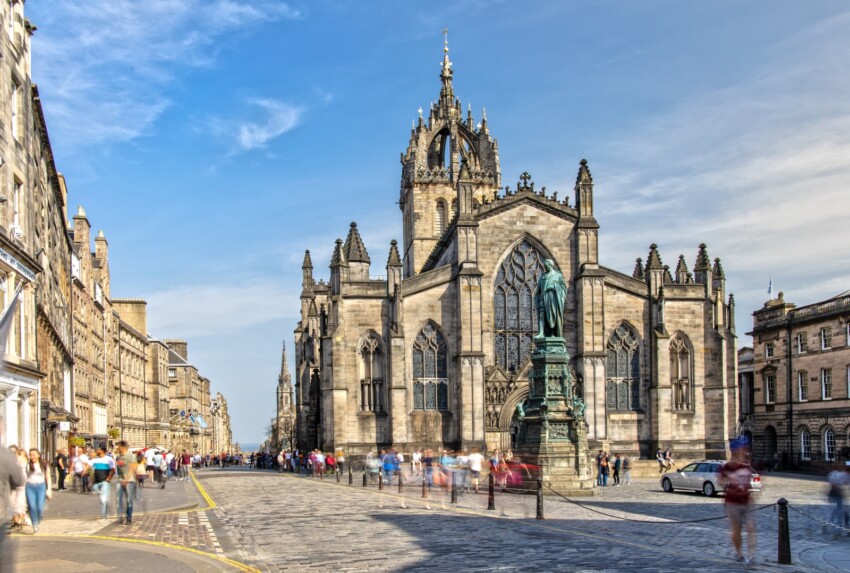
Continuing along the Royal Mile, you’ll reach High Street, arguably the most famous section of Edinburgh’s iconic thoroughfare. This area is home to major historical institutions including the Court of Session, the former Parliament and St Giles’ Cathedral, alongside numerous shops, restaurants and pubs.
At the entrance to High Street, on the left-hand side, you’ll find a bronze statue dedicated to the celebrated Enlightenment philosopher David Hume, a central figure in 18th-century empiricist and sceptical thought. Positioned in front of the High Court of Justice, this sculpture is the focus of a curious tradition: university students rub the big toe of the right foot for good luck before exams.
Beside St Giles’ Cathedral, set into the pavement, you’ll notice a distinctive heart-shaped granite mosaic decorated with the cross of St Andrew. This marks the site of the Old Tolbooth, the city jail built in the 15th century and demolished in 1817, notorious for its harsh conditions and instruments of torture.
A curious local custom sees Edinburgh residents spit on this symbol as they pass over it – a gesture whose original meaning is debated: some argue it was a sign of solidarity with prisoners, whilst others believe it stemmed from released prisoners spitting on the jail as they left. Today, it’s often interpreted as bringing good luck and ensuring a return to the city.
The church dedicated to Edinburgh’s patron saint, formally known as the High Kirk of Edinburgh, represents one of Scotland’s most significant places of worship for almost a thousand years. The present building largely dates from the 14th century, though it underwent substantial restoration during the 19th century, when the magnificent stained-glass windows depicting biblical scenes and saints were installed.
A crucial moment in the building’s history came when John Knox delivered the Reformation sermon that led to the founding of the Scottish Presbyterian Church. Particular attention should be paid to the Thistle Chapel, a refined Neo-Gothic space created in 1911 in honour of the Order of the Thistle, Scotland’s most prestigious chivalric honour.
The impressive spire of this former parish church is an unmistakable visual landmark along the Royal Mile. Its name derives from the “Tron Beam”, a medieval public scales used to weigh goods and positioned outside the building. Built between 1636 and 1647, the structure ceased its religious function in 1952 and today frequently hosts cultural events, particularly during the Edinburgh Festival.
Beneath the building lie the archaeological remains of Marlin’s Wynd, considered Scotland’s first paved street.
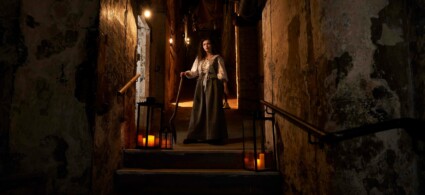
This labyrinthine network of narrow lanes dating from the 17th century represents one of Edinburgh’s most unusual and fascinating attractions. Partially demolished and used as foundations for the Royal Exchange (now the City Chambers), it remained buried and inaccessible for centuries, preserving intact the atmosphere of the medieval city.
Reopened to the public in 2003 as a tourist attraction (The Real Mary King’s Close), it offers a unique immersion into daily life in 17th-century Edinburgh, through evocative underground passages that reveal beautifully preserved homes, shops and streets.
Opened in 1955 as the world’s first museum entirely devoted to the history of childhood, this venue houses an extraordinary collection of toys, illustrated books, clothing and accessories from different eras and cultures. With free admission, it provides a pleasant thematic variation within the Royal Mile’s historical journey, particularly appreciated by visitors with children.
This 15th-century residence is traditionally associated with the renowned reformer John Knox, who spearheaded Scotland’s spiritual renewal. The building was actually reconstructed in the 16th century by goldsmith James Mossman, a craftsman who remodelled the crown for James V and who, due to his loyalty to the Catholic Mary, Queen of Scots, met a tragic end through execution.
Today, the house museum illustrates the history of the Protestant Reformation and offers an authentic glimpse into city life four centuries ago.
Continuing beyond High Street and St Mary’s Street, you reach the predominantly residential section of the Royal Mile. Canongate comprises the lower section of this main thoroughfare and takes its name (literally “canons’ road”) from the Augustinian friars of Holyrood Abbey, to whom King David I granted the right to found a settlement in 1140. This burgh maintained its own administrative independence until 1856, when it was finally incorporated into the city of Edinburgh.
This picturesque building with medieval lines is the oldest structure in the area, dating from 1591. Originally it served as the administrative headquarters, courthouse and jail for the independent burgh of Canongate, marking the boundary with Holyrood. The structure, characterised by a prominent clock face added in 1884, today houses the People’s Story Museum, an exhibition space dedicated to the everyday life of Edinburgh’s inhabitants from the 18th century to the present day.
This church serves as the official place of worship for Edinburgh Castle and the Palace of Holyroodhouse and was designed by architect James Smith, being constructed between 1688 and 1691. Its recent fame is also linked to royal weddings celebrated within its walls, such as that of Zara Phillips (granddaughter of Queen Elizabeth II) to former England rugby captain Mike Tindall in 2011.
In front of the building stands a bronze statue of the poet Robert Fergusson, a prominent 18th-century literary figure who died prematurely at the age of twenty-four.
The graveyard adjacent to the church merits a visit for its evocative moss-covered gravestones and magnificent views over Calton Hill. Among the notable burials is that of economist Adam Smith, father of economic liberalism, whose tomb is easily identifiable by small metal markers placed on the grass. At the entrance stands the Canongate Mercat Cross, a merchant cross that once served both as a commercial gathering point and a stage for public proclamations.
This lane represents one of the best-preserved examples of medieval Edinburgh architecture. Despite alterations over the centuries, it retains its intact 16th-century arched entrance, offering visitors an authentic image of how the city appeared in past centuries. Its cultural significance earned it selection as a filming location for scenes in the television series Outlander, where it appears as the home of Alexander Malcolm’s printing shop.
Among the hidden gems of the Royal Mile, this splendid 17th-century style garden represents an oasis of tranquillity in the heart of the bustling city. Named after David Dunbar, a writer who owned several properties in the area, the garden was donated to the city council in 1978 by the Mushroom Trust, a charitable foundation dedicated to creating and enhancing urban green spaces. With its geometric flower beds and panoramic views over Calton Hill, it offers a peaceful corner ideal for a relaxing break.
Beyond its discreet entrance gateway, this lane immediately transports visitors to another era through its 17th-century buildings, magnificently restored in the 1960s. Originally called Davidson’s Close, it took its present name from the inn that once stood here, a stopping point for carriages and traditionally associated with Mary, Queen of Scots’ white horse. During the Jacobite Rising of 1745, the complex housed officers accompanying Bonnie Prince Charlie during his stay in Edinburgh.
Since 2004, the Scottish legislative authority has been seated in this innovative architectural complex situated opposite the Palace of Holyroodhouse. Designed by Catalan architect Enric Miralles, the building is characterised by organic forms inspired by the Scottish landscape, with structures reminiscent of leaves and a wing clad in vegetation. Entry is free and visitors can observe parliamentary sessions from the public gallery of the Debating Chamber, an elegant semicircular chamber created in glass and wood.
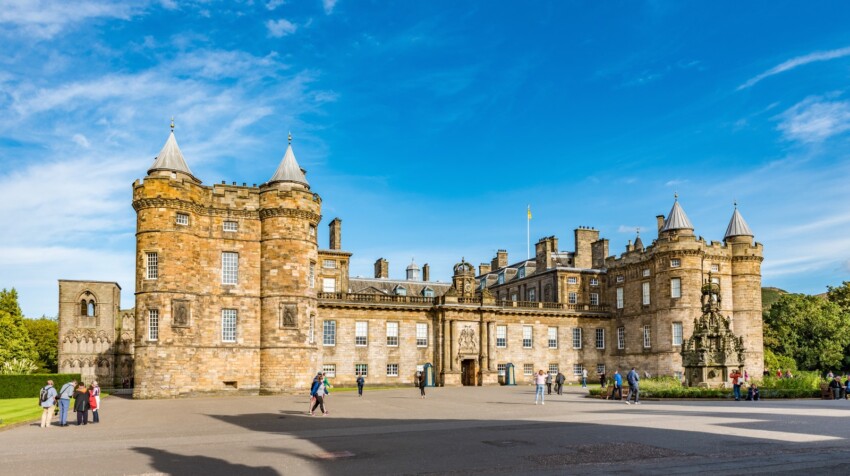
We finally reach the last section of our journey, Abbey Strand, named after the small watercourse that once ran through this area. This section encompasses the historic Holyrood Abbey, the magnificent Palace of Holyroodhouse and the extensive surrounding parkland.
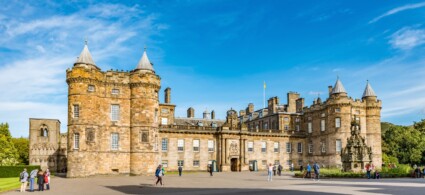
The official residence of the British monarchy in Scotland since the 16th century, the Palace of Holyroodhouse sits at the eastern end of the Royal Mile, positioned symmetrically opposite the Castle. The building developed from an original nucleus connected to the Augustinian abbey founded in 1128 by King David I. King James IV initiated the transformation of the site into a royal residence, a project continued by his successor James V.
The building’s historical fame is inextricably linked to the stay of Mary, Queen of Scots between 1561 and 1567, a turbulent period culminating in the dramatic assassination of her secretary David Rizzio, stabbed 56 times in 1566 by conspirators led by her husband Lord Darnley. A metal plaque marks on the floor the alleged bloodstains from this heinous crime.
Even today, the British royal family stays regularly at the palace during “Holyrood Week”, a week of official engagements held annually between late June and early July.
Adjacent to the palace stand the evocative ruins of the Augustinian abbey founded in 1128 by King David I. The name derives from the term “rood“, an ancient English word for the cross of the Crucifixion, making “Holyrood” equivalent to “Holy Cross”.
According to legend, during a hunting expedition in 1127 in the surrounding woods, King David I was thrown from his horse and nearly gored by a stag. His miraculous escape, attributed to the appearance of a luminous cross between the animal’s antlers, inspired the founding of the abbey the following year as a sign of gratitude.
Of the original building, the western portal, one of the entrance towers and part of the right-hand nave survive today, elements that nonetheless retain considerable dramatic impact, particularly striking at sunset.
Opened in 2002 by Elizabeth II, this art gallery integrated into the Holyroodhouse complex hosts temporary exhibitions of works belonging to the Royal Collection, one of the world’s most important art collections. The exhibitions are periodically refreshed, offering visitors the opportunity to view masterpieces not normally accessible to the public.
At the base of the Royal Mile, near the entrance to Holyrood Palace, a sequence of three brass letters “S” set into the cobblestones marks the boundary of the ancient “Abbey Sanctuary”. This area, which extended for five miles, constituted a legal refuge primarily for insolvent debtors, humorously nicknamed by locals “Abbey Lairds”. A curious arrangement allowed them to temporarily leave the protected zone each Sunday (when legal proceedings were suspended), enjoying 24 hours of freedom from midnight on Saturday. The sanctuary ceased to exist in 1880, when legislative reform abolished imprisonment for debt.
Though technically not part of the Royal Mile, these geological formations dominate the Abbey Strand skyline. Arthur’s Seat, an extinct volcano dating back 350 million years, represents Edinburgh’s highest point and offers spectacular views across the entire city. For a less strenuous excursion, the Salisbury Crags provide a scenic alternative: this sequence of reddish rocks surrounding the Palace of Holyroodhouse is accessible via the path known as the Radical Road, so named because it was constructed by weavers who had risen in revolt during the popular unrest of 1820, subsequently employed on public works following the suppression of the protests.
Below is a selection of the best accommodation options near the Royal Mile, the most central and convenient area for visiting Edinburgh.
City Card allow you to save on public transport and / or on the entrances to the main tourist attractions.
 Hotel
Hotel  Budget accommodations
  Apartments
  Family Hotel
  Luxury Hotel