1 Motel One Edinburgh-Royal
Edinburgh - 18-21 Market Street
Situated in the centre of Edinburgh, the Motel One Edinburgh-Royal is 5 minutes’ walk away from the train station, and only half a mile from the Castle.
Book now
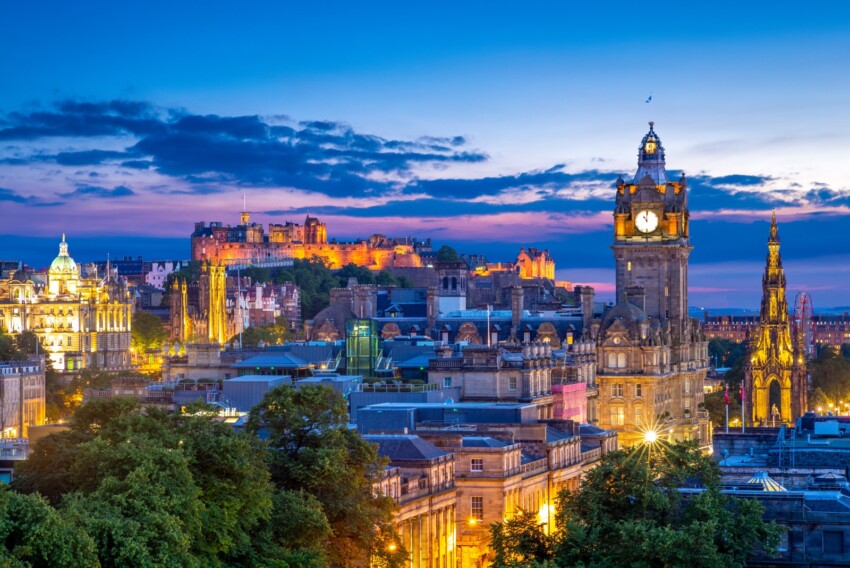
Edinburgh is undoubtedly one of Europe’s most beautiful cities. Its charm will captivate you from the very first moment, whether you visit in summer or winter. You’ll most likely start your trip to Scotland here, but you could also visit it as a standalone destination during a long weekend or bank holiday break, thanks to the abundance of flights – especially budget airlines – connecting it with major European hubs, with the promise of returning for longer to embark on a road trip discovering the country’s beauty.
Whatever the duration of your stay in Edinburgh, you’ll need to sort out finding accommodation. There are many areas to stay in the city, each with its own advantages and disadvantages. Here’s what they are, so you can choose wisely based on your budget and travel preferences and style.
The Royal Mile is the main street of Edinburgh’s historic centre: a mile-long stretch well worth exploring, gently sloping downhill, running from Edinburgh Castle to the Palace of Holyroodhouse, the Scottish residence of the British royal family, passing through the small square where St Giles’ Cathedral stands proudly.
Along the Royal Mile, which officially divides into the streets of Lawnmarket, High Street and Canongate, you’ll find many hotels, bed and breakfasts and guest houses. It’s equally easy to find accommodation in the adjacent streets: this is one of the best areas to stay in Edinburgh thanks to its proximity to the city’s main attractions and monuments. It’s also well served with shops (including souvenir shops), bars, pubs and restaurants serving typical Scottish cuisine.
The advantages of staying along the Royal Mile are obvious. However, there are also several drawbacks to consider, chief among them the impossibility of parking, which is especially problematic if you have a rental car. Moreover, everything here is more expensive because it’s a very touristy area.
At the western end of the Royal Mile, perched on a hillside, you’ll find Edinburgh Castle. If you choose to head down the hill in a southerly direction along Johnston Terrace, you’ll find yourself in a very quiet neighbourhood of Edinburgh, far less touristy, though accommodation options are still plentiful. These are mainly hotels belonging to major international chains, such as Hilton, Novotel and Leonardo, alongside other options including B&Bs and guest houses.
The area beneath the castle hill is very well served. Among the highlights worth visiting are the Farmers’ Market, held every week where you can buy local gastronomic delicacies, the concert hall Usher Hall and Lauriston Campus of Edinburgh University.
Waverley Station is Edinburgh’s main railway hub. It makes sense to find accommodation here if you arrive in the city by train, as you won’t have to carry your luggage and bags along the cobbled, sloping streets of the historic centre. Similarly, Waverley Station ideally divides Edinburgh into two zones: the Old Town and the New Town, which stretches along Princes Street and its surroundings.
Staying near Waverley Station puts all of Edinburgh within reach, without needing to use public transport to get around. Definitely a highly recommended area!
Edinburgh’s New Town lies north of Waverley Station. Despite its name, it’s no longer particularly new, dating back to the Georgian era, between the late 18th and early 19th centuries. You’ll find elegant streets lined with terraced townhouses in typical British style, as well as high-end shopping streets like Princes Street and George Street.
The New Town is also home to some of Edinburgh’s most interesting museums and monuments, including the National Galleries of Scotland, the Scott Monument and the Dugald Stewart Monument, located within Calton Hill park.
Edinburgh’s New Town is a very upmarket area, and consequently accommodation prices are higher than average. You’ll find small guest houses and bed and breakfasts, but also boutique hotels and major international chains such as Marriott, Mercure and Premier Inn.
Haymarket is a neighbourhood in Edinburgh located west of the historic centre. It’s a less touristy but certainly no less busy area! The focal point of the neighbourhood is the railway station, where trains depart and arrive for Glasgow, Aberdeen and Inverness, as well as local connections to Waverley, which is just a couple of kilometres away. There are also numerous buses stopping at Haymarket Station, so you certainly won’t have any problems getting around.
Staying in Haymarket will allow you to get away slightly from the centre, with all the associated pros and cons: fewer entertainment options, but fewer tourists around, generally lower prices, and restaurants and pubs frequented mainly by locals.
North of Haymarket lies the West End neighbourhood, which as its name suggests marks the western edge of Edinburgh’s city centre. It’s a very pleasant area, characterised by the typical terraced townhouses that line the streets. Here you’ll find the historic Waldorf Astoria hotel, located along Lothian Road, where you can find numerous restaurants and pubs serving typical Scottish fare.
West End doesn’t lack independent boutiques, unusual homeware shops and trendy bars, especially along William Street and Stafford Street. Charlotte Square is one of the main squares in the area, with a large park in its centre and elegant Georgian-style townhouses facing onto it.
Staying in West End will allow you to relive Edinburgh’s Georgian past, whilst being close to the centre without being overwhelmed by it.
Looking at photos and postcards of Edinburgh, you might not immediately realise that it’s actually a coastal city. Leith is the neighbourhood that overlooks the water, specifically the Firth of Forth, a fjord that opens out onto the North Sea.
Staying in Leith to visit Edinburgh makes sense? Absolutely, especially if you love harbour and maritime atmospheres, to experience a real holiday within a holiday. After all, getting to the centre takes less than 20 minutes by tram, or 25 minutes by bus, so it certainly won’t be a problem. Moreover, Leith is home to one of Edinburgh’s main attractions, the Royal Yacht Britannia, a large ship used by the British royal family for official state visits for over 40 years, now moored in port and converted into a museum.
Leith is also perfect for golf enthusiasts, as it’s home to the Craigentinny Golf Course, a beautiful 18-hole golf course.
If Leith represents Edinburgh’s port neighbourhood, Portobello represents the city’s beach. Bear in mind, we’re on the North Sea, with maximum temperatures in August rarely exceeding 20 degrees, so don’t expect a seaside holiday in Edinburgh!
However, the atmosphere you’ll experience strolling through Portobello and along its seafront is truly pleasant, and in summer the beach is popular with couples, groups of friends and families for picnics, games or simply to relax – when the weather permits, of course!
Finally, among the best areas to stay in Edinburgh you can’t overlook the international airport. It’s very convenient to choose accommodation near the terminal for your first night if you’re arriving late in the evening, or for your last night if you’re departing early in the morning.
Edinburgh Airport is located about 15 kilometres from the city centre, heading west, within the Ingliston neighbourhood. For staying at Edinburgh Airport you have a limited number of choices, but they’re adequate: there are 4 hotels, all belonging to international chains, namely Hilton, DoubleTree by Hilton, Moxy and Holiday Inn Express. If your budget doesn’t stretch that far, head a few kilometres towards the settlement of Gogar, to the east, where you’ll find numerous other hotels and accommodation options.
Use the form below to check room availability and prices in real time.
 Hotel
Hotel  Budget accommodations
  Apartments
  Family Hotel
  Luxury Hotel