Fairmont St Andrews, Scotland
St. Andrews - Kingask
Book now
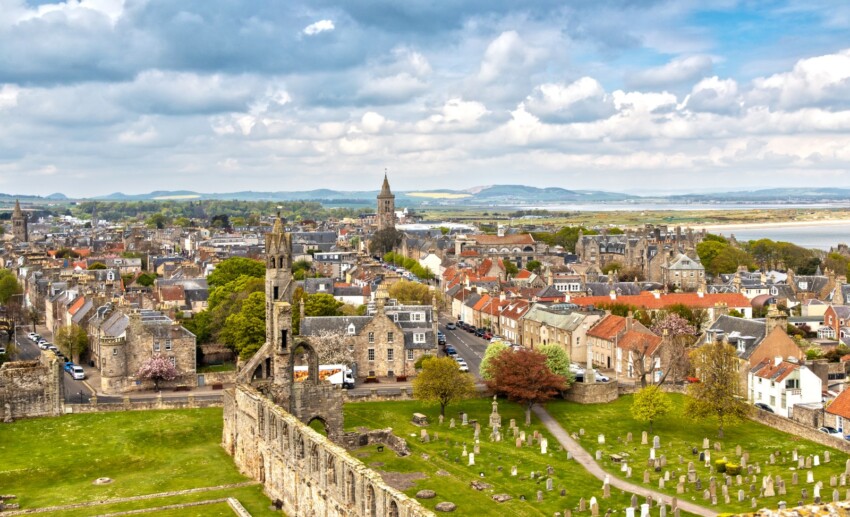
Nestled on the eastern coast of Fife, St Andrews, despite its modest size, packs an incredible array of attractions, making it an unmissable stop on any Scottish journey.
The historic centre is a maze of cobbled streets lined with local craft shops, cosy cafés and traditional pubs. The atmosphere is made all the more vibrant by the presence of the university, Scotland’s oldest and the third oldest in the English-speaking world, which attracts students from across the globe (members of the British Royal Family have studied here too!).
St Andrews is the ideal destination for both a short day trip from Edinburgh or a longer stay exploring Fife and its wonders.
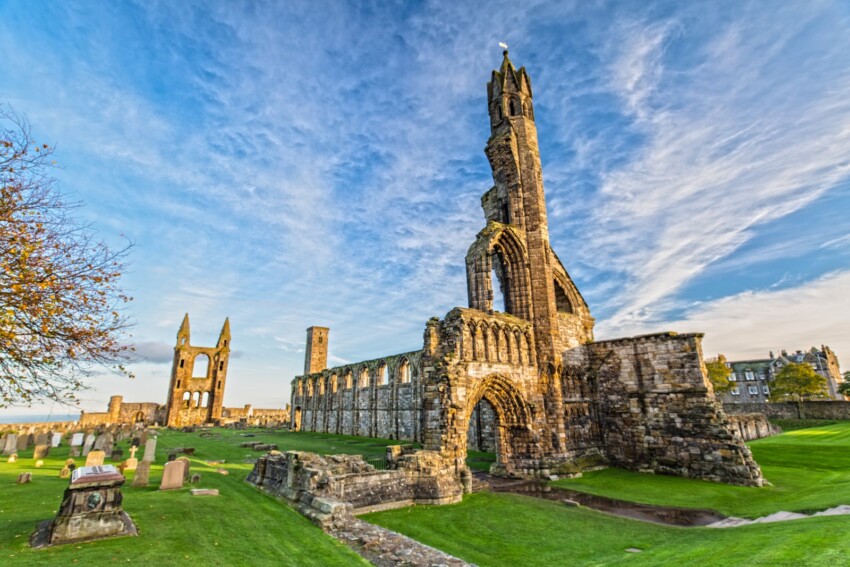
The St Andrews Cathedral stands as one of the most impressive and significant monuments in medieval Scotland. Built in 1158 and consecrated in 1318 in the presence of Robert the Bruce, it was for centuries Scotland’s largest church and the centre of the nation’s religious life. At 119 metres in length, it surpassed almost all other British cathedrals of the era, testament to St Andrews’ importance as a medieval ecclesiastical centre.
The construction of this imposing structure required more than 150 years of work, spanning several architectural phases that remain visible in the ruins today. The cathedral’s history is intertwined with the turbulent events of the Scottish Reformation. In June 1559, following a fiery sermon by John Knox in Perth, a crowd of reformers reached St Andrews and systematically stripped the cathedral of its ornaments, altars and images, which they considered symbols of idolatry. This event marked the beginning of the structure’s decline. Deprived of its religious function and left unmaintained, it gradually fell into ruin. The cathedral’s stones were subsequently used as building material for local structures, accelerating the deterioration process.
A fascinating detail we discovered is that the cathedral was built to house a precious relic: the bones of the Apostle St Andrew, patron saint of Scotland. Although these relics were lost during the Reformation, their historical and cultural significance endures, and St Andrews remains a place of pilgrimage, albeit more historical than religious in nature.
The cathedral’s predominant style is Gothic, with Romanesque influences in its earliest sections. During our visit, we observed how the cathedral was originally structured with a central nave on three levels, north and south transepts, and a presbytery with radiating chapels – an ambitious design reflecting the power and wealth of the St Andrews archdiocese.
Walking amongst the remains of imposing walls and columns allows you to imagine the building’s original grandeur. The eastern arch is particularly striking, especially when framed against the North Sea beyond. The remains of the south wall still display the characteristic Norman zigzag pattern that once decorated the entire building. Near the south-western corner, you can observe the remains of the chapterhouse, where the canons gathered daily.
Particularly memorable is the climb up St Rule’s Tower, a 12th-century structure standing 33 metres high that predates the cathedral itself. This tower, dedicated to St Regulus (or Rule), a Greek monk who, according to legend, brought the relics of St Andrew to Scotland in the 4th century, is one of the few remaining parts of the original complex that has survived largely intact.
Its 158 steps lead to a viewing platform offering breathtaking views over the town, coastline and sea. On clear days, the vista extends to the mountains of Perthshire and Angus, providing opportunities for spectacular photographs.
The graveyard surrounding the cathedral is one of Scotland’s oldest and most fascinating. Its gravestones and monuments, some dating back to the 15th century, tell stories of sailors, merchants, academics and local dignitaries. Particularly notable are the medieval grave slabs preserved in an open-air museum within the cathedral precinct, displaying elaborate carvings of crosses, swords, occupational symbols and, in some cases, effigies of knights and prelates.
The Cathedral Museum, located at the entrance to the site, displays a rich collection of artefacts recovered from archaeological excavations, including fragments of coloured glass, decorative stone elements, coins and liturgical objects. During our visit, we were impressed by a detailed model showing how the cathedral would have appeared at the height of its splendour in the 15th century.
Today the site is managed by Historic Scotland, which has installed detailed information panels throughout the perimeter, allowing visitors to navigate the ruins and understand their history and architecture. The organisation also offers guided tours during certain periods of the year, which we highly recommend for a more in-depth experience.
Visiting the cathedral requires at least an hour to be properly appreciated, though we suggest dedicating at least two hours if you intend to climb St Rule’s Tower and visit the museum. The site is open year-round, with extended hours during summer months. Be aware that the tower climb can be challenging for those with mobility issues or claustrophobia, but the rest of the site is relatively accessible, with flat paths through the main ruins.
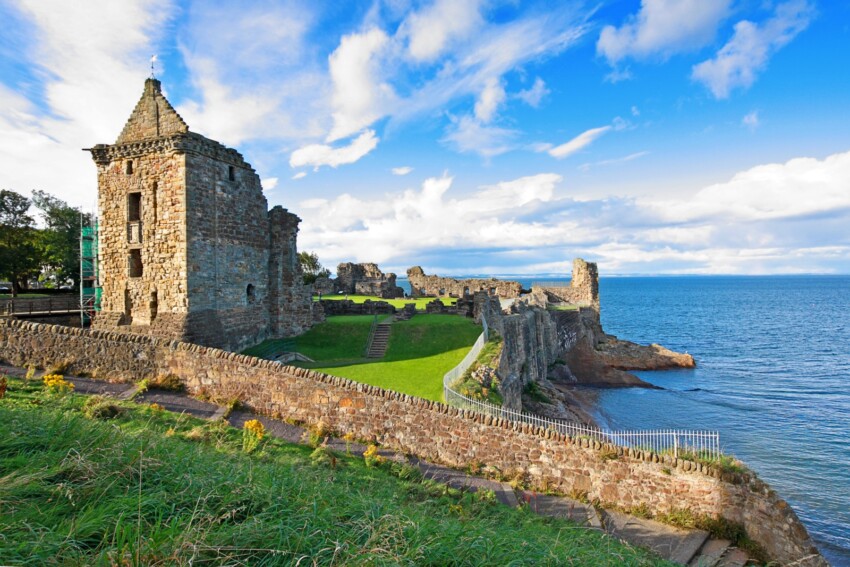
St Andrews Castle dominates a rocky promontory jutting into the North Sea, offering a fascinating example of medieval defensive architecture. Built around 1200 as a fortified residence for the bishops of St Andrews, it played a central role in many dramatic events of Scottish history, including episodes of the Protestant Reformation.
During our exploration, we were particularly struck by the underground prisons and the mysterious “bottle dungeon”, a bottle-shaped prison carved into the living rock. Equally impressive is the mine and counter-mine tunnel, a rare example of 16th-century siege warfare that visitors can explore, experiencing conditions similar to those faced by soldiers of the era.
From the top of the castle walls, there are spectacular views over St Andrews Bay and the neighbouring cathedral. The visitor centre features an interactive exhibition illustrating the castle’s turbulent history, including sieges, imprisonments and executions that took place within these walls. We found the collection of artefacts recovered from archaeological excavations particularly interesting, with items offering glimpses into medieval daily life.
The Old Course at St Andrews is far more than a simple golf course: it is a place of pilgrimage for golf enthusiasts from around the world and a site of historical and cultural importance. Considered the “birthplace of golf”, this legendary course has hosted numerous editions of the Open Championship and has seen the greatest champions in golf history compete here.
During our visit, even without playing, we were able to savour the magic of this place by strolling along the public fairways (the Old Course closes on Sundays and becomes a public park) and observing the famous Swilcan Bridge, the small stone bridge on the 18th fairway that has become an iconic photograph in world golf.
The British Golf Museum, situated right beside the Old Course, offers a fascinating overview of the sport’s history, from its medieval origins to the present day. Inside are displayed over 500 years of golf memorabilia, including antique clubs and balls, trophies, period clothing and mementoes of great champions.
For those wishing to play the Old Course, advance booking is necessary or you can enter the daily ballot. However, St Andrews offers six other championship-standard golf courses (New Course, Jubilee Course, Eden Course, Strathtyrum Course, Balgove Course and Castle Course), some of which are more accessible for last-minute bookings.
The University of St Andrews, founded between 1410 and 1413, is Scotland’s oldest and the world’s third oldest university in the Anglophone world. Walking across the campus means immersing yourself in centuries of academic tradition, in an environment where ancient stone buildings blend harmoniously with modern structures.
St Salvator’s College (known locally as “St Sally’s”) is one of the most photographed buildings, with its distinctive quadrangle and 15th-century Gothic chapel. During our tour, we noticed students wearing traditional red gowns, a custom dating back to the Middle Ages that is still observed during official ceremonies and certain events.
Another interesting attraction is the St Mary’s College Quadrangle, a peaceful Renaissance courtyard housing the divinity faculty. The Museum of the University of St Andrews (MUSA) offers a fascinating overview of the institution’s history, with a collection including ancient scientific instruments, works of art and academic artefacts.
The university gained additional international prominence when Prince William and Kate Middleton met here during their studies. Today, it continues to be one of the UK’s most prestigious universities, with a cosmopolitan atmosphere that significantly contributes to St Andrews’ appeal.
West Sands Beach is one of Scotland’s most spectacular beaches, stretching nearly two miles of golden sand flanked by dunes that extend into the distance. Made world-famous by the opening scene of the film “Chariots of Fire“, this beach offers panoramic views over the Eden Estuary and, on clear days, the mountains of Perthshire.
During a stroll along the beach, you’ll enjoy spectacular views of St Andrews town and the Old Course golf links sitting right beside it. Although the water is generally cold, during the summer months you may see brave swimmers and water sports enthusiasts.
The St Andrews Botanic Garden is an oasis of tranquillity set over 18 acres of beautifully maintained grounds. Founded in 1889 as a research garden for the university, it is now a public attraction that combines science, education and pure aesthetic pleasure.
Particularly enchanting is the Chinese Garden, with its authentic pavilion and thoughtful arrangement of Asian plants and ornamental rocks.
The glasshouses offer a warm refuge on rainy days and house a remarkable collection of tropical plants, succulents and cacti. The garden is also an excellent spot for wildlife watching, with numerous bird species, insects and small mammals that have made this space their home.
Throughout the seasons, the garden transforms completely: in spring it explodes with colour from thousands of blooming bulbs, in summer the mixed borders reach their peak, in autumn the foliage creates spectacular colour contrasts, whilst in winter the structural forms of plants emerge with elegant simplicity.
The St Andrews Museum is housed in an elegant Victorian building surrounded by a fine park in the heart of the town. This welcoming museum tells the rich story of St Andrews, from prehistoric times to the present day, through a varied collection of artefacts, photographs and testimonies.
Notable is the gallery dedicated to daily life through the centuries, showing how lifestyles, crafts and local traditions have evolved. Equally interesting is the section devoted to the university and its impact on the town, with objects that chronicle student life across the ages.
The museum also hosts temporary exhibitions ranging from contemporary art to local history, keeping its offerings fresh and engaging. The ground-floor café, with its welcoming atmosphere and views over the park, is a perfect spot for a relaxing break.
Admission to the museum is free, making it an excellent attraction to include in your itinerary, especially on rainy days.
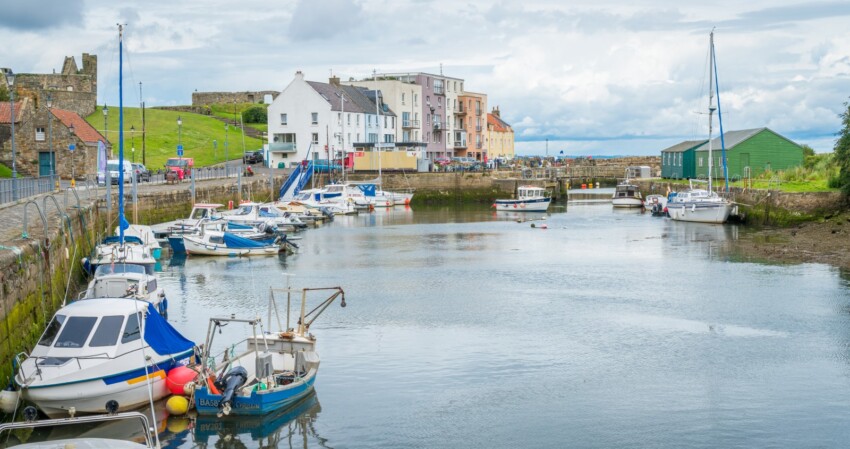
The St Andrews Harbour offers a fascinating glimpse into the maritime life of this coastal town. Although today it is primarily used for recreational activities and sport fishing, in the past it was a thriving commercial hub connecting St Andrews with European ports and supporting the local fishing industry.
The pier is a popular spot for both local fishermen and visitors wanting simply to breathe in the sea air and watch the boats.
Nearby stands the Fisher and Divers Memorial, a touching tribute to those who lost their lives at sea. The harbour area is home to several excellent seafood restaurants where we enjoyed fresh catches and other local dishes, with views of the sea.
For photography enthusiasts, the harbour offers exceptional opportunities, particularly at sunrise and sunset when golden light illuminates the ancient pier stones and moored boats. In summer, it’s possible to book boat trips for marine wildlife viewing, including seals, dolphins and a wide range of seabirds.
The St Andrews Aquarium is one of the most beloved attractions for families visiting the town. Situated in a panoramic location overlooking the North Sea, this relatively small but well-maintained aquarium houses a surprising variety of marine creatures and more.
Among the aquarium’s most popular inhabitants are Humboldt penguins, small-clawed Asian otters, sharks, colourful jellyfish and a collection of exotic reptiles and amphibians. The animal feeding times, which take place at set times throughout the day, are particularly engaging and informative.
The aquarium’s location, right above West Sands Beach, adds a perfect natural context to the experience.
For those travelling with children, the aquarium offers excellent educational entertainment, especially on rainy days, which are common in Scotland. A visit typically requires a couple of hours, sufficient time to see all the exhibits without rushing.
The Scores is a picturesque panoramic street running along the cliffs between St Andrews Castle and the Old Course. This walk, which we took several times during our stay, offers some of the town’s most spectacular views.
The route is dotted with elegant Victorian buildings, many belonging to the university or converted into luxury hotels. Along the way you’ll find the St Andrews Cathedral Viewpoint, a viewing terrace offering breathtaking views of the cathedral ruins, the harbour and the entire bay. This vantage point is particularly atmospheric at sunrise and sunset, when warm light bathes the ancient cathedral stones.
On clear days, views extend to the Angus mountains and, in the opposite direction, along the entire Fife coast.
In the following map you can see the location of the main places of interest mentioned in this article.
St Andrews historic centre is your best option for accommodation. You’ll find a selection of charming boutique hotels housed in historic buildings, welcoming bed and breakfasts, and well-appointed apartments. During our stay in the centre, we particularly appreciated the ability to venture out in the evening for dinner or drinks at local pubs without worrying about how to get back. The area is lively thanks to the university student population, yet it maintains a relaxed and safe atmosphere.
The harbour area offers accommodation with views over the North Sea. From here, you can easily reach the centre on a pleasant 10–15 minute walk.
St Andrews is located in the Fife region, on Scotland’s east coast, approximately 80 km north-east of Edinburgh.
For those travelling by car, St Andrews is easily accessible via the A91. From Edinburgh, the journey takes around an hour and a half. Hiring a car is certainly the best option as it will allow you to explore the picturesque coastal villages of Fife at your leisure.
If you prefer to travel by train, the nearest station is Leuchars, situated approximately 10 km from St Andrews centre. From there, frequent buses (route 99) will take you into town in around 10 minutes.
There are also direct coach services connecting St Andrews with Edinburgh, Glasgow and other Fife locations, mainly operated by Stagecoach.
Another option is to join organised coach tours departing from Edinburgh that will allow you to discover St Andrews in a day trip.
St Andrews is located in the Fife region and lies approximately 80 km from Edinburgh (an hour and a half by car), 115 km from Glasgow (two hours) and 22 km from Dundee (30 minutes).

 Hotel
Hotel  Budget accommodations
  Apartments
  Family Hotel
  Luxury Hotel