1 The Z Hotel Glasgow
Glasgow - 36 North Frederick Street
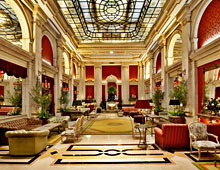
In the city centre beside George Square and 200 metres from Queen Street Station, The Z Hotel Glasgow features compact and luxury accommodation in a contemporary design.
Book now
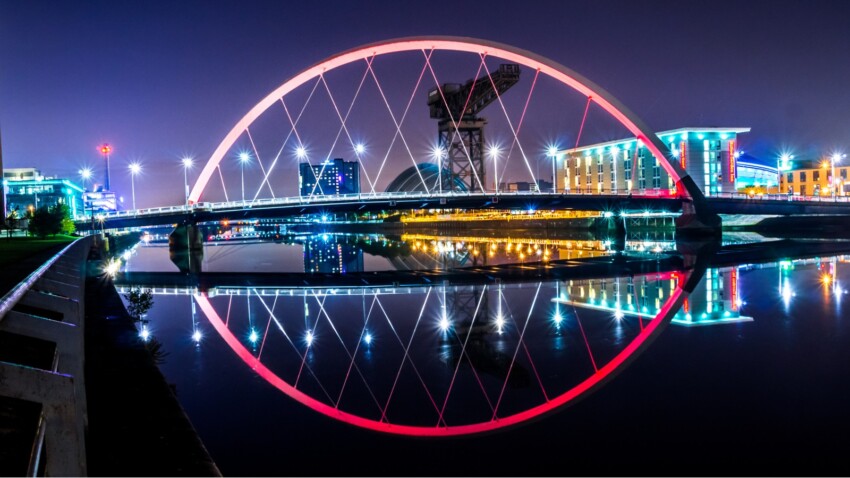
It may not have the allure of Edinburgh and it’s not one of Scotland’s must-sees like the Isle of Skye or Loch Ness, but Glasgow remains the country’s principal economic hub and largest city nonetheless. Don’t overlook it—add it to your itinerary and spend a couple of days discovering all it has to offer before moving on.
What’s more, you might choose to visit Glasgow during one of the city’s numerous events, whether that’s football or rugby matches, concerts, festivals and everything in between. There are countless reasons to visit Glasgow, but whatever brings you to the city, you’ll eventually need to sort out where to stay.
Where to stay in Glasgow, then? The city is sprawling, particularly when you factor in its metropolitan area, which has now completely merged with the original boundaries, making it even larger. However, the main attractions are just a few kilometres from the centre, on both sides of the River Clyde.
Merchant City is a neighbourhood in Glasgow city centre situated immediately east of Central Station and south of Queen Street Station. It’s the heart of the city, where you’ll find plenty of services, pedestrian streets, the covered market Merchant Square, the City Halls & Old Fruitmarket and much more.
Bounded on its eastern side by High Street, one of Glasgow’s main thoroughfares, Merchant City proves an excellent area to stay in Glasgow: you’ll be just steps from transport links, with plenty of amenities on your doorstep and most attractions within a few minutes’ walk. On the downside, expect higher-than-average prices, considerable difficulty finding parking if you’ve hired a car, and limited peace and quiet unless you find accommodation on a quieter side street.
Townhead is a neighbourhood situated north-east of Glasgow city centre. The most important landmark here is the cathedral, a must-see if you’re in the city. Staying in Townhead will allow you to reach it comfortably on foot. The neighbourhood is very green, with spacious open areas and lawns rather than formal parks. To put it simply, you won’t feel hemmed in, and the buildings are never cramped together. That’s a real plus!
As mentioned, Central Station (known as Glasgow Central) marks the western edge of Merchant City. On the opposite side, you’ll find a vast array of hotels and accommodation of every type, plus some of Glasgow city centre’s most significant streets, such as Argyle Street, always bustling with activity, or Hope Street, where practically every bus stops.
By choosing to stay near Glasgow’s central station, you’ll be in the heart of the city and perfectly positioned for public transport. However, you’ll again face higher-than-average prices and extremely limited parking options.
The stretch along the River Clyde that extends westward from Glasgow’s centre has undergone enormous regeneration over recent years. Along Finnieston Quay and Congress Street and their immediate surroundings, you’ll find some of the city’s most futuristic buildings, which define Glasgow’s 21st-century skyline. We’re talking about the Clyde Arc bridge, the SEC Armadillo auditorium, the OVO Hydro sports venue, the Scottish Event Campus conference centre and much more besides. Exploring this part of the city will transport you to the future, and it’s also where many of Glasgow’s major events take place.
It’s a very trendy area, dominated almost exclusively by 4-star hotels from major international chains—modern, cutting-edge and naturally equipped with all amenities. Parking won’t be an issue, and you’ll enjoy plenty of peace at night. On the downside, there’s the distance from the centre—though not excessive—and a shortage of public transport options, though Exhibition Centre Station is within easy reach. Naturally, the high quality of hotels in this part of Glasgow comes at a premium.
Crossing the River Clyde via the Millennium Bridge, Bell’s Bridge or Clyde Arc, you’ll find yourself on the opposite bank from Finnieston Quay and Congress Road, in Glasgow’s newest area which we’ve just discussed. But the “other” side of the river is equally worth noting: it too has been subject to extensive regeneration, with the jewel in the crown being the Glasgow Science Centre, a vast museum dedicated to science and technology offering interactive exhibits and a planetarium. There’s also an IMAX cinema here, and a short distance away you can visit the South Rotunda, one of old Glasgow’s notable monuments.
Ibrox is home to Glasgow Rangers and one of Europe’s most prestigious stadiums, so much so that it’s earned a 4-star rating from UEFA, which means it can host Champions League and European Championship finals. Opened in 1899 and last renovated in 1990, if you’re a football fan and decide to visit Glasgow to watch your team play here, you might consider staying near Ibrox Stadium so you can walk to the match without any stress. You’ll be south of the River Clyde, a few kilometres from the centre, but don’t worry: the underground railway is nearby, and getting to the more touristy neighbourhoods will be a breeze.
Finally, if you’re staying in Glasgow because you’re arriving by air late in the evening or have an early morning flight, there’s nothing better than staying near the airport. It lies within the boundaries of Paisley, at its northern edge, roughly 10–15 kilometres from the city centre.
Near Glasgow Airport, you can choose from numerous hotels run by major international chains, such as Holiday Inn and Holiday Inn Express, Premier Inn, Marriott and Travelodge, accessible by shuttle or even on foot; alternatively, in Paisley’s centre or nearby Renfrew (both towns are now fully absorbed into Glasgow’s metropolitan area), you’ll find more budget-friendly hotels and several guesthouses.
Use the form below to check room availability and prices in real time.
 Hotel
Hotel  Budget accommodations
  Apartments
  Family Hotel
  Luxury Hotel