Dunollie Hotel ‘A Bespoke Hotel’
Broadford - Broadford, Isle Of Skye
Book now
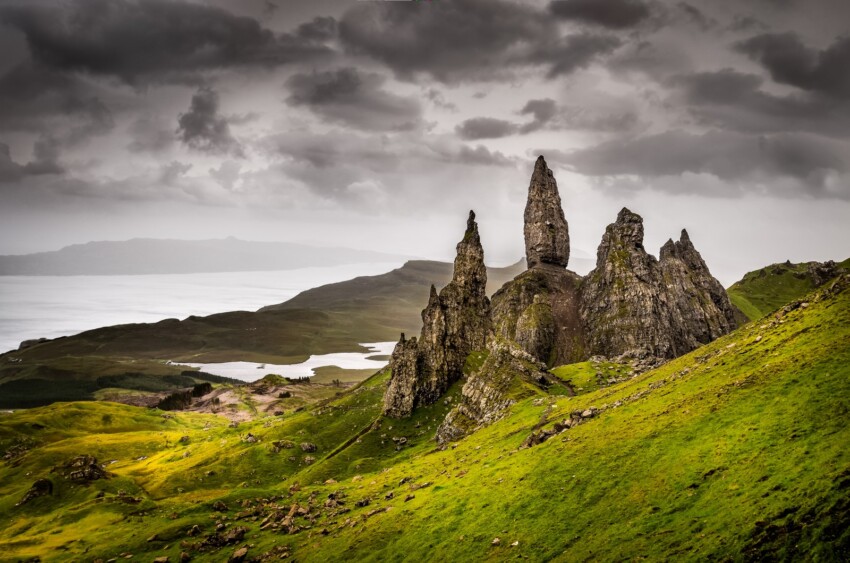
The Isle of Skye is a destination that shouldn’t be missed by any self-respecting traveller. It’s the largest and most northerly of the Inner Hebrides, an archipelago off the north-west coast of Scotland, and it’s truly sensational. Here you’ll find dramatic cliffs, beaches, mountains, moorland, heather-covered slopes, fairy-tale scenery and picturesque villages, all packed into just over 1,500 square kilometres.
Inhabited since prehistoric times, it has been home to Celtic tribes, Scandinavian Vikings and Gaelic clans. After centuries when residents made their living from farming and fishing, the main activity on the Isle of Skye today is tourism. Everything revolves around Portree, a village of 2,300 inhabitants located roughly in the middle of the island, overlooking the sea on the east coast, which serves as its capital and main settlement. From here you can venture out to explore the rest of Skye and some nearby small islands.
Visit Skye and you’ll fall in love with it. But be aware that you’re not alone: the island has been chosen by film directors and writers as a filming location for various films and as a setting for novels, poetry and songs.
Driving across the entire Isle of Skye from south to north (or rather, from south-east to north-west, as this is the direction of the main road that crosses it) takes just over an hour and a half. This is why once you arrive here, you’ll want to see everything! Here’s what the best things to see on the Isle of Skye are, from charming villages to castles and natural landscapes to discover on foot.
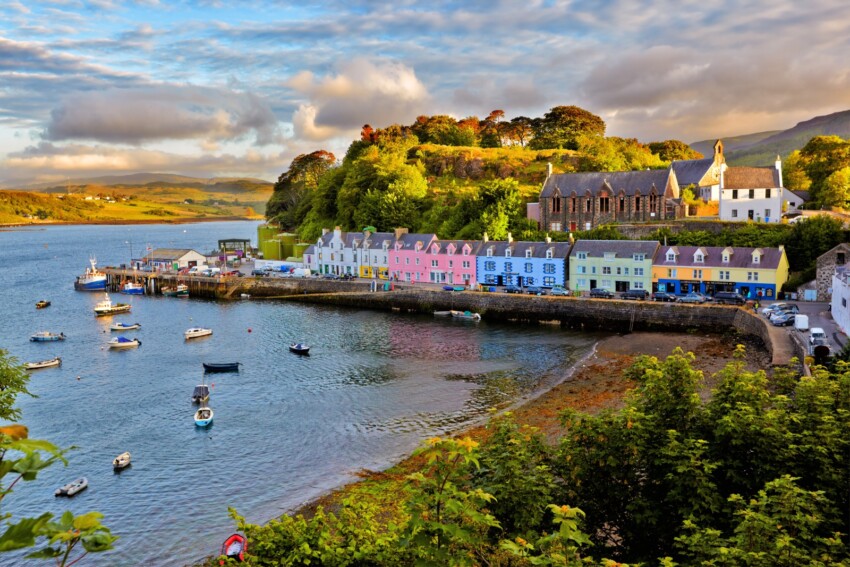
It’s unlikely you’ll visit Skye without passing through Portree, the island’s largest village. But it’s definitely worth visiting, and you might even want to stay here as a base for your entire holiday. You’ll find plenty of amenities here, along with bars, restaurants and, of course, numerous guest houses and bed and breakfasts. One of the most interesting things to see is definitely the promontory called The Lump, just outside the town, reachable on foot via a marked trail that offers wonderful views over Portree and its surroundings.
But the real icon of Portree is the row of colourful cottages that line the waterfront, featured on postcards and souvenirs from the area. Take stunning photographs from every angle and even from the sea by joining one of the many boat tours that depart daily from Portree.
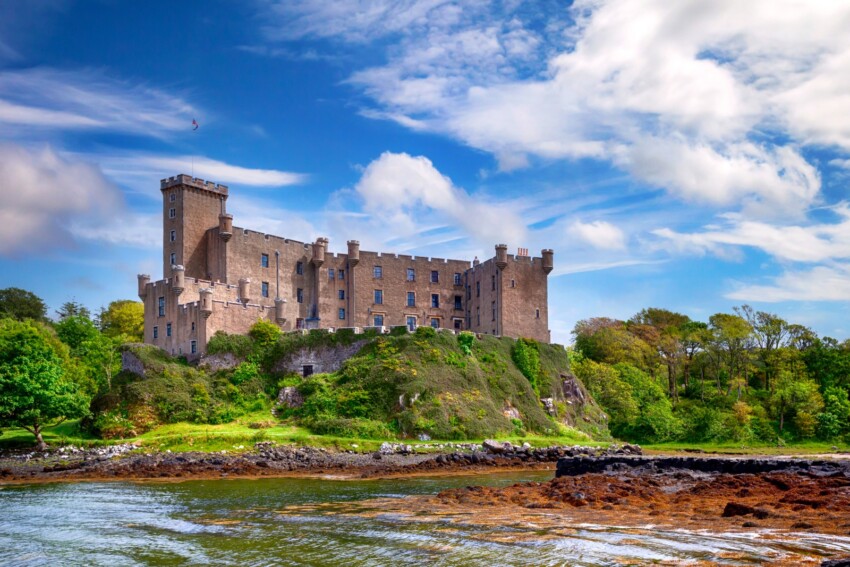
Dunvegan is a small village of just under 400 inhabitants situated on the north-west coast of Skye. Surrounded by beautiful landscapes, we recommend making the trip primarily to visit Dunvegan Castle, located less than two kilometres north of the main settlement on a small rise. Originally built in 1200, it was completely rebuilt in a pseudo-medieval style around 500 years later. In addition to the castle itself, the gardens are well worth exploring, beautifully maintained with lawns, flower beds and numerous plant species.
Furthermore, from the castle jetty, every day from April to September you can take part in a boat trip lasting 25 minutes to search for seals. Tours run daily, subject to boat capacity, with departures from 10:00 to 16:30. Finally, there’s the option of taking a guided tour of Dunvegan Castle at regular intervals, daily from 10:30 to 16:15.
Dunvegan Castle is open daily from 29 March to 15 October from 10:00 to 17:30, with last admission at 17:00. Free parking is available for cars and motorhomes, as well as dedicated spaces for coaches and minibuses; toilet facilities are also located at the car parks. Dogs are only permitted in the gardens, provided they’re on a lead.
You can purchase tickets for the gardens alone, or a combined ticket that also includes entry to the castle. Children under 5 enter free, while students, over-65s and children aged 5-15 receive a discount on admission.
Talisker is a famous Scottish whisky produced on the Isle of Skye itself since 1830. The distillery is located on the west coast of Skye, overlooking Loch Harport, and is easily accessible by car or buses 607 and 608.
If you’re a whisky enthusiast, don’t miss it! Inside you can take part in a tasting tour where you can sample 6 different Taliskers, including those aged for 18 and 25 years, as well as the standard distillery tour where the entire production process is explained. There are various options for each tour, but we recommend booking your visit in advance, as it can get very busy during peak season.
The Talisker Distillery is open daily from 10:00 in the morning until 16:30; from March to October, closing time is extended by half an hour, until 17:00.
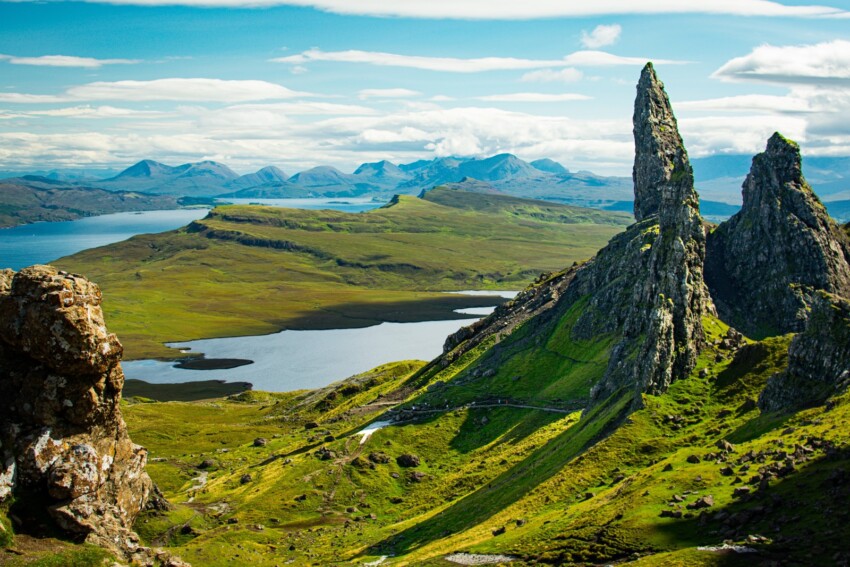
On the Trotternish Peninsula, located north of Portree, you’ll find Storr, a hill distinguished by having a rocky and mountainous eastern slope, whilst its western slope descends gently through moorland. At 719 metres high, Storr can be climbed on foot via a well-marked and straightforward path that starts from the A855 road just north of Leathan Loch.
But the area’s main feature is undoubtedly the Old Man of Storr, a 55-metre monolith that stands out against the Storr’s skyline and is one of the most photographed spots on the entire Isle of Skye. A true icon of Scotland itself, the Old Man of Storr appears on postcards, souvenirs, posters and tourist guides everywhere. As one of the most visited attractions in the area, it’s always rather busy, so much so that the small car park at the start of the path isn’t sufficient for all visitors’ cars, forcing them to park along the roadside during peak season.
The ascent to the Old Man of Storr offers enchanting views, with vistas stretching from the sea to the hills right across the Isle of Skye. The path is initially wide and gravelled, but becomes narrower and unpaved as you climb. Be aware that in rainy conditions (not uncommon in these parts), it can become muddy and slippery.
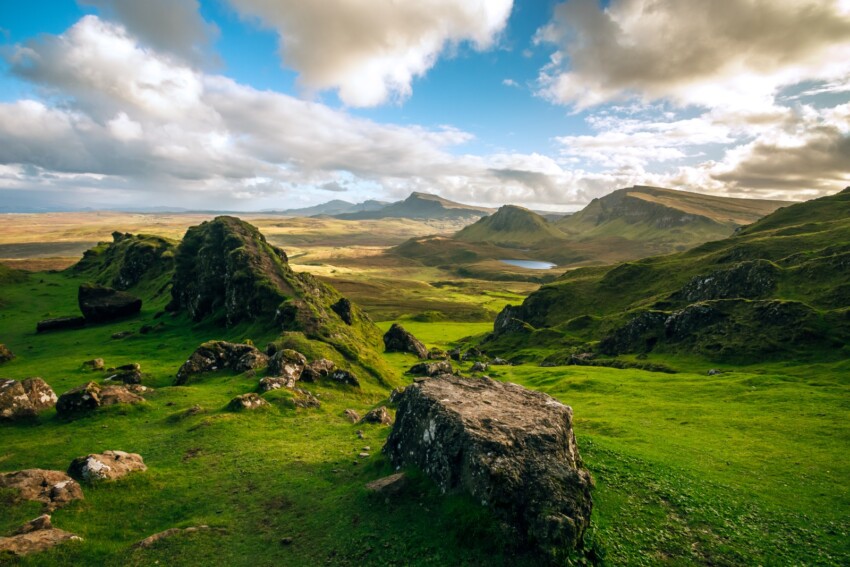
The Quiraing landscape welcomes visitors to the northern tip of the Trotternish Peninsula. This is another area you shouldn’t miss when visiting Skye, and the reason lies entirely in the fairy-tale panoramas you can enjoy walking along the circular trail of about 7 kilometres, starting and finishing from the car park on the main road, roughly half an hour’s drive from Portree. Without stopping, you can complete it in about 2 hours, but be assured that photo stops will be frequent!
As you walk the trail, you’ll feel as though you’re inside a fantasy film, surrounded by hills, lochs, mountains and distinctive rock formations that have earned their own names, such as The Needle, a 37-metre pinnacle, The Table, a grassy plateau, or The Prison, a pyramid-shaped rocky peak that resembles a fortified tower.
Be aware that the Quiraing trail isn’t suitable in all weather conditions. Try to avoid it in windy or poor visibility conditions, as you’ll pass alongside steep slopes.
Another essential location on Skye situated on the Trotternish Peninsula, Brother’s Point represents one of the island’s most beautiful landscapes, and at the same time is far less crowded than Quiraing or Storr. To reach it, drive to Culnacnoc, roughly 25 minutes north of Portree, and park in the small car park, then start on the gravel and earth path. It’s just under 4 kilometres long, and the visit takes around 2 hours, including photo stops.
Along the trail you’ll enjoy wonderful views of the east coast of the Isle of Skye, with its rock formations and meadows that slope gently down to the sea. You’ll reach first a pebbly beach, then cliffs that drop sheer into the sea, before finally arriving at Brother’s Point itself, a small peninsula also overlooking the water, which offers magnificent vistas.
In the following map you can see the location of the main places of interest mentioned in this article.
Filmmakers have always been hugely attracted to the dramatic landscapes of Skye, and justifiably so. Even if you’ve never been to the island, you’ve probably already seen it on the big or small screen – in some films merely in passing, but in others as a leading character in its own right.
You may already have seen the Quiraing, for instance, one of the island’s most iconic landscapes, sculpted by cliffs, slopes and pinnacles that give it an otherworldly appearance. It shouldn’t surprise you, then, that many films have scenes shot here, such as Macbeth (2015), Stardust (2007) and 47 Ronin (2013), starring Keanu Reeves.
The Old Man of Storr also lends itself perfectly to film, being a truly distinctive rock formation visible from kilometres away. This is why director Ridley Scott chose to include it in his Prometheus (2012), as did Robin Hardy in 1973 for the famous British horror film The Wicker Man.
Other pinnacles, other films. This time it’s the turn of the Cuillin, one of the UK’s most challenging mountains to climb, formed by 36 peaks stretched across a 12-kilometre ridge. Scenes from Highlander (1986) and Seachd: The Inaccessible Pinnacle (2007) were filmed here – the latter didn’t reach mainstream cinemas in the UK but made history as the first Scottish Gaelic film to be distributed in mainstream cinemas.
Two other very famous films featuring scenes shot on the Isle of Skye are Stardust (2007) and Made of Honor. For the first, scenes were filmed at Fairy Glen, whilst for the second the Dunvegan Castle and gardens were used.
The main option for accommodation on the Isle of Skye is small guest houses and bed and breakfasts, in true Scottish tradition. Forget about large hotels! In fact, there are very few hotels of standard size – fewer than 10 across the entire island – but they’re almost all of excellent standard, three or four-star properties, designed in traditional style, beautifully furnished and equipped with all amenities.
The best area to stay is undoubtedly Portree: you’ll have a village with its services at your disposal, and at the same time you’ll never be too far from the main attractions. Watch out for prices: accommodation on Skye is notably expensive. We therefore recommend booking well in advance to avoid finding higher prices and limited availability.
The remote location of the Isle of Skye means it’s not easy to reach. The nearest airport is Inverness, located about 3 hours’ drive away, but it doesn’t offer many direct flights outside the UK. To minimise air travel, we recommend landing at Glasgow or Edinburgh, and driving for roughly 5 hours in a north-westerly direction.
If you decide to include the island in a Scotland road trip, you’ll first need to get to Kyle of Lochalsh, a small village from where the Skye Bridge departs – a major bridge connecting the mainland to Skye. The distances are long, but we recommend taking the A82 road, stopping at Loch Lomond and Fort William, two of Scotland’s major attractions, so you can break the journey over two days if needed.
You can also reach Kyle of Lochalsh using public transport, by bus or train, and then continue to Skye, either by bus or ferry.
A convenient alternative for visiting the Isle of Skye is to join a group tour. There are several available, depending on the departure point. Typical durations are one day departing from Inverness, or three days departing from Edinburgh and Glasgow.
What's the weather at Isle of Skye? Below are the temperatures and the weather forecast at Isle of Skye for the next few days.
Skye is located in the Inner Hebrides archipelago, of which it is the largest island, off the north-west coast of Scotland.
 Hotel
Hotel  Budget accommodations
  Apartments
  Family Hotel
  Luxury Hotel