Ayre Hotel & Ayre Apartments
Kirkwall - Ayre Road
Book now
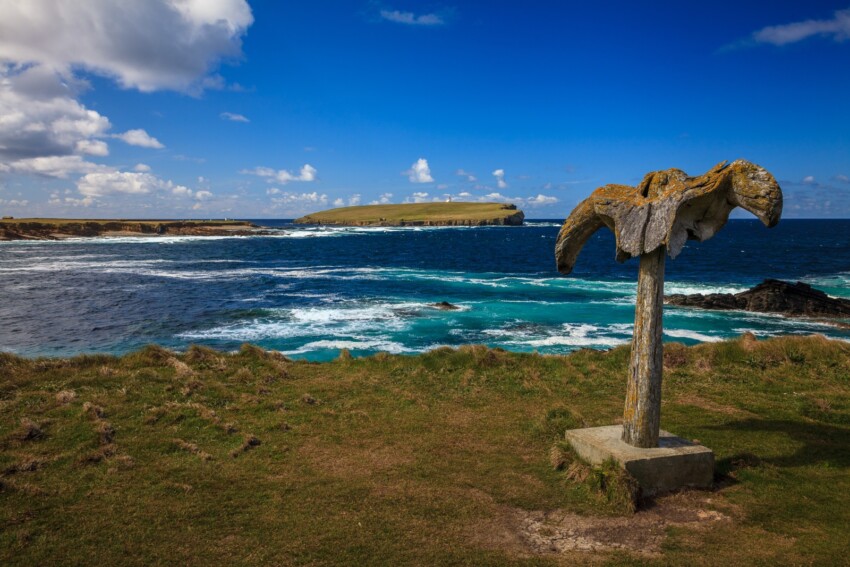
Off the extreme north-eastern tip of Scotland, free of high ground and composed of more than 70 islands, the Orkney Islands played a crucial role in both world wars.
Separated from the mainland by the Pentland Firth, Orkney, like Shetland, is historically very closely connected to Scandinavia and tends to regard itself as a distinct region from Scotland, given its cultural and geographical proximity to the neighbouring inhabitants of the Scandinavian peninsula.
On Orkney, the past is tangible, from ancient standing stones to castles and fortresses. You will certainly be struck by the legendary Skara Brae, where you can discover settlements dating back over 5,000 years.
But the real draw of Orkney is undoubtedly the wild and untamed landscape: the beauty of towering cliffs carpeted with soft green turf plunging into cobalt-blue sea will take your breath away. During the summer months, the best time to visit these islands, you can admire coves and sheer rock faces inhabited by seabirds and colonies of puffins, while in the often turbulent waters you’ll see seals swimming. A true paradise for nature lovers!
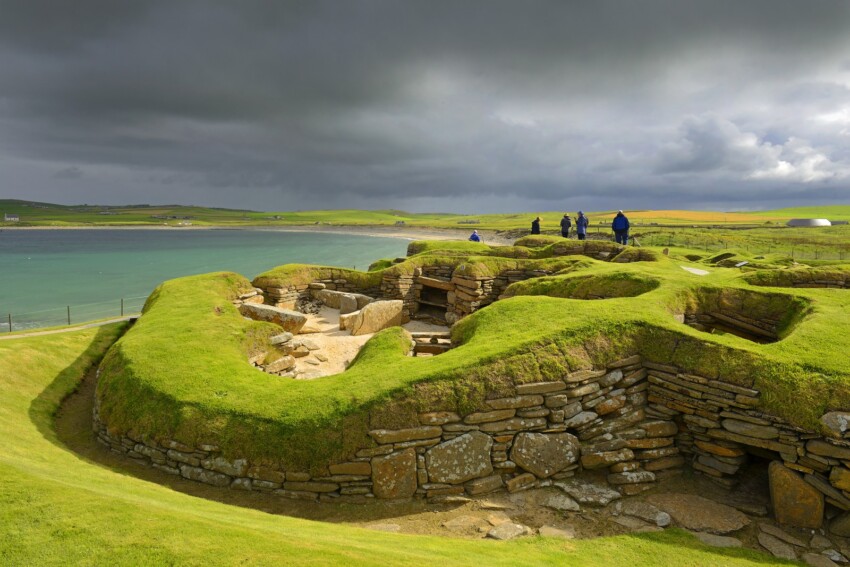
Skara Brae is the most famous and important prehistoric site on Orkney: an entire Neolithic village overlooking a beautiful crescent-shaped white beach, the Bay of Skaill.
This settlement was discovered after a violent storm swept away the sand dunes, bringing to light the remains of 10 homes belonging to farmers and fishermen from around 3000 BC.
You can walk freely between the perfectly preserved houses, covered with turf: they are all built in the same manner, with a single central room along whose walls you can still see domestic furnishings such as dressers, hearths, stone cupboards, beds and storage chests, all crafted from stone.
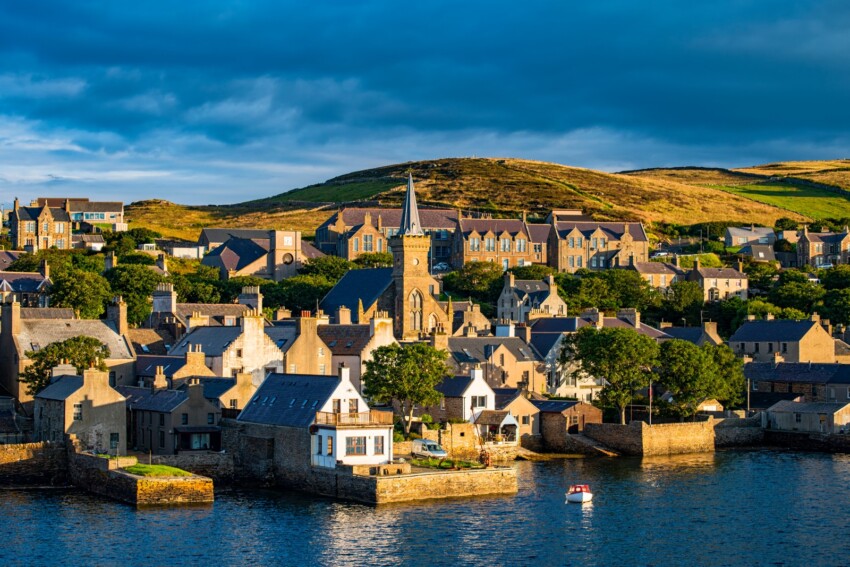
The lively town of Stromness embodies the image of a remote fishing village lost at sea.
Its enchanting harbour is a succession of activities related to fishing and transport: if you once imagined old sea-dogs descending from fishing boats laden with nets to mend, you’ll see plenty of them here.
The historic centre runs along the seafront and consists essentially of a single main street from which a dense network of narrow closes and alleyways branch off, well worth exploring at a leisurely pace. As you’ll discover, many houses have their facades facing directly onto the sea, and in times past each had its own jetty where merchants conducted business with passing ships.
There are no particular sights to see in the town, but what will stay with you is the atmosphere, the colours and the faces of the people.
Following Victoria Street to its end, a small path leads off, little more than a footway, taking you to discover the most picturesque houses and finally to a public garden perched above the sea.
You can visit a permanent exhibition of British art centred on the sea at the Pier Arts Centre.
In May, the renowned Orkney Folk Festival is worth attending, dedicated to traditional music and culture.
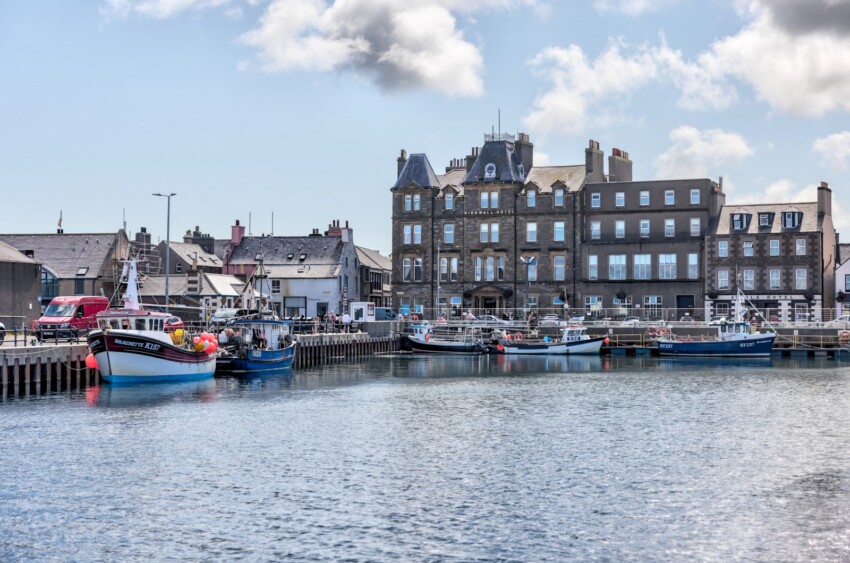
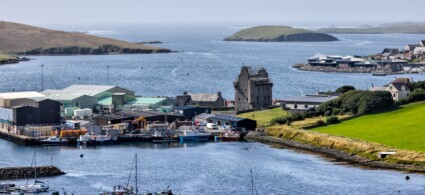
Compared with the picturesque character of Stromness, Kirkwall appears rather uninspiring at first glance. In fact, contributing to this initially unfavourable impression is the monochromatic greyness of its buildings.
Most ferries from Scrabster and John O’Groats dock here, and the town is a true working port, a sort of gateway for exploring the island.
The crowning jewel of the town is undoubtedly St. Magnus Cathedral, an imposing church of red sandstone dating from 1137, dedicated to the uncle of Earl Rognvald, who had it built to honour the cult that spontaneously developed around Magnus. The interior is spectacular and on close inspection you will notice symbols carved into the stone indicating mortality, such as skulls and crossbones, and unsettling inscriptions reminding the visitor of their mortality.
Despite its ruined state, Bishop’s Palace retains intact towers with spiral staircases, from whose summit you enjoy fine views over the town’s rooftops. Earl’s Palace is better preserved and you can visit the damp dungeons, the rooms with bay windows, the enormous fireplaces and the sumptuous reception hall.
In June, the St. Magnus Festival takes place with an extensive programme.
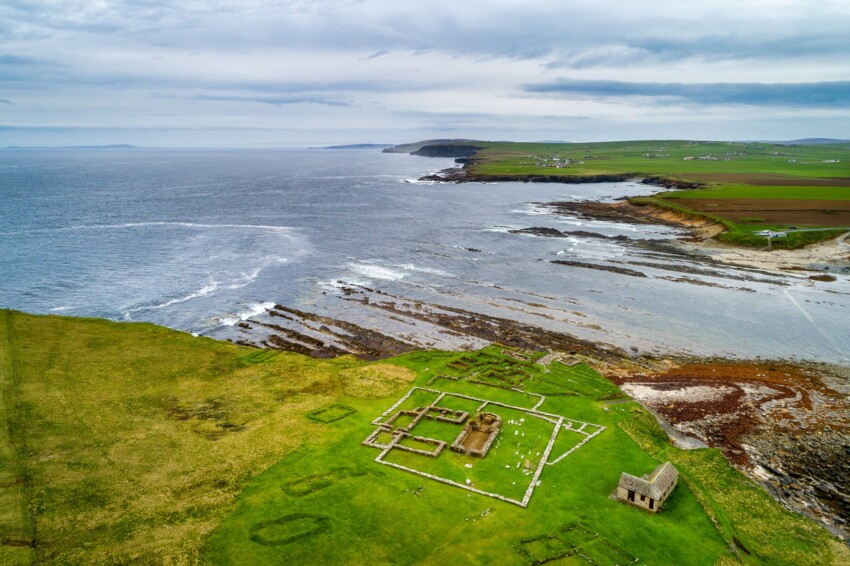
Orkney is primarily a natural haven and to fully appreciate its beauty, you need to leave your car and venture on foot to admire the cliffs, moorland and turbulent seas.
A splendid opportunity for a walk is a visit to Brough of Birsay, an important Pictish settlement located on a small islet in the Birsay district. The island is accessible on foot at low tide.
The settlement is not spectacular, but the experience is marvellous, especially if you arrive near the causeway when the water is still high: you can witness the beautiful sight of the sea retreating, leaving behind seaweed, shells and bewildered crabs.
Once you reach the island, you can walk around its perimeter admiring the wonderful cliffs inhabited by puffins, or you can make your way to the atmospheric lighthouse.
It is very important to be aware of the tide times, which you can obtain from the tourist offices in Stromness and Kirkwall and are also broadcast by Radio Orkney.
About 1 km north of the causeway stands Earl’s Palace, the ruined palace of Robert Stewart, Earl of Orkney, built in the second half of the 16th century in red sandstone using forced labour from the island’s inhabitants.
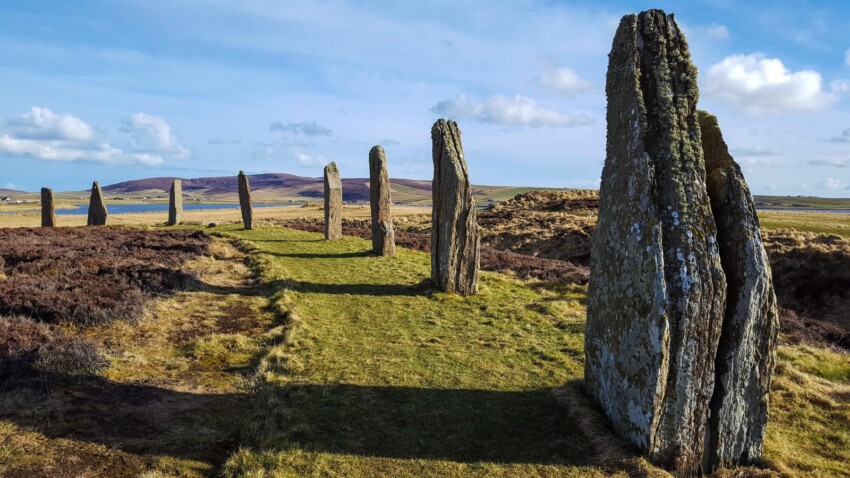
If you arrive at sunset, the Ring of Brodgar will enchant you with its ancient and mysterious allure.
You will encounter a ring dramatically positioned on an embankment facing the sea, composed of 27 of the original 60 monoliths. A magical place, silent and incredibly atmospheric.
Just 1 km from here you’ll also find the Stones of Stenness, a circle of immense stones once comprising 12 slabs, now reduced to 4. It’s particularly beautiful to see, especially the largest of the stones, standing over 5 metres high with an extraordinarily slender profile.
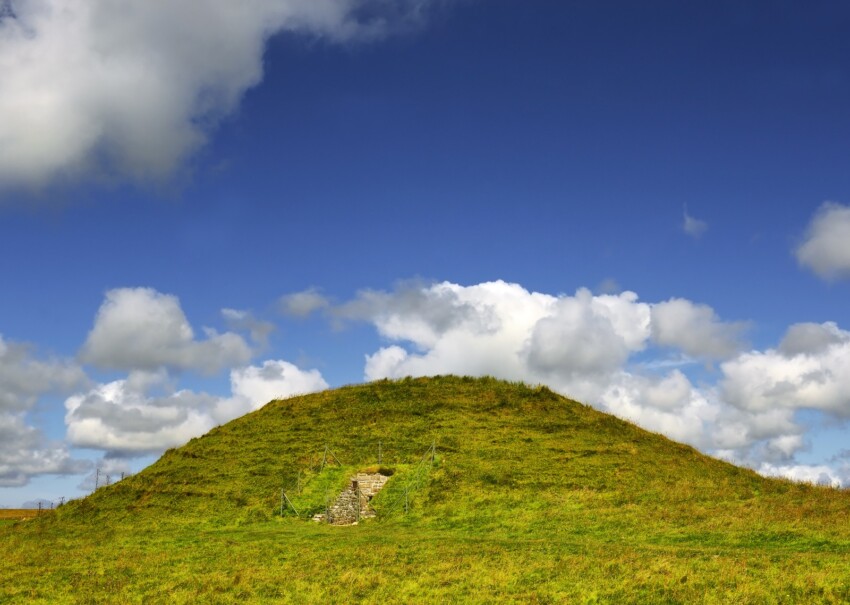
Immersed in a desolate and solitary landscape stands one of Europe’s most extraordinary Neolithic burial chambers, Maes Howe.
It is a large grass-covered mound with a burial chamber that from a distance looks like a simple hillside. Despite being dated to 3000 BC, it has remained perfectly preserved inside thanks to the sandstone slabs, some weighing up to 3 tonnes, used in its construction.
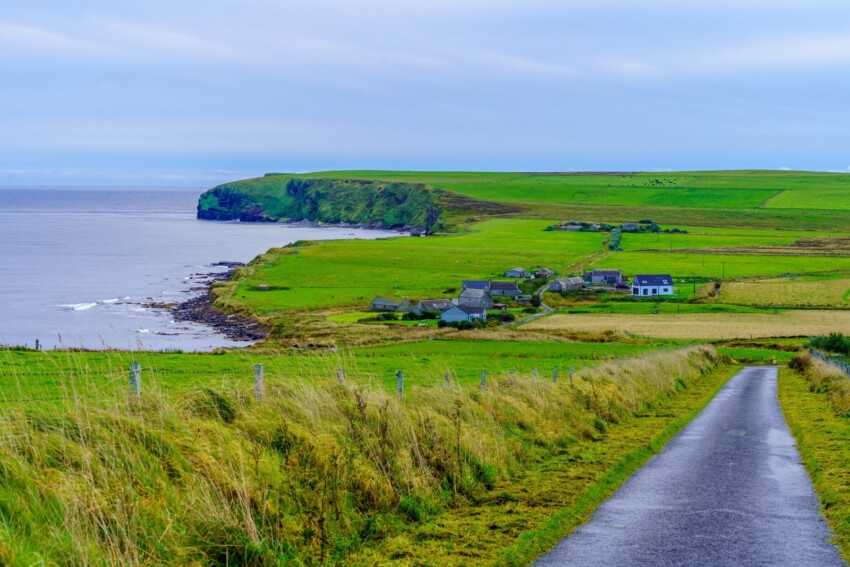
Mainland is connected by sea-level causeways to two smaller isles, Burray and South Ronaldsay. Those with time to venture this far will be enchanted: the landscapes are the epitome of bucolic beauty, with lush green fields and dry-stone walls.
The scenic road was actually built during the Second World War as a barrage against German U-boats hunting British ships. The Royal Navy was based at Scapa Flow, a natural anchorage safe in wartime. Still today, the wrecks of seven German ships lie beneath these waters, occasionally resurfacing at low tide like ghosts of the past.
The barriers, now serving as a roadway, were constructed by war prisoners, some 1,700 of them, two-thirds of whom were prisoners of war: from a corrugated metal and concrete hangar they created a small chapel renamed the Italian Chapel, decorated and frescoed. An incredible and moving tribute to the ingenuity of these prisoners far from home.
On the south tip of the island you’ll find an archaeological site called the Tomb of the Eagles. Many guides describe it as unmissable, but in our view it is nothing exceptional: it is merely a small prehistoric burial chamber accessed by lying on a skateboard. The introduction at the visitor centre is exhausting, though the walk along the cliffs to get there is lovely.
In the following map you can see the location of the main places of interest mentioned in this article.
To reach the Orkney Islands, you can board from the two main ports in the Caithness area, namely Thurso and John O’Groats, or from Aberdeen, but bear in mind that the sea journey will be considerably longer and the sea is often rough.
Northlink Ferries operates direct routes between Scotland, Orkney and Shetland with ships that also carry cars.
These are large vessels equipped with all mod cons, from restaurants to cinemas, from internet connections to on-board shops, from cabins to children’s play areas: this is because some routes involve many hours at sea, such as the Lerwick-Aberdeen crossing.
The company operates multiple daily sailings during peak season (June to September), whilst reducing frequencies in winter months as it adapts to more severe weather conditions.
The crossing from Scrabster (Scotland’s most northerly point) to Stromness, on Orkney, takes 90 minutes and all sailings connect with the bus service to Kirkwall.
Between Gills Bay near John o’ Groats and St Margaret’s Hope on Orkney, Pentland Ferries operates a passenger and car ferry service with 3 daily crossings lasting 1 hour.
John o’ Groats Ferries operates a daily passenger-only service from May to September, from John o’ Groats to Burwick on Orkney. The crossing takes 40 minutes.
During summer, the shipping company also offers day-trip excursions from John o’ Groats (May-September) and from Inverness (June-September).
Orkney Ferries Ltd operates inter-island services within the Orkney archipelago: it’s an excellent way to explore the 13 more remote islands of this group, less known to the general public but certainly fascinating.
 Hotel
Hotel  Budget accommodations
  Apartments
  Family Hotel
  Luxury Hotel