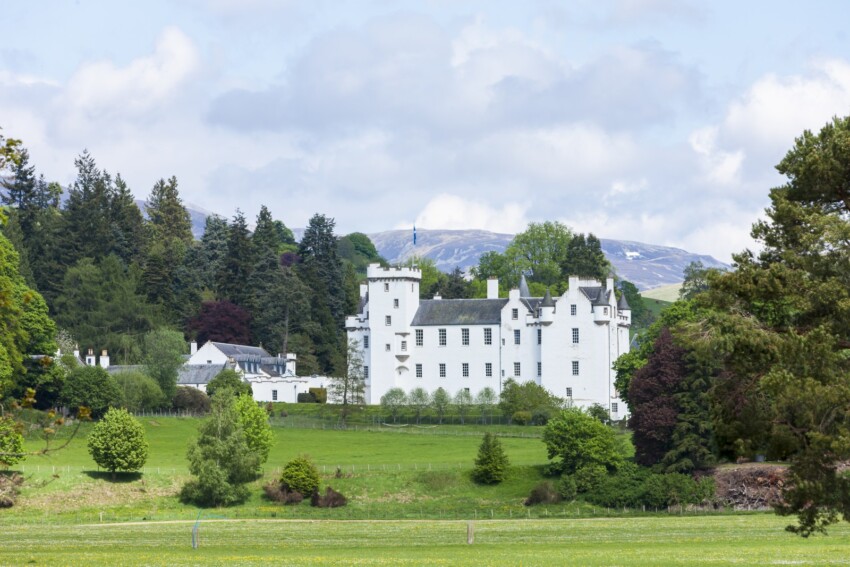
Scotland is a land of castles, and Blair Castle is undoubtedly one of the most famous and the most beautiful in Perthshire. You’ll recognise it instantly: with its distinctive white-painted façades, it’s unmistakable.
The castle’s location, on the main route through the Highlands, is strategically significant. It’s no coincidence that whoever owned Blair Castle was considered a sort of guardian of the mountains and the route northwards, all the way to Inverness.
Situated just under ten kilometres from the picturesque village of Pitlochry, it’s an imposing fortification that presents, however, an aesthetic that differs from that typical of other great Scottish castles. It’s impossible not to be struck, even from a distance, by its walls—all pristine white, as pure as snow.
Upon arrival at the main entrance, visitors are greeted by live music played by a bagpiper, who’s always ready to take photos with all the guests.
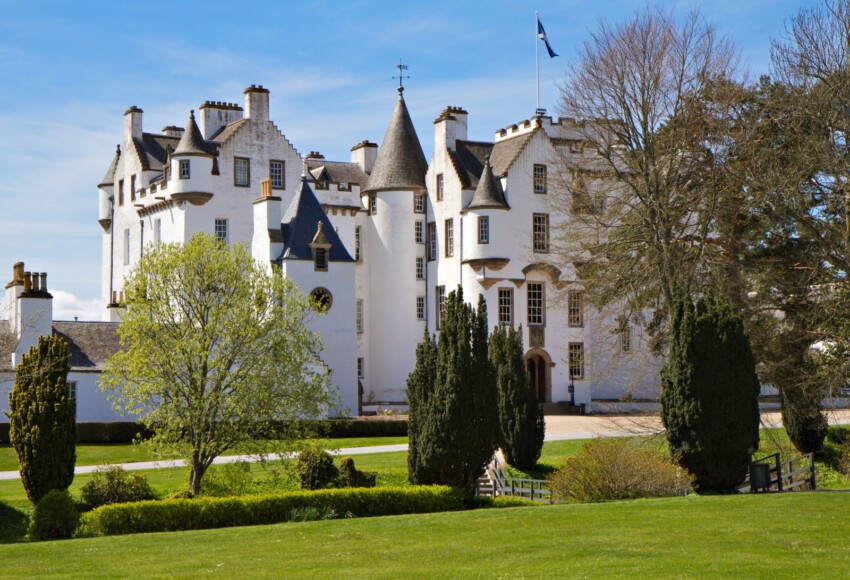
Blair Castle is the ancient seat of the Dukes of Atholl, and the current duke still maintains his private army, the Atholl Highlanders. Although now merely ceremonial, this is Europe’s only private army. Every year, on the last weekend of May, a grand parade is held. It’s during the Atholl Gathering and Highland Games that you can see the army on display.
Within the castle, you can visit 30 rooms, all beautifully and meticulously preserved with their original furnishings and fittings. This historic residence is filled with elegant period furniture and artwork, lace, armour collections, Jacobite memorabilia, and exquisite porcelain that fill much of the rooms.
Harry Potter fans will find something familiar about the “Picture Staircase”, which is adorned with countless family portraits. Equally striking, though rather sombre, is the sheer number of mounted antlers and stag heads that decorate the castle’s corridors.
Certainly this residence offers a splendid insight into over 700 years of Scottish history. Let’s take a closer look at the various rooms.
In 1872, the seventh Duke commissioned Scottish architect David Bryce to design a baronial entrance. This was part of the Duke’s plan to transform the Georgian residence into a castle. The magnificent display of arms includes shields and muskets used at the Battle of Culloden.
The dining room was converted from the sixteenth-century Great Hall by the second duke, as he transformed the old castle into a Georgian residence. The plasterwork by Thomas Clayton can be seen here and throughout much of the castle.
Family and guests would arrive for dinner by the main staircase and, before being seated, had to pass through an ante-room. The cook and butler naturally paid particular attention to how the food was presented. The kitchens were located at the far end of the castle, and before being served by the domestics, dishes had to travel some 100 metres through passages and up a dumb waiter.
From Queen Victoria to Princess Anne, this room has welcomed many high-ranking guests. In 1921, following the austerity of the First World War, Queen Mary, Prime Minister Lloyd George, and Prince Hirohito of Japan passed through here.
The drawing room’s ceiling is among the finest in Scotland. The furnishings include gilt chairs and Louis XVI sofas by Chipchase with embroidered covers from the third duchess and her family. The Bulloch cabinets are made from larch timber that belonged to the estate.
Perhaps, however, the most spectacular room in the castle is the Tapestry Room. The Mortlake tapestries that line this room belonged to King Charles I and were sold by Cromwell after the king’s execution. Discovered in Paris and purchased by the 1st Duke, they were brought to Blair Castle.
The magnificent William and Mary State bed is crafted from fine Huguenot silk from Spitalfields. It was brought to Blair Castle from Holyrood Palace by the first duke, who had apartments there as Lord Privy Seal in the Scottish Parliament, until he was sent home under house arrest for opposing the Act of Union.
Commissioned by the 7th Duke, the ballroom was designed by David Bryce for the Atholl Highlanders. The celebrated violinist Niel Gow was closely associated with the 2nd, 3rd, and 4th Dukes, and his portrait by Sir Henry Raeburn, his chair, and his violin are displayed on the stage. Today, the magnificent ballroom hosts parties, wedding receptions, private corporate dinners, as well as the Atholl Highlanders’ annual ball.
If the castle is a marvel, the gardens surrounding it, dating from the Victorian era, are equally impressive. Around the castle extends the Atholl Estate, a park covering approximately 60,000 hectares, offering visitors cycling trails and bridleways. Highland cattle graze in the nearby fields, and the native red squirrel can often be spotted in the garden’s trees. Peacocks roam freely, a popular photo opportunity for visitors.
Visitors can enjoy following the sculpture trail, which features a mix of contemporary and eighteenth-century sculptures, through the castle gardens.
The heart of Blair Castle’s park is the Hercules Garden, named after the life-size statue of Hercules that overlooks the garden walls. The Hercules Garden is an enclosed nine-acre garden that has been restored to its original Georgian design. There are beautifully landscaped ponds, a Chinese bridge, and an orchard with over 100 fruit trees.
In the woods near the castle lies Diana’s Grove, a tranquil area surrounded by giant trees that rank among the tallest and oldest in all of Great Britain. Just a short walk from the woods stand the ruins of St. Bride’s Kirk, a church dating back to the tenth century, though the present building is medieval. Following the Battle of Killiecrankie in 1689, Viscount Dundee, John Graham of Claverhouse, known as Bonnie Dundee, was buried in this church.
For those travelling with children, we recommend the Castle Detectives Challenge: children hunt for the castle’s treasures using provided clues. Parents can also participate and will probably enjoy it more than their children. The activity sheet is given to you in the Castle’s Entrance Hall, from which you then access the various rooms.
Normally the castle is open every day of the week, from April to October, from 10:00 to 17:30. However, we recommend you check opening hours and admission prices on the official website.
Getting to Blair Castle is really straightforward. The castle is located near the town of Blair Atholl, just over ten kilometres north of Pitlochry, on the A-9 road, along the route through the Scottish Highlands that runs from Perth to Loch Ness.
As always, our recommendation for exploring Scotland comfortably is to hire a car from Edinburgh or Glasgow airport.
If you prefer to use public transport, you can reach Blair Atholl by train. The railway station is just a short walk from the castle. Connections and timetables are available on the Scotrail website.
Blair Castle is located in the immediate vicinity of Blair Atholl, in Perth and Kinross, in central Scotland, approximately 50 km north of Perth, 130 km north of Edinburgh, 145 km north-east of Glasgow and 120 km south of Inverness.
 Hotel
Hotel  Budget accommodations
  Apartments
  Family Hotel
  Luxury Hotel