Islesburgh House Hostel
Lerwick - King Harald Street
Book now
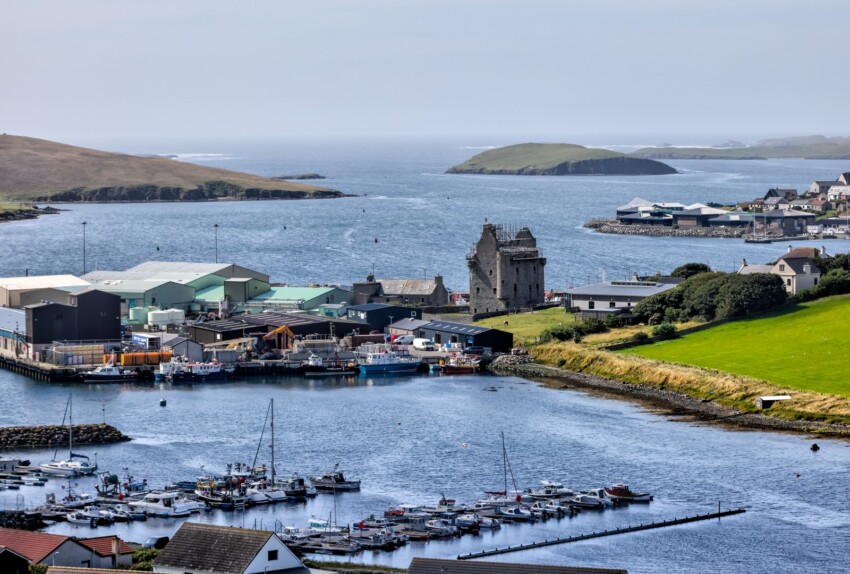
The remote archipelago of the Shetland Islands consists of 100 rocky islands and bare skerries that face the fury of the elements every day.
Reaching here by sea is an adventure, but the effort will be rewarded by an absolutely magnificent landscape of low hills, rocks and windswept moorland. It truly feels as though you’ve reached the end of the world: there are very few settlements, it’s cold even in summer, trees struggle to grow in the force of the wind, and the islands are inhabited almost exclusively by seals and puffins, making them a true paradise for birdwatchers.
The population also has a unique character and takes pride in its distinctiveness: indeed, the 24,000 inhabitants feel more Scandinavian than Scottish, thanks to their geographical proximity to Norway. Their strategic position on northern trade routes has given Shetland a distinctive frontier-outpost atmosphere and a Viking rather than Scottish culture. You’ll notice this diversity in their distinctive dialect, the renowned Up Helly Aa festival, the Viking celebration, in their music, which features predominantly the fiddle rather than bagpipes.
Shetland is not a mainstream tourist destination, but precisely because of its isolation and the harshness of nature, it represents a unique place to explore.
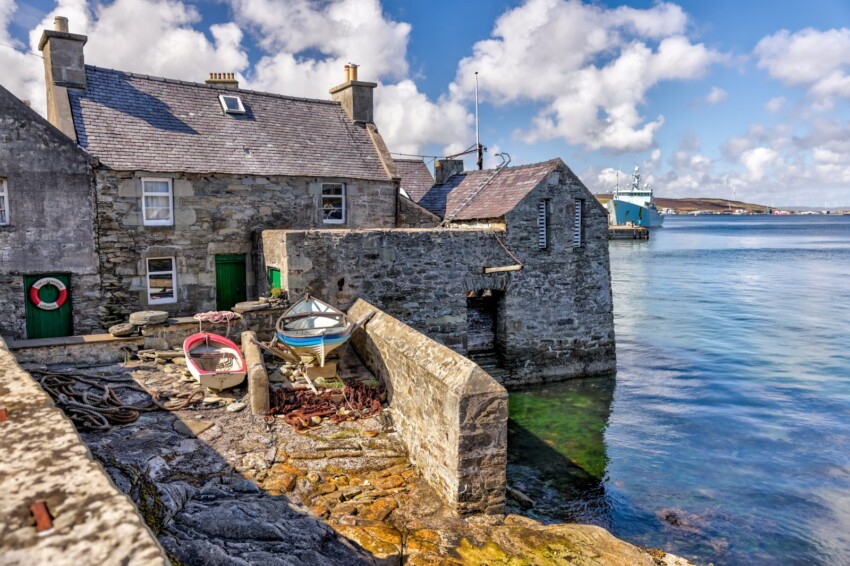
Lerwick is the hub of Shetland, concentrating a third of the archipelago’s entire population: it’s the main town on Mainland, the largest island in the archipelago.
Its harbour bustles with ferries, fishing boats and numerous vessels transiting through the North Sea. In summer the atmosphere is lively, as the town is a gateway to visiting the islands and a reference point for hikers and tourists.
The town centre develops around the harbour and spreads out through narrow, picturesque alleyways known as closses that descend to the sea and climb towards the new town in late-Victorian style, once considered the town’s poorest quarters.
Lerwick is a small town worthy of exploration on foot, mixing with locals and wandering through the alleyways and boats moored in the harbour. It’s renowned for its seafood cuisine: crustaceans, shellfish and salmon are absolutely worth trying!
Fort Charlotte, dating from the 1600s, once stood almost directly on the beach. Today the impressive walls remain and you can visit free of charge.
Don’t miss the Shetland Museum: built inside a dock on the waterfront, it houses a rich collection of archaeological finds from the islands, the Monks Stone and many objects that tell the story of life on the islands and whaling.
Just 1.5 km from the town centre you can visit the Clickimin Broch, a circular prehistoric tower built for defence of a settlement. Beyond the ferry terminal is the Böd of Gremista, birthplace of Arthur Anderson, sailor, businessman, philanthropist, first MP for Shetland and founder of the archipelago’s first newspaper.
From the harbour you can take a ferry to the small island of Bressay, from where you can reach the tiny isle of Noss: it’s only 1.5 km wide but encompasses all the charm of Shetland: a Pony Pound where the famous Shetland ponies are bred, a coastline of impressive cliffs rising up to 153 metres above the sea where magnificent colonies of seabirds nest. The most spectacular point is Holm of Noss, a tiny island once connected to Noss by a cradle, a basket suspended by ropes to allow sheep access to the pastures.
In summer the town’s nightlife comes alive with many traditional music sessions in numerous bars and pubs. Don’t miss the Shetland Folk Festival where you can let loose to the rhythm of the fiddle, the traditional violin.
The most daring who brave reaching Shetland in the depths of winter can witness one of northern Europe’s most thrilling festivals, the Up Helly-Aa, a spectacular fire festival in which nearly 1,000 men dress as Vikings and torch-light the night in a spectacular re-enactment of Viking tradition.
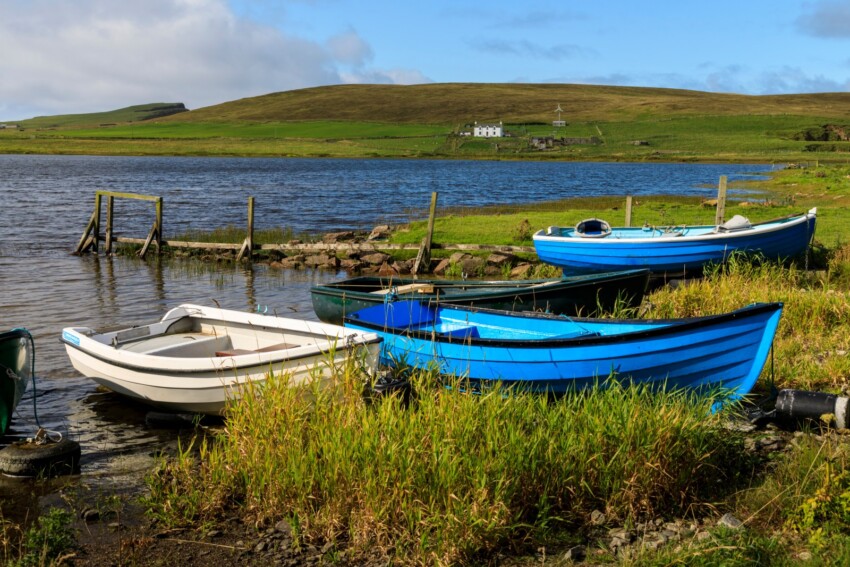
The South Mainland of Shetland is a long, narrow peninsula jutting into the sea: 40 km of wild rolling landscapes alternating with breathtaking cliffs and cultivated countryside.
It may feel as though you’ve reached the end of the world, and if you take time to leave the car and venture out on foot along the numerous signposted paths, you’ll almost certainly spot seals sunbathing on the rocks and energetic puffins that populate this coastline.
At Sandwick you can see the Broch of Mousa, an imposing circular tower 12 metres tall dating back over 2,000 years.
South of Bigton, the coast becomes truly spectacular with magnificent cliffs alternating with white sandy beaches and cultivated fields until you reach Loch Spiggie, a sea inlet where nearly 400 whooper swans find refuge.
To learn more about life on Shetland through the centuries, you can visit the Croft House Museum: in a small thatched cottage you’ll see 19th-century living with period furniture and artefacts.
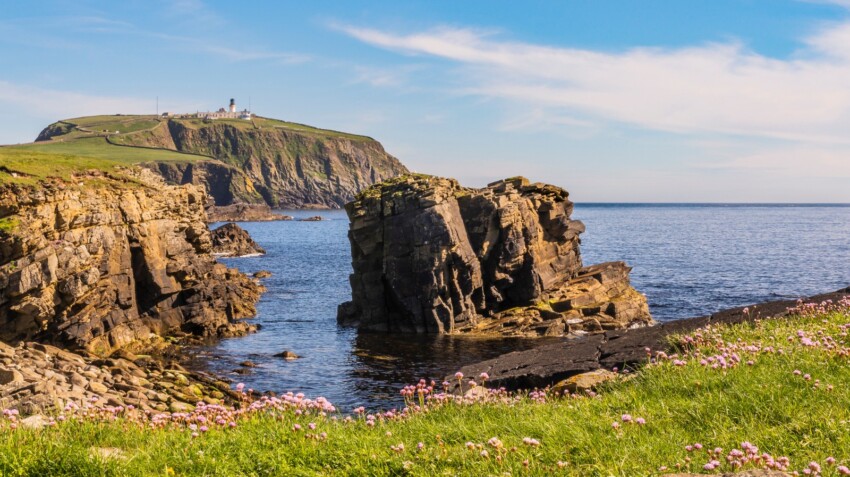
Your journey through South Mainland ends at Sumburgh Head. It’s a wild, remote stretch of coastline, swept by winds and inhabited only by magnificent colonies of puffins who won’t be deterred by your presence. The best spot to spot puffins is below the western wall surrounding the lighthouse: if you look a few metres down to the rocks below, you’ll see hundreds of these charming seabirds coming and going from their nests, carrying small blue fish in their beaks to feed their chicks.
The road to the lighthouse (not open to visitors) will give you the chance to admire splendid scenery: a truly marvellous walk that on sunny days offers postcard-perfect views.
To reach this corner of South Mainland, you’ll pass through Sumburgh, where Shetland’s main airport is located: take care as the main road crosses the runway!
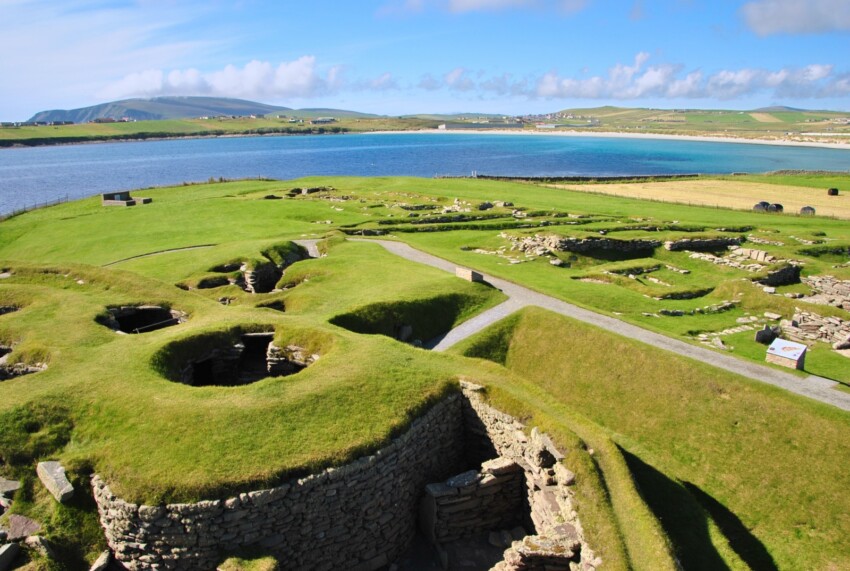
Before reaching the southern tip of the peninsula, you’ll come across the most spectacular archaeological site in the Shetland archipelago, Jarlshof.
It’s an immense archaeological excavation in which 4,000 years of human settlement from the Stone Age to the early 1600s have been layered over the centuries. It wasn’t until the late 1800s, however, after a violent storm exposed the upper part of the turf covering, that these ancient settlements came to light.
Walking freely across the entire site, you can admire a Bronze Age forge, Iron Age dwellings, and small stone cottages grouped around a dramatic broch by the sea, still equipped with shelves, water cisterns and stone beds.
You can also enter the Viking longhouses and the ruins of the landowner’s house who discovered the archaeological site.
Like Skara Brae on the Orkney Islands, at Jarlshof history seems to come alive before your eyes.
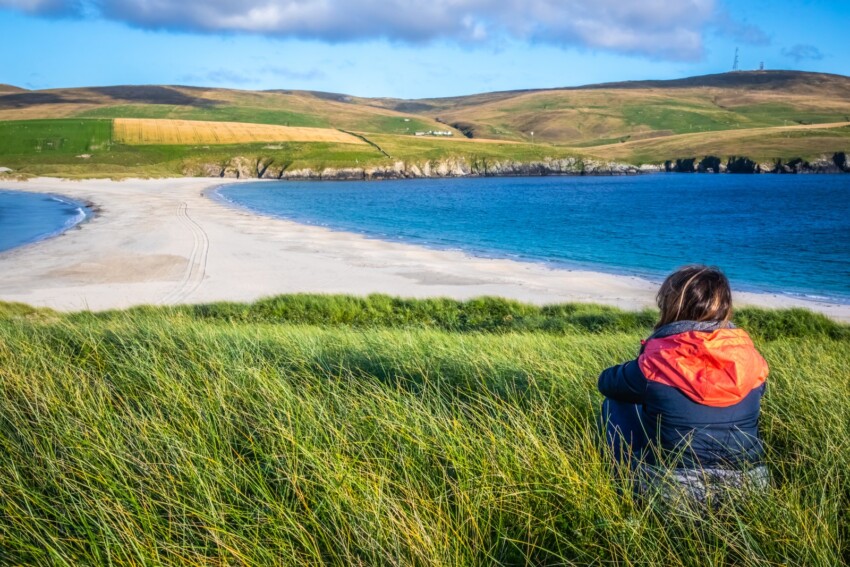
Near Bigton, a signposted track leads to a corner of Shetland you absolutely shouldn’t miss. Following a raised road, a tombolo of fine silvery sand composed of shell fragments, you can reach St Ninian’s Isle on foot at low tide.
Here you’ll find a postcard-perfect landscape, with the white sandy crescent glimmering on sunny days and verdant meadows with tall grass swaying silently in the wind.
On the island you can see excavations of a prehistoric settlement where a treasure of 28 silver objects from the Pictish period was discovered, hidden in a larch chest beneath a stone slab.
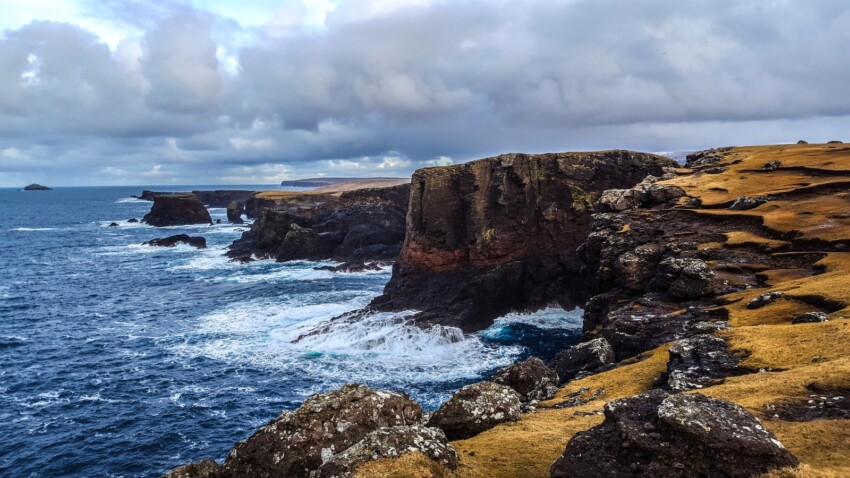
Northmavine, the northern peninsula of Mainland, is one of the most spectacular and picturesque areas of the island, with its harsh and wild scenery: if you leave the main roads, you can enjoy breathtaking views dotted with pink and red rocks where you’ll often encounter the ruins of old farmsteads, testifying to the struggles of Shetland’s inhabitants against the forces of nature.
The most spectacular point of the peninsula is undoubtedly Eshaness, where immense cliffs of red granite crash against the Atlantic waves: below you is a sheer drop and in the white sea foam you’ll surely see seals poking their friendly faces above the water.
This stretch of coast has been shaped by the forces of the elements and is characterised by an impressive series of rock stacks with bizarre forms such as The Drong.
At the Tangwick Haa Museum you can learn about the poignant history of Shetland’s inhabitants and their role in whaling: old photographs, fishing equipment, shells and the Gunnister Man, whose remains dating back 250 years were discovered in peat along with his personal effects.
To further understand the harsh life of Shetland’s fishermen, take a look at the old fishing station at Stenness with the ruins of the bods where fish were dried: in the 1800s there were 70 open boats here making at least 18 journeys a year northwards.
From the Esha Ness Lighthouse you’ll have the best perspective to admire the red cliffs, the rock stacks and the blowholes, tunnels and holes through which seawater shoots out in powerful jets.
We recommend spending some time walking along this stretch of coast to explore truly unparalleled scenery: for example, the most spectacular blowhole is Holes of Scraada, a rock fissure from which the sea explodes up to 275 metres above the cliff edge.
Take great care when visiting this part of the coastline, especially on stormy days: such is the force of the wind and sea that storm beaches occur, the deposit of enormous boulders torn from the cliffs and placed by storms on their summits.
Keen hikers can finally climb Ronas Hill, the highest peak in Shetland, from which you can enjoy a spectacular 360° view.
The solitary lands of the Westside are characterised by exceptional purple moorland scenery dotted with tiny silver lochs.
Don’t be surprised to spend hours driving without encountering a soul: admiring this uninhabited landscape covered with boulders, you’ll arrive at Sandness Hill, a fertile oasis of green meadows, cliffs and lovely beaches.
The few houses you’ll encounter will reveal all their charm as outposts in a hostile and wild natural environment.
Voe, a tiny fishing village, merits a stop for its picturesque character and Scandinavian appearance thanks to its broad coloured wooden façades.
The view of the village overlooking the sea is simply delightful, and Voe can be a good base for exploring the wild North Mainland, the most spectacular part of Shetland.
In the following map you can see the location of the main places of interest mentioned in this article.
The only direct connection between Scotland and Shetland is operated by Northlink Ferries, which runs the route exclusively from Aberdeen to Lerwick. Alternatively, you can reach the Orkney Islands and from there the Shetland Islands.
To get around the archipelago and reach the more remote islands, you need to rely on the Shetland Islands Council, which publishes a complete timetable of services between and to the islands. Services between the islands are frequent and relatively economical, though it’s advisable to book in advance during peak periods.
 Hotel
Hotel  Budget accommodations
  Apartments
  Family Hotel
  Luxury Hotel