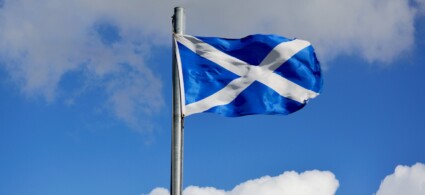
The St Andrew’s Cross: The Flag of Scotland
All about the Scottish flag, the Saltire: history, the meaning of St Andrew's Cross, the legend of Athelstaneford and its role in the Union Jack.
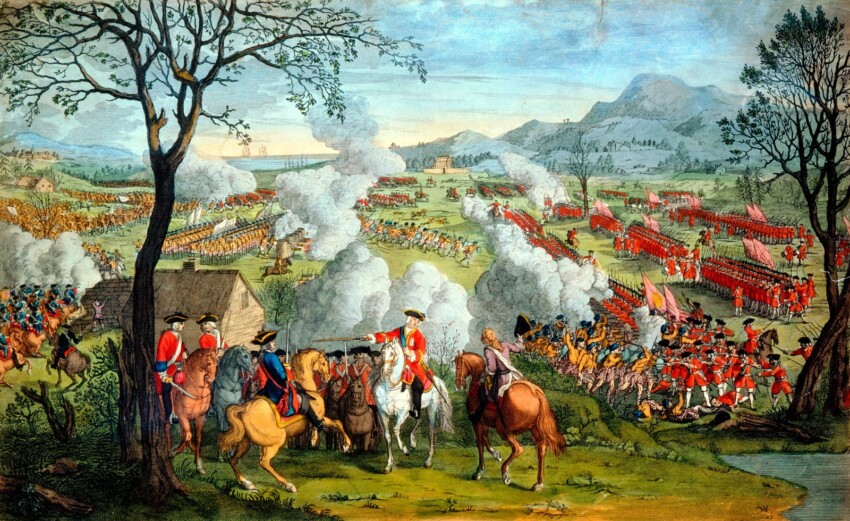
The history of Scotland is one of the most fascinating and turbulent in Europe: millennia of invasions, resistance, betrayed alliances and cultural conquests that have forged an extraordinarily resilient national identity. From a territory contested among Celtic tribes, Roman legions and Norse Vikings, Scotland became over the centuries an independent kingdom, then part of a union with England, until the autonomous nation with its own parliament that we know today. Understanding this history means understanding why the Scottish are what they are: proud, pragmatic and deeply attached to their land.
The first stable inhabitants of the territory we now call Scotland arrived over 10,000 years ago, following the retreat of the last ice age. They were Mesolithic hunter-gatherers who travelled north from continental Europe across what was then still exposed land. Over time, Neolithic populations brought agriculture and left extraordinary evidence such as the Callanish Stones in the Outer Hebrides and the Neolithic village of Skara Brae in the Orkney Islands, preserved so perfectly that it is one of the best-preserved prehistoric sites in Europe.
In the Iron Age the territory was dominated by Celts, divided into numerous tribes. Among these, the Picts — whose name probably means “the painted people”, from their use of body dyes — occupied much of the north and east. The Picts left us no written texts, but a corpus of enigmatic carved stones with animal and geometric symbols that still challenge historians’ interpretation today.
When the Roman legions of Agricola advanced up Britain in 78–84 AD and clashed with the tribes of the north, they found a resistance they never managed to break definitively. The emperor Hadrian had built in 122 AD the famous wall that bears his name, effectively marking the border between the Roman world and the unconquered north. Seventy years later, the emperor Antoninus Pius attempted to push further north with a second wall, the Antonine Wall, but it was abandoned after just twenty years. Rome never managed to conquer the Highlands: that impassable frontier would fuel the myth of Scottish independence for centuries to come.
Around the 5th century AD, a Gaelic population from Ireland — the Scots — settled on the western coast, in the region called Dál Riata, which stretched between present-day Argyll and the northeast of Ireland. It was from them that the country took its name. In this same period, the Irish monk Columba landed on the island of Iona in 563 AD and founded a monastery that became one of the most important spiritual and cultural centres of the entire medieval Christian west, spreading the Gospel to Scotland and northern England.
In the 9th century, the Viking threat drove the tribes to unite. King Kenneth MacAlpin unified the Picts and the Scots around 843 AD, giving rise to the Kingdom of Alba, considered the original nucleus of modern Scotland. It was an epoch-making turning point: for the first time a shared political authority governed much of Scottish territory. Over the following centuries the kingdom expanded southward, incorporating the Britons of Lothian and the Angles of Northumbria, until it assumed the approximate borders of present-day Scotland.
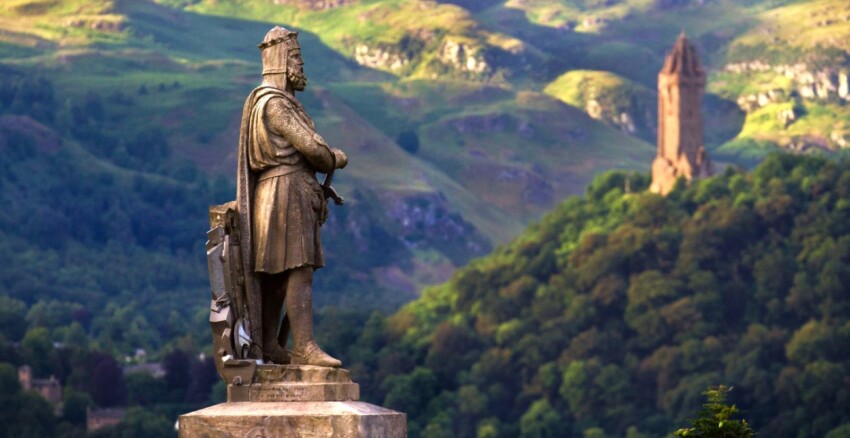
The death without direct heirs of King Alexander III in 1286 and the subsequent disappearance of his granddaughter Margaret of Norway opened a succession crisis that the English king Edward I skilfully exploited to assert his supremacy over Scotland. In 1296 Edward invaded the country, deposed the Scottish king John Balliol and stole the Stone of Destiny — the stone on which Scottish kings were crowned — carrying it to Westminster as a trophy of conquest.
The Scottish response was not long in coming. William Wallace, a knight of obscure origins, organised the resistance and in 1297 defeated the English army at Stirling Bridge, one of the most surprising military victories of the European Middle Ages: a Scottish infantry army that routed the heavy English cavalry on carefully chosen terrain. Wallace became guardian of the realm, but was captured and executed in 1305 with exemplary cruelty that instantly transformed him into a martyr.
It was Robert the Bruce who brought the war of independence to an end. Crowned king in 1306, he conducted exhausting guerrilla warfare against the English until the decisive battle of Bannockburn in 1314, where his army decisively defeated the forces of Edward II, effectively securing Scottish independence. In 1320, Scottish nobles subscribed to the famous Declaration of Arbroath, one of the most extraordinary documents of the Middle Ages: a letter to the Pope affirming that the Scottish people would fight for their freedom as long as one remained alive, and that even the king himself, if he surrendered to England, would be deposed. A principle of popular sovereignty that anticipates by centuries many modern ideas.
The 15th and 16th centuries saw Scotland governed by the Stuart dynasty, a house marked by repeated tragedies: almost all the kings died young, in battle or by the hand of conspirators. James IV, the most capable among them, fell at the battle of Flodden in 1513 against the English — the most serious Scottish military defeat of the Renaissance, in which much of the country’s aristocracy perished.
It was in this climate of instability that the Protestant Reformation spread. The preacher John Knox, trained at Calvin’s school in Geneva, returned to Scotland in 1559 and led a religious revolution that in 1560 abolished papal authority and established the Presbyterian Church as Scotland’s national church. The contrast with the Catholic Mary, Queen of Scots was immediate and dramatic: the queen, elegant and Francophile, found herself governing a country that no longer recognised her faith. Her story — the flight to England, years of imprisonment, execution by order of her cousin Elizabeth I in 1587 — is one of the most tragic in the European Renaissance.
Mary’s son, James VI of Scotland, became in 1603 also king of England as James I, uniting the two crowns in a single person while keeping the two kingdoms formally separate. It was the beginning of a long rapprochement that culminated in the Acts of Union in 1707, whereby Scotland and England merged into the Kingdom of Great Britain, with a single parliament at Westminster.
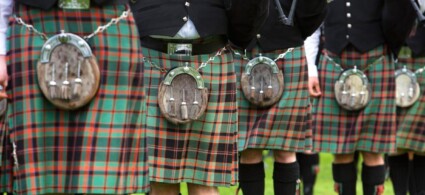
The union was controversial from the outset. The Scottish parliament approved it partly for economic reasons — Scotland had just emerged from the disastrous failure of the Darien Scheme, a colonial venture in Panama that had wiped out much of the country’s financial reserves — and partly through corruption and political pressure. Resistance came from supporters of the Catholic Stuart dynasty, the Jacobites, who organised two uprisings in 1715 and 1745. The latter, led by the charismatic Charles Edward Stuart (“Bonnie Prince Charlie”), came close to threatening London before being crushed decisively at the battle of Culloden in 1746, the last battle fought on British soil. The repression that followed was brutal: the Highland clan system was dismantled, the use of Gaelic prohibited, kilts and bagpipes banned.
In the 18th century, paradoxically in the decades following Culloden, Scotland witnessed one of the most extraordinary intellectual flowerings in European history. The Scottish Enlightenment produced thinkers of worldwide significance: Adam Smith, father of modern economics with The Wealth of Nations (1776); David Hume, among the greatest empiricist philosophers; James Watt, whose improvements to the steam engine sparked the Industrial Revolution; Joseph Black, discoverer of latent heat. Edinburgh became the “Athens of the North”, a city where philosophers, scientists and men of letters met in coffeehouses and masonic lodges to discuss everything.
The Industrial Revolution profoundly transformed Scotland, particularly the Glasgow region and the Clyde Valley. The shipyards of the Clyde became among the most productive in the world, building ships that sailed all the oceans. The textile, mining and steel industries drew vast masses of workers from the countryside and from Ireland to the cities, creating conditions of life often terrible but also an organised working class that would play a crucial role in 20th-century politics.
During the 20th century Scottish nationalism gradually consolidated as a political force. The Scottish National Party was founded in 1934 and for decades remained a marginal force, until the discovery of oil in the North Sea in the 1970s reignited the independence debate: why should the wealth of Scotland’s subsoil be managed by London? The 1979 referendum on devolution failed on a technical clause despite a majority of voters saying yes.
It was not until 1997, with the Blair government, that a new referendum approved the creation of the Scottish Parliament, which took its seat in Edinburgh in 1999 after nearly three hundred years of absence. The parliament has powers over health, education, justice and some fiscal matters, but defence and foreign policy remain at Westminster. In 2014, a second referendum on full independence saw the No vote prevail with 55% of votes, but the Brexit of 2016 — voted against by the will of the Scottish majority — reignited the debate vigorously, keeping the question of independence still open and central to contemporary Scottish politics.
Through millennia of invasions, forced unions and economic transformations, Scotland has preserved a distinctive culture expressed in the Gaelic language still spoken in the Highlands and the islands, in the music of bagpipes, in literature from Robert Burns to Walter Scott to Irvine Welsh, in the philosophy of law and in architecture. The Highlands, the castles, the lochs and remote islands are not merely tourist backdrops: they are the landscape in which this history unfolded, and which continues to shape those who inhabit it.
 Hotel
Hotel  Budget accommodations
  Apartments
  Family Hotel
  Luxury Hotel