Edinburgh: Loch Ness, Glencoe & the Scottish Highlands Tour
19.554 reviews
Buy now
From 81,59€ per person
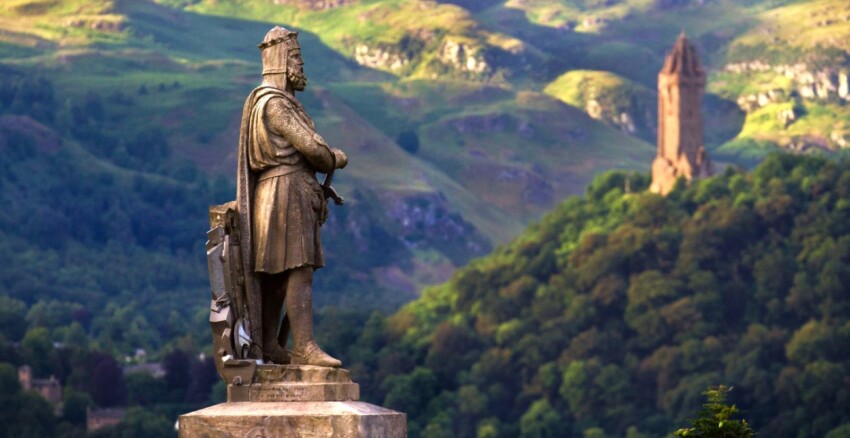
Sir William Wallace (c. 1270 – 1305) was a Scottish patriot who led his countrymen in rebellion against the occupation of Scotland by the Norman-descended English; within the context of the Scottish Wars of Independence, Wallace also fought against King Edward I of England.
Popular perception often regards Wallace as a “man of the people,” in contrast to his compatriot Robert the Bruce (Robert I of Scotland), who was of noble lineage. Wallace’s family descended from Richard Wallace (Richard the Welshman), a landowner who lived under the early members of the Stewart family, later a fully-fledged royal house.
Wallace was born at Elderslie, in Renfrewshire (near Kilmarnock, Ayrshire) around 1270, which made him still young during his years of greatest prominence, between 1297 and 1305.
There are few contemporary sources of information about Wallace’s youth, and considerable reliance is placed on the account of Blind Harry, written around 1470, some two centuries after Wallace’s birth. He tells us that Wallace was born in Ayrshire, his father was Sir Malcolm Wallace of Riccarton, and that he had two brothers, Malcolm and John.
William received his education from two uncles who were priests, and thus enjoyed a superior education for the time, speaking both French and Latin.
Blind Harry makes no mention of Wallace ever leaving Scotland, or of any military experience before 1297. A record from August 1296 simply refers to a thief, a William le Waleys, at Perth.
Contrary to popular belief, John Balliol had a legitimate claim to the Scottish throne. However, it was deemed necessary that an independent arbitrator be invited to Scotland, so that no accusation of bias could be levelled. In a reckless gesture, the Scots invited Edward I of England to settle the succession to the Scottish throne.
Rather than arriving as an impartial arbiter, he appeared at the Anglo-Scottish border with a large army and announced himself as a supreme overlord, come to resolve a dispute in a vassal state, forcing every potential king to do him homage. After hearing all the claims, Edward chose John Balliol as king of what he described as the vassal state of Scotland.
In March 1296, Balliol refused to pay homage to Edward, and by the end of the month Edward stormed Berwick-upon-Tweed, plundering border towns and causing considerable bloodshed. In April, he defeated the Scots at the Battle of Dunbar in Lothian, and by July he had forced Balliol to abdicate at Kincardine Castle.
Edward travelled to Berwick in August to receive formal homage from around 2,000 Scottish chiefs, having previously removed the Stone of Destiny from Scone Palace, the seat of the Scottish kings. Scotland fell under effective English rule.
The following year, 1297, saw the beginning of Wallace’s rise. According to local Ayrshire legend, Wallace was stopped by two English soldiers over some fish he had caught. The dispute escalated into a full-blown brawl, resulting in Wallace killing the soldiers. A warrant for his arrest was issued shortly after. Whether this story is true or false, it is clear that Wallace harboured a long-standing hatred of the English, fuelled by the death of his father at English hands in 1291. Wallace further avenged his father’s loss by winning battles at Loudoun Hill (near Darvel, Ayrshire) and at Ayr.
In May he fought alongside Sir William Douglas at Scone, routing the English administrator. The supporters of the increasingly popular rebellion suffered a severe setback when in July Scottish nobles made peace with England at Irvine, and in August Wallace left his base in Selkirk Forest to join Andrew de Moray’s army at Stirling. Moray had initiated another uprising, and at Stirling their combined forces prepared to meet the English in battle.
On 11 September 1297, Wallace and the Scots achieved a decisive victory at Stirling Bridge. Despite being vastly outnumbered, the Scottish forces led by Andrew de Moray (an important nobleman as the eldest son) and with Wallace as their commander, routed the English army. The Earl of Surrey’s force of professional soldiers, numbering 300 cavalry and 10,000 infantry, met with disaster as it crossed the river from the north. The bridge was too narrow for many soldiers to cross at once (probably no more than three abreast), so as the English crossed, the Scots waited and killed them as they came.
English soldiers began to retreat whilst their comrades from the rear pressed forward, and under excessive weight, the bridge collapsed, drowning many. Unknown to the panicked English army, part of the Scottish forces had forded the river further upstream. With the English army divided on both banks, the two Scottish forces pressed both halves towards the river. It was a crushing victory and a tremendous boost to the Scottish army’s morale. Hugh Cressingham, Edward’s treasurer in Scotland, was killed during the battle.
Following the victory, Wallace was knighted and appointed Guardian of Scotland in March 1298. Unfortunately, de Moray was seriously wounded in the battle and died three months later. Their alliance had proved successful, but now Wallace stood alone with even greater battles ahead.
A year later, however, the situation reversed. On 15 June 1298, the English invaded Scotland at Roxburgh. They plundered Lothian and recaptured some castles, but failed to draw Wallace into battle. The Scots had adopted a scorched-earth policy, and errors by the supply chain left the English short of food and morale, but Edward’s search for Wallace would end at Falkirk.
Wallace had positioned his pikemen in four “schiltrons” – circular hedgehog-like formations, surrounded by a defensive wall of wooden stakes. The English gained an advantage, however, by attacking first with cavalry, wreaking havoc among the Scottish archers. The Scottish cavalry fled and Edward’s men began to assault the schiltrons. It is unclear whether the decisive factor was the hail of darts, arrows and stones from the infantry, or a cavalry attack from behind.
In any case, gaps soon appeared in the schiltrons, and the English exploited these to quell the remaining resistance. The Scots lost many men, though Wallace managed to escape, though his pride and military reputation were severely damaged.
By the end of September 1298, Wallace had decided to surrender the title of Guardian to Robert Bruce, Earl of Carrick, and to John Comyn of Badenoch, the half-brother of the former King John Balliol. Bruce reconciled with Edward in 1302, whilst Wallace resisted these moves towards peace. He spent some time in France on a purported diplomatic mission.
Sir William managed to evade capture by the English until May 1305, when Sir John de Menteith, a Scottish knight loyal to Edward, captured him near Glasgow. After a summary trial, the English authorities executed him brutally on 23 August 1305 at Smithfield in London, in the traditional manner reserved for traitors.
He was hanged and then drawn and quartered. His head was impaled on a spike and displayed on London Bridge. The English government displayed his limbs gruesomely at Newcastle, Berwick, Edinburgh, and Perth.
A memorial stone can be found on a wall of St Bartholomew’s Hospital, near the site of Wallace’s execution at Smithfield. Scottish patriots and others with an interest in the subject often visit this spot and leave flowers.
The 1995 film Braveheart offers a highly romanticised account of William Wallace’s life.
 Hotel
Hotel  Budget accommodations
  Apartments
  Family Hotel
  Luxury Hotel