Edinburgh: Loch Ness, Glencoe & the Scottish Highlands Tour
18.051 reviews
Buy now
From 76,03€ per person

With a history dating back to the 9th century, the flag of Scotland is one of the oldest still in use around the world. Known as the Saltire or St Andrew’s Cross, it features a white diagonal cross on a blue background: a symbol simple in form, yet extraordinarily rich in history, legend and national identity. In Scottish Gaelic it is called bratach na h-Alba, meaning “flag of Scotland”.
Few flags in the world can boast such a long symbolic continuity. The Saltire accompanied armies into battle during the Middle Ages, became part of the Union Jack in 1606 and today flies proudly in front of the Scottish Parliament in Edinburgh. Understanding the history of this flag means delving into the heart of Scottish national identity.
The Scottish flag consists of just two elements: a blue background and a white diagonal cross that runs across the cloth from corner to corner. The cross, technically called a crux decussata or decussate cross, is X-shaped and represents the manner in which St Andrew, apostle and patron saint of Scotland, met his martyrdom.
The exact shade of blue has been the subject of debate for centuries: throughout history, versions with sky blue, royal blue and navy blue have coexisted. Only in 2003 did the Scottish government standardise the official colour, adopting cobalt blue corresponding to Pantone 300. Versions with darker blue, particularly common in naval use, are now considered less appropriate for official use.
The term Saltire derives from the Latin saltatorium, indicating something “X-shaped”. It denotes a decussate cross, or diagonal cross, like the one upon which St Andrew was martyred. The term was already in use in medieval French as saultoir, from where it passed into British heraldic vocabulary.

The origins of the Saltire are shrouded in one of the most fascinating legends in Scottish history. In 832, on the eve of a battle between a combined army of Picts and Scots led by King Angus and a force of Angles, the morning before the clash a strange formation of clouds appeared against the azure sky, forming a white diagonal cross.
St Andrew had appeared to the king in a dream, assuring him of victory: the next day, in the clear sky above the battlefield, a white X formed by clouds appeared, symbolising the apostle’s martyrdom. This sign encouraged the Scottish tribes and terrified their enemies, ultimately leading to the triumph of the defenders. From that moment, the white diagonal cross on a blue background was adopted as the emblem of the nation.
The site of the legendary battle, Athelstaneford, in East Lothian, is still today a small village where a Scottish flag flies day and night in remembrance of the event. Visiting it is one of the most evocative experiences for anyone wishing to connect with the deepest roots of Scottish identity.
Beyond the legend, historical documents place the first official attestations of St Andrew’s Cross in the 12th century, initially in a religious context, as seals of bishops and symbols of cathedrals. The first “secular” version of the Cross appears thanks to the Guardians of Scotland in 1286, following the death of Alexander III.
Historical documents from 1385 report that, by order of the Scottish parliament, soldiers were to wear a uniform with a clearly visible decussate cross, testifying to its now widespread use and recognition as a national symbol. During the same period the Saltire also appears in coinage: in 1390 King Robert III had 5-shilling pieces minted bearing the saint’s image.
The oldest flag of which physical evidence survives dates to 1503 and is characterised by a white decussate cross on a red background; only in the following decades did a blue or azure background become the dominant standard, establishing the appearance we know today.
The bond between Scotland and St Andrew is ancient and profound. According to tradition, the relics of the apostle were brought to Scotland by a monk named Regulus, guided by divine vision to the Scottish coast. This event helped establish the veneration of St Andrew in the country long before he became officially the national patron.
Following Robert the Bruce’s victory at Bannockburn in 1314, St Andrew was officially named Patron Saint of Scotland by the Declaration of Arbroath, and in 1358 the Saltire became the Scottish national flag. The choice of St Andrew as patron was no accident: the apostle was venerated throughout Europe and the connection with his relics gave Scotland religious and political prestige of the highest order.
The feast of St Andrew is celebrated on 30 November (St Andrew’s Day), Scotland’s national day comparable in importance to Ireland’s St Patrick’s Day on 17 March. On this day the Saltire is displayed throughout the country, including on United Kingdom embassies abroad.
One of the most significant events in the history of the Saltire is its contribution to the birth of the United Kingdom flag. In 1606 King James VI combined St Andrew’s Cross with the cross of St George, creating the first embryonic symbol of the United Kingdom, later enshrined with the Act of Union in 1707: the Union Jack.
The incorporation of the Saltire into the Union Jack led to a progressive marginalisation of the Scottish flag as an independent symbol. From 1801 onwards, with the adoption of the new United Kingdom flag that also included the cross of St Patrick, the Saltire fell further into disuse, particularly as the authorities associated it with the Jacobite rebellions of the first half of the 18th century.
The modern revival of the Saltire is closely linked to the Scottish independence movement: only from the 1970s onwards, with the strengthening of modern Scottish nationalism, did the flag become widely used again, sometimes alongside or even replacing the Union Jack. On 1 July 1999, during the first meeting of Donald Dewar’s devolved Scottish government, St Andrew’s Cross flew on the flagpoles of the Scottish Parliament alongside the British flag: a moment laden with symbolic significance.
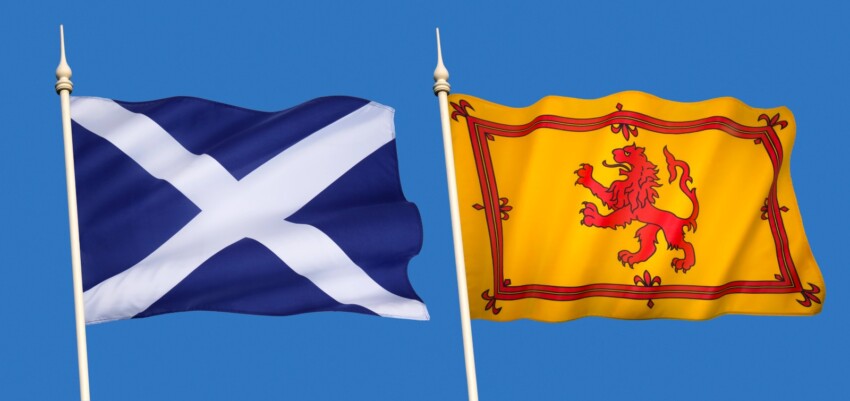
Alongside the Saltire, Scotland has a second flag, unofficial but equally recognisable: the Lion Rampant. This features a gold background with a red rampant lion, surrounded by a decorative border, used for centuries as the royal standard by Scottish kings and queens.
Technically the Lion Rampant is reserved for use by the British sovereign in Scotland and should not be displayed by private citizens, although this rule is widely ignored, particularly at sporting events. At the stands of Scottish national football and rugby matches it is common to see both the Saltire and the Lion Rampant, testimony to how deeply rooted both symbols are in the collective imagination.
The use of the Scottish flag is completely free: as established by the Lord Lyon, it may be displayed at any time by private individuals, companies, local authorities, hospitals and schools. No permission is needed to hoist it on a vertical flagpole.
However, there are certain official dates on which the display of the Saltire is particularly encouraged by Scottish authorities, including St Andrew’s Day (30 November), the day of the founding of the Scottish Parliament and other historic occasions. An exception is made for National Days established by the central British government, when the Saltire must be replaced by the Union Jack on government buildings, unless multiple flagpoles are available.
In front of the Scottish Parliament in Edinburgh five flagpoles fly: the Saltire is always present, alongside the United Kingdom flag and, on special occasions, the Commonwealth flag. At Edinburgh Castle, however, the coexistence of the Saltire and Union Jack remains today a subject of heated political debate: the British flag flies on the clock tower every day, whilst the Saltire is hoisted on the Battery Half Moon.
The Saltire symbol has left its mark on various flags around the world, often linked to Scottish diaspora or historical connections with Scotland. The flag of Nova Scotia (Canada) is one of the most direct examples: it incorporates the Saltire with a central coat of arms, recalling Scottish colonisation of the region in the 17th century.
More surprisingly, there is a connection with the flag of Tenerife, in the Canary Islands, which features the same white diagonal cross on a blue background design. Tsarist Russia also once used a white Saltire on a blue background for some of its naval ensigns. These parallels testify to the lasting influence of one of Europe’s most recognisable heraldic symbols.
 Hotel
Hotel  Budget accommodations
  Apartments
  Family Hotel
  Luxury Hotel