Edinburgh: Loch Ness, Glencoe & the Scottish Highlands Tour
18.051 reviews
Buy now
From 76,03€ per person
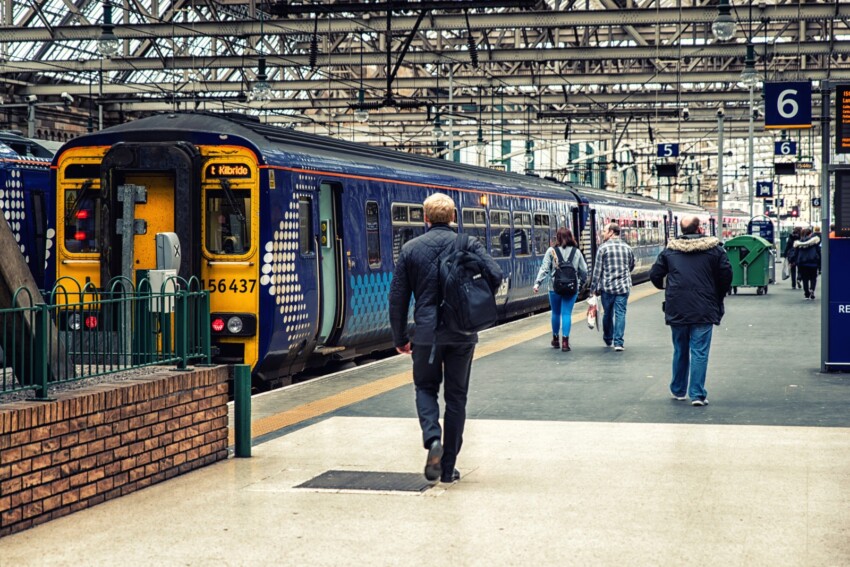
Travelling by train in Scotland is an experience that goes far beyond mere logistics. Some of Scotland’s railway routes rank among Europe’s most spectacular: Victorian viaducts suspended over moorland, lochs opening suddenly beyond the hills, glens shrouded in morning mist. The railway network covers the main cities and most popular destinations well, allowing you to reach comfortably Edinburgh, Glasgow, Aberdeen, Dundee and Inverness without needing a car.
The main operator of local trains is ScotRail, which returned to public ownership in 2022 and operates the vast majority of lines within Scotland. For connections with England, long-distance operators LNER (on the east coast) and Avanti West Coast (on the west coast) take over. Understanding how this network is structured, and where the train doesn’t reach, is the starting point for planning a realistic itinerary.
It’s worth being clear from the outset: the train is ideal for travelling between cities and for taking major scenic routes, but it doesn’t serve the rural areas of the Highlands, the islands and much of the coast. For those areas, car hire in Scotland remains the most effective solution.
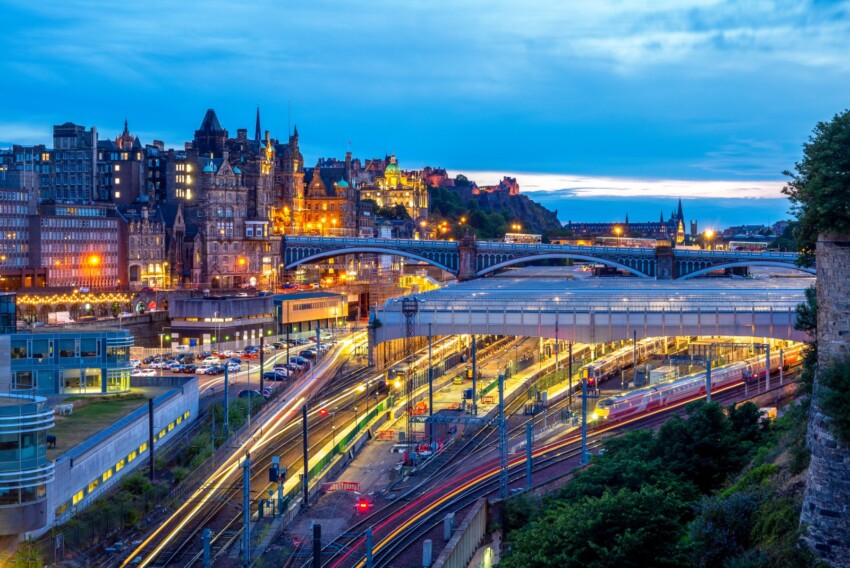
Reaching Scotland from England by train is not only possible, but often better value than flying, especially if you’re travelling from London or cities in the north of England. The British railway network connects the capital with Edinburgh and Glasgow via two major routes, each with distinct characteristics.
The London King’s Cross – Edinburgh Waverley route is operated by LNER (London North Eastern Railway) along the East Coast Main Line. The fastest trains cover the roughly 630 km in 4 hours 20 minutes, with frequent departures during the day — typically every hour during peak times. Waverley is Edinburgh’s central station, located in the heart of the city, just a few minutes’ walk from the Royal Mile and the main city-centre hotels.
By booking 6–8 weeks in advance, you can find one-way fares from £30–40; prices rise quickly closer to the date, reaching £150–200 for first-class or flexible tickets. Tickets can be purchased directly from the LNER website or through aggregators like Trainline.
The London Euston – Glasgow Central route is operated by Avanti West Coast along the West Coast Main Line. The fastest trains take around 4 hours 30 minutes, with regular departures throughout the day. Glasgow Central is the city’s main station, well connected with the underground and suburban trains to reach any part of the metropolitan area.
There’s also a direct London Euston – Edinburgh service via West Coast, also operated by Avanti, with slightly longer journey times than the LNER route. Night travellers can consider the Caledonian Sleeper, the overnight train departing London Euston and arriving in Edinburgh, Glasgow, Aberdeen, Inverness and Fort William during the night, with private cabins or shared berths available. It’s an experience in itself and lets you save a night’s hotel bill.
If you’re flying into London and want to continue by train to Scotland, you’ll need to first reach King’s Cross (for LNER) or Euston (for Avanti). From Heathrow, the quickest option is the Piccadilly Line underground to King’s Cross (around 50 minutes) or the express bus to Euston. From Gatwick, Thameslink reaches King’s Cross directly in around 45 minutes. For those flying directly to Scotland, Edinburgh Airport is connected to the city centre by tram in 30 minutes, whilst Glasgow Airport is served by Airlink buses to the central station.
Within Scotland, ScotRail operates a network of around 5,000 km of track with over 350 stations. The service is comprehensive in central areas — the so-called Central Belt between Edinburgh and Glasgow — but becomes increasingly sparse as you head north towards the Highlands. Below are the main routes of interest to travellers.
Scotland’s busiest route: trains connect Edinburgh Waverley and Glasgow Queen Street every 15 minutes during peak hours, for a journey of around 50 minutes. A second route, via Shotts, takes around 70 minutes but stops at more intermediate stations. There’s also the Edinburgh Haymarket – Glasgow Central service, useful if you’re staying on Edinburgh’s west side. The frequency and speed of this connection make the train far more practical than driving, which during rush hours can take 90 minutes with city traffic and access roads.
From the Central Belt you can easily reach some of the country’s most important historic cities. Stirling, with its castle dominating the plain of Bannockburn, is around 45 minutes from Edinburgh and 35 minutes from Glasgow, served by frequent trains in both directions. Perth, ancient royal capital of Scotland, is roughly an hour from Edinburgh. Dundee, on the north bank of the Firth of Tay, is reachable in around 1 hour 20 minutes from Edinburgh, with a striking crossing of the Tay Bridge — nearly 3 km long — that offers a unique perspective on the river.
The Edinburgh – Aberdeen line covers around 200 km in 2 hours 30 minutes, with intermediate stops at Kirkcaldy, Dundee and Montrose. Aberdeen, the granite city in Scotland’s north-east, is an ideal starting point for exploring the Castle Trail (Aberdeenshire’s castle route) and the Speyside Whisky Trail. The line runs alongside the North Sea for long stretches, with particularly impressive views between Stonehaven and Montrose.
The Edinburgh – Inverness line offers two alternative routes. The faster one passes through Perth and the Drumochter Pass — Britain’s highest railway pass at 452 metres above sea level — and takes around 3 hours 15 minutes. The Aberdeen route is longer (around 4 hours) but more scenic along the coastal section. Inverness is the main railway hub of the Highlands and the starting point for three of Europe’s most spectacular scenic lines.
Glasgow has a well-developed suburban railway network, with trains reaching surrounding suburbs and towns every 10–15 minutes. The city also has its own circular underground — the Subway, affectionately nicknamed the “Clockwork Orange” for its train colour — with 15 stations looping around the centre. For those visiting Loch Lomond, trains from Glasgow Queen Street reach Balloch, at the loch’s southern tip, in around 45 minutes.
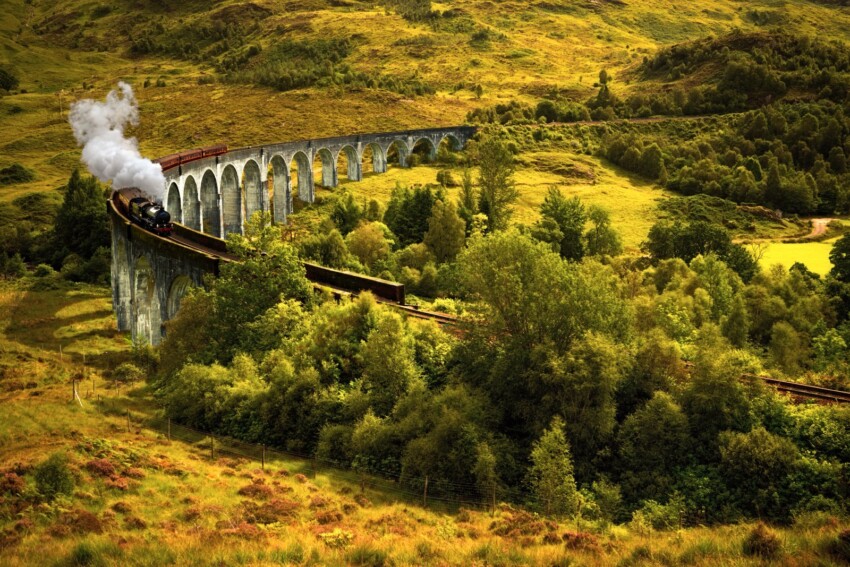
Scotland is home to some of the world’s most scenically spectacular railway routes. Travelling them isn’t just a way to get from A to B, but an attraction in itself: these lines pass through landscapes that a car can’t reach from the same perspective, crossing Victorian viaducts and along loch shores where roads often don’t even go. Book a seat on the right side of the train — indicated below — to make the most of the views.
Considered by many the most beautiful railway line in the world, the West Highland Line departs from Glasgow Queen Street and reaches Fort William in around 3 hours 45 minutes, passing Loch Lomond, the moorland of Rannoch Moor — one of the UK’s wildest and most desolate areas — and the glens of the western Highlands. The final section from Fort William to Mallaig (around an additional 1 hour 20 minutes) is perhaps the most spectacular: it crosses the Glenfinnan Viaduct, the 21-arch viaduct many recognise from the Harry Potter films, with views of Glenfinnan Monument and Loch Shiel.
The Glasgow – Mallaig stretch takes around 5 hours 15 minutes in total, with 3–4 departures daily in each direction. Book a seat on the right-hand side heading towards Mallaig for the best views of Loch Lomond; once past Crianlarich, the finest views open out on both sides. Mallaig is the embarkation point for ferries to the Isle of Skye (Armadale) and the Hebrides.
The Kyle Line links Inverness to Kyle of Lochalsh, the land-based access point to the Isle of Skye, in around 2 hours 30 minutes. The line crosses the north-western Highlands via Achnasheen and Strathcarron, with views of lochs, moorland and the Torridon mountains. Kyle of Lochalsh sits just 500 metres from the Skye Bridge: from the station forecourt you can already see the island. Departures are limited — typically 3–4 daily — and the summer service runs slightly more frequently than winter.
The Far North Line is Britain’s most northerly railway and one of Europe’s longest single-track, non-electrified lines. From Inverness it reaches Thurso (the most northerly point on the British railway network) and Wick in around 4 hours, passing through the open plains of Sutherland and Caithness — a treeless, open landscape completely different from the romantic image of the Highlands. There are 2–3 departures daily. It’s not scenic in the traditional sense, but it offers immersion in Scotland’s most remote and authentic landscape, far from tourist circuits.
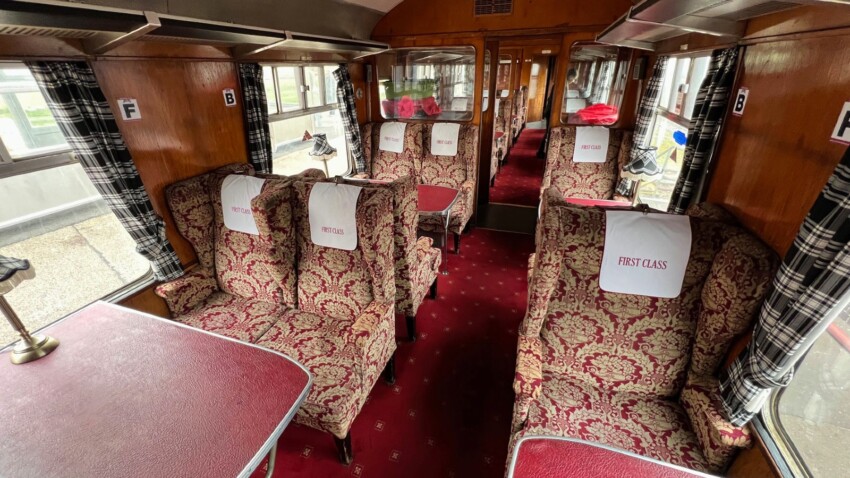
Each summer, between May and October, the West Highland Line becomes the stage for a unique attraction: the Jacobite Steam Train, the steam-hauled train that Harry Potter fans know as the Hogwarts Express. The train runs the Fort William – Mallaig route there and back, departing Fort William at 10:15 and returning from Mallaig at 14:10, for a day excursion of around 5 hours including the stop time at Mallaig.
The journey’s highlight is the crossing of the Glenfinnan Viaduct, where photographers gather on the surrounding hills from early morning. The viaduct is best seen from outside the train, but from within it also offers a remarkable perspective, particularly from the left-hand side heading towards Mallaig. Our complete guide to the Harry Potter train in Scotland provides all the details on booking tickets, where to photograph the viaduct and how to plan your day. Seats sell out weeks ahead, especially in July and August: book as soon as possible on the West Coast Railways official website.
The British railway ticketing system is among the most complex in Europe, but it also holds excellent savings opportunities for those who know how to navigate it. The fundamental rule is straightforward: the further in advance you book, the less you pay. Advance fares, available until 23:59 on the day before departure, can cost a third or less compared to Anytime fares purchased on the day.
ScotRail tickets can be purchased directly on the ScotRail official website, at station ticket offices or at ticket machines. For long-distance journeys to and from England, the National Rail website aggregates all operators and allows you to compare timetables and prices. The aggregator Trainline is widely used for the convenience of its app and the ability to easily compare alternatives, although it does apply a small booking fee.
For those planning to travel extensively by train over several days, the Scotland Rover is an unlimited pass allowing unrestricted travel across the entire ScotRail network for 3 days out of 7, 8 days out of 15, or 3 consecutive days. Prices vary depending on the option chosen and age. The pass does not include the Jacobite Steam Train or trains operated by other companies towards England.
Visitors from overseas may want to consider the BritRail Pass, which can only be purchased outside the United Kingdom (including online, before departure). It comes in an “All Britain” version and a “Spirit of Scotland” version, the latter valid only on the Scottish network. The BritRail Pass is worthwhile if you’re planning at least 4–5 significant journeys during the validity period.
Off-Peak and Super Off-Peak fares apply to trains departing outside peak hours: generally, by avoiding morning trains between 7:00 and 9:30 on weekdays, you can achieve significant savings. Many Advance fares are tied to a specific train: if you miss it, the ticket is non-refundable and cannot be transferred to later services, unless you’ve purchased a flexible ticket. Always check the terms and conditions before confirming your purchase.
Being honest about this point is essential to avoid disappointment during your journey. The Scottish railway network, valuable as it is, does not reach many of the most visited destinations in the Highlands and beyond. Loch Ness is not directly served by any railway station: the nearest station is Inverness, from which the northern shore of the loch can be reached by bus or taxi (approximately 30–40 minutes). Eilean Donan Castle, an iconic image of Scotland, is not accessible by train. Neither is Glencoe, Ullapool or the North Coast 500 covered by the railway network.
The Hebrides, the Orkneys and Shetland are accessible only by ferry or plane. Those wishing to explore Scotland beyond the Central Belt and major cities need to factor in the necessity of a car, at least for part of the journey. The most practical approach for many travellers is to combine both modes of transport: arrive by train in Edinburgh or Glasgow, hire a car and set off to explore the rural areas. Our guide to car hire in Scotland and the one on how to drive in Scotland (on the left, often on single-track roads) will help you prepare thoroughly.
 Hotel
Hotel  Budget accommodations
  Apartments
  Family Hotel
  Luxury Hotel