Edinburgh: Loch Ness, Glencoe & the Scottish Highlands Tour
18.051 reviews
Buy now
From 76,03€ per person
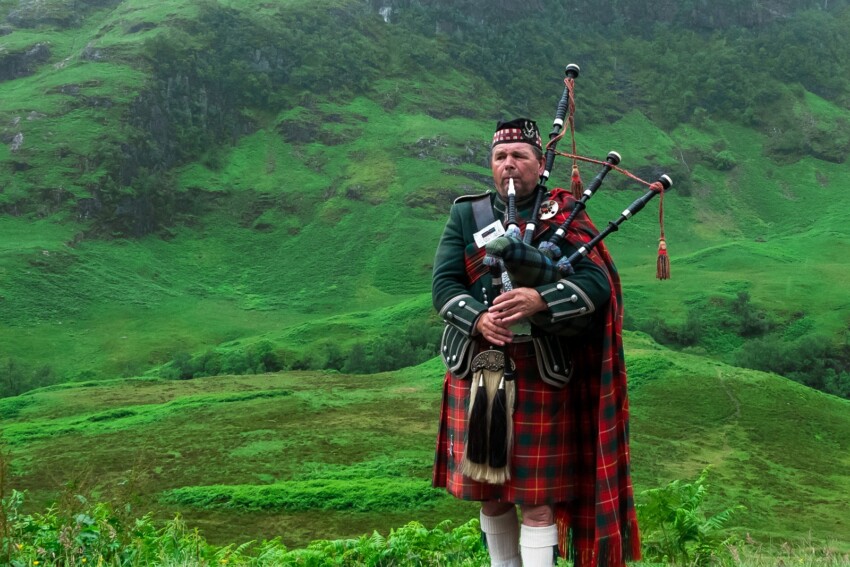
Beyond the stereotypical images that associate Scotland with a kilted bagpiper, there is no denying the importance that this instrument, with its unmistakable sound and capacity to evoke intense emotional reactions, has held (and continues to hold) in the history and culture of this region of the United Kingdom.
Certainly, most people associate the Scottish bagpipe – referring specifically to the Highland war pipes – with military parades or funerals, that is, with functions of an eminently public nature. Yet a closer examination of the “bagpipe phenomenon” reveals the richness of a traditional music form that ranks among the most developed and fascinating of the entire Celtic world.
Many countries around the world have a musical tradition associated with the bagpipe, but it is only in the Scottish Highlands that this tradition evolved into forms comparable to classical music. It is now widely accepted that the bagpipe did not originate in Scotland, but rather in the Middle East, and that it spread throughout Europe via itinerant musicians during the twelfth and thirteenth centuries. By the fourteenth century, travelling pipers were present in rural communities across Greece, Ireland, Italy and Sweden. The exact date of the bagpipe’s arrival in Scotland remains uncertain, but most scholars place it during the fifteenth century. The earliest documented evidence of a bagpipe in Scotland appears in the Testament Of Mr. Andrew Kennedy, published in 1508.
What is certain is that by the sixteenth century the pipes had become an instrument of military use in Scotland. Before the arrival of the bagpipe, folk music in the Highlands consisted of little more than songs accompanied by a drum or rudimentary wind instruments. The harp was an instrument reserved for the nobility and special occasions, but its weak sound limited its use to indoor settings. By contrast, the powerful sound of bagpipes, enhanced by the presence of the drones, could be heard for miles across the Scottish glens.
The social rank of the piper within a clan was particularly elevated, equal to that of bards and clarsach players – players of the Celtic harp. Clan chiefs granted them certain lands, which could be passed down through inheritance, and the art of bagpiping was transmitted from father to son. Around 1700, the first piping colleges began to emerge. Clan chiefs would send their pipers to study with particularly skilled and knowledgeable masters. Some of these masters, and their dynasties, became particularly renowned in Scotland: the most celebrated names included the Rankins of Mull, the MacArthurs of Skye, the Mackays of Gairloch, and above all the MacCrimmons, pipers to the MacLeod clan of Dunvegan (see box).
Tracing the broad sweep of Highland history, following Scotland’s defeat by English forces (Culloden, 1746), the Highlands witnessed a genuine twilight of its traditions (bagpipes included), and the subsequent Proscription Act dealt a severe blow to Scottish pride and self-esteem.
Poverty, overpopulation, exorbitant taxes and hostility from the English Church did the rest. Many Scots chose to emigrate to regions of North America (and we shall later see the importance of this phenomenon for bagpipe music), while many others enlisted in the “Highland regiments” of the British Army. This paradoxically helped preserve bagpipe music, which faced a serious threat of extinction.
Pipers joined forces with drummers of the English military tradition, and this marked the origin of the military pipe band – a phenomenon that experienced a genuine “explosion” during the golden age of British colonialism in the eighteenth and nineteenth centuries. Ironically, the decline of the pipes was arrested not by Scottish tradition, but by that very British imperialism against which the old pipers had previously fought.
This renewed attention to the Highland war pipes also indirectly contributed to the decline of other types of bagpipe found in Scotland, the bellows-blown small pipes and the Border (or Lowland) Pipes.
Canadian scholar Hamish Moore managed, in the mid-1980s, to shed light on the likely performance techniques of Highland pipe music from the period before the Culloden defeat. This all stemmed from observations about pipe music in the Canadian territory of Nova Scotia, specifically on the island of Cape Breton. These territories became the destination for the Scottish emigration that followed the 1746 Culloden defeat.
The first Scottish colonists brought with them to Cape Breton the typical step dancing, which was accompanied by the sound of bagpipes. Now, accompanying this type of dance required a playing style entirely based on rhythm, to allow dancers to maintain time. In other words, these colonists brought with them the old piping styles of their homeland – quite different from the modern “traditional” style, which is based essentially on melodic ornamentation techniques and cadences typical of pipe bands.
Hamish Moore, a veterinarian who taught at the Gaelic College in Cape Breton, eventually concluded that the “old” style of piping, based entirely on rhythm rather than technique, can paradoxically today be heard not in Scotland, but in Canada, specifically in Nova Scotia. In light of Moore’s research, the sound of reels, jigs and strathspeys performed today by Cape Breton pipers (and with profound differences compared to modern Scottish piping techniques!) would be essentially the same as what could be heard in seventeenth and eighteenth-century Scotland.
In Hamish Moore’s own words: “…the performance techniques of those times were based exclusively on rhythm, as it was dance music: like rock’n’roll. Basically, it was the rock’n’roll of eighteenth-century Scotland!”
The bagpipe currently enjoys a period of great popularity in Scotland. Virtuosi of the instrument are particularly numerous, and pipe band activity is often frenetic. Around 800 pipe bands exist throughout the United Kingdom, half of which compete in official competitions. It is estimated that a similar number of pipe bands exist elsewhere in the world, concentrated mainly in former British colonies such as Canada and Australia.
It is ceol beg – the small music comprised of jigs, reels, marches, strathspeys and hornpipes – that currently enjoys the greatest success with Scottish audiences. The competition circuit keeps the main pipe bands continuously engaged, bands that in recent years have significantly modernised their approach to bagpipe music. Among the most innovative pipe bands are the Shotts Pipe Band and the Dykehead Pipe Band (world champions in 1997 and 1994 respectively), the Vale of Atholl and the Dysart & Dundonald in Scotland, the Australian Victoria Police Pipe Band, and the Canadian Fraser University Pipe Band and 78th Fraser Highlanders.
Whilst such success among pipe bands might be thought responsible for a certain decline in solo performance, it is equally true that the band technique itself has been instrumental in raising the technical standard of most pipers, who often combine their marching band activities with personal solo work.
 Hotel
Hotel  Budget accommodations
  Apartments
  Family Hotel
  Luxury Hotel