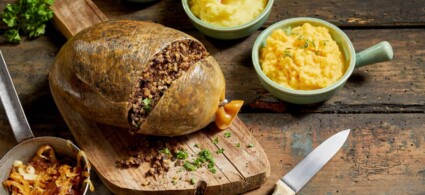
Haggis
Haggis is the most celebrated traditional Scottish dish. Made from lamb offal and oatmeal, it is wrapped and cooked in a sheep's stomach.
Read more
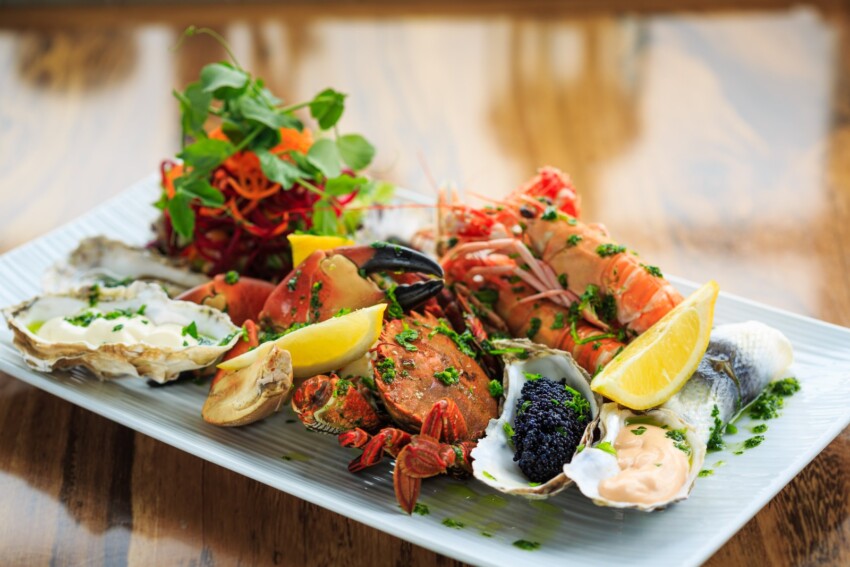
A Scottish breakfast is a joy and, together with afternoon tea, a genuine gastronomic experience. The traditional Scottish breakfast is very similar to its English or Irish counterpart – an extremely hearty plate typically comprising eggs, sausages, bacon and potatoes (as either fritters or baked) with the optional addition of mushrooms, beans and tomatoes.
However, Scots don’t eat this rich dish daily, and especially during the week they prefer lighter breakfasts.
Porridge comes first – for many Scots an indispensable daily pleasure and one of the symbols of national cuisine: it’s an oatmeal “pottage” eaten hot, with a pinch of salt, sometimes also with brown sugar and creamy milk.
A curious detail: Scots traditionally referred to porridge using the plural “they”, and conventionally “they” is always eaten standing up.
Aberdeen rowies are small pastries made with lard and butter: eaten warm, with butter and marmalade – bitter orange preserve.
Finally, a treat in themselves are baps – delightfully soft rolls, oval in shape and slightly flattened, at their best when still warm from the oven, filled with a fried egg and Ayrshire bacon, one of Scotland’s most succulent specialities.
Even during the darkest days of the BSE crisis, Scottish beef always represented a safe product. The quality is truly extraordinary. A piece of roasted Aberdeen Angus beef is one of the finest dishes one could wish for.
Pairing beef with seafood is a characteristic of much British cuisine: in Scotland you can taste an excellent steak and oyster pie – a savoury pastry with beef and oysters. Once oysters were so abundant that they were considered poor man’s food and were added to many dishes to enrich and flavour them.
One of the most popular meat dishes is also one of the simplest: mince and tatties – minced beef stew served with mashed potatoes. It’s one of those dishes Scots could never tire of eating.
In Scottish cuisine, pork has never played a major role, with the exception of bacon.
Other traditional meat dishes are those based on game, such as rabbit pie – a rabbit stew, boned and covered with pastry – or roast venison, usually served with a cranberry sauce.
Tweed Kettle is salmon poached (very gently) in water and wine, with dill and bay leaf. The leftovers can be used for potted salmon – a cream of salmon and butter, flavoured with nutmeg, eaten spread on oatcakes.
An ancient dish is cabbie-claw – cod (or salt cod) boiled and served with a horseradish and cayenne pepper sauce. For the more adventurous, crappit heid – cod’s head stuffed with the fish’s liver mixed with oats.
Scots vie with the Irish for the title of great potato eaters, and countless, albeit rather monotonous, recipes feature them. Stovies are sliced potatoes first fried in roasting fat (or butter) with onions, then cooked through with stock. Stovies are the typical accompaniment to Sunday roast.
Particularly good are mashed potatoes with the addition of turnip and swede, which, it seems, should be accompanied by generous glasses of cold milk.
Cock-a-leekie and Scotch Broth are among the jewels of Scottish gastronomy. Cock-a-leekie is a chicken broth with leeks and dried prunes; the meat can be served separately or shredded and returned to the broth. Scotch broth is heartier: a beef or mutton broth with dried peas, barley, carrots, cabbage and turnips.
Typical of winter months, when fresh meat was scarce, was reested mutton soup – a soup made with dried, salted mutton that resembled salt cod in appearance.
For centuries a poor man’s dish, mussel brose – a mussel broth – has all the characteristics of a Nordic dish: mussels (though other seafood can be used), fish stock extended with milk, oats to thicken, and finally, chives.
According to many, Scottish cuisine is at its best in home baking. Puddings, steamed and eaten hot, accompanied by warm custard, are truly special: among the finest are steamed marmalade pudding, made with orange preserve, or sticky toffee pudding, with dates.
Famous worldwide are shortbread – a type of shortcrust pastry, extremely rich, buttery and crumbly – and Dundee cake, a cake packed with currants and candied orange peel, ideal for afternoon tea. Dundee cake takes its name from the Scottish city itself.
Below you’ll find a list of those dishes and foods typical of Scotland that you’ll likely have the opportunity to taste only here. Although some may seem “extreme”, we encourage you to try them.
In Scotland, oat consumption has always been very high. Not only is it a highly versatile food (appearing in countless recipes, from soups to desserts), but it’s also warmly recommended by modern dietetics, as it’s rich in fibre, iron, zinc and vitamins.
With oats you can make oatcakes – biscuits that pair beautifully with cheese. Fine oat flour can be added to standard shortcrust pastry ingredients to make it pleasantly crispy. In a sweet called cranachan, oats with brown sugar are toasted under the grill and then, once cooled, mixed into lightly whipped cream in which raspberries have been folded. Orkney broonie is instead a ginger sweetbread made with wheat flour and oats, typical of the Orkney Islands.
Similar to blood sausage, it’s a sausage made with oats, kidney fat, onion and sheep’s or pork’s blood. Pan-fried and served with a fried egg and grilled tomatoes, it’s perhaps one of the most appetising “Nordic” breakfasts (ideal before a walk in the bitterly cold Scottish winter).
Scotch pies are very common, especially in Dundee, where they’re simply called ‘pies’: savoury tarts filled with minced beef and biscuit crumbs, with a pastry case made hot with lard – an unusual method.
Haggis is perhaps the most famous dish in Scottish cuisine: lamb’s lung cooked for hours and then mixed with beef fat, onion, oats (of various types) and spices (white pepper, nutmeg and coriander, among others).
The mixture is then minced and used to stuff lamb intestines (or beef casings). Haggis is then steamed and ready for home consumption: sliced and briefly pan-fried, it’s generally eaten with champit tatties – mashed potatoes.
Certain types of seaweed have constituted a common foodstuff in the Scottish diet for centuries. The most used were redware (porphyria lacinata), dulse (rhodymenia crispus) and carrageen (chondrus crispus). These seaweeds could be boiled in water, drained and dressed with melted butter and lemon juice. Or they could be made into a soup: cooked with potatoes in milk and the whole thing then sieved and served piping hot, with a squeeze of lemon. Grilled dulse, charred, with a splash of vinegar, can still be enjoyed in some old pubs.
These are smoked haddock (they resemble cod). They’re roasted in the oven with butter. Another truly traditional dish is herring in oatmeal – herring coated in oats and fried in butter: with new potatoes it’s one of the finest summer dishes of Scottish cuisine.
 Hotel
Hotel  Budget accommodations
  Apartments
  Family Hotel
  Luxury Hotel