Edinburgh: Loch Ness, Glencoe & the Scottish Highlands Tour
18.051 reviews
Buy now
From 76,03€ per person
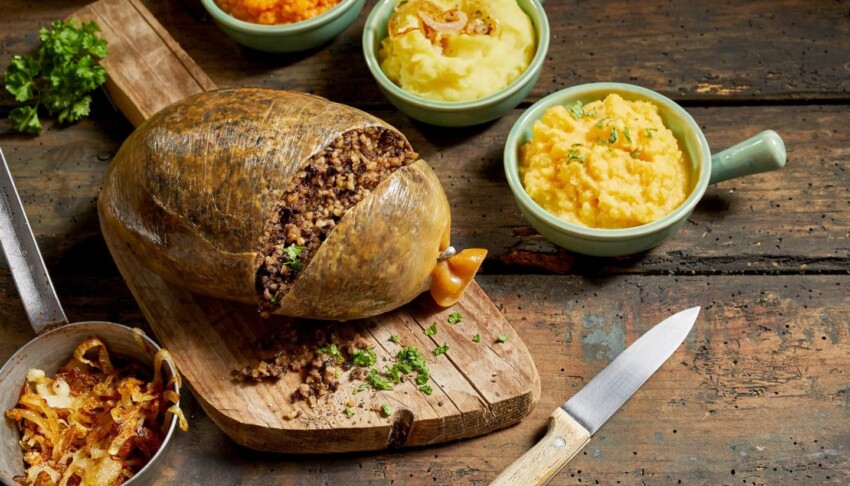
Haggis is a traditional Scottish sausage made from ingredients that once epitomised the essence of poor man’s cooking: lamb offal (heart, liver and lungs), onion, suet, oatmeal, spices and salt. This mixture is traditionally wrapped and cooked in a sheep’s stomach, creating a natural casing for the filling.
The result is a dish with a rich and intense flavour, with a compact yet crumbly texture. The taste of haggis is distinctly distinctive: earthy, spiced, with notes of pepper and nutmeg that balance the richness of the offal and the granular texture provided by the oatmeal.
Authentic haggis should have a complex yet harmonious flavour, where no single ingredient dominates the others, and a texture that crumbles gently under the fork.
When you visit Scotland, we invite you to set aside any preconceptions and taste this iconic dish in its various forms.
The origins of haggis are shrouded in the mists of history, with various theories competing for the truth about the birth of this emblematic dish.
Contrary to what one might think, haggis is probably not exclusively a Scottish invention. Similar dishes existed in many European cultures from ancient times. As early as 423 BC, Greek playwright Aristophanes mentioned sausages made from offal that could be considered ancestors of haggis.
The idea of using an animal’s stomach as a container to cook a filling of meat and grains is a culinary technique found in numerous gastronomic traditions, from Roman cuisine to Viking cooking.
What is certain is that haggis found ideal conditions in the Scottish Highlands to take root and become a central element of local gastronomic culture. The first written mentions of haggis in Scotland date back to the 15th century, but the dish was probably already widespread by then.
Various theories explain why haggis became so popular in Scotland:
During our visit to the Scottish Food Museum in Edinburgh, a curator told us how haggis was actually a common dish in many parts of Britain until the 18th century, but survived mainly in Scotland, where it became a symbol of national identity.
No discussion of haggis would be complete without mentioning Robert Burns, Scotland’s national poet who played a decisive role in elevating this humble dish to cultural symbol.
In 1786, Burns wrote the ode “Address to a Haggis“, a poem that celebrates the virtues of this traditional dish, describing it as “great chieftain o’ the puddin’-race”.
Burns’s poem, written in the Scottish dialect, exalts haggis as a symbol of the honest simplicity of Scottish life, in contrast to the elaborate pretensions of French cuisine, then in vogue among the British upper classes.
This ode is recited during Burns Suppers, celebratory dinners held on 25 January each year (the poet’s birthday) throughout the world wherever Scottish communities exist. At these dinners, haggis is brought ceremoniously to the table, preceded by a bagpiper, and the poem is recited before the dish is cut and served.
Traditional haggis is typically served with “neeps and tatties” (turnips and potatoes), both boiled and mashed, and with a whisky-based sauce. This trio of flavours – the spiced richness of haggis, the sweetness of turnips and the creamy texture of potatoes – creates a perfect balance that represents the essence of Scottish cuisine.
The traditional drink to accompany haggis is undoubtedly whisky, preferably a Highland or Islay single malt, whose smoky and complex character pairs perfectly with the intense flavours of the dish.
If you’re planning a trip to Scotland and want to taste authentic haggis, here are some suggestions based on our experience:
During your stay, we also recommend visiting one of the artisan butchers that produce haggis, such as Macsween in Edinburgh or Stornoway Black Pudding Company on the Isle of Lewis, where you can discover the secrets of preparation and perhaps purchase haggis to take home (checking customs regulations for your country first).
Contemporary haggis exists in many variations, some more faithful to the traditional recipe, others decidedly innovative. In recent years, Scotland’s national dish has experienced something of a renaissance, with Michelin-starred chefs offering refined interpretations and artisan producers exploring new possibilities.
On the Isle of Skye there is also a seafaring interpretation of haggis, served with a garnish of local seaweed and accompanied by an island whisky, Talisker, known for its salty notes that evoke the sea surrounding the island.
A curious aspect concerns restrictions on the export of traditional haggis. Since 1971, the United States has banned the importation of products containing sheep’s lungs, making it impossible to market authentic haggis in the American market. Producers have therefore developed alternative versions that omit this ingredient.
Similar restrictions exist in other countries, which has led to the creation of “export versions” with slightly modified recipes to comply with local regulations.
The preparation of traditional haggis is a laborious process that requires time, skill and a certain amount of culinary courage. Here’s how it’s made according to the classic recipe:
For traditional haggis you need:
During our food tour in Edinburgh, we visited a small artisan butcher where the butcher, a third-generation haggis producer, proudly showed us the preparation process, emphasising how each family has its own small variations in the recipe, especially regarding the mix of spices used.
Beyond its culinary role, haggis holds a special place in Scottish popular culture and in (often humorous) depictions of Scotland abroad.
One of the funniest legends tells of the wild haggis, an imaginary creature said to live on Scottish hillsides. According to this jest, haggis would be a small animal with shorter legs on one side than the other, an adaptation that would allow it to run easily around steep Scottish hills (but always in the same direction).
This tongue-in-cheek legend is often told to more credulous tourists, and has spawned various souvenirs and humorous postcards. During our tour in Scotland, our guide told us with a straight face about spotting a wild specimen that very morning, keeping up the joke for the entire trip.
Haggis is the star of various folk events, including:
One of the most bizarre events we attended was a race where participants had to carry haggis over an obstacle course, being careful not to damage it too much before the finish line, where it was judged both on completion time and the integrity of the haggis.
 Hotel
Hotel  Budget accommodations
  Apartments
  Family Hotel
  Luxury Hotel