Scottish Clans
You cannot understand Scottish history without knowing about the clan system, which was central to countless historic and legendary conflicts.
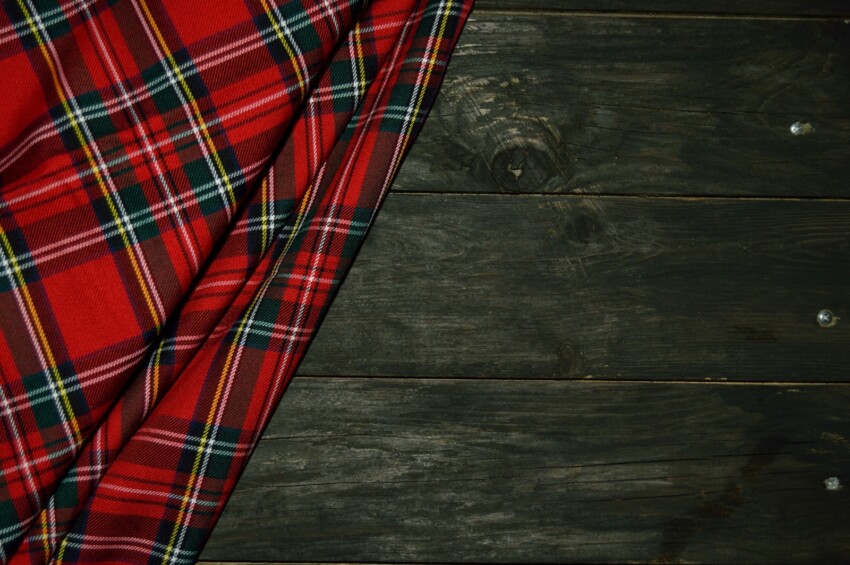
Walking through the streets of Edinburgh, you cannot help but notice shop windows filled with fabrics featuring colourful geometric patterns that immediately catch your eye. Scottish tartan is far more than a simple textile pattern: it is a powerful symbol of cultural identity, a link to Scotland’s history and traditions that has spanned the centuries to become a globally recognised icon.
Whether you have Scottish roots or are simply fascinated by the beauty of these coloured weaves, tartan offers a fascinating glimpse into the culture and traditions of a country proud of its identity.
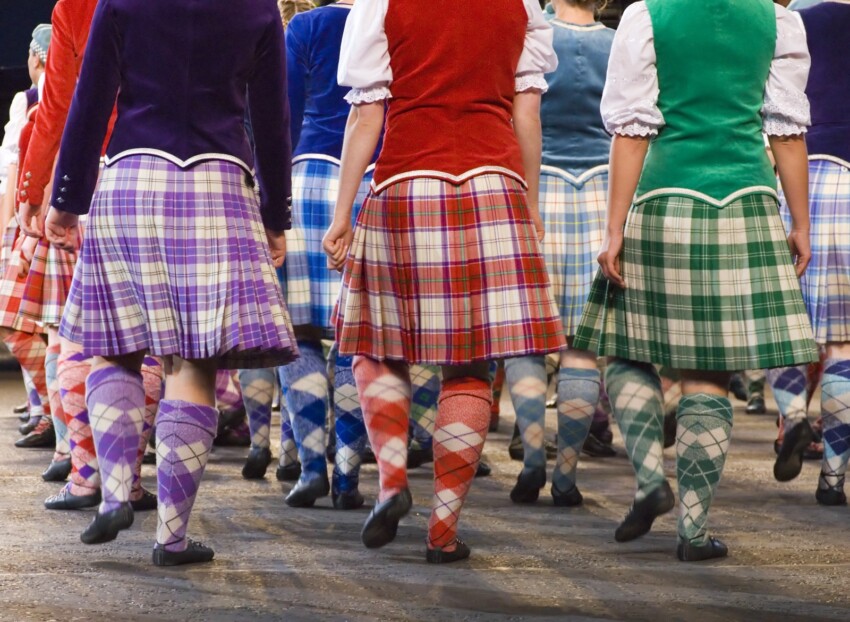
Tartan is a textile pattern made up of stripes of different colours that intersect at right angles, creating a unique checked pattern. Technically, the term refers to the design itself, whilst the woollen fabric in which it is traditionally made is called “plaid”. However, in modern terminology, the two terms are often used interchangeably.
Each combination of colours and stripe widths creates a unique pattern, known as a “sett”. The main characteristic of tartan is that the pattern repeats identically both horizontally and vertically, creating what is known in textile terms as a “twill” structure, where threads weave over and under in a 2-2 sequence (two over, two under).
From a technical standpoint, weaving tartan requires considerable skill to ensure that the pattern develops correctly in both directions. Over the centuries, production has progressed from the hand looms of small rural communities to modern textile factories, yet the appeal and complexity of these patterns remain unchanged.
Contrary to what one might think, the origins of tartan are far from clear and certainly do not date back to the earliest days of Scottish Celtic civilisation. The earliest archaeological evidence of fabrics that can be classified as tartan dates to the 3rd century AD, but it is only from the 16th century onwards that we have more consistent written and visual testimony of the use of these fabrics in the Scottish Highlands.
Originally, tartans were not necessarily associated with specific clans. Weavers in each region tended to use the natural dyes available locally, creating patterns that became typical of that geographical area. The pigments derived mainly from plants, lichens and minerals: yellow from heather or wild chamomile, red from madder roots, blue from woad, green from a combination of yellow and blue dyes, and brown and black from alder bark or oak galls.
The link between tartan and clan developed gradually and only became established between the 17th and 18th centuries, during a period when the clan system in the Scottish Highlands was reaching its height.
A dramatic turning point in tartan’s history came after the defeat of the Jacobite uprising at the Battle of Culloden in 1746. In an attempt to break the social structure of the Highlands that had supported the rebellion, the British government introduced the Act of Proscription, which among its repressive measures included a ban on wearing the kilt and tartan, except for regiments of the British Army.
This ban lasted until 1782, but it had the paradoxical effect of transforming tartan into a powerful symbol of Scottish national identity. When the ban was lifted, tartan had become an emblem of cultural resistance and national pride.
The popularity of tartan received a further boost during the Romantic era of the 19th century, particularly following the visit of King George IV to Scotland in 1822, an event orchestrated by writer Sir Walter Scott. On that occasion, the king himself wore the kilt, helping to transform tartan from a symbol of rebellion into an element of aristocratic fashion.
During the reign of Queen Victoria, a great enthusiast of Scottish culture who had the Balmoral Castle built in the Highlands, “tartan mania” reached its peak, with the British aristocracy enthusiastically adopting tartan patterns and motifs in their furnishings and clothing.
The system of Scottish clans (from the Gaelic “clann”, meaning family or descent) was a social structure that dominated life in the Scottish Highlands for centuries. Each clan was led by a chief and comprised several families linked by real or presumed kinship, who occupied and defended a specific territory.
Today, the vast majority of tartans are associated with specific Scottish clans or families. Each clan tartan features a unique combination of colours and stripe widths, which forms the distinctive pattern of that family. The right to wear a particular tartan traditionally belonged to members of the corresponding clan, although today these rules are far less rigid.
Beyond clan tartans, there are numerous other categories:
The creation of a new tartan is not a random process. New designs are carefully planned, often incorporating symbolic elements in the colours and proportions. Once created, a new tartan can be officially registered with the Scottish Register of Tartans, a government institution that maintains a database of all recognised tartans.
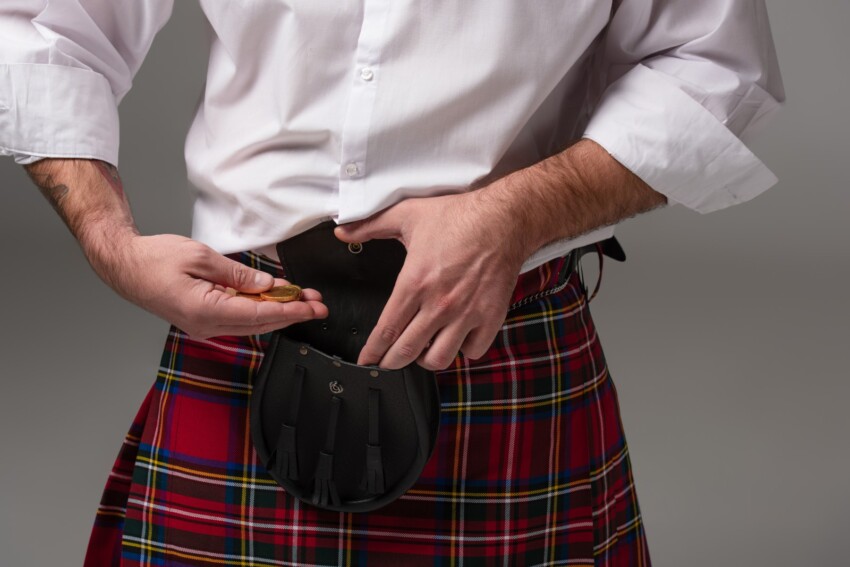
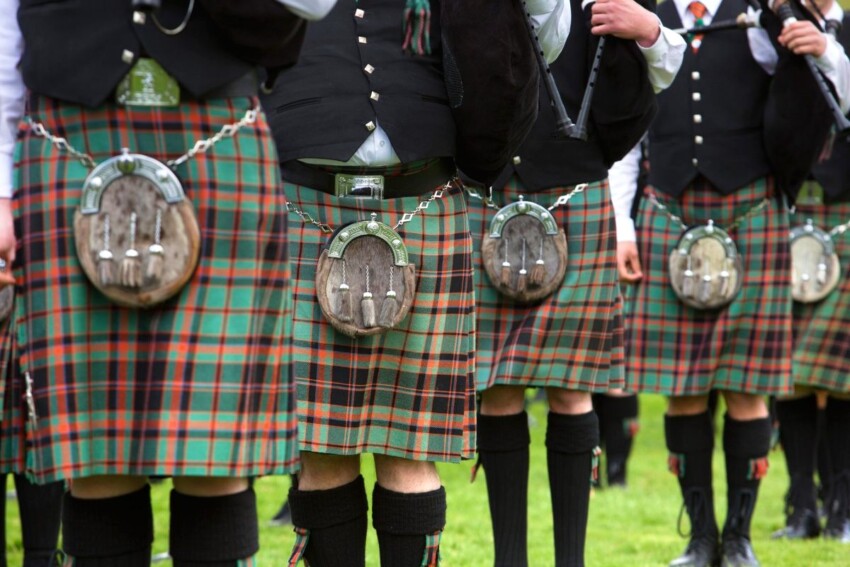
When one thinks of tartan, the image that immediately comes to mind is that of the kilt, the traditional Scottish male garment. The modern kilt is a garment wrapped around the waist, pleated at the back and sides and smooth at the front, falling to just above the knee.
The ancestor of the modern kilt was the “féileadh mòr” (great kilt), a large piece of tartan fabric some 5-6 metres long that was wrapped around the waist and draped over the shoulder, serving as both lower garment and cloak. This garment, common in the Highlands until the 18th century, offered practicality and versatility: it could serve as a blanket at night or, if necessary, be quickly unfastened to allow greater freedom of movement in battle.
The modern kilt, or “féileadh beag” (small kilt), developed as a simplified version, eliminating the upper draping. This innovation is said to have been introduced around 1720 by English industrialist Thomas Rawlinson, who worked in a foundry in the Highlands and sought a more practical garment for his workers.
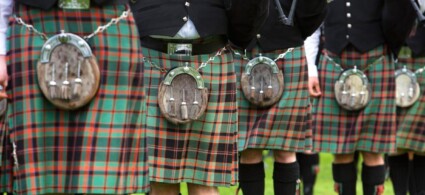
A complete traditional tartan outfit includes numerous accessories:
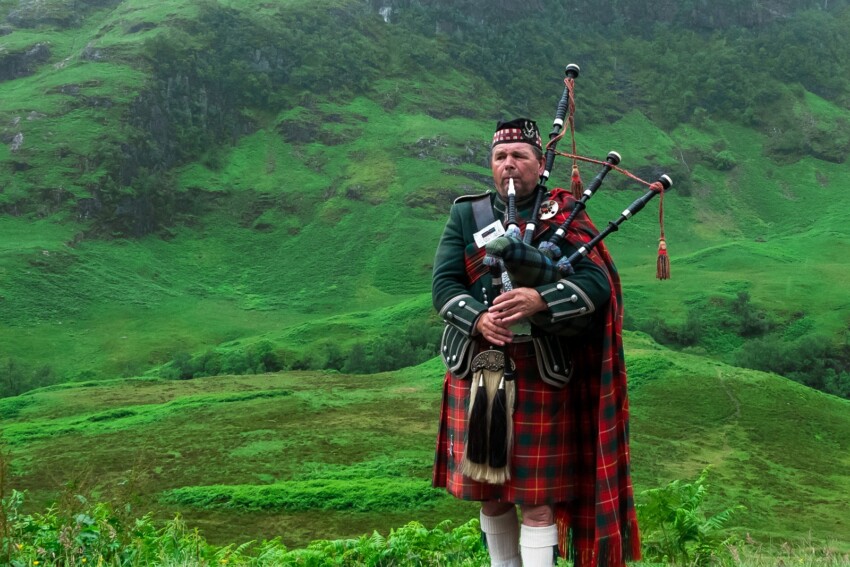
If you attend the Military Tattoo in Edinburgh, you will be able to admire traditional Scottish dress in all its splendour, worn by the bagpipe bands and dancers performing on the Castle Esplanade.
Beyond the kilt, tartan is used for many other clothing items and accessories, both traditional and modern:
Tartan continues to be a vital element of contemporary Scottish culture. On one hand it represents a link to tradition and history, on the other it is a versatile pattern that has evolved to adapt to modern tastes.
Today tartan appears in various contexts:
The global popularity of tartan has also led to the creation of patterns specific to countries, states and provinces outside Scotland. For example, almost all American states and Canadian provinces now have their official tartan, as do many nations worldwide.
Despite this global spread, the heart of the tartan industry remains in Scotland, where historic companies such as Lochcarron of Scotland, Johnstons of Elgin and House of Edgar continue to produce high-quality fabrics using traditional methods whilst embracing technological innovation.
One of the most frequent questions from visitors concerns which tartan they can legitimately wear. The answer is less rigid than one might think.
Traditionally, you wear the tartan of your clan or that of a clan to which you have a family connection. If you have Scottish ancestors, you can carry out genealogical research to discover which clan your family belonged to. Several websites and the Scottish Register of Tartans can help you with this research.
If you have no documented Scottish origins, there are several options:
It is important to remember that whilst traditions related to tartan exist, there are no strict “rules” today that prevent anyone from wearing any pattern. The exception is royal tartans, such as the Balmoral, whose use is reserved for the British Royal Family.

If you are fascinated by tartan and wish to deepen your knowledge during a trip to Scotland, there are several places worth visiting:
Located in Edinburgh, it houses an extensive collection of historic tartans and offers a comprehensive overview of the history and evolution of this iconic fabric.
In various parts of Scotland you can visit traditional weaving mills that often offer guided tours where you can observe the entire tartan production process. Some of the most notable are:
In major Scottish cities such as Edinburgh and Glasgow, you will find numerous specialist shops offering a wide range of tartan products, from traditional kilts to modern accessories. Many of these shops have knowledgeable staff who can help you discover if you have connections to any Scottish clan.
On Edinburgh’s Royal Mile in particular, you will find several historic shops such as “Geoffrey (Tailor) Highland Crafts” and “The Scottish Shop“, where you can purchase high-quality tartan items and receive personalised advice.
The Highland Games, held in various locations during the summer, offer an opportunity to see tartan worn in traditional contexts, during sporting competitions, dance performances and bagpipe band processions.
The Edinburgh Festival Fringe and the Royal Edinburgh Military Tattoo also present numerous occasions to admire traditional Scottish dress in tartan.
Some fascinating facts about tartan:

 Hotel
Hotel  Budget accommodations
  Apartments
  Family Hotel
  Luxury Hotel