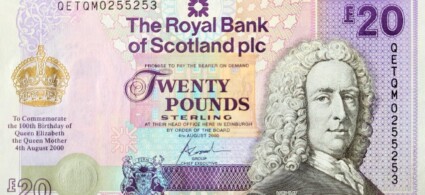
Scottish Currency: Banknotes and Euro to Pound Exchange
Scottish banknotes are pounds sterling in every respect but printed by Bank of Scotland, RBS and Clydesdale Bank. Here's why Scotland has its own banknotes and how to use them.
Read more
The British pound sterling is the oldest currency still in circulation in the world. It has survived twelve centuries of history, enduring the Industrial Revolution, two world wars, the end of the colonial empire and Brexit, emerging each time with its identity intact. For visitors to the United Kingdom, understanding it is essential: not only for managing everyday payments, but for gaining insight into the country that uses it.
Its symbol is £, an abbreviation from the Latin libra, and its international code is GBP (Great British Pound). It is divided into 100 pence, with the symbol “p”. Despite decades of European integration, the United Kingdom has never adopted the euro, even when it was part of the EU: the pound sterling was and remains such a deeply rooted part of national identity that it was too important to sacrifice for monetary union.
If you’re curious to know what a pound is worth and what the current exchange rate with the EURO is, you’ll find a conversion table with the main European currencies constantly updated below.
If you’re planning a trip to London or the United Kingdom and want to exchange euros for pounds sterling or vice versa, we recommend using Wise, which offers real exchange rates with no hidden fees.
The relationship between the euro and the pound has always been volatile, reflecting the political and economic fortunes of the United Kingdom. At the worst point of the 2008 financial crisis, the pound had crashed to near parity with the euro (1 euro = 0.98 pounds), a level not seen since the introduction of the single currency. The 2016 Brexit referendum triggered another sharp depreciation, with the pound losing around 15% of its value against the euro in the weeks following the vote.
In the years that followed, the exchange rate gradually stabilised. The average exchange rate over the past six months for the pound sterling against the euro has been around 1 pound = 1.15 euros. In practical terms, this means that for every 100 euros you get approximately 86-87 pounds, and that each pound is worth around 1.15-1.16 euros. The rate fluctuates daily and it’s always worth checking the current rate on the European Central Bank website before travelling.
The origins of the pound sterling date back to the 8th century, when the Anglo-Saxon kingdoms of England introduced the silver penny, inspired by the Carolingian monetary system. The term “sterling” first appears in medieval documents referring to silver pennies of particular purity, minted by certain mints in northern Europe. Twenty shillings made a pound, a sum that in medieval England was enough to purchase a small herd of livestock.
The institutional turning point came in 1694 with the establishment of the Bank of England, the central bank that has since regulated the issuance of currency and managed the country’s monetary policy. It was during this period that the pound began to circulate also in the form of banknotes, and that London established itself as the world’s leading financial centre. Between 1880 and 1914, the pound was anchored to the gold standard and became the principal currency of international commerce, symbolising the economic power of the British Empire. One pound was then worth approximately 4.87 US dollars.
The First World War marked the end of the gold standard and the beginning of a long relative decline against the dollar, but the pound maintained enormous weight in the world economy throughout the twentieth century. From 1971, the United Kingdom allowed the pound’s value to float freely on foreign exchange markets, finally abandoning any fixed anchorage.
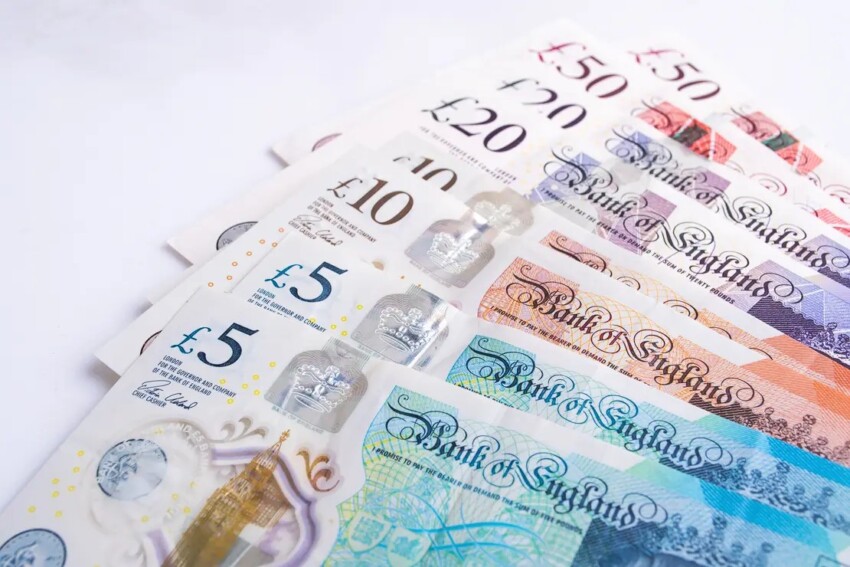
Pound sterling banknotes are issued by the Bank of England for England and Wales, and by three authorised commercial banks for Scotland (Bank of Scotland, Royal Bank of Scotland, Clydesdale Bank) and two for Northern Ireland. Scottish and Northern Irish banknotes are legally valid throughout the United Kingdom, but in practice they may encounter resistance outside their respective territories: it’s always advisable to exchange Scottish banknotes for Bank of England notes if travelling in England or Wales.
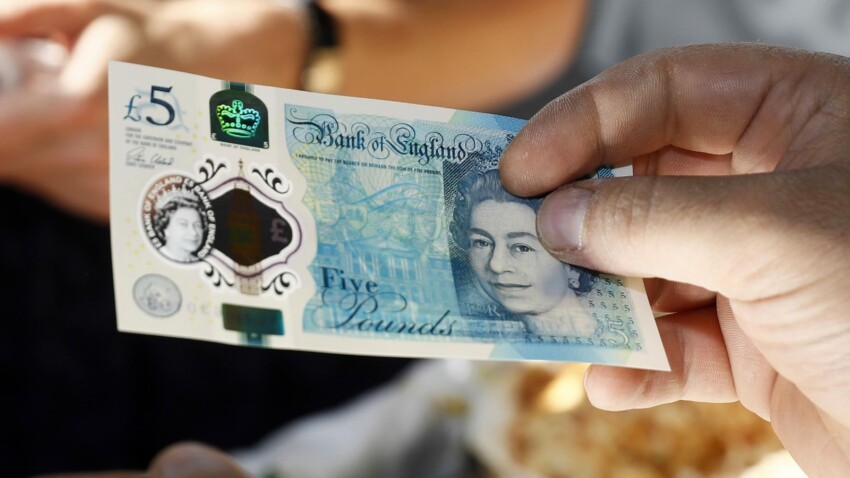
The denominations available are £5, £10, £20 and £50, each with a distinct colour and a historical figure on the reverse. From 2016 onwards, the Bank of England has progressively replaced traditional paper banknotes with banknotes made of polymer — a thin and durable plastic that is virtually impossible to counterfeit — making British money among the safest in the world. Polymer banknotes are distinctive to the touch and feature transparent windows with holograms that change image when tilted.
The reverse of the banknotes celebrates icons of British culture: Winston Churchill on the £5, Jane Austen on the £10, painter J.M.W. Turner on the £20, mathematician Alan Turing — father of modern computer science and a key figure in breaking the Enigma code during the Second World War — on the £50. The obverse features a portrait of the reigning monarch.
From 5 June 2024, new banknotes featuring King Charles III entered circulation, nearly two years after the death of Queen Elizabeth II. The designs on the reverse remained unchanged: the only modification is the portrait on the obverse. Banknotes featuring Elizabeth II remain perfectly valid and will continue to circulate alongside those of Charles III until they wear out naturally. In July 2025, the Bank of England launched a public consultation to decide the theme for the next series of banknotes.
There are eight coins in circulation: 1p, 2p, 5p, 10p, 20p, 50p, £1 and £2. The most interesting to examine are the £1 coin, a bimetallic twelve-sided piece introduced in 2017 to replace the previous circular version, featuring four national symbols engraved — the English rose, Welsh leek, Scottish thistle and Northern Irish shamrock — and the £2 coin, a bimetallic piece with a gold-coloured outer ring and silver-coloured centre. On all coins, by long tradition, the monarch’s portrait alternates facing right and left with each change of reign.
An interesting detail: British slang has proper names for almost every denomination. One pound is a quid, five pounds a fiver, ten a tenner. Fifty pence is often simply called fifty pee. If you’re in a pub in Glasgow or at a market in London, you’ll hear these expressions regularly.
The United Kingdom is one of the European countries where cash is least used. Payments by debit and credit card — and contactless payments via smartphone (Apple Pay, Google Pay) — are accepted almost everywhere, from pubs to taxis, from local markets to museums. In many establishments in London and Edinburgh, cash is not accepted at all, a trend that accelerated during the pandemic and has never reversed. It’s still prudent to carry some banknotes for small purchases and outdoor markets, but it’s not strictly necessary to have large sums in your pocket.
For exchanging currency, the best options are online services such as Wise or Revolut, which apply the real market rate with no hidden fees, or your bank. Currency exchange counters at airports and tourist areas apply very high spreads and should be avoided. Cash machines (ATMs or cash machines) are found in all cities, but the network is shrinking: in rural areas and on more remote islands it can be difficult to find one, so it’s advisable to obtain cash before venturing outside populated centres.
If you pay with a foreign card, some British terminals may offer Dynamic Currency Conversion (DCC): they’ll ask if you want to pay in euros rather than pounds. Always decline: the rate applied is almost invariably less favourable than the one your bank would apply.
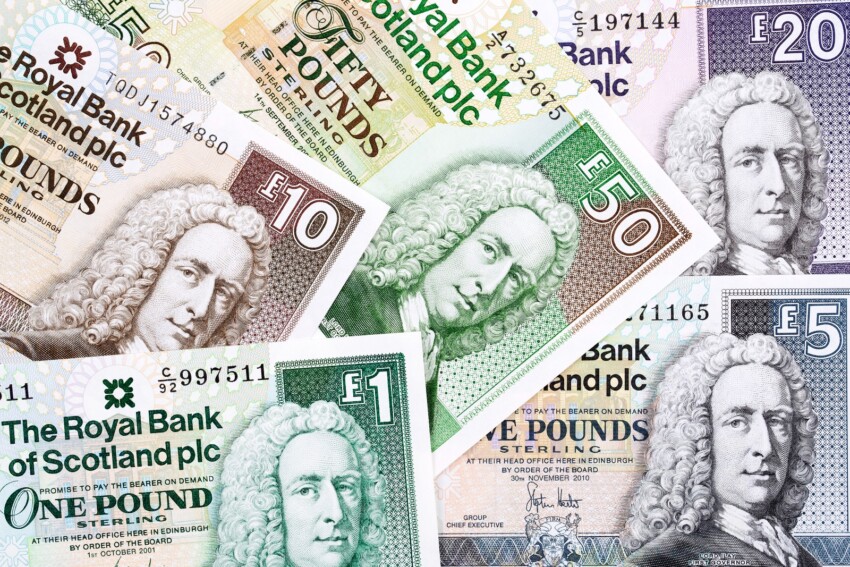
When visiting Scotland, you may receive banknotes different from those of the Bank of England: these are banknotes issued by Bank of Scotland, Royal Bank of Scotland and Clydesdale Bank, which are perfectly legal and have the same value as English ones. The designs are different — they often depict castles, landscapes or Scottish historical figures — and some historic series have become collector’s items. In Scotland they are accepted without any problem everywhere; outside Scotland, particularly in England, some shopkeepers might refuse them due to unfamiliarity, although they have no right to do so if the banknote is genuine.
 Hotel
Hotel  Budget accommodations
  Apartments
  Family Hotel
  Luxury Hotel