
Why book with us?
- Best price guaranteed
- Free cancellation
- No commissions
- 24h Service - 7/7d

Hiring a car in Great Britain is the smartest choice for those who want to explore the country without the constraints of public transport. Rail networks connect major cities well, but it’s the countryside, coastlines and more remote regions — the Scottish Highlands, the Cotswolds, Cornwall, rural Wales — that offer the most memorable experiences, and a car is often the only practical way to reach them. With a vehicle at your disposal, you can stop wherever you like, change your plans at the last minute and reach villages, castles and coastal views that don’t appear in any timetable.
Great Britain has an extensive and well-maintained road network, with motorways linking major cities and secondary roads weaving through valleys and national parks. Distances are manageable: London to Edinburgh is around 650 km, London to Cardiff less than 250 km. Even an itinerary spanning the entire length of Scotland is perfectly feasible in one or two weeks.
Before you get behind the wheel, however, it’s essential to prepare for a driving experience different from what you may be used to: in Great Britain, you drive on the left side of the road, with the steering wheel positioned on the right. It’s not difficult to adapt to, but it does require attention, especially in the first few days. In the sections that follow, you’ll find everything you need to know: where to hire, how much it costs, how to navigate British roads and which routes to plan.
Below are the cheapest prices for car hire at in Great Britain, to book click here.





The prices of car rental at the in Great Britain varies depending on the time of year. This graph shows the average prices in the various months to help you find out which is the best period to rent a low cost car.
According to reviews by other travellers, the following are the best car rental companies in Great Britain. To compare rates click here.









The ideal pick-up point, especially for those arriving from abroad, is the airport. The UK’s major airports — London Heathrow, London Gatwick, Edinburgh and Glasgow — host all the major international operators such as Hertz, Avis, Enterprise, Budget and Europcar, with dedicated desks in the arrivals areas. The advantage is clear: pick up your vehicle as soon as you land and return it before your flight home, without any extra transfers.
At Heathrow Airport, Europe’s busiest airport, car rental companies are located in terminals 2, 3, 4 and 5 or in a dedicated rental centre connected to the terminals by free shuttle buses. The range of vehicles available is extensive, from compact hatchbacks to SUVs and family minivans. Gatwick Airport also offers a wide selection with operators at both the South Terminal and North Terminal.
In Scotland, Edinburgh and Glasgow airports are the preferred starting points for those wanting to explore the Highlands by car. From both airports, you can reach the first Scottish glens in less than an hour’s drive. For those planning a one-way itinerary (e.g. from Glasgow to the Highlands to Edinburgh), many companies allow return to a different city from the pick-up location, with a variable surcharge.
Beyond airports, car rental agencies are present at all major railway stations and in city centres. This option is useful for those arriving by train or who only need a car for part of their stay — for example, to explore the surrounding areas after spending a few days in London or Edinburgh using public transport.
Car hire rates in Great Britain vary significantly depending on the season, how far in advance you book and the vehicle category. Generally speaking, an economy hatchback (such as a Ford Fiesta or Volkswagen Polo) can cost from £30 to £60 per day in low season, whilst in the summer months and during holidays prices rise considerably. For a mid-range saloon or compact SUV, rates start from around £50-80 per day.
One factor to consider is fuel: petrol and diesel in Great Britain are expensive compared to the European average. Rental vehicles are generally delivered with a full tank, with the obligation to return them in the same condition. Some operators instead offer the full-to-empty formula, which allows you to return the car without refuelling, but includes the anticipated cost of fuel in the price, often at less advantageous rates.
Insurance is a cost to consider carefully. Basic rental includes mandatory third-party liability and partial coverage for vehicle damage (CDW), but with a excess that can be very high. You can reduce it or eliminate it by purchasing additional insurance from the operator or, often at more advantageous rates, through independent travel insurance. Some premium credit cards include coverage for car hire: check the terms before you leave.
Motorway tolls are not common in Great Britain, but there are some exceptions: the tunnel beneath the Thames (Dartford Crossing), some bridges in Wales and Scotland and the M6 Toll in central England. Many of these are paid online, not at physical barriers, so it’s worth checking in advance to avoid penalties.

The aspect that concerns continental travellers most is left-hand driving. In Great Britain — as in Ireland, Australia and Japan — you drive on the left side of the road and the steering wheel is on the right. For those from countries where you drive on the right, adaptation requires concentration, but most drivers report feeling comfortable within the first few hours.
The situations that require most attention are roundabouts, which are very common in Great Britain as an alternative to traffic lights. At a roundabout you always travel clockwise, giving way to traffic coming from the right (i.e. from the inside). For those used to anti-clockwise roundabouts, your initial instinct is reversed: it’s worth slowing down and observing before entering.
Turning also requires specific attention. Turning left is the equivalent of turning right in Italy: it’s the simplest manoeuvre, requiring no crossing of traffic lanes. Turning right, on the other hand, is the trickier manoeuvre, equivalent to turning left on roads with two-way traffic: you need to cut across the flow of traffic coming from the opposite lane, as you would in Italy when turning left on a two-way road.
Another critical moment is parking and departing after a stop. It’s easy, after parking, to get back in the car and automatically drive off on the wrong side of the road. Many drivers use a sticky note on the dashboard or steering wheel with the reminder “Keep left” as a prompt, especially in the first few days.
The country roads of Scotland, Wales and Cornwall often feature single-track roads, with passing places to allow traffic in both directions. In these cases, the rule is to give way to the vehicle that has the passing place on its left; if you have it, pull over to let oncoming traffic pass. These roads are among the most scenic in Great Britain — those on the Isle of Skye and the Outer Hebrides are unforgettable — but they require patience and attention.
Speed limits in Great Britain are expressed in miles per hour (mph), not km/h. The limit in residential areas and urban roads is generally 30 mph (approximately 48 km/h), on rural roads 60 mph (approximately 96 km/h) and on motorways 70 mph (approximately 113 km/h). Some residential areas have 20 mph zones, increasingly common in cities.
The system of fixed speed cameras is very widespread, indicated by yellow signs. Average speed cameras are particularly common on motorway roadworks and measure average speed over long stretches, not just at the detection point. Respecting speed limits is therefore essential not only for safety but also to avoid fines that could reach you by post weeks after you return home.
Drink driving is severely punished: the legal limit in England and Wales is 80 mg of alcohol per 100 ml of blood (similar to Italy), but in Scotland the limit is more restrictive: 50 mg per 100 ml, equivalent to practically zero tolerance even for a single glass of wine. Penalties include driving licence suspension and imprisonment.
As for your driving licence, an Italian licence is valid throughout the United Kingdom without the need for an international driving permit. Car hire companies generally require the driver to be at least 21 years old (in some cases 25) and to have held a driving licence for at least 12 months. Additional drivers must be present at the time of pick-up.
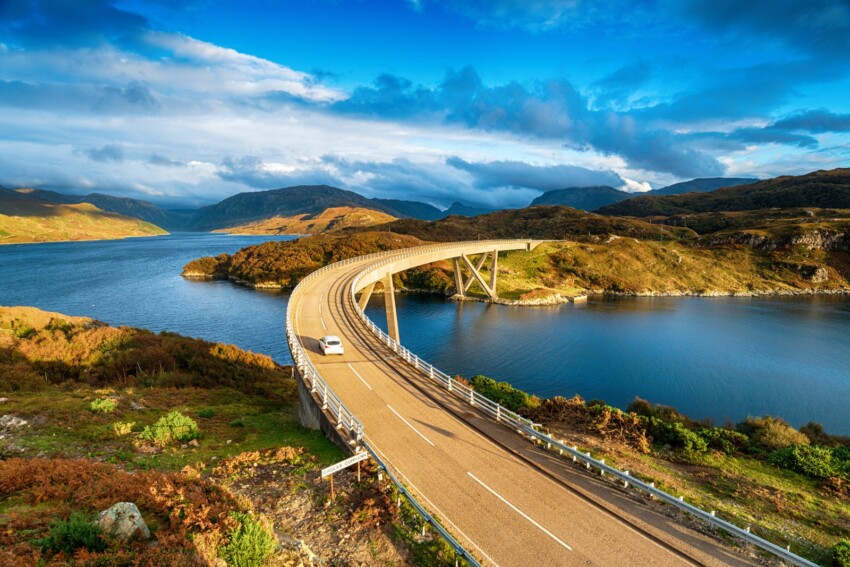
This itinerary is considered one of Europe’s most spectacular routes and ideally takes five or six days, starting from Glasgow and heading north. The first stop is Loch Lomond, Britain’s largest freshwater lake, reachable in less than an hour from the city. The national park surrounding it offers extraordinary lakeside scenery, with charming villages such as Luss that deserve a stop.
From Loch Lomond, the route climbs into the Highlands through Glencoe, Scotland’s most dramatic valley, with its sheer rock walls and screes descending to the valley floor. The A82 road is one of the most intensely scenic stretches in the entire country. From Glencoe, you reach Fort William, the ideal base for climbing Ben Nevis, Britain’s highest mountain at 1,345 metres.
The route continues to Eilean Donan Castle, Scotland’s most photographed castle, reflected in the waters of Loch Duich against a mountain backdrop that looks like it belongs in a film. From here, you reach the ferry to the Isle of Skye, where single-track roads between the Cuillin mountains and the Kilt Rock cliffs offer some of Europe’s most exhilarating driving experiences. The itinerary concludes in Inverness, with the option of a detour to Loch Ness before returning. In total you’ll cover approximately 500 km, though driving times stretch pleasantly with every scenic bend.
A four or five-day itinerary through the heart of quintessential England—verdant countryside, honey-coloured stone villages and ancient university towns. Starting from London, you head west on the M40, with your first stop at Oxford: medieval spires, colleges of England’s oldest university and pubs filled with students and academics offer a complete immersion in British academic atmosphere.
From Oxford, you reach the Cotswolds in approximately 45 minutes. This region of rolling hills and villages like Bourton-on-the-Water, Burford and Chipping Campden embodies picture-postcard English countryside, with cottages built in Cotswold stone—the local honey-coloured limestone—manicured gardens and pubs where you can stop for a traditional lunch. The Cotswolds’ roads are narrow and winding, perfect for slowing down and savouring the landscape.
The next stop is Bath, a UNESCO World Heritage city built by the Romans around its natural hot springs. The Roman Baths are England’s most visited archaeological site after Stonehenge, and the city’s Georgian architecture—particularly the Royal Crescent and the Circus—ranks among Europe’s finest. From Bath, you can make a detour to Stonehenge, reachable in under 40 minutes. The return to London is via the M4, with a possible final stop at Windsor to visit the royal family’s castle.
North Wales is perhaps the least-known part of Great Britain among international visitors, yet it offers landscapes and monuments of extraordinary quality. This four-day itinerary departs from Cardiff, the capital, and heads north through the country. The first stop is Brecon Beacons National Park, with its hidden waterfalls and ridge-top trails.
The heart of the itinerary is Snowdonia National Park, dominated by Snowdon (1,085 m), the highest mountain in England and Wales. The roads crossing the park—particularly the A498 between Beddgelert and Pen-y-Pass—rank among Britain’s most scenic, with glacial lakes, Victorian viaducts and views across to offshore islands. Harlech Castle, perched on a headland overlooking the sea, is one of thirteen castles built by Edward I to subdue Wales and today forms part of a UNESCO site.
North Wales’s coastline leads to Anglesey Island, connected to the mainland by the Menai Bridge. Here, coastal roads run between white sandy beaches and historic lighthouses, with rhythms entirely different from England. The return to Cardiff—or drop-off at Manchester or Liverpool, easily reached within a couple of hours—concludes an approximately 700 km itinerary that would be difficult to navigate any other way than by car.
Most drivers adapt to left-hand driving within a few hours. The most challenging situations are the first trips in the morning (when instinct makes you head for the wrong side) and roundabouts. It’s advisable to start with motorway or rural stretches before tackling city traffic, and keep a visual reminder in the car for the first few days.
No. Your driving licence from your home country is recognised and valid throughout the United Kingdom without requiring translation or an international licence. Car hire companies accept EU licences directly.
Most operators require a minimum age of 21 years, with at least 12 months of driving experience. Drivers under 25 often pay a supplement (young driver fee). Some companies accept drivers from 18 years old, but with higher rates and excess charges.
Yes, but it’s advisable to book in advance as automatic vehicles are less readily available than in other countries. In Great Britain, most cars have manual gearboxes. Driving a manual car on the left requires additional adjustment, as the gear stick is on the driver’s left (where you’d find nothing in a right-hand drive car).
For visiting London alone, no: traffic is heavy, parking is expensive and the Congestion Charge (the toll for entering the centre) adds a daily cost of £15. London’s public transport is excellent. A car makes sense from London to reach the countryside or as a starting point for trips outside the city.
It’s a daily toll of £15 to drive in central London (roughly within the Circle Line) on weekdays from 07:00 to 18:00. Payment is made online by midnight the same day, or face a hefty fine. Some hybrid and fully electric vehicles are exempt.
London’s Ultra Low Emission Zone (ULEZ) covers all of Greater London and levies a daily supplement of £12.50 on vehicles that don’t meet certain emissions standards. Recent hire cars generally comply, but it’s worth checking at the time of booking. Many other British cities have introduced Clean Air Zones with similar rules.
Yes, most operators allow collection and return at different locations (one-way rental). This is a very convenient option for linear itineraries, such as arriving in London and departing from Edinburgh Airport. The supplement varies depending on the company and the distance between locations.
Generally no: British motorways are free. The exceptions are the Dartford Crossing (the tunnel under the Thames on the M25, £3), the M6 Toll in central England and some bridges in Wales and Scotland. Payment is almost always made online, with no physical barriers.
Car hire companies provide a 24-hour roadside assistance number. In the event of an accident, you must call the police (999 for emergencies, 101 for non-urgent matters), exchange details with the other party and document the scene with photographs. The standard accident form isn’t universal in the British system, but photographs and exchange of details serve the same purpose for insurance claims.
Absolutely. Booking online in advance guarantees significantly lower rates than at the airport desk on arrival, a wider choice of vehicles (including automatics) and the ability to compare offers from multiple operators. During peak seasons—July, August, Christmas and Easter—availability sells out quickly.
Here are some quick answers to the most common doubts about car rental in Great Britain.
To reserve a car in Great Britain a credit card or debit card is sufficient. However, when you go to collect the car, you will need:
The car rental companies in Great Britain allow to rent a car to all those who are between 21 and 70 years old. However, there is an additional cost for under 25 and for those over 70.
A car rental in Great Britain always includes:
Any extras or additional insurance coverage are separate.
Find the best rates by comparing all car rental companies in one search.






 Hotel
Hotel  Budget accommodations
  Apartments
  Family Hotel
  Luxury Hotel