
Organising your smartphone before travelling to the UK has become more important than many European travellers might expect. Brexit has changed the rules of the game: the UK is no longer part of the European Union, and this has concrete consequences for how calls, SMS and data are charged once you cross the Channel. What until 2020 was just another trip across Europe — with your home mobile plan valid without extra charges — today requires some additional checks before you leave.
The good news is that the options for staying connected in the UK are numerous and, with minimal planning, it’s possible to browse and make calls at reasonable costs. Between roaming with your own operator, local prepaid SIM cards and eSIMs purchasable conveniently before departure, every traveller can find the solution that best suits their needs. This guide examines all available options, with particular attention to the changes introduced by several European operators from 2025 onwards.
From 1 January 2021, with the completion of Brexit, the UK left the European Union and automatically lost the benefits of the Roaming Like at Home (RLAH) regulation, which guaranteed EU citizens the ability to use their mobile plans in the 27 member states on the same domestic terms. In theory, from that moment on, travelling to the UK should have incurred extra charges for data, calls and SMS. In practice, most European operators had voluntarily chosen to maintain RLAH conditions for the UK as well — but that period of grace is coming to an end.
During 2025 and early 2026, major Italian operators began to adjust: TIM eliminated RLAH for the UK from 30 March 2025, Kena Mobile from 17 April, Wind Tre and Very Mobile from 16 June 2025. Iliad announced the same change from 1 January 2026. Among the major operators, Fastweb and Vodafone continue for now to include the UK under European conditions, but the picture is evolving rapidly and could change further.
The situation is similar for travellers from other European countries: each operator applies its own rules, and the advice remains the same: check with your operator before departure for the specific rates for the UK. Travellers in 2026 can no longer assume that their European plan applies to London, Edinburgh or Cardiff without additional charges.
The first step, before making any other decision, is to check the terms of your contract. You can do this quickly on your operator’s website, in the “roaming” or “abroad” section, or by calling customer service. The key questions to find answers to are: is the UK included in European roaming without extra costs? If yes, with what limitations on data? If no, what is the cost per MB, per minute of call and per SMS?
Those who discover that their operator applies extra charges for the UK have three main alternatives: activate a roaming package offered by the operator itself (often with a fixed daily or monthly cost for a bundle of data and minutes), purchase a local British prepaid SIM, or opt for a UK-specific eSIM. Each solution has pros and cons depending on the length of your stay, how you plan to use your phone, and whether you need to keep your home or European number active. Before you travel, consulting useful information about the UK can help you prepare properly.
Buying a British prepaid SIM card is traditionally the most economical choice for those staying in the UK for more than a week. The four main local operators — EE, Vodafone, O2 and Three — offer prepaid plans (Pay as you go) designed with tourists in mind, available at airports, supermarkets (Tesco, Sainsbury’s), pharmacies (Boots) and mobile phone shops on the main streets of every city.
Prices are competitive: basic plans start from around £10 for 10 GB of data with unlimited calls and SMS within the UK. Mid-range options, the most popular with tourists, range from £15 to £20 for 10-20 GB, valid for 30 days. There are also unlimited data plans at around £25-30. Almost all plans include unlimited calls and SMS within the UK; the deciding factor is therefore the amount of data.
An important note: with a local SIM you will not have access to your European number, which means calls and messages received on your home number could be lost or redirected to voicemail. Those who need to remain reachable on their own number should consider the alternatives. It’s worth avoiding purchasing directly at airport desks, where prices are often inflated compared to shops in town.
As for coverage, EE is generally considered the fastest network with the best coverage in rural areas — useful if you’re visiting the Scottish Highlands or the Lake District. Vodafone and O2 offer a good balance between coverage and price in cities. Three is interesting for those travelling in Europe too, as it includes EU roaming in over 70 destinations in its plans.
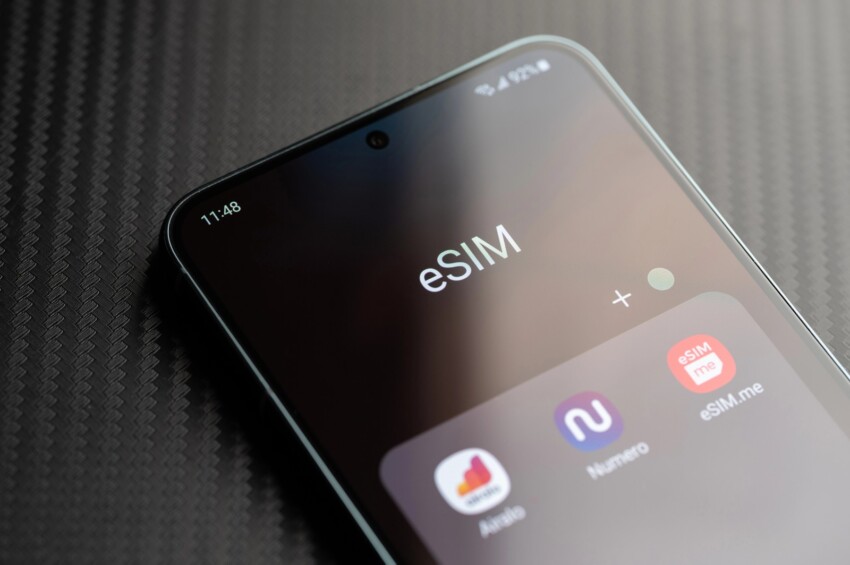
The eSIM (embedded SIM) represents the most convenient solution for modern travellers: it doesn’t require finding a shop on arrival, it doesn’t involve physically changing SIM cards and can be purchased and set up comfortably from home before departure. It’s a virtual SIM that installs directly onto your smartphone via a QR code or activation link, with no physical support needed.
eSIM works in dual SIM mode: your phone maintains both the UK eSIM profile (used for browsing at local rates) and your European SIM (available for calls and SMS on your home number). This combination is particularly advantageous: you pay little for data and remain reachable on your own number. The only requirement is having a compatible smartphone: most recent models are (iPhone XS or later, Samsung Galaxy S20 and above, Google Pixel from the fourth generation), but it’s always worth checking before purchase.
There are two categories of eSIMs for the UK on the market. eSIMs from local operators (EE, Vodafone, O2, Three) offer resident rates and often also include a UK number valid for local calls and SMS — the best choice for medium to long stays. eSIMs from international providers like Holafly, Airalo, Saily, Nomad or Roamless are data-only plans, purchasable in just a few clicks, ideal for short stays: they offer immediate activation, no contract and coverage via the networks of major local operators. Prices range from a few pounds for plans with 5-10 GB to £20-30 for unlimited data plans; VoIP apps like WhatsApp, FaceTime and Skype cover calling needs using the included data.
Public Wi-Fi is widespread in major British cities: airports, railway stations, hotels, cafés, restaurants and large chain shops almost always offer free connectivity. In London, most underground stations now have Wi-Fi above ground and in many areas even in the tunnels — a development introduced on the Central, Northern and Jubilee lines from late 2024 onwards.
It is advisable to use public Wi-Fi with caution for sensitive activities such as accessing bank accounts or online shopping, always preferring password-protected networks to completely open ones. A VPN can provide an additional layer of security when connecting to unfamiliar networks.
The UK international dialling code is +44 (equivalent to 0044), valid for England, Scotland, Wales and Northern Ireland. To call a UK number from abroad, dial +44 followed by the local number without the initial zero: if the number is 020 7946 0000, from abroad you dial +44 20 7946 0000.
UK phone numbers follow a specific structure. Landline numbers always start with 0 when called from within the UK and have varying prefixes for cities and regions: 020 for London (followed by 8 digits), 0121 for Birmingham, 0161 for Manchester, 0113 for Leeds, 0141 for Glasgow, 0131 for Edinburgh, 029 for Cardiff. Mobile numbers always start with 07 (from within the UK) or +44 7 (from abroad) and consist of 10 digits in total: for example +44 7700 900000. Freephone numbers (free to call from within the UK) start with 0800 or 0808, but may have high charges if called from abroad or from a roaming mobile. Special numbers starting with 084x, 087x, 09xx are charged at a premium rate and should be avoided unless absolutely necessary.
To call from Italy or another European country to the UK, the correct format is: +44 + city code (without the 0) + local number. To call from within the UK to Italy, the format is: 00 39 + full Italian number. The European emergency number 112 works in the UK as throughout Europe, but you can also use 999, the traditional UK emergency number for police, ambulance and fire services.
 Hotel
Hotel  Budget accommodations
  Apartments
  Family Hotel
  Luxury Hotel