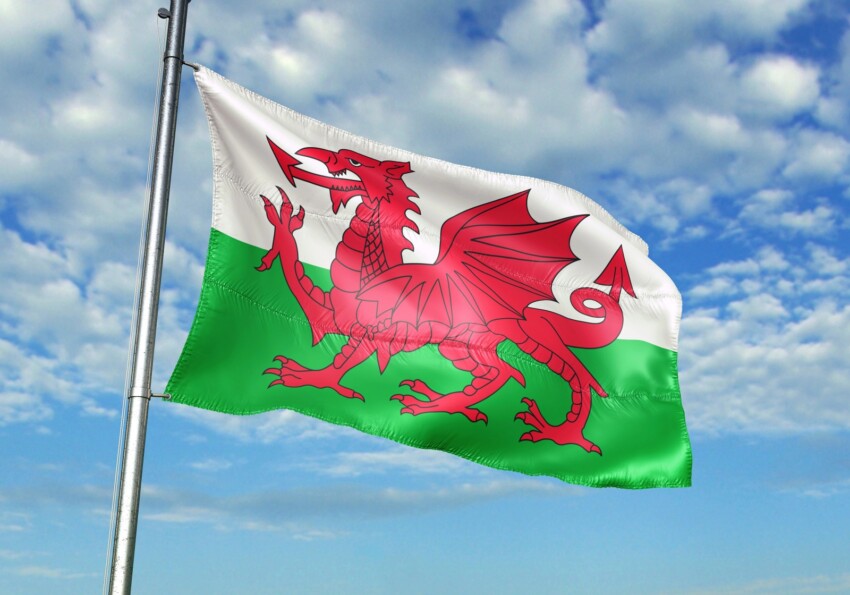
Among all the national flags in Europe, that of Wales is perhaps the most unmistakable: a red, winged dragon breathing fire dominates the centre of a field divided horizontally between white at the top and green below. This is no mere ornamental symbol, but the beating heart of an ancient national identity, fierce and deeply rooted in Celtic mythology.
The Welsh flag is known throughout the world as Y Ddraig Goch, a Welsh expression that literally means “the red dragon”. Its official Welsh name is Baner Cymru, or “flag of Wales”. It is one of the rarest national flags to feature a dragon: only Wales and Bhutan have a dragon on their national flags worldwide.
Its origins are lost between documented history, Celtic mythology and medieval legend, making it one of the most fascinating and complex national symbols in the United Kingdom. Officially recognised only in 1959, the Welsh flag embodies centuries of resistance, culture and pride of a people who have managed to preserve their identity despite centuries of English rule.
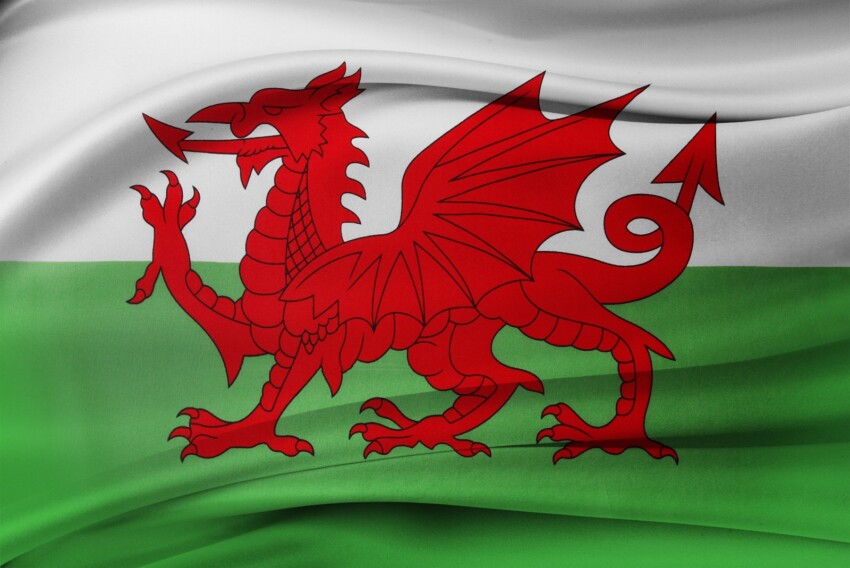
The Welsh flag is composed of three elements: a two-coloured background divided horizontally in half (white in the upper half, green in the lower half) and a red dragon at the centre, depicted in passant position, that is, walking with one front paw raised.
The Welsh dragon has four legs, open wings, a pointed tail and its mouth wide open. Unlike many national flags, the exact shape of the dragon is not standardised: over the centuries, different graphic interpretations of the symbol have existed and continue to coexist, with variations in proportions, tail position, wing opening and anatomical details. This lack of standardisation is an integral part of the flag’s visual history.
The official colours are red Pantone 186C for the dragon and green Pantone 355C for the lower half of the background. White and green were the colours of the Tudor dynasty, which had Welsh origins: Henry VII adopted them as his livery, and from there they passed into Welsh heraldic tradition. Green also represents the nature and hills of Wales, whilst white is traditionally associated with peace.
The roots of the Welsh red dragon probably go back to the period of the Roman occupation of Britain. The Romans used the dragon as a military standard: the draconarii were the standard-bearers of Roman cohorts, and their banner — called a draco — depicted a dragon with open mouth, designed to whistle in the wind during charges. When the Romans left Britain, Celtic military leaders adopted the symbol, so much so that the ancient Britons called their military commanders “dragons”.
The first written record of the dragon as a symbol of Wales is found in the Historia Brittonum, written around 820. Here appears the legend of the two dragons of Dinas Emrys, which would become one of the founding stories of Welsh identity. The symbol is later taken up and developed in the Mabinogion, the oldest collection of prose works from Britain, with texts dating from between 1000 and 1200.
The most famous legend connected to the Welsh dragon features the king Vortigern and the young Merlin. The Celtic king was looking for a place to build his castle and chose the hill of Dinas Emrys, in Snowdonia. However, every night, the newly built walls were mysteriously demolished. The king’s advisers suggested finding an orphan boy with prophetic powers: the choice fell on the young Merlin — called Myrddin Emrys in Welsh — found in the town of Caer Myrddin, present-day Carmarthen.
Merlin explained to Vortigern that beneath the hill lay a hidden pool, and in the pool slept two hollow stones, each containing a dragon. The king had them excavated: the dragons woke and began to fight. After a long battle, the red dragon defeated the white dragon. Merlin interpreted the prophecy: the red dragon represented the Britons and Celtic Welsh people, whilst the white dragon symbolised the invading Saxons. The victory of the red dragon predicted the resistance and eventual triumph of the Welsh people.
Remarkably, excavations conducted in 1945 at Dinas Emrys uncovered concrete evidence of an artificial lake and fortress dating to Vortigern’s era, lending the legend an unexpected historical foundation. The site is now open to visitors and remains one of the most evocative destinations for those exploring Wales in search of its mythological roots.
A second version of the legend appears in the Mabinogion, in the story of Lludd and Llefelys. In this tale, the red dragon fights an invading white dragon, and their cries of pain bring calamities upon the land: women miscarry, animals die, plants become sterile.
King Lludd goes to his wise brother Llefelys, who suggests he dig a pit at the centre of Britain, fill it with mead and cover it with cloth. The dragons, attracted by the smell, drink the mead and fall asleep. Lludd captures them and imprisons them at Dinas Emrys, in Snowdonia. The legend thus intertwines with the actual Welsh landscape, transforming specific geographical locations into mythological scenarios still vivid in the collective imagination.
In the Middle Ages the red dragon was closely associated with the rulers of Gwynedd, the main region of North Wales. In particular, it is linked to the figure of Cadwaladr, king of Gwynedd in the seventh century, who used it as his personal emblem. From then on, the red dragon became a symbol of Welsh resistance against subsequent Norman and English invasions.
In the fourteenth century, Owain Glyndŵr — the great leader of the Welsh rebellion against English rule between 1400 and 1416 — used a banner with a golden dragon on a red background (Y Draig Aur), a variant that emphasised the leader’s royal ambitions. His uprising remained the last great attempt at Welsh independence before definitive absorption into the English kingdom.
The decisive turning point came with Henry VII, the first Tudor king, who had Welsh origins. At the Battle of Bosworth in 1485, Henry Tudor marched under a banner depicting Y Ddraig Goch, seeking to gain the support of the Welsh people. After his victory, the banner was carried in solemn procession to St Paul’s Cathedral in London, and the red dragon was included as a supporter element in the Tudor royal coat of arms to signify its Welsh origins.
One of the most curious and debated aspects of the Welsh flag is its absence from the Union Jack, the flag of the United Kingdom. The Union Jack, in its first version of 1606, combined the Cross of St George (England) with the Scottish Saltire. Wales was not included because, starting with the Laws in Wales Act of 1535-1542 under Henry VIII, it had been formally incorporated into the kingdom of England and considered an integral part of it, not a separate nation to be represented.
The result is that Wales is the only constituent nation of the United Kingdom whose flag does not appear in the Union Jack. Over the years, various proposals have been put forward to modify the British flag by including the Welsh dragon — including a proposal by Labour MEP Ian Lucas, which envisaged the dragon at the centre of the cloth — but none has come to fruition. The question remains a sensitive point in the debate over Welsh identity and relations between Wales and the rest of the United Kingdom.
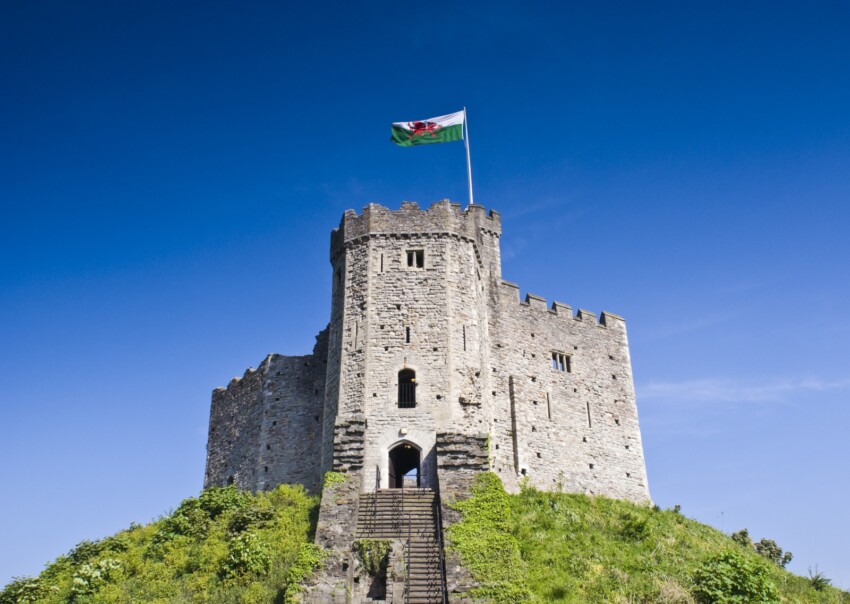
Despite centuries of use as a national symbol, the Welsh flag was officially recognised as a national standard only on 10 December 1959, by royal decree. The officially adopted form was based on the old heraldic motto used by English and British monarchs since the Tudor dynasty: on a mount vert a dragon gules, or “a red dragon on a green mount”.
Before 1959 there were two main versions: one with the red dragon on a simple white and green background, and one with the addition at the bottom of a shield bearing the inscription Y Ddraig Goch Ddyry Cychwyn (“the red dragon opens the way”), the motto of the House of Tudor. The official version adopted in 1959 is that without the inscription, the same one we know today.
Wales’s national day falls on 1 March, on the occasion of Dydd Gŵyl Dewi, or St David’s Day, the country’s patron saint. It is the day when Y Ddraig Goch is displayed with greatest prominence throughout Wales and in Welsh communities worldwide. St David (in Welsh Dewi Sant) was a monk and bishop of the sixth century, canonised in the twelfth century by Pope Callixtus II.
On this day it is traditional to wear a leek or a daffodil in your buttonhole — the two Welsh national floral symbols — and to participate in cultural celebrations that include music, poetry and performances in the Welsh language. St David’s Day is not, however, an official public holiday in the United Kingdom, despite periodic campaigns to have it recognised as such.
Today Y Ddraig Goch is an omnipresent symbol in everyday Welsh life. In rugby stadiums — the national sport par excellence — the red dragon flies everywhere, and the Welsh national team is nicknamed “the Red Dragon”. Rugby is the context in which Welsh identity expresses itself with the greatest emotional intensity, and matches at the Principality Stadium in Cardiff are famous for the warmth of support and collective singing of national anthems.
The red dragon also appears on the coat of arms of the Prince of Wales, on many Welsh public buildings and in hundreds of products, badges and posters that evoke Welsh identity. In the Welsh diaspora around the world — particularly numerous in Patagonia, Argentina, where a Welsh community settled in 1865 — the flag is a powerful symbol of cultural belonging and collective memory.
 Hotel
Hotel  Budget accommodations
  Apartments
  Family Hotel
  Luxury Hotel